Roman Storm, co-founder of the sanctioned Tornado Cash cryptocurrency mixer, has accused federal prosecutors of fundamentally mishandling key evidence ahead of his July 14 criminal trial in Manhattan. The dispute centers on a Telegram message reading “Heya, anyone around to chat about axie? Would like to ask a few general questions about how one goes about cashing out 600 mil,” which referenced the $600 million Axie Infinity exploit. According to court filings dated July 12, 2025 , prosecutors initially claimed the message was authored by Storm’s co-developer Alexey Pertsev. Source: Court Listener Defense attorneys revealed the message was actually written by Andrew Thurman, a former CoinDesk senior tech reporter, then forwarded to a Tornado Cash chat by Pertsev. The revelation emerged just days before Storm’s trial on charges of conspiracy to commit money laundering and sanctions violations related to Tornado Cash, which allegedly facilitated over $1 billion in illicit transactions. Government’s Evidence Chain Under Tight Scrutiny The controversy stems from Dutch authorities’ extraction of what prosecutors claim is Pertsev’s phone following his arrest in the Netherlands, where he was sentenced to 64 months in prison for money laundering through Tornado Cash. ⚖️ DOJ pursues federal charges against Roman Storm, cofounder of Tornado Cash, after dropping unlicensed money transmission charge. #TornadoCash #RomanStorm https://t.co/ZGXe7IGREZ — Cryptonews.com (@cryptonews) May 16, 2025 Storm’s defense argues that the government’s extraction contains multiple fatal flaws, including missing author information for forwarded Telegram messages and incomplete file retrieval by FBI Agent Dickerman from Dutch authorities. The defense contends that prosecutors cannot authenticate the extraction’s completeness because they were limited in what files they could obtain from Dutch law enforcement. This authentication challenge becomes more significant given that the government admitted in court filings that its original September 2023 production of extracted text messages to the defense did not include “forwarded” tags on forwarded messages. Prosecutors provided a corrected version in December 2024, which they plan to use at trial, but defense attorneys argue this timeline raises serious questions about the government’s handling of evidence. The misattribution carried real consequences in court proceedings when Assistant U.S. Attorney Ben Arad referenced the message during a July 8 pretrial hearing, telling the judge it demonstrated the co-founders’ awareness of wrongdoing. According to the hearing transcript, Arad told the court: “For example, when the Ronin hack happened, one of the co-conspirators asked, sum and substance, I’d like to ask you some questions about how you go about laundering $600 million worth of stolen crypto.” The defense characterized this as providing “false information” to both the court and potentially the grand jury that issued the indictment. Defense attorneys wrote in their filing: “Given that the government mistakenly attributed the reporter’s Telegram message to Pertsev at the Pretrial Conference, it appears that the government itself was unaware of this issue until the defense raised it.” Enforcement Challenges Echo Across Crypto Cases The evidence dispute highlights a pattern of prosecutorial challenges emerging across high-profile cryptocurrency cases, particularly when international evidence gathering intersects with complex digital communications. Just last month, the DOJ faced similar authentication issues in the case of Russian crypto CEO Iurii Gugnin, who was charged with orchestrating a $530 million fraud scheme through his Miami-based platform Evita. 🇷🇺 A Russian crypto firm CEO used his crypto company, Evita, to funnel $530 million of overseas payments via US banks and crypto platforms. #Evita #CryptoFraud #IuriiGugnin https://t.co/hk5kgucF95 — Cryptonews.com (@cryptonews) June 10, 2025 That case also involved cross-border evidence collection and questions about the authenticity of digital communications used to establish criminal intent. Storm’s defense has consistently argued that the case threatens to criminalize open-source software development, with the Ethereum Foundation pledging $500,000 toward his legal defense and matching up to $750,000 in community contributions. As part of the DOJ’s crypto fraud crackdown, the recently seized $225 million in USDT was linked to a global “pig butchering” scam that defrauded over 400 victims through a network of international exchanges and wallets.Roman Storm, co-founder of the sanctioned Tornado Cash cryptocurrency mixer, has accused federal prosecutors of fundamentally mishandling key evidence ahead of his July 14 criminal trial in Manhattan. The dispute centers on a Telegram message reading “Heya, anyone around to chat about axie? Would like to ask a few general questions about how one goes about cashing out 600 mil,” which referenced the $600 million Axie Infinity exploit. According to court filings dated July 12, 2025 , prosecutors initially claimed the message was authored by Storm’s co-developer Alexey Pertsev. Source: Court Listener Defense attorneys revealed the message was actually written by Andrew Thurman, a former CoinDesk senior tech reporter, then forwarded to a Tornado Cash chat by Pertsev. The revelation emerged just days before Storm’s trial on charges of conspiracy to commit money laundering and sanctions violations related to Tornado Cash, which allegedly facilitated over $1 billion in illicit transactions. Government’s Evidence Chain Under Tight Scrutiny The controversy stems from Dutch authorities’ extraction of what prosecutors claim is Pertsev’s phone following his arrest in the Netherlands, where he was sentenced to 64 months in prison for money laundering through Tornado Cash. ⚖️ DOJ pursues federal charges against Roman Storm, cofounder of Tornado Cash, after dropping unlicensed money transmission charge. #TornadoCash #RomanStorm https://t.co/ZGXe7IGREZ — Cryptonews.com (@cryptonews) May 16, 2025 Storm’s defense argues that the government’s extraction contains multiple fatal flaws, including missing author information for forwarded Telegram messages and incomplete file retrieval by FBI Agent Dickerman from Dutch authorities. The defense contends that prosecutors cannot authenticate the extraction’s completeness because they were limited in what files they could obtain from Dutch law enforcement. This authentication challenge becomes more significant given that the government admitted in court filings that its original September 2023 production of extracted text messages to the defense did not include “forwarded” tags on forwarded messages. Prosecutors provided a corrected version in December 2024, which they plan to use at trial, but defense attorneys argue this timeline raises serious questions about the government’s handling of evidence. The misattribution carried real consequences in court proceedings when Assistant U.S. Attorney Ben Arad referenced the message during a July 8 pretrial hearing, telling the judge it demonstrated the co-founders’ awareness of wrongdoing. According to the hearing transcript, Arad told the court: “For example, when the Ronin hack happened, one of the co-conspirators asked, sum and substance, I’d like to ask you some questions about how you go about laundering $600 million worth of stolen crypto.” The defense characterized this as providing “false information” to both the court and potentially the grand jury that issued the indictment. Defense attorneys wrote in their filing: “Given that the government mistakenly attributed the reporter’s Telegram message to Pertsev at the Pretrial Conference, it appears that the government itself was unaware of this issue until the defense raised it.” Enforcement Challenges Echo Across Crypto Cases The evidence dispute highlights a pattern of prosecutorial challenges emerging across high-profile cryptocurrency cases, particularly when international evidence gathering intersects with complex digital communications. Just last month, the DOJ faced similar authentication issues in the case of Russian crypto CEO Iurii Gugnin, who was charged with orchestrating a $530 million fraud scheme through his Miami-based platform Evita. 🇷🇺 A Russian crypto firm CEO used his crypto company, Evita, to funnel $530 million of overseas payments via US banks and crypto platforms. #Evita #CryptoFraud #IuriiGugnin https://t.co/hk5kgucF95 — Cryptonews.com (@cryptonews) June 10, 2025 That case also involved cross-border evidence collection and questions about the authenticity of digital communications used to establish criminal intent. Storm’s defense has consistently argued that the case threatens to criminalize open-source software development, with the Ethereum Foundation pledging $500,000 toward his legal defense and matching up to $750,000 in community contributions. As part of the DOJ’s crypto fraud crackdown, the recently seized $225 million in USDT was linked to a global “pig butchering” scam that defrauded over 400 victims through a network of international exchanges and wallets.

Tornado Cash Developer Storm Claims DOJ Bungled Critical Telegram Evidence

Roman Storm, co-founder of the sanctioned Tornado Cash cryptocurrency mixer, has accused federal prosecutors of fundamentally mishandling key evidence ahead of his July 14 criminal trial in Manhattan.

The dispute centers on a Telegram message reading “Heya, anyone around to chat about axie? Would like to ask a few general questions about how one goes about cashing out 600 mil,” which referenced the $600 million Axie Infinity exploit.

According to court filings dated July 12, 2025, prosecutors initially claimed the message was authored by Storm’s co-developer Alexey Pertsev.
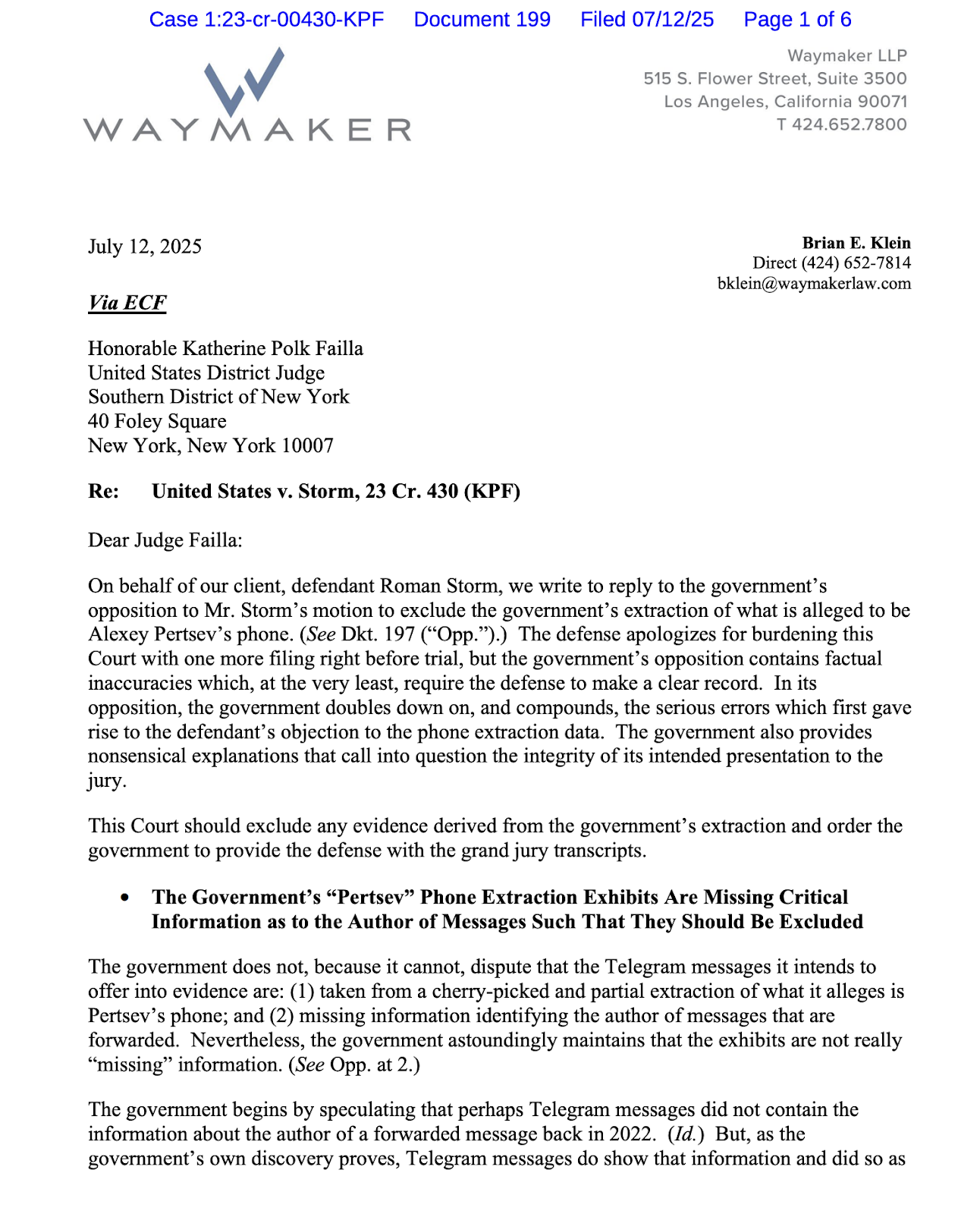
Tornado Cash Developer Storm Claims DOJ Bungled Critical Telegram EvidenceSource: Court Listener

Defense attorneys revealed the message was actually written by Andrew Thurman, a former CoinDesk senior tech reporter, then forwarded to a Tornado Cash chat by Pertsev.

The revelation emerged just days before Storm’s trial on charges of conspiracy to commit money laundering and sanctions violations related to Tornado Cash, which allegedly facilitated over $1 billion in illicit transactions.

Government’s Evidence Chain Under Tight Scrutiny

The controversy stems from Dutch authorities’ extraction of what prosecutors claim is Pertsev’s phone following his arrest in the Netherlands, where he was sentenced to 64 months in prison for money laundering through Tornado Cash.

Storm’s defense argues that the government’s extraction contains multiple fatal flaws, including missing author information for forwarded Telegram messages and incomplete file retrieval by FBI Agent Dickerman from Dutch authorities.

The defense contends that prosecutors cannot authenticate the extraction’s completeness because they were limited in what files they could obtain from Dutch law enforcement.

This authentication challenge becomes more significant given that the government admitted in court filings that its original September 2023 production of extracted text messages to the defense did not include “forwarded” tags on forwarded messages.

Prosecutors provided a corrected version in December 2024, which they plan to use at trial, but defense attorneys argue this timeline raises serious questions about the government’s handling of evidence.

The misattribution carried real consequences in court proceedings when Assistant U.S. Attorney Ben Arad referenced the message during a July 8 pretrial hearing, telling the judge it demonstrated the co-founders’ awareness of wrongdoing.

According to the hearing transcript, Arad told the court: “For example, when the Ronin hack happened, one of the co-conspirators asked, sum and substance, I’d like to ask you some questions about how you go about laundering $600 million worth of stolen crypto.”

The defense characterized this as providing “false information” to both the court and potentially the grand jury that issued the indictment.

Defense attorneys wrote in their filing: “Given that the government mistakenly attributed the reporter’s Telegram message to Pertsev at the Pretrial Conference, it appears that the government itself was unaware of this issue until the defense raised it.”

Enforcement Challenges Echo Across Crypto Cases

The evidence dispute highlights a pattern of prosecutorial challenges emerging across high-profile cryptocurrency cases, particularly when international evidence gathering intersects with complex digital communications.

Just last month, the DOJ faced similar authentication issues in the case of Russian crypto CEO Iurii Gugnin, who was charged with orchestrating a $530 million fraud scheme through his Miami-based platform Evita.

That case also involved cross-border evidence collection and questions about the authenticity of digital communications used to establish criminal intent.

Storm’s defense has consistently argued that the case threatens to criminalize open-source software development, with the Ethereum Foundation pledging $500,000 toward his legal defense and matching up to $750,000 in community contributions.

As part of the DOJ’s crypto fraud crackdown, the recently seized $225 million in USDT was linked to a global “pig butchering” scam that defrauded over 400 victims through a network of international exchanges and wallets.


Market Opportunity
DAR Open Network Logo
DAR Open Network Price(D)
$0.01332
$0.01332$0.01332
-1.33%
USD
DAR Open Network (D) Live Price Chart
Disclaimer: The articles reposted on this site are sourced from public platforms and are provided for informational purposes only. They do not necessarily reflect the views of MEXC. All rights remain with the original authors. If you believe any content infringes on third-party rights, please contact service@support.mexc.com for removal. MEXC makes no guarantees regarding the accuracy, completeness, or timeliness of the content and is not responsible for any actions taken based on the information provided. The content does not constitute financial, legal, or other professional advice, nor should it be considered a recommendation or endorsement by MEXC.

You May Also Like

Token allocations on Binance are still a small share of total supply

Token allocations on Binance are still a small share of total supply

The post Token allocations on Binance are still a small share of total supply appeared on BitcoinEthereumNews.com. Binance has been listing only a small share of
Share
BitcoinEthereumNews2025/12/23 17:02
How to earn from cloud mining: IeByte’s upgraded auto-cloud mining platform unlocks genuine passive earnings

How to earn from cloud mining: IeByte’s upgraded auto-cloud mining platform unlocks genuine passive earnings

The post How to earn from cloud mining: IeByte’s upgraded auto-cloud mining platform unlocks genuine passive earnings appeared on BitcoinEthereumNews.com. contributor Posted: September 17, 2025 As digital assets continue to reshape global finance, cloud mining has become one of the most effective ways for investors to generate stable passive income. Addressing the growing demand for simplicity, security, and profitability, IeByte has officially upgraded its fully automated cloud mining platform, empowering both beginners and experienced investors to earn Bitcoin, Dogecoin, and other mainstream cryptocurrencies without the need for hardware or technical expertise. Why cloud mining in 2025? Traditional crypto mining requires expensive hardware, high electricity costs, and constant maintenance. In 2025, with blockchain networks becoming more competitive, these barriers have grown even higher. Cloud mining solves this by allowing users to lease professional mining power remotely, eliminating the upfront costs and complexity. IeByte stands at the forefront of this transformation, offering investors a transparent and seamless path to daily earnings. IeByte’s upgraded auto-cloud mining platform With its latest upgrade, IeByte introduces: Full Automation: Mining contracts can be activated in just one click, with all processes handled by IeByte’s servers. Enhanced Security: Bank-grade encryption, cold wallets, and real-time monitoring protect every transaction. Scalable Options: From starter packages to high-level investment contracts, investors can choose the plan that matches their goals. Global Reach: Already trusted by users in over 100 countries. Mining contracts for 2025 IeByte offers a wide range of contracts tailored for every investor level. From entry-level plans with daily returns to premium high-yield packages, the platform ensures maximum accessibility. Contract Type Duration Price Daily Reward Total Earnings (Principal + Profit) Starter Contract 1 Day $200 $6 $200 + $6 + $10 bonus Bronze Basic Contract 2 Days $500 $13.5 $500 + $27 Bronze Basic Contract 3 Days $1,200 $36 $1,200 + $108 Silver Advanced Contract 1 Day $5,000 $175 $5,000 + $175 Silver Advanced Contract 2 Days $8,000 $320 $8,000 + $640 Silver…
Share
BitcoinEthereumNews2025/09/17 23:48
Nasdaq futures test upper structure as price negotiates key pivots

Nasdaq futures test upper structure as price negotiates key pivots

The post Nasdaq futures test upper structure as price negotiates key pivots appeared on BitcoinEthereumNews.com. Daily and intraday price action centres on acceptance
Share
BitcoinEthereumNews2025/12/23 17:20