

Quid Pro Quo or Crypto? Congress Probes UAE Deal as LiquidChain Emerges as Secure Institutional Alternative
 Congress is probing World Liberty Financial over fears that foreign crypto investments could act as ‘quid pro quo’ for political influence.
- The regulatory scrutiny highlights the risks of personality-driven DeFi projects compared to code-based infrastructure.
- LiquidChain solves liquidity fragmentation by unifying $BTC, $ETH, and $SOL without the geopolitical risks associated with centralized deals.
- Institutional interest is shifting toward technical interoperability solutions that offer verifiable settlement and sub-second finality.
High politics and decentralized finance just collided in Washington, and lawmakers aren’t happy.
A formal inquiry into potential conflicts of interest surrounding World Liberty Financial (WLFI) has triggered alarm bells across the sector. At the center of the storm sits a letter from Rep. Jamie Raskin (D-MD) and Rep. Robert Garcia (D-CA), probing whether foreign entities, specifically those connected to recent UAE dealings and investments from figures like Justin Sun, are using crypto projects as a vehicle for political influence.
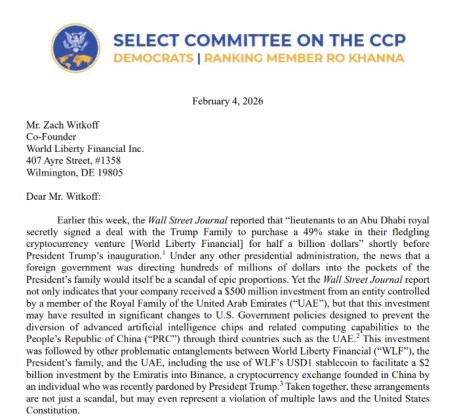 It’s not just about blockchain mechanics; the concern focuses on the ‘quid pro quo’ potential of opaque financial structures. When a project is tied intrinsically to a political figurehead, large foreign investments raise national security questions: are these purchases of tokens, or purchases of access?
The probe highlights a critical vulnerability in personality-driven crypto ventures. If the underlying value proposition relies on connections rather than code, the project becomes a lightning rod for regulatory enforcement.
This scrutiny creates a vacuum in the institutional DeFi sector. While D.C. dissects the tangled web of WLFI’s foreign ties, the market is quietly shifting capital toward infrastructure-heavy alternatives that prioritize code over connections.
The volatility of politically exposed assets is driving smart money toward verifiable, tech-first solutions. That flight to quality is evident in the rising interest surrounding LiquidChain ($LIQUID), a Layer 3 protocol designed to solve fragmentation without the geopolitical baggage.
Escaping Geopolitical Risk Through LiquidChain’s Unified Layer
The congressional probe into World Liberty Financial exposes a fatal flaw in centralized, personality-centric DeFi: counterparty risk. When a protocol relies on opaque dealings with foreign sovereign wealth funds or controversial crypto tycoons, ‘decentralization’ becomes little more than a marketing slogan.
In contrast, LiquidChain is capitalizing on the market’s demand for a trustless execution environment. Rather than relying on boardroom deals to move liquidity, LiquidChain utilizes a Layer 3 architecture to fuse Bitcoin, Ethereum, and Solana into a single execution layer.
That distinction matters because institutions require certainty. They can’t allocate capital to platforms where the regulatory status hinges on the outcome of an election or a congressional hearing. LiquidChain’s ‘Deploy-Once’ architecture allows developers to build applications that access liquidity across all major chains simultaneously, removing the need for risky, fragmented bridges or politically sensitive partnerships.
By creating a Unified Liquidity Layer, the protocol offers the interoperability that WLFI promised, but delivers it through verifiable smart contracts rather than handshake deals in Dubai.
For the developer ecosystem, this represents a massive efficiency unlock. Instead of writing distinct code for the EVM (Ethereum) and SVM (Solana), LiquidChain’s Cross-Chain VM handles the translation.
As regulatory heat increases on projects like WLFI, infrastructure plays that solve the ‘wrapped asset risk’ problem. where assets are pegged and potentially manipulated, are becoming the preferred safe harbor for long-term capital.
EXPLORE LIQUIDCHAIN ON ITS PRESALE PAGE
$LIQUID Presale Gains Traction Amidst Regulatory Uncertainty
While headlines scream about subpoenas and congressional letters, on-chain data reveals a divergence in where retail and developer capital is actually flowing. The LiquidChain presale has quietly accelerated, with the project raising over $526K to date.
Unlike the hype-driven cycles of meme coins or political tokens, this capital injection suggests a methodical accumulation by investors betting on infrastructure over narrative.
At the current entry price of $0.0135, the market is pricing $LIQUID as an early-stage infrastructure bet. The tokenomics model positions $LIQUID not just as a governance token, but as the transaction fuel for the entire cross-chain environment. Every time a user swaps $SOL for $BTC or engages in DeFi activities across the unified layer, the protocol generates demand for the token.
This utility-driven demand contrasts sharply with the speculative nature of tokens currently under the congressional microscope. It’s easy to see why it could be one of the next crypto to explode.
The timing of this capital raise is notable. As investors rotate out of high-risk, politically sensitive assets, they’re seeking ‘picks and shovels’ plays, protocols that facilitate the industry’s growth regardless of which political party holds power.
With liquidity staking incentives encouraging long-term holding, LiquidChain is positioning itself to capture the volume that is fleeing from regulatory uncertainty.
BUY YOUR $LIQUID TODAY
This article is for informational purposes only and does not constitute financial advice. Cryptocurrency investments carry high risk, including the potential loss of principal. Always perform your own due diligence.


You May Also Like

Bitcoin Miners Warn No Bottom Yet, CryptoQuant Says—What On-Chain Metrics Reveal

Anchor plops Trumper in hotseat over president’s 'grift'

Veterans urge GOP to back War Powers Resolution and honor 13 Americans killed in Iran



