The new executive order could unlock trillions in retirement funds for crypto, with a 1% shift potentially pushing Bitcoin to $194,000. Still, volatility and regulatory risks may limit quick adoption. Last week, markets flicked from cautious to almost electric. Ethereum…The new executive order could unlock trillions in retirement funds for crypto, with a 1% shift potentially pushing Bitcoin to $194,000. Still, volatility and regulatory risks may limit quick adoption. Last week, markets flicked from cautious to almost electric. Ethereum…

Here’s how high Bitcoin price go with 1% pension fund allocation

The new executive order could unlock trillions in retirement funds for crypto, with a 1% shift potentially pushing Bitcoin to $194,000. Still, volatility and regulatory risks may limit quick adoption.

Summary
  • A recent executive order could enable crypto investments within employer-sponsored retirement plans, unlocking access to $12.2 trillion in assets.
  • Bitwise projects that a 1% allocation shift could raise Bitcoin’s price to about $194,000, while a 10% shift might push it toward $868,700.
  • Despite this potential, volatility, regulatory uncertainty, and fiduciary responsibilities remain big challenges.

Last week, markets flicked from cautious to almost electric. Ethereum (ETH) surged past $4,300, a level not seen since late 2021, while Bitcoin (BTC) flirted with a breathtaking $121,000, approaching its prior all-time high. Now, some financial analysts suggest an often-overlooked potential accelerant: U.S. retirement savings.

A fresh Bitwise report suggests that today’s 401(k) ecosystem could unleash literally trillions of dollars into crypto, and with it, possibly triggering a near-textbook price explosion.

Table of Contents

  • Bitwise’s Bitcoin forecast
  • Everything changed
  • Demand side
  • Volatility and fees loom

Bitwise’s Bitcoin forecast

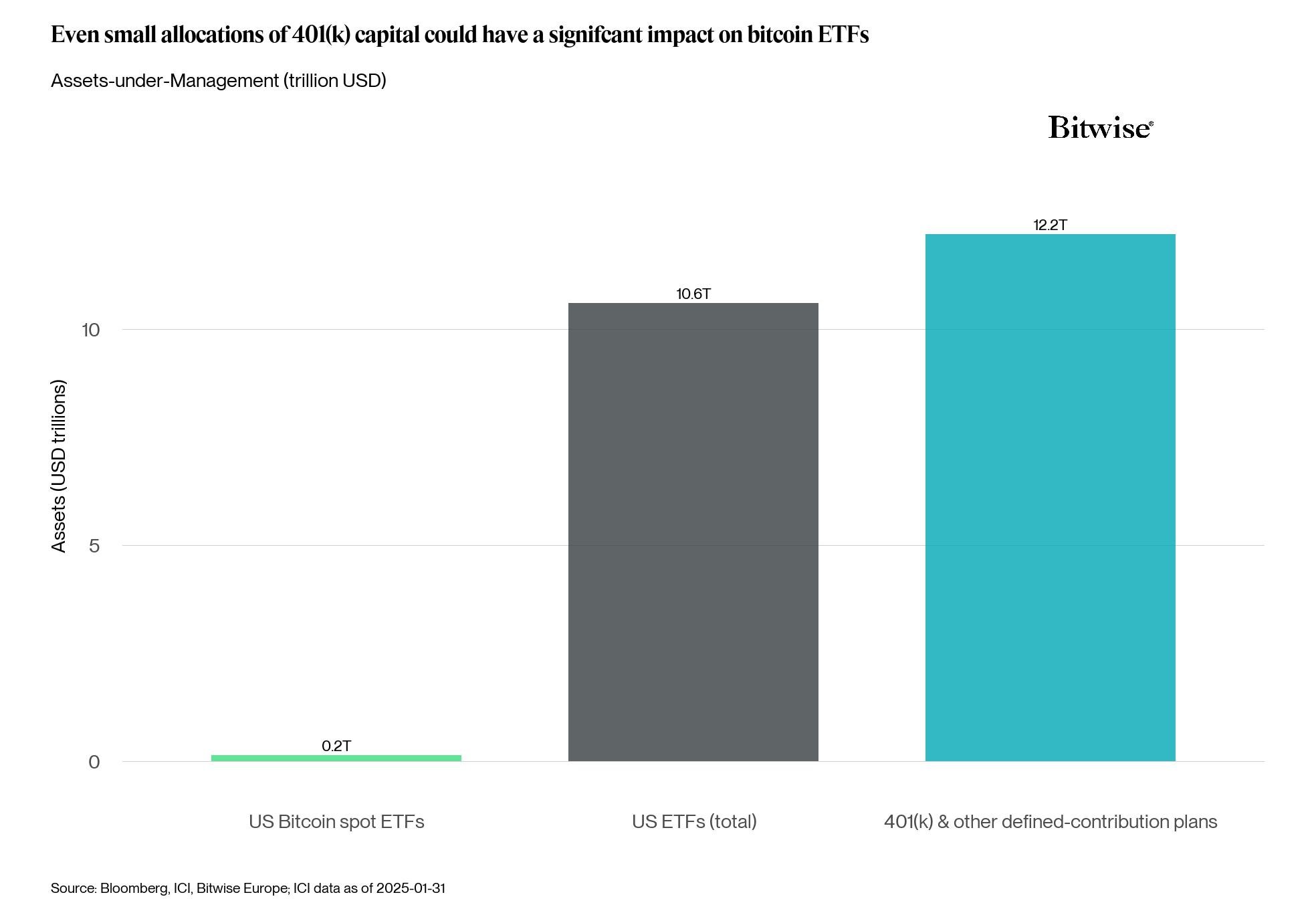
Bitwise’s “Chart-of-the-Week” lays it all out with razor clarity, saying “approximately $12.2 trillion is managed in 401(k) and other defined-contribution retirement plans,” more than the ~$10.6 trillion parked in U.S. ETFs. The report suggests that even modest reallocations could have a meaningful impact on crypto markets.

Bitwise notes that 401(k) plans typically allocate via ETFs, making a spot-ETF entry all the more plausible, and potent. Using a simplified projection from Bitcoin’s current price of around $119,000, a 1% inflow from 401(k) assets might lift its price to roughly $193,970. A 10% allocation shift, about $1.22 trillion in theoretical buying power, could — if the relationship scaled linearly — push prices toward $868,700.

Everything changed

Until recently, crypto was viewed as taboo in employer-sponsored retirement accounts. That changed when U.S. President Donald Trump signed an executive order Aug. 7, directing the Department of Labor, SEC, and Treasury to expand access to alternative assets in employer 401(k) plans, explicitly naming cryptocurrencies alongside real estate and private equity.

Regulators were urged to clarify fiduciary responsibilities and reduce legal friction so plan sponsors could consider crypto investments while meeting their obligation to act in savers’ best interests.
Here’s how high Bitcoin price go with 1% pension fund allocation - 1

If implemented as envisioned, such a regulatory change, combined with the sheer scale of assets involved, could mean that plans run by BlackRock, Fidelity, and others might eventually offer spot Bitcoin or Ethereum ETFs, either as standard menu items or via self-directed brokerage windows, potentially opening a new channel for capital.

Per the Investment Company Institute, employer-based defined-contribution accounts hold about $12.2 trillion, with roughly $8.7-$8.9 trillion in 401(k)s. That number towers over the current global crypto market, estimated at $4 trillion. Even a 1% pivot — $87 billion — would be enough to reshape the supply-demand balance.

To put it another way: the entire U.S. 401(k) system now represents more than double the size of all the crypto in existence.

Demand side

Younger investors appear to be leading interest in crypto-based retirement strategies. A 2024 Bank of America Private Bank study found that among high-net-worth individuals under age 44, nearly 50% already own cryptocurrencies, and an additional 38% are interested in owning them, placing crypto just behind real estate as the top perceived growth opportunity.

Meanwhile, evidence suggests that many younger investors prioritize crypto over traditional retirement vehicles. A 2025 YouGov survey, referenced by Money, reports that 42% of Gen Z investors own crypto, whereas only 11% hold a retirement account.

Defaults play a compelling role as well. Most 401(k) contributions are funneled into professional default options like target-date funds. If, following regulatory changes, these defaults begin to include crypto exposure, participation in crypto-linked investments could rise markedly, perhaps requiring minimal action by the plan participants themselves.

Volatility and fees loom

It isn’t all rocket fuel and unchecked enthusiasm. Bitcoin has weathered 70-80% crashes in past bear markets, behaviors entirely at odds with the “safe and steady” goal of retirement investing. Regulatory ambiguity, fiduciary liability, and fee structures also pose hurdles. 401(k) mutual funds often charge ~0.26%, while alternative or crypto structures may have higher fees or less transparency.

Plan sponsors, rightly cautious, will likely wait for clear guidance under ERISA before turning crypto from an optional sidebar into a core component.

And market plumbing seems to be already reacting. Spot crypto ETFs in the U.S. set subscription records in July, while futures open interest hit all-time highs. Liquidity improved, bid-ask spreads narrowed, and macro forces began driving pricing more than viral crypto narratives.

In essence, if retirement inflows become a steady buyer, markets stand to become more resilient and less wild. That structural demand could prevent extreme volatility and broaden legitimacy.


Market Opportunity
MAY Logo
MAY Price(MAY)
$0.01385
$0.01385$0.01385
+0.50%
USD
MAY (MAY) Live Price Chart
Disclaimer: The articles reposted on this site are sourced from public platforms and are provided for informational purposes only. They do not necessarily reflect the views of MEXC. All rights remain with the original authors. If you believe any content infringes on third-party rights, please contact service@support.mexc.com for removal. MEXC makes no guarantees regarding the accuracy, completeness, or timeliness of the content and is not responsible for any actions taken based on the information provided. The content does not constitute financial, legal, or other professional advice, nor should it be considered a recommendation or endorsement by MEXC.

You May Also Like

CEO Sandeep Nailwal Shared Highlights About RWA on Polygon

CEO Sandeep Nailwal Shared Highlights About RWA on Polygon

The post CEO Sandeep Nailwal Shared Highlights About RWA on Polygon appeared on BitcoinEthereumNews.com. Polygon CEO Sandeep Nailwal highlighted Polygon’s lead in global bonds, Spiko US T-Bill, and Spiko Euro T-Bill. Polygon published an X post to share that its roadmap to GigaGas was still scaling. Sentiments around POL price were last seen to be bearish. Polygon CEO Sandeep Nailwal shared key pointers from the Dune and RWA.xyz report. These pertain to highlights about RWA on Polygon. Simultaneously, Polygon underlined its roadmap towards GigaGas. Sentiments around POL price were last seen fumbling under bearish emotions. Polygon CEO Sandeep Nailwal on Polygon RWA CEO Sandeep Nailwal highlighted three key points from the Dune and RWA.xyz report. The Chief Executive of Polygon maintained that Polygon PoS was hosting RWA TVL worth $1.13 billion across 269 assets plus 2,900 holders. Nailwal confirmed from the report that RWA was happening on Polygon. The Dune and https://t.co/W6WSFlHoQF report on RWA is out and it shows that RWA is happening on Polygon. Here are a few highlights: – Leading in Global Bonds: Polygon holds 62% share of tokenized global bonds (driven by Spiko’s euro MMF and Cashlink euro issues) – Spiko U.S.… — Sandeep | CEO, Polygon Foundation (※,※) (@sandeepnailwal) September 17, 2025 The X post published by Polygon CEO Sandeep Nailwal underlined that the ecosystem was leading in global bonds by holding a 62% share of tokenized global bonds. He further highlighted that Polygon was leading with Spiko US T-Bill at approximately 29% share of TVL along with Ethereum, adding that the ecosystem had more than 50% share in the number of holders. Finally, Sandeep highlighted from the report that there was a strong adoption for Spiko Euro T-Bill with 38% share of TVL. He added that 68% of returns were on Polygon across all the chains. Polygon Roadmap to GigaGas In a different update from Polygon, the community…
Share
BitcoinEthereumNews2025/09/18 01:10
How to earn from cloud mining: IeByte’s upgraded auto-cloud mining platform unlocks genuine passive earnings

How to earn from cloud mining: IeByte’s upgraded auto-cloud mining platform unlocks genuine passive earnings

The post How to earn from cloud mining: IeByte’s upgraded auto-cloud mining platform unlocks genuine passive earnings appeared on BitcoinEthereumNews.com. contributor Posted: September 17, 2025 As digital assets continue to reshape global finance, cloud mining has become one of the most effective ways for investors to generate stable passive income. Addressing the growing demand for simplicity, security, and profitability, IeByte has officially upgraded its fully automated cloud mining platform, empowering both beginners and experienced investors to earn Bitcoin, Dogecoin, and other mainstream cryptocurrencies without the need for hardware or technical expertise. Why cloud mining in 2025? Traditional crypto mining requires expensive hardware, high electricity costs, and constant maintenance. In 2025, with blockchain networks becoming more competitive, these barriers have grown even higher. Cloud mining solves this by allowing users to lease professional mining power remotely, eliminating the upfront costs and complexity. IeByte stands at the forefront of this transformation, offering investors a transparent and seamless path to daily earnings. IeByte’s upgraded auto-cloud mining platform With its latest upgrade, IeByte introduces: Full Automation: Mining contracts can be activated in just one click, with all processes handled by IeByte’s servers. Enhanced Security: Bank-grade encryption, cold wallets, and real-time monitoring protect every transaction. Scalable Options: From starter packages to high-level investment contracts, investors can choose the plan that matches their goals. Global Reach: Already trusted by users in over 100 countries. Mining contracts for 2025 IeByte offers a wide range of contracts tailored for every investor level. From entry-level plans with daily returns to premium high-yield packages, the platform ensures maximum accessibility. Contract Type Duration Price Daily Reward Total Earnings (Principal + Profit) Starter Contract 1 Day $200 $6 $200 + $6 + $10 bonus Bronze Basic Contract 2 Days $500 $13.5 $500 + $27 Bronze Basic Contract 3 Days $1,200 $36 $1,200 + $108 Silver Advanced Contract 1 Day $5,000 $175 $5,000 + $175 Silver Advanced Contract 2 Days $8,000 $320 $8,000 + $640 Silver…
Share
BitcoinEthereumNews2025/09/17 23:48
China Blocks Nvidia’s RTX Pro 6000D as Local Chips Rise

China Blocks Nvidia’s RTX Pro 6000D as Local Chips Rise

The post China Blocks Nvidia’s RTX Pro 6000D as Local Chips Rise appeared on BitcoinEthereumNews.com. China Blocks Nvidia’s RTX Pro 6000D as Local Chips Rise China’s internet regulator has ordered the country’s biggest technology firms, including Alibaba and ByteDance, to stop purchasing Nvidia’s RTX Pro 6000D GPUs. According to the Financial Times, the move shuts down the last major channel for mass supplies of American chips to the Chinese market. Why Beijing Halted Nvidia Purchases Chinese companies had planned to buy tens of thousands of RTX Pro 6000D accelerators and had already begun testing them in servers. But regulators intervened, halting the purchases and signaling stricter controls than earlier measures placed on Nvidia’s H20 chip. Image: Nvidia An audit compared Huawei and Cambricon processors, along with chips developed by Alibaba and Baidu, against Nvidia’s export-approved products. Regulators concluded that Chinese chips had reached performance levels comparable to the restricted U.S. models. This assessment pushed authorities to advise firms to rely more heavily on domestic processors, further tightening Nvidia’s already limited position in China. China’s Drive Toward Tech Independence The decision highlights Beijing’s focus on import substitution — developing self-sufficient chip production to reduce reliance on U.S. supplies. “The signal is now clear: all attention is focused on building a domestic ecosystem,” said a representative of a leading Chinese tech company. Nvidia had unveiled the RTX Pro 6000D in July 2025 during CEO Jensen Huang’s visit to Beijing, in an attempt to keep a foothold in China after Washington restricted exports of its most advanced chips. But momentum is shifting. Industry sources told the Financial Times that Chinese manufacturers plan to triple AI chip production next year to meet growing demand. They believe “domestic supply will now be sufficient without Nvidia.” What It Means for the Future With Huawei, Cambricon, Alibaba, and Baidu stepping up, China is positioning itself for long-term technological independence. Nvidia, meanwhile, faces…
Share
BitcoinEthereumNews2025/09/18 01:37