An X post by Bonk core contributor Nom (@TheOnlyNom) argues that a new wave of Digital Asset Treasury (DAT) vehicles aimed at SOL could move price more than comparable Bitcoin or Ether treasuries—because of Solana’s smaller market cap, heavy staking that suppresses immediately available float, and the ability for treasuries to buy discounted or locked tokens before they ever touch the open market. Why Solana DATs Could Move Price 10x Faster Than ETH “SOL DATs will be more efficient at accumulating currently trading supply (which is different than circulating supply) compared to ETH or BTC DATs,” Nom wrote, adding that “the recent announcements of $2.5b in SOL DATs should be looked at like a $30b raise for ETH or $91b for BTC.” Nom opens with disclosures and caveats rather than price calls. “I’m not going to argue whether inflation is good or bad, I have already spent enough time talking on that and look forward to the changes,” he wrote. He also underscores his own positioning and bias: “I am a spot SOL, staked SOL, and locked SOL holder (thanks to an SPV on the estate SOL) … I would also like tokens I own to go up in value—so a flat token price is bad in my point of view.” Related Reading: REX Financial CEO Picks Solana Over Ethereum: Here’s Why On the overhang from the FTX bankruptcy estate, Nom contends that the risk is shrinking fast even if it still looms in the narrative. “At the time of bankruptcy, FTX’s estate held 41m SOL tokens … with the majority going to the folks at Galaxy and Pantera with strike prices of approximately $64 and $102 … this is currently massively in the money at Solana’s current ~$190 price tag,” he wrote. Based on his reading of staking accounts and vesting schedules, Nom estimates the “‘Estate SOL’ is currently at about 5 million units remaining to be unlocked, or about $1b notional.” He sets that against broader unlocks: “From the good folks over at 4shpool (gelato.sh) there’s about 21m [units] of Solana remaining to unlock until 2028, or ~$4b notional at current pricing … ‘Estate SOL’ is ~1/4 of all remaining SOL to be unlocked.” The thread’s central mechanism is flow versus float. Nom argues that issuance plus unlocks create persistent sell pressure unless matched by price-insensitive buyers. “This matters for one specific number that we need to focus on, which is the amount of SOL hitting the market on a daily basis,” he wrote. “If you give someone tokens for free (staking inflation/unlocks) or at a discount (FTX SOL) — you can expect some % of people to sell. I assume 100% of this inflation of 37.5m SOL in the next year to be sold.” That sets a high bar for demand: “In order to offset 37.5m SOL a year at $200 SOL … you need ~$7.5b/year in inflows, or ~$20.5m per day.” The Differences Between SOL And ETH Crucially, he argues, DATs can meet that bar more efficiently if they accumulate outside the open market. “If the DATs can more efficiently buy SOL at a discount from either the estate SOL, or other locked SOL areas, that improves the efficiency of the inflows,” he wrote. “Raising $400m to buy SOL at a 5% discount is equivalent to $420m in inflows, which is better than $400m in inflows—the only question is how do you equate the time value of buying SOL off the market today, vs removing future sales tomorrow.” He adds that, on his numbers, issuance dominates the supply picture: “Our inflation over the next 3 years is greater than the unlocks (EOY 2028 as end of lock schedules) … and the FTX SOL is only a quarter of the remaining unlocks—so the DATs buying the estate SOL rather than the market is not a realistic concern.” Related Reading: Solana Boost – Medical Firm’s $400M Stock Sale Powers New SOL Treasury Nom insists the difference between “trading supply” and headline “circulating supply” is what makes SOL especially sensitive to steady buyers. “Circulating supply is NOT equivalent to amount available on the market, especially for staked assets. You cannot buy staked SOL, but you can buy LSTs,” he wrote. Citing current snapshots, he notes, “Solana has 384m of its 608m SOL staked currently, or 63.1% off the market. LSTs account for 33.5m SOL, so let’s put that back as supply available to buy and round it to 350m/508m off the market, or 57.5% off the market and unavailable for purchase (at least with a 2 day lag).” By his math, that thinner immediate float means each new dollar has more price impact than on chains with lower staking penetration. Valuation magnifies the effect, he says. “Solana is at a much lower valuation than ETH or BTC … a dollar spent on a SOL DAT is like $5 on an ETH DAT or $22 on a BTC DAT when looking at relative valuations.” Adjusting for staked versus readily tradable supply, he pushes the comparison further: “When you factor in the circulating supply amounts with staking, that’s closer to 11x for ETH efficiency or 36x for BTC efficiency.” He also weaves in the role of ETFs and corporate vehicles alongside treasuries. “SSK is doing some of the work at roughly $2m/day in inflows since launch, however the inflation schedule needs 10x inflows — and this will likely come with further ETF approvals,” he wrote, arguing that DATs have a flywheel effect: “These DATs take supply off the market, they earn tokens based on staking yield … and they make subsequent buys by vehicles like ETFs more effective at moving the market.” On sector leadership, he’s blunt about the need for a standard-bearer: “SOL DATs need a Michael Saylor or a Tom Lee, narrative is the name of the game.” His summary distills the thesis to a few lines: “Right now less than 1% of supply is under SOL DAT management, this will likely shift to 3% with the 3 newly announced vehicles, and 5% with planned future vehicles.” “Current ETF inflows are not sufficient,” he added, “however larger vehicles should be approved by start of Q4 and SOL remains a contender for institutional bid.” Solana Treasury Boom In The Making Notably, Nom’s framing arrives amid a cascade of new vehicles. On Aug. 25–26, Galaxy Digital, Multicoin Capital and Jump Crypto are in talks to raise roughly $1 billion to build a publicly traded Solana treasury company, with Cantor Fitzgerald as lead banker. Separately, Pantera Capital is weighing a plan to raise up to $1.25 billion to convert a Nasdaq-listed firm into “Solana Co.,” a dedicated SOL treasury vehicle. Meanwhile, Nasdaq-listed Sharps Technology announced a $400 million private placement explicitly to establish what it calls the largest corporate Solana treasury to date. Together, these deals sketch out at least $2.5–$3.0 billion of potential new institutional demand pointed squarely at SOL. At press time, SOL traded at $204. Featured image created with DALL.E, chart from TradingView.comAn X post by Bonk core contributor Nom (@TheOnlyNom) argues that a new wave of Digital Asset Treasury (DAT) vehicles aimed at SOL could move price more than comparable Bitcoin or Ether treasuries—because of Solana’s smaller market cap, heavy staking that suppresses immediately available float, and the ability for treasuries to buy discounted or locked tokens before they ever touch the open market. Why Solana DATs Could Move Price 10x Faster Than ETH “SOL DATs will be more efficient at accumulating currently trading supply (which is different than circulating supply) compared to ETH or BTC DATs,” Nom wrote, adding that “the recent announcements of $2.5b in SOL DATs should be looked at like a $30b raise for ETH or $91b for BTC.” Nom opens with disclosures and caveats rather than price calls. “I’m not going to argue whether inflation is good or bad, I have already spent enough time talking on that and look forward to the changes,” he wrote. He also underscores his own positioning and bias: “I am a spot SOL, staked SOL, and locked SOL holder (thanks to an SPV on the estate SOL) … I would also like tokens I own to go up in value—so a flat token price is bad in my point of view.” Related Reading: REX Financial CEO Picks Solana Over Ethereum: Here’s Why On the overhang from the FTX bankruptcy estate, Nom contends that the risk is shrinking fast even if it still looms in the narrative. “At the time of bankruptcy, FTX’s estate held 41m SOL tokens … with the majority going to the folks at Galaxy and Pantera with strike prices of approximately $64 and $102 … this is currently massively in the money at Solana’s current ~$190 price tag,” he wrote. Based on his reading of staking accounts and vesting schedules, Nom estimates the “‘Estate SOL’ is currently at about 5 million units remaining to be unlocked, or about $1b notional.” He sets that against broader unlocks: “From the good folks over at 4shpool (gelato.sh) there’s about 21m [units] of Solana remaining to unlock until 2028, or ~$4b notional at current pricing … ‘Estate SOL’ is ~1/4 of all remaining SOL to be unlocked.” The thread’s central mechanism is flow versus float. Nom argues that issuance plus unlocks create persistent sell pressure unless matched by price-insensitive buyers. “This matters for one specific number that we need to focus on, which is the amount of SOL hitting the market on a daily basis,” he wrote. “If you give someone tokens for free (staking inflation/unlocks) or at a discount (FTX SOL) — you can expect some % of people to sell. I assume 100% of this inflation of 37.5m SOL in the next year to be sold.” That sets a high bar for demand: “In order to offset 37.5m SOL a year at $200 SOL … you need ~$7.5b/year in inflows, or ~$20.5m per day.” The Differences Between SOL And ETH Crucially, he argues, DATs can meet that bar more efficiently if they accumulate outside the open market. “If the DATs can more efficiently buy SOL at a discount from either the estate SOL, or other locked SOL areas, that improves the efficiency of the inflows,” he wrote. “Raising $400m to buy SOL at a 5% discount is equivalent to $420m in inflows, which is better than $400m in inflows—the only question is how do you equate the time value of buying SOL off the market today, vs removing future sales tomorrow.” He adds that, on his numbers, issuance dominates the supply picture: “Our inflation over the next 3 years is greater than the unlocks (EOY 2028 as end of lock schedules) … and the FTX SOL is only a quarter of the remaining unlocks—so the DATs buying the estate SOL rather than the market is not a realistic concern.” Related Reading: Solana Boost – Medical Firm’s $400M Stock Sale Powers New SOL Treasury Nom insists the difference between “trading supply” and headline “circulating supply” is what makes SOL especially sensitive to steady buyers. “Circulating supply is NOT equivalent to amount available on the market, especially for staked assets. You cannot buy staked SOL, but you can buy LSTs,” he wrote. Citing current snapshots, he notes, “Solana has 384m of its 608m SOL staked currently, or 63.1% off the market. LSTs account for 33.5m SOL, so let’s put that back as supply available to buy and round it to 350m/508m off the market, or 57.5% off the market and unavailable for purchase (at least with a 2 day lag).” By his math, that thinner immediate float means each new dollar has more price impact than on chains with lower staking penetration. Valuation magnifies the effect, he says. “Solana is at a much lower valuation than ETH or BTC … a dollar spent on a SOL DAT is like $5 on an ETH DAT or $22 on a BTC DAT when looking at relative valuations.” Adjusting for staked versus readily tradable supply, he pushes the comparison further: “When you factor in the circulating supply amounts with staking, that’s closer to 11x for ETH efficiency or 36x for BTC efficiency.” He also weaves in the role of ETFs and corporate vehicles alongside treasuries. “SSK is doing some of the work at roughly $2m/day in inflows since launch, however the inflation schedule needs 10x inflows — and this will likely come with further ETF approvals,” he wrote, arguing that DATs have a flywheel effect: “These DATs take supply off the market, they earn tokens based on staking yield … and they make subsequent buys by vehicles like ETFs more effective at moving the market.” On sector leadership, he’s blunt about the need for a standard-bearer: “SOL DATs need a Michael Saylor or a Tom Lee, narrative is the name of the game.” His summary distills the thesis to a few lines: “Right now less than 1% of supply is under SOL DAT management, this will likely shift to 3% with the 3 newly announced vehicles, and 5% with planned future vehicles.” “Current ETF inflows are not sufficient,” he added, “however larger vehicles should be approved by start of Q4 and SOL remains a contender for institutional bid.” Solana Treasury Boom In The Making Notably, Nom’s framing arrives amid a cascade of new vehicles. On Aug. 25–26, Galaxy Digital, Multicoin Capital and Jump Crypto are in talks to raise roughly $1 billion to build a publicly traded Solana treasury company, with Cantor Fitzgerald as lead banker. Separately, Pantera Capital is weighing a plan to raise up to $1.25 billion to convert a Nasdaq-listed firm into “Solana Co.,” a dedicated SOL treasury vehicle. Meanwhile, Nasdaq-listed Sharps Technology announced a $400 million private placement explicitly to establish what it calls the largest corporate Solana treasury to date. Together, these deals sketch out at least $2.5–$3.0 billion of potential new institutional demand pointed squarely at SOL. At press time, SOL traded at $204. Featured image created with DALL.E, chart from TradingView.com

Solana DATs Could Move Price 10x Faster Than Ethereum, Expert Warns

2025/08/27 20:00

An X post by Bonk core contributor Nom (@TheOnlyNom) argues that a new wave of Digital Asset Treasury (DAT) vehicles aimed at SOL could move price more than comparable Bitcoin or Ether treasuries—because of Solana’s smaller market cap, heavy staking that suppresses immediately available float, and the ability for treasuries to buy discounted or locked tokens before they ever touch the open market.

Why Solana DATs Could Move Price 10x Faster Than ETH

“SOL DATs will be more efficient at accumulating currently trading supply (which is different than circulating supply) compared to ETH or BTC DATs,” Nom wrote, adding that “the recent announcements of $2.5b in SOL DATs should be looked at like a $30b raise for ETH or $91b for BTC.”

Nom opens with disclosures and caveats rather than price calls. “I’m not going to argue whether inflation is good or bad, I have already spent enough time talking on that and look forward to the changes,” he wrote. He also underscores his own positioning and bias: “I am a spot SOL, staked SOL, and locked SOL holder (thanks to an SPV on the estate SOL) … I would also like tokens I own to go up in value—so a flat token price is bad in my point of view.”

On the overhang from the FTX bankruptcy estate, Nom contends that the risk is shrinking fast even if it still looms in the narrative. “At the time of bankruptcy, FTX’s estate held 41m SOL tokens … with the majority going to the folks at Galaxy and Pantera with strike prices of approximately $64 and $102 … this is currently massively in the money at Solana’s current ~$190 price tag,” he wrote.

Based on his reading of staking accounts and vesting schedules, Nom estimates the “‘Estate SOL’ is currently at about 5 million units remaining to be unlocked, or about $1b notional.” He sets that against broader unlocks: “From the good folks over at 4shpool (gelato.sh) there’s about 21m [units] of Solana remaining to unlock until 2028, or ~$4b notional at current pricing … ‘Estate SOL’ is ~1/4 of all remaining SOL to be unlocked.”

The thread’s central mechanism is flow versus float. Nom argues that issuance plus unlocks create persistent sell pressure unless matched by price-insensitive buyers. “This matters for one specific number that we need to focus on, which is the amount of SOL hitting the market on a daily basis,” he wrote.

“If you give someone tokens for free (staking inflation/unlocks) or at a discount (FTX SOL) — you can expect some % of people to sell. I assume 100% of this inflation of 37.5m SOL in the next year to be sold.” That sets a high bar for demand: “In order to offset 37.5m SOL a year at $200 SOL … you need ~$7.5b/year in inflows, or ~$20.5m per day.”

The Differences Between SOL And ETH

Crucially, he argues, DATs can meet that bar more efficiently if they accumulate outside the open market. “If the DATs can more efficiently buy SOL at a discount from either the estate SOL, or other locked SOL areas, that improves the efficiency of the inflows,” he wrote.

“Raising $400m to buy SOL at a 5% discount is equivalent to $420m in inflows, which is better than $400m in inflows—the only question is how do you equate the time value of buying SOL off the market today, vs removing future sales tomorrow.”

He adds that, on his numbers, issuance dominates the supply picture: “Our inflation over the next 3 years is greater than the unlocks (EOY 2028 as end of lock schedules) … and the FTX SOL is only a quarter of the remaining unlocks—so the DATs buying the estate SOL rather than the market is not a realistic concern.”

Nom insists the difference between “trading supply” and headline “circulating supply” is what makes SOL especially sensitive to steady buyers. “Circulating supply is NOT equivalent to amount available on the market, especially for staked assets. You cannot buy staked SOL, but you can buy LSTs,” he wrote. Citing current snapshots, he notes, “Solana has 384m of its 608m SOL staked currently, or 63.1% off the market. LSTs account for 33.5m SOL, so let’s put that back as supply available to buy and round it to 350m/508m off the market, or 57.5% off the market and unavailable for purchase (at least with a 2 day lag).” By his math, that thinner immediate float means each new dollar has more price impact than on chains with lower staking penetration.

Valuation magnifies the effect, he says. “Solana is at a much lower valuation than ETH or BTC … a dollar spent on a SOL DAT is like $5 on an ETH DAT or $22 on a BTC DAT when looking at relative valuations.” Adjusting for staked versus readily tradable supply, he pushes the comparison further: “When you factor in the circulating supply amounts with staking, that’s closer to 11x for ETH efficiency or 36x for BTC efficiency.”

He also weaves in the role of ETFs and corporate vehicles alongside treasuries. “SSK is doing some of the work at roughly $2m/day in inflows since launch, however the inflation schedule needs 10x inflows — and this will likely come with further ETF approvals,” he wrote, arguing that DATs have a flywheel effect: “These DATs take supply off the market, they earn tokens based on staking yield … and they make subsequent buys by vehicles like ETFs more effective at moving the market.” On sector leadership, he’s blunt about the need for a standard-bearer: “SOL DATs need a Michael Saylor or a Tom Lee, narrative is the name of the game.”

His summary distills the thesis to a few lines: “Right now less than 1% of supply is under SOL DAT management, this will likely shift to 3% with the 3 newly announced vehicles, and 5% with planned future vehicles.” “Current ETF inflows are not sufficient,” he added, “however larger vehicles should be approved by start of Q4 and SOL remains a contender for institutional bid.”

Solana Treasury Boom In The Making

Notably, Nom’s framing arrives amid a cascade of new vehicles. On Aug. 25–26, Galaxy Digital, Multicoin Capital and Jump Crypto are in talks to raise roughly $1 billion to build a publicly traded Solana treasury company, with Cantor Fitzgerald as lead banker. Separately, Pantera Capital is weighing a plan to raise up to $1.25 billion to convert a Nasdaq-listed firm into “Solana Co.,” a dedicated SOL treasury vehicle.

Meanwhile, Nasdaq-listed Sharps Technology announced a $400 million private placement explicitly to establish what it calls the largest corporate Solana treasury to date. Together, these deals sketch out at least $2.5–$3.0 billion of potential new institutional demand pointed squarely at SOL.

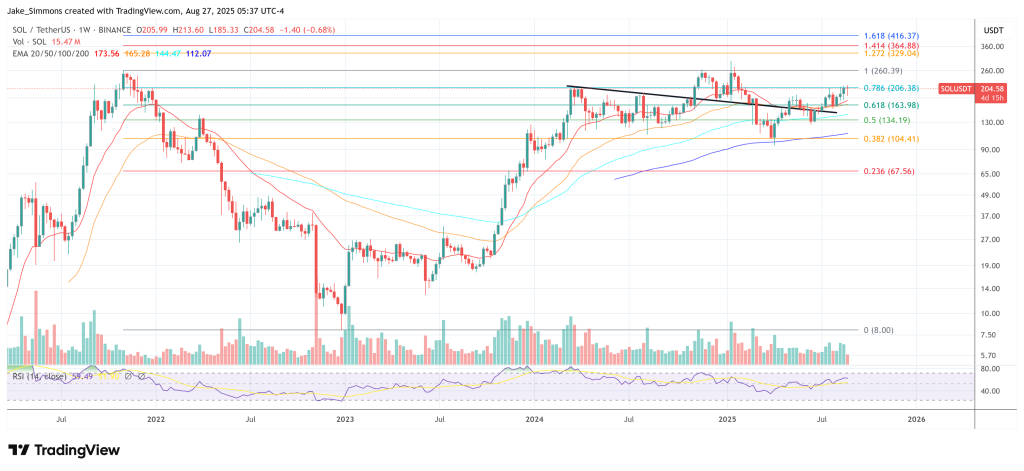
At press time, SOL traded at $204.

Solana price
Market Opportunity
MemeCore Logo
MemeCore Price(M)
$1.54413
$1.54413$1.54413
-2.35%
USD
MemeCore (M) Live Price Chart
Disclaimer: The articles reposted on this site are sourced from public platforms and are provided for informational purposes only. They do not necessarily reflect the views of MEXC. All rights remain with the original authors. If you believe any content infringes on third-party rights, please contact service@support.mexc.com for removal. MEXC makes no guarantees regarding the accuracy, completeness, or timeliness of the content and is not responsible for any actions taken based on the information provided. The content does not constitute financial, legal, or other professional advice, nor should it be considered a recommendation or endorsement by MEXC.

You May Also Like

American Bitcoin’s $5B Nasdaq Debut Puts Trump-Backed Miner in Crypto Spotlight

American Bitcoin’s $5B Nasdaq Debut Puts Trump-Backed Miner in Crypto Spotlight

The post American Bitcoin’s $5B Nasdaq Debut Puts Trump-Backed Miner in Crypto Spotlight appeared on BitcoinEthereumNews.com. Key Takeaways: American Bitcoin (ABTC) surged nearly 85% on its Nasdaq debut, briefly reaching a $5B valuation. The Trump family, alongside Hut 8 Mining, controls 98% of the newly merged crypto-mining entity. Eric Trump called Bitcoin “modern-day gold,” predicting it could reach $1 million per coin. American Bitcoin, a fast-rising crypto mining firm with strong political and institutional backing, has officially entered Wall Street. After merging with Gryphon Digital Mining, the company made its Nasdaq debut under the ticker ABTC, instantly drawing global attention to both its stock performance and its bold vision for Bitcoin’s future. Read More: Trump-Backed Crypto Firm Eyes Asia for Bold Bitcoin Expansion Nasdaq Debut: An Explosive First Day ABTC’s first day of trading proved as dramatic as expected. Shares surged almost 85% at the open, touching a peak of $14 before settling at lower levels by the close. That initial spike valued the company around $5 billion, positioning it as one of 2025’s most-watched listings. At the last session, ABTC has been trading at $7.28 per share, which is a small positive 2.97% per day. Although the price has decelerated since opening highs, analysts note that the company has been off to a strong start and early investor activity is a hard-to-find feat in a newly-launched crypto mining business. According to market watchers, the listing comes at a time of new momentum in the digital asset markets. With Bitcoin trading above $110,000 this quarter, American Bitcoin’s entry comes at a time when both institutional investors and retail traders are showing heightened interest in exposure to Bitcoin-linked equities. Ownership Structure: Trump Family and Hut 8 at the Helm Its management and ownership set up has increased the visibility of the company. The Trump family and the Canadian mining giant Hut 8 Mining jointly own 98 percent…
Share
BitcoinEthereumNews2025/09/18 01:33
Whales Shift Focus to Zero Knowledge Proof’s 3000x ROI Potential as Zcash & Toncoin’s Rally Slows Down

Whales Shift Focus to Zero Knowledge Proof’s 3000x ROI Potential as Zcash & Toncoin’s Rally Slows Down

Explore how Zero Knowledge Proof (ZKP) is reshaping personal finance, challenging banks, and standing out as one of the top crypto gainers ahead of ZCash and Toncoin
Share
coinlineup2026/01/15 13:00
Visa Brings Stablecoins To $1.7T Platform In BVNK Deal

Visa Brings Stablecoins To $1.7T Platform In BVNK Deal

The post Visa Brings Stablecoins To $1.7T Platform In BVNK Deal appeared on BitcoinEthereumNews.com. Visa Brings Stablecoins To $1.7T Platform In BVNK
Share
BitcoinEthereumNews2026/01/15 13:03