

Will Bitcoin price drop to $65,000 as bearish forces come into play?
Bitcoin price risks a drop back to the $65,000 zone as bearish macroeconomic forces continue to impact investor risk sentiment.
- Bitcoin price failed to hold the $70,000 support on Thursday.
- Investor demand for risk assets dropped amid surging oil prices and rising U.S. Treasury yields.
- The latest U.S. CPI print came in line with market expectations, which can force the Fed to keep interest rates elevated for a longer period.
According to data from crypto.news, Bitcoin (BTC) price fell 4.8% over the past 7 days, dropping below the $70,000 support level. Trading at $69,385 at the time of writing, the bellwether was nearly 29% below its year-to-date high of around $97,500 and 45% from its all-time high.
Bearish macro pressures continue to hurt Bitcoin
Currently, Bitcoin faces a number of geopolitical and macroeconomic risks that could push its price towards $65,000 and subsequently the $60,000 mark.
First, Iran has announced that it would change its retaliation strategy in the Middle East from reciprocal hits to continuous strikes against the interests of its adversaries, a move intended to punish Israel and the United States.
Additionally, Tehran said that it would continue blocking all ships carrying oil to Israel and the United States from using the Strait of Hormuz, where millions of barrels of crude pass through daily.
Through these measures, Iran aims to push crude oil prices to as high as $200, a move that could ultimately lead to higher inflation throughout the world, with the greatest impact coming on the U.S., which remains sensitive to energy price shocks. This escalating tension in the Middle East has historically driven investors away from volatile assets like cryptocurrency and into traditional safe havens.
Second, Wednesday’s U.S. core CPI data for February came in line with market expectations, essentially forcing the Federal Reserve to maintain elevated interest rates for a longer period.
Meanwhile, if the war continues to drive up energy costs, it could fuel inflation further and dampen any hopes for a pivot in monetary policy this year. Higher interest rates typically sap the liquidity necessary for speculative assets to thrive.
According to the CME FedWatch data, there is a 99.3% chance that the interest rates will remain unchanged during the March FOMC meeting, with the current target rate sitting at 350 to 375 basis points. Odds of an April rate cut meanwhile stood at just 10.9% when writing, down sharply from 21% one month earlier.
It should also be noted that February inflation data came without fully accounting for the recent impact of surging oil prices and hence does not reflect the hawkish stance the Fed will be forced to adopt over the coming weeks.
Third, US yields on the 10-year Treasury have continued to go higher as bond markets react to these inflationary pressures. These yields recently rose by several basis points, making the guaranteed returns of government debt far more attractive than the risks associated with digital currencies.
Bitcoin price analysis
In terms of technicals, Bitcoin has once again fallen below the $70,000 mark. Traders are closely watching the $68,500 support level, but persistent selling pressure suggests that the path of least resistance remains to the downside with a potential retracement to the $65,000 support zone until global stability returns.
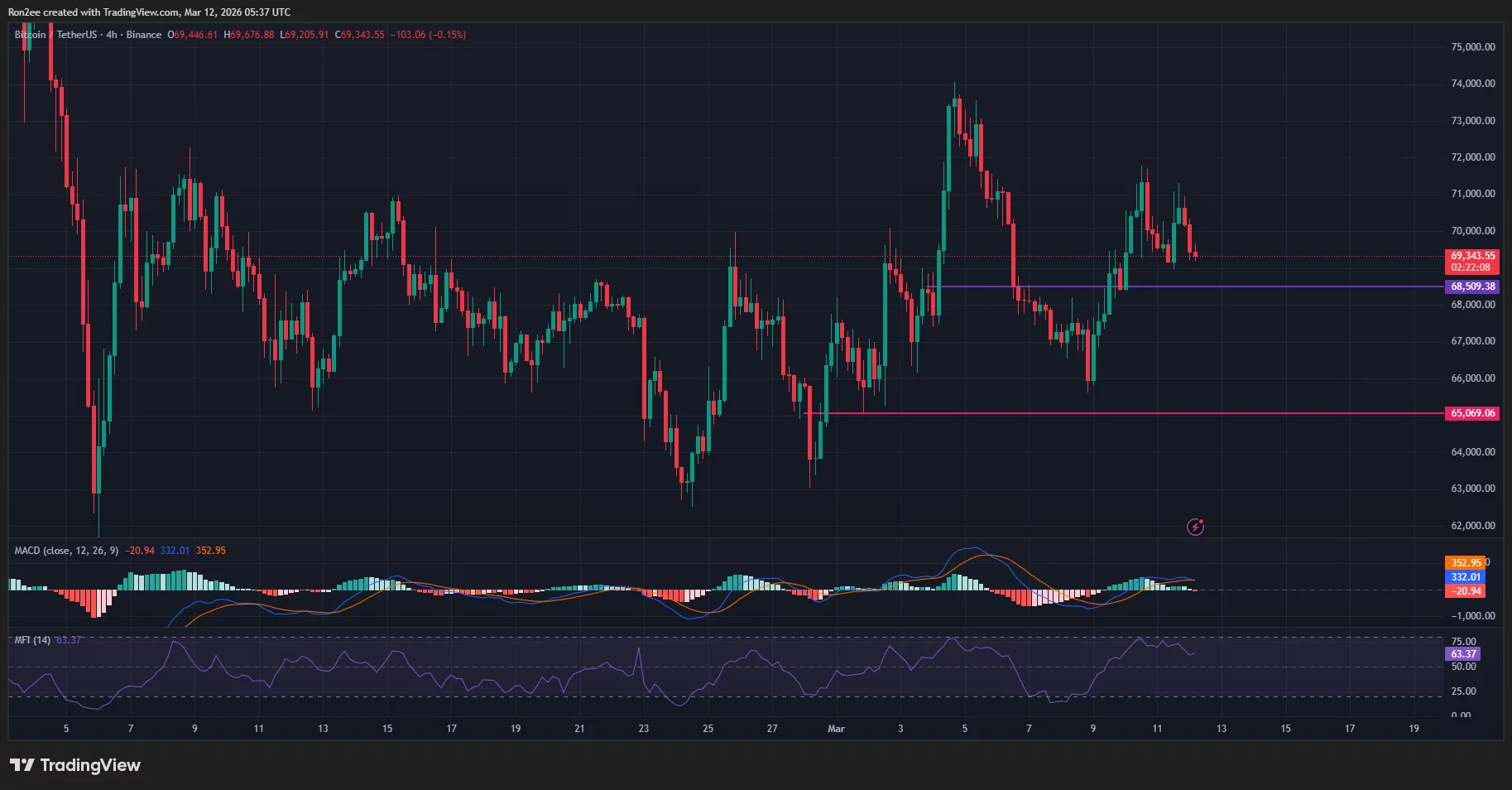
On the 4-hour chart, momentum indicators suggest that the bearish structure has already started building. The MACD lines are close to confirming a bearish crossover, while the RSI is trending downwards after hitting overbought levels.
Disclosure: This article does not represent investment advice. The content and materials featured on this page are for educational purposes only.


You May Also Like

Not a loophole: Singapore AI export controls let China tap US AI legally

Exclusive interview with Smokey The Bera, co-founder of Berachain: How the innovative PoL public chain solves the liquidity problem and may be launched in a few months

Chainlink Whale Activity Rises While Price Bleeds for 7 Straight Months



