TLDR Lilly launches AI platform TuneLab, stock rises on biotech collaboration. Lilly debuts TuneLab with $1B data, Circle Pharma joins cancer research push. AI-powered TuneLab launch boosts Lilly stock, Circle Pharma enters oncology pact. Lilly’s TuneLab transforms biotech R&D, Circle Pharma leads with cancer trials. Lilly unveils TuneLab AI hub, strengthens biotech ties, stock climbs [...] The post Eli Lilly and Company (LLY) Stock: Surge on $1B AI-Powered Drug Discovery Platform and Circle Pharma Deal appeared first on CoinCentral.TLDR Lilly launches AI platform TuneLab, stock rises on biotech collaboration. Lilly debuts TuneLab with $1B data, Circle Pharma joins cancer research push. AI-powered TuneLab launch boosts Lilly stock, Circle Pharma enters oncology pact. Lilly’s TuneLab transforms biotech R&D, Circle Pharma leads with cancer trials. Lilly unveils TuneLab AI hub, strengthens biotech ties, stock climbs [...] The post Eli Lilly and Company (LLY) Stock: Surge on $1B AI-Powered Drug Discovery Platform and Circle Pharma Deal appeared first on CoinCentral.

Eli Lilly and Company (LLY) Stock: Surge on $1B AI-Powered Drug Discovery Platform and Circle Pharma Deal

2025/09/10 08:16
3 min read
For feedback or concerns regarding this content, please contact us at crypto.news@mexc.com

TLDR

  • Lilly launches AI platform TuneLab, stock rises on biotech collaboration.
  • Lilly debuts TuneLab with $1B data, Circle Pharma joins cancer research push.
  • AI-powered TuneLab launch boosts Lilly stock, Circle Pharma enters oncology pact.
  • Lilly’s TuneLab transforms biotech R&D, Circle Pharma leads with cancer trials.
  • Lilly unveils TuneLab AI hub, strengthens biotech ties, stock climbs on momentum.

Eli Lilly and Company shares climbed sharply on September 9 after a pivotal AI platform launch and biotech collaboration. The stock opened the day around $738.27 and surged to an intraday high of $753.96. It closed at $750.61, marking a 1.62% gain, despite a minor after-hours pullback to $748.50.
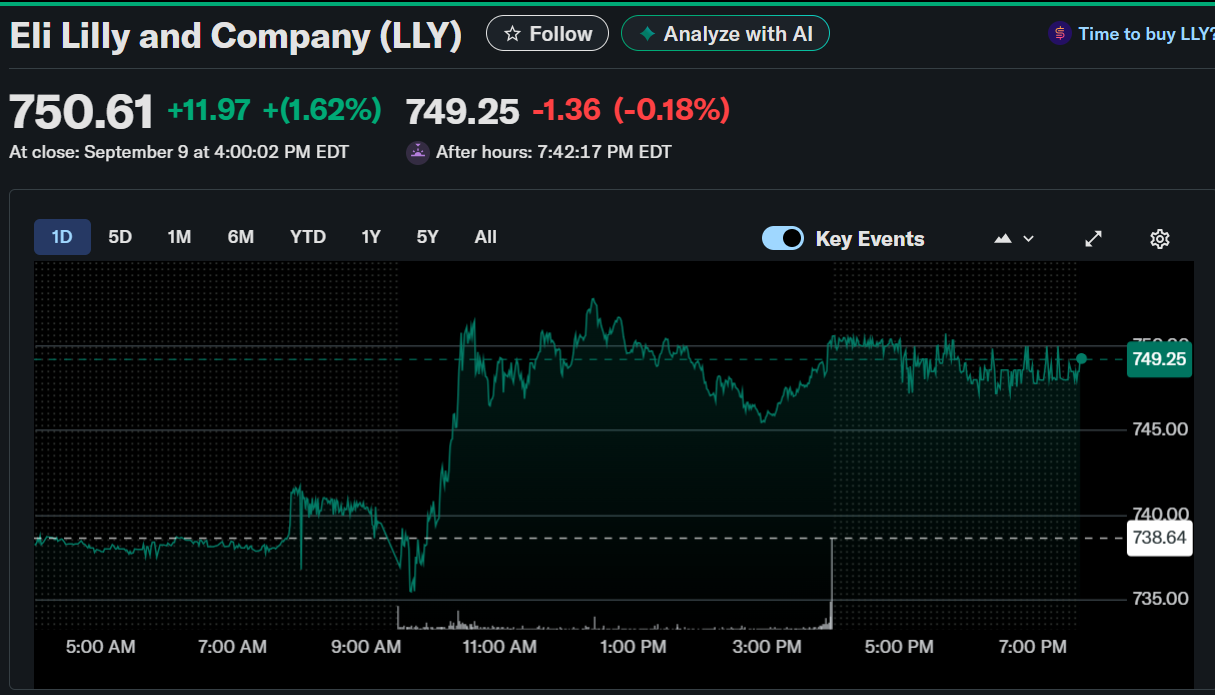
Eli Lilly and Company (LLY)

Lilly TuneLab Launches with $1B in Proprietary Data

Eli Lilly launched TuneLab, a platform trained on over $1 billion worth of proprietary experimental and preclinical research data. This tool provides biotech companies with secure access to advanced AI-driven drug discovery models. The initiative allows selected partners to contribute data, enhancing model performance without data exposure.

The platform includes extensive molecular, disposition, and safety datasets collected over decades by Lilly’s R&D teams. Using federated learning, TuneLab maintains data privacy while boosting collective research outcomes. A third-party infrastructure manages access and security to protect all parties involved.

This AI-powered collaboration aims to accelerate, inform, and scale drug development across biotech firms of various sizes. Lilly intends to enhance TuneLab’s scope with in vivo predictive tools exclusive to the platform. This move aligns with its long-term goal to democratize access to advanced pharmaceutical intelligence.

Circle Pharma Joins Forces with Lilly to Advance Cancer Program

Circle Pharma entered a strategic partnership with Lilly to utilize TuneLab to optimize macrocycle drug development. The company will integrate the platform into its MXMO system, which is designed to enhance bioavailability and cell permeability. Circle’s lead candidate, CID-078, is in a Phase 1 trial targeting advanced solid tumors.

By combining proprietary AI models with Circle’s platform, the collaboration seeks to overcome historical barriers in oncology drug design. The focus remains on traditionally hard-to-drug targets like cyclins, where precision is crucial. TuneLab will help Circle make earlier, smarter decisions and improve scalability.

This partnership supports Circle’s ongoing growth as it advances its pipeline and scales its oncology platform. It demonstrates TuneLab’s early industry traction and potential for wider biotech adoption. Both firms aim to streamline clinical translation through high-quality predictive insights.

Lilly Strengthens Catalyze360 Ecosystem

The launch of TuneLab is part of Lilly’s broader Catalyze360 initiative, which supports biotechs with resources and infrastructure. The ecosystem includes venture funding, lab space through Gateway Labs, and now access to AI-driven development platforms. Together, these offerings position Lilly as a key partner in emerging drug development.

TuneLab complements existing capabilities and provides smaller firms a significant data advantage in drug research. The model improves continuously as partners contribute, creating a shared innovation cycle. Lilly’s investment signals a deep commitment to collaborative pharmaceutical advancement.

The stock’s rise reflects growing market confidence in Lilly’s AI strategy and biotech partnerships. With TuneLab’s rollout and its integration into real-world biotech pipelines, Lilly reinforces its leadership in AI-powered drug discovery.


The post Eli Lilly and Company (LLY) Stock: Surge on $1B AI-Powered Drug Discovery Platform and Circle Pharma Deal appeared first on CoinCentral.

Market Opportunity
DAR Open Network Logo
DAR Open Network Price(D)
$0.007032
$0.007032$0.007032
-0.31%
USD
DAR Open Network (D) Live Price Chart
Disclaimer: The articles reposted on this site are sourced from public platforms and are provided for informational purposes only. They do not necessarily reflect the views of MEXC. All rights remain with the original authors. If you believe any content infringes on third-party rights, please contact crypto.news@mexc.com for removal. MEXC makes no guarantees regarding the accuracy, completeness, or timeliness of the content and is not responsible for any actions taken based on the information provided. The content does not constitute financial, legal, or other professional advice, nor should it be considered a recommendation or endorsement by MEXC.

You May Also Like

DBS Tests Repo With Ripple RLUSD and Franklin sgBENJI

DBS Tests Repo With Ripple RLUSD and Franklin sgBENJI

The post DBS Tests Repo With Ripple RLUSD and Franklin sgBENJI appeared on BitcoinEthereumNews.com. Ripple, DBS, and Franklin Templeton launch tokenized repo pilot on DBS Exchange. Repo trades use Ripple’s RLUSD stablecoin and Franklin Templeton’s sgBENJI token. sgBENJI issued on XRP Ledger enables fast collateralized lending and settlements. DBS, Ripple, and Franklin Templeton have signed a memorandum of understanding to bring repo transactions into tokenized finance. The framework pairs Ripple’s RLUSD stablecoin with Franklin Templeton’s sgBENJI tokenized money market fund, listed on DBS Digital Exchange. The setup gives accredited clients a path to rebalance cash into a regulated, yield-bearing vehicle while transacting with stablecoins that settle within minutes. For institutions used to overnight repo desks, this is a first look at how traditional liquidity tools can migrate onto public blockchains. Related: Franklin Templeton Launches its DeFi Solution Benji on Ethereum Demand From Institutions Shapes the Design The three firms cited rising demand for digital asset allocations, with surveys showing nearly nine in ten institutional investors plan to increase exposure in 2025. The repo model was chosen because it mirrors an existing backbone of global funding markets: collateralized lending against short-term securities. By allowing RLUSD to trade directly against sgBENJI on DBS Digital Exchange, desks can manage intraday liquidity, park stablecoin reserves into a fund earning regulated yield, and unwind positions quickly when cash is needed. DBS to Expand Collateralized Lending The next phase extends sgBENJI beyond a trading instrument into repo collateral. DBS plans to let investors pledge sgBENJI against credit lines arranged through the bank or third-party lenders. That opens deeper liquidity pools with the assurance that collateral sits inside a regulated balance sheet. For trading desks, that means onchain repo could eventually function like its traditional counterpart, rolling positions overnight, secured by tokenized assets that settle in near real-time. XRP Ledger as the Settlement Rail Franklin Templeton will issue sgBENJI tokens on…
Share
BitcoinEthereumNews2025/09/18 20:25
Pepeto Attracts Capital As Early Shiba Inu And Pepe Investors Hunt Big Gains And The Next 100x Story

Pepeto Attracts Capital As Early Shiba Inu And Pepe Investors Hunt Big Gains And The Next 100x Story

The post Pepeto Attracts Capital As Early Shiba Inu And Pepe Investors Hunt Big Gains And The Next 100x Story appeared first on Coinpedia Fintech News Early Shiba Inu and PEPE stories are legendary. Some first movers turned $1,000 into well over $1,000,000 as SHIB ran more than 26,000% in 2021, while PEPE delivered multi-thousand % bursts for the earliest entries. After riding those arcs, many of those holders are hunting the next big move, shifting from SHIB to PEPE and …
Share
CoinPedia2025/09/18 19:02
A 3821% surge in 20 years: Why are Pokémon cards valuable investments?

A 3821% surge in 20 years: Why are Pokémon cards valuable investments?

By David Unyime Nkanta Compiled by: TechFlow The Pokémon trading card game is extremely popular around the world, especially in Japan. These cards are very valuable, especially the rare ones. (Image source: Twitter / FADA Pack Magic @FadaPackMagic) Pokémon trading cards have gone from amusement park items to one of the world's hottest alternative investments. According to data from analytics firm Card Ladder, the Pokémon card market has grown 3,821% in value since 2004, far outpacing the S&P 500's 483% increase and Meta Platforms' 1,844% growth. From hobby to high-yield asset Pokémon trading cards, launched by Nintendo in 1996, have become a popular investment, traded across platforms including eBay, TCGplayer, and international expos. The market has seen explosive growth during the pandemic, as stimulus policies and lockdowns have driven collectors toward alternative assets. For some, the investment has yielded life-changing returns. Lucas Shaw, a 27-year-old account manager in Ohio, said the profits from selling the cards helped him pay for his wedding rings and celebrations. Similarly, Justin Wilson, a 32-year-old advertising manager in Oklahoma City, estimates the total value of his collection of 500 cards and 100 sealed items at about $100,000. He considers Pokémon cards part of his investment portfolio, alongside his Roth IRA and securities accounts. The appeal of Pokémon cards lies not only in financial gain but also in their emotional resonance. "You have to collect them all," Wilson said, referencing the series's classic slogan. For many, the cards represent both childhood nostalgia and speculative opportunity. Where does the value of rare Pokémon cards come from? A classic Poké Ball toy with matching Pokémon trading cards. Zapdos, Ninetales, and a trainer card are clearly visible. Image credit: Thimo Pedersen/Unsplash Unlike stocks, Pokémon cards don't generate dividends; their value depends on their rarity, condition, and cultural significance. Cards graded as perfect PSA 10 by the Professional Sports Authenticator (PSA) often fetch exorbitant prices. The most dramatic example occurred in 2022, when influencer Logan Paul purchased a near-perfect "Pikachu Illustrator" card for $5.3 million, setting a Guinness World Record for the most expensive Pokémon card ever sold privately. This event further ignited market interest and highlighted the speculative potential of high-level cards. Risks of the Pokémon Card Market Financial advisors warn against considering collectibles as the core of a portfolio. Card prices are extremely volatile, influenced by hype, media coverage, and collector sentiment. Counterfeit cards also remain a potential threat, with scams frequently occurring. Image source: Flickr/c0rnnibblets Still, the resilience of the Pokémon brand provides some stability to the market. Pokémon spans video games, movies, and merchandise, and unlike sports trading cards, the characters are immune to scandals, making them a safer investment for some collectors. The Future of Collectibles Investing The rapid rise of Pokémon cards reflects a broader shift in people's perception of value. As digital assets like Bitcoin face regulatory scrutiny and tech stocks undergo a market correction, tangible collectibles offer a nostalgic and potentially profitable haven. While the sustainability of its value remains uncertain, the 3,821% growth over the past 20 years has established Pokémon trading cards as the most vivid example of how a childhood hobby can transform into a multi-million dollar investment.
Share
PANews2025/09/18 18:00