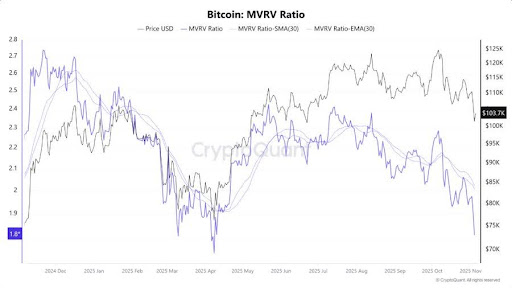
Bitcoin’s latest market pullback has pushed its MVRV ratio back into a critical zone that has historically been associated with macro correction lows and early-stage recovery setups. The MVRV metric now reflects a valuation reset similar to the conditions that preceded major rebound phases in prior cycles. Why The Reset Reinforces Bitcoin Value Proposition The crypto bearish performance echoes through the Bitcoin community as the Market Value to Realized Value (MVRV) ratio dips into the critical 1.8 to 2.0 range, a zone significant for past cycle corrections where BTC found its footing before initiating a recovery. An ambassador and market expert, BitBull, has revealed on X that for those unfamiliar with its significance, the MVRV ratio compares BTC’s current market value to its realized value, which is what investors actually paid for their coins. Related Reading: Bitcoin Sentiment Flatline: Bull Score Crashes To 0 – What This Means For The Market However, when this ratio dips near 2, it signals that a majority of holders are hovering around their cost basis. At this point, there’s no greed left in the system, just conviction. Historically, this 1.8 to 2.0 MVRV range has coincided with major market bottoms in June 2021, November 2022, and April 2025, when the market felt broken, but BTC was quietly resetting. With the MVRV ratio currently re-entering this same critical zone, combined with the massive liquidations observed recently and a palpable sense of panic across the market, the pattern feels eerily familiar. Every time sentiment turns into hopelessness, on-chain data would show a different story of exhaustion, not collapse. BitBull personally views this phase as one of compression, not capitulation, indicating short-term pain but a long-term opportunity. The same market dynamics cycle that previously punished excessive leverage is now washing out the remaining weak hands. BitBull concluded that if history rhymes, this will be the part of the story where the bottom gets written, not the top. Why Liquidity Matters More Than Interest Rates Liquidity has been a crucial component of the Bitcoin market. A full-time crypto trader and investor, Daan Crypto Trades, has pointed out that if there is one macro factor that drives BTC and the broader crypto market, it’s the amount of global liquidity within the financial system, not interest rates. Related Reading: Bitcoin Liquidity Grabs: Institutions Target Low-Volume Zones To Move BTC Price This correlation is clear from comparing the global liquidity index with BTC’s price movements over the years. Daan has recently observed a shift where global liquidity has stopped expanding and begun to trend downwards again.  However, this change has put a halt to BTS’s upward momentum, combined with the anticipated profit-taking behavior observed during the 4-year market cycle. “Once global liquidity starts expanding at a rapid pace, the market environment for crypto will become significantly more supportive than it is currently,” the expert noted. Featured image from Pixabay, chart from Tradingview.comBitcoin’s latest market pullback has pushed its MVRV ratio back into a critical zone that has historically been associated with macro correction lows and early-stage recovery setups. The MVRV metric now reflects a valuation reset similar to the conditions that preceded major rebound phases in prior cycles. Why The Reset Reinforces Bitcoin Value Proposition The crypto bearish performance echoes through the Bitcoin community as the Market Value to Realized Value (MVRV) ratio dips into the critical 1.8 to 2.0 range, a zone significant for past cycle corrections where BTC found its footing before initiating a recovery. An ambassador and market expert, BitBull, has revealed on X that for those unfamiliar with its significance, the MVRV ratio compares BTC’s current market value to its realized value, which is what investors actually paid for their coins. Related Reading: Bitcoin Sentiment Flatline: Bull Score Crashes To 0 – What This Means For The Market However, when this ratio dips near 2, it signals that a majority of holders are hovering around their cost basis. At this point, there’s no greed left in the system, just conviction. Historically, this 1.8 to 2.0 MVRV range has coincided with major market bottoms in June 2021, November 2022, and April 2025, when the market felt broken, but BTC was quietly resetting. With the MVRV ratio currently re-entering this same critical zone, combined with the massive liquidations observed recently and a palpable sense of panic across the market, the pattern feels eerily familiar. Every time sentiment turns into hopelessness, on-chain data would show a different story of exhaustion, not collapse. BitBull personally views this phase as one of compression, not capitulation, indicating short-term pain but a long-term opportunity. The same market dynamics cycle that previously punished excessive leverage is now washing out the remaining weak hands. BitBull concluded that if history rhymes, this will be the part of the story where the bottom gets written, not the top. Why Liquidity Matters More Than Interest Rates Liquidity has been a crucial component of the Bitcoin market. A full-time crypto trader and investor, Daan Crypto Trades, has pointed out that if there is one macro factor that drives BTC and the broader crypto market, it’s the amount of global liquidity within the financial system, not interest rates. Related Reading: Bitcoin Liquidity Grabs: Institutions Target Low-Volume Zones To Move BTC Price This correlation is clear from comparing the global liquidity index with BTC’s price movements over the years. Daan has recently observed a shift where global liquidity has stopped expanding and begun to trend downwards again.  However, this change has put a halt to BTS’s upward momentum, combined with the anticipated profit-taking behavior observed during the 4-year market cycle. “Once global liquidity starts expanding at a rapid pace, the market environment for crypto will become significantly more supportive than it is currently,” the expert noted. Featured image from Pixabay, chart from Tradingview.com

Bitcoin Valuation Reset: MVRV Slides Into Macro Correction Territory — What This Means

2025/11/08 10:00

Bitcoin’s latest market pullback has pushed its MVRV ratio back into a critical zone that has historically been associated with macro correction lows and early-stage recovery setups. The MVRV metric now reflects a valuation reset similar to the conditions that preceded major rebound phases in prior cycles.

Why The Reset Reinforces Bitcoin Value Proposition

The crypto bearish performance echoes through the Bitcoin community as the Market Value to Realized Value (MVRV) ratio dips into the critical 1.8 to 2.0 range, a zone significant for past cycle corrections where BTC found its footing before initiating a recovery. An ambassador and market expert, BitBull, has revealed on X that for those unfamiliar with its significance, the MVRV ratio compares BTC’s current market value to its realized value, which is what investors actually paid for their coins.

However, when this ratio dips near 2, it signals that a majority of holders are hovering around their cost basis. At this point, there’s no greed left in the system, just conviction. Historically, this 1.8 to 2.0 MVRV range has coincided with major market bottoms in June 2021, November 2022, and April 2025, when the market felt broken, but BTC was quietly resetting.
Bitcoin

With the MVRV ratio currently re-entering this same critical zone, combined with the massive liquidations observed recently and a palpable sense of panic across the market, the pattern feels eerily familiar. Every time sentiment turns into hopelessness, on-chain data would show a different story of exhaustion, not collapse.

BitBull personally views this phase as one of compression, not capitulation, indicating short-term pain but a long-term opportunity. The same market dynamics cycle that previously punished excessive leverage is now washing out the remaining weak hands. BitBull concluded that if history rhymes, this will be the part of the story where the bottom gets written, not the top.

Why Liquidity Matters More Than Interest Rates

Liquidity has been a crucial component of the Bitcoin market. A full-time crypto trader and investor, Daan Crypto Trades, has pointed out that if there is one macro factor that drives BTC and the broader crypto market, it’s the amount of global liquidity within the financial system, not interest rates.

This correlation is clear from comparing the global liquidity index with BTC’s price movements over the years. Daan has recently observed a shift where global liquidity has stopped expanding and begun to trend downwards again. 

However, this change has put a halt to BTS’s upward momentum, combined with the anticipated profit-taking behavior observed during the 4-year market cycle. “Once global liquidity starts expanding at a rapid pace, the market environment for crypto will become significantly more supportive than it is currently,” the expert noted.

Bitcoin
Disclaimer: The articles reposted on this site are sourced from public platforms and are provided for informational purposes only. They do not necessarily reflect the views of MEXC. All rights remain with the original authors. If you believe any content infringes on third-party rights, please contact service@support.mexc.com for removal. MEXC makes no guarantees regarding the accuracy, completeness, or timeliness of the content and is not responsible for any actions taken based on the information provided. The content does not constitute financial, legal, or other professional advice, nor should it be considered a recommendation or endorsement by MEXC.

You May Also Like

Fed rate decision September 2025

Fed rate decision September 2025

The post Fed rate decision September 2025 appeared on BitcoinEthereumNews.com. WASHINGTON – The Federal Reserve on Wednesday approved a widely anticipated rate cut and signaled that two more are on the way before the end of the year as concerns intensified over the U.S. labor market. In an 11-to-1 vote signaling less dissent than Wall Street had anticipated, the Federal Open Market Committee lowered its benchmark overnight lending rate by a quarter percentage point. The decision puts the overnight funds rate in a range between 4.00%-4.25%. Newly-installed Governor Stephen Miran was the only policymaker voting against the quarter-point move, instead advocating for a half-point cut. Governors Michelle Bowman and Christopher Waller, looked at for possible additional dissents, both voted for the 25-basis point reduction. All were appointed by President Donald Trump, who has badgered the Fed all summer to cut not merely in its traditional quarter-point moves but to lower the fed funds rate quickly and aggressively. In the post-meeting statement, the committee again characterized economic activity as having “moderated” but added language saying that “job gains have slowed” and noted that inflation “has moved up and remains somewhat elevated.” Lower job growth and higher inflation are in conflict with the Fed’s twin goals of stable prices and full employment.  “Uncertainty about the economic outlook remains elevated” the Fed statement said. “The Committee is attentive to the risks to both sides of its dual mandate and judges that downside risks to employment have risen.” Markets showed mixed reaction to the developments, with the Dow Jones Industrial Average up more than 300 points but the S&P 500 and Nasdaq Composite posting losses. Treasury yields were modestly lower. At his post-meeting news conference, Fed Chair Jerome Powell echoed the concerns about the labor market. “The marked slowing in both the supply of and demand for workers is unusual in this less dynamic…
Share
BitcoinEthereumNews2025/09/18 02:44