A new report reveals 6.51 million Bitcoin worth $188 billion are vulnerable to quantum attacks in the next five years, with no community consensus on protective measures. The post HRF Warns Quantum Computers Could Break Bitcoin Encryption Within 5 Years appeared first on Coinspeaker.A new report reveals 6.51 million Bitcoin worth $188 billion are vulnerable to quantum attacks in the next five years, with no community consensus on protective measures. The post HRF Warns Quantum Computers Could Break Bitcoin Encryption Within 5 Years appeared first on Coinspeaker.

HRF Warns Quantum Computers Could Break Bitcoin Encryption Within 5 Years

2025/11/01 05:03

The Human Rights Foundation published a report on Oct. 31, 2025, warning that cryptographically relevant quantum computers pose a significant threat to Bitcoin BTC $109 626 24h volatility: 2.0% Market cap: $2.18 T Vol. 24h: $61.99 B security. The report states that 6.51 million BTC are vulnerable to quantum attacks within the next five years.

The vulnerable supply includes 1.72 million BTC in early Pay-to-Public-Key addresses, according to the report. These coins, valued at approximately $188 billion, are considered dormant and include an estimated 1.1 million BTC attributed to Satoshi Nakamoto. An additional 4.49 million BTC remain vulnerable, though active owners could migrate these funds to quantum-secure address types.

Timeline and Technical Threats

Eighty experts at the July 2025 Presidio Bitcoin Quantum Summit assessed that quantum computers capable of breaking Bitcoin’s encryption could emerge within 5-10 years. Market analyst Charles Edwards’ 2026 quantum threat warning aligns with the urgency expressed at the summit. Recent hardware advances from IBM, including a 120-qubit system, and Google’s 105-qubit Willow chip add material urgency to the threat assessment.
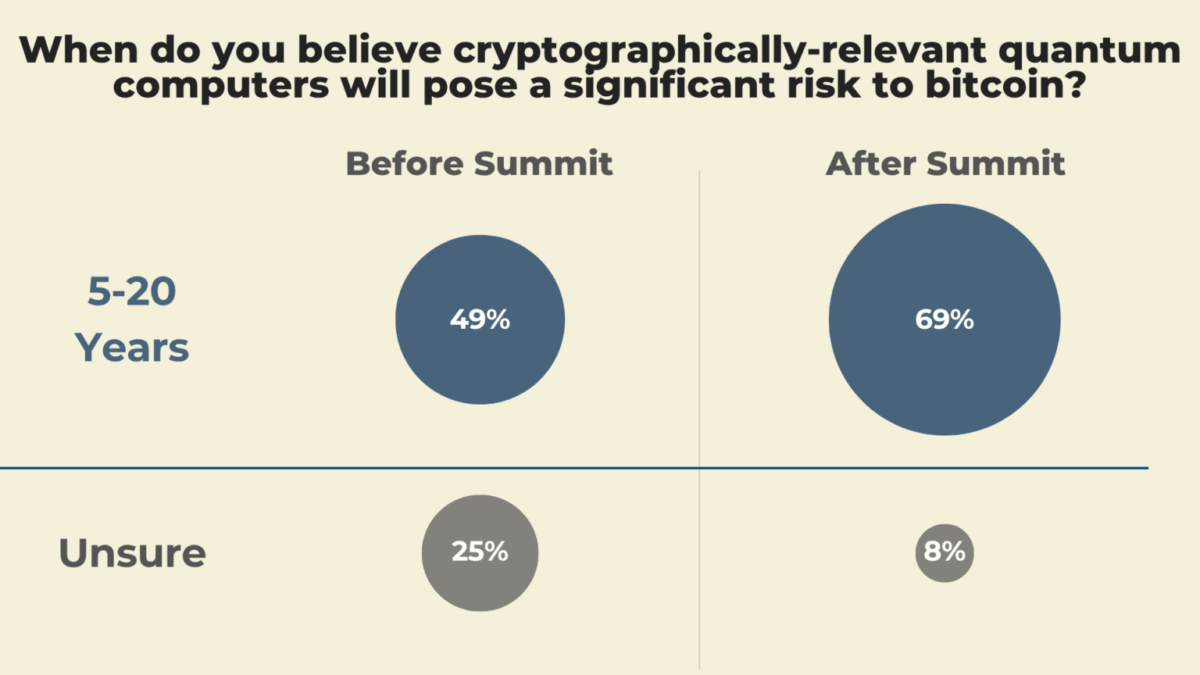
Presidio Bitcoin Survey | Source: Presidio Bitcoin

Presidio Bitcoin Survey | Source: Presidio Bitcoin

Quantum computers running Shor’s algorithm could execute long-range attacks on addresses with exposed public keys, including P2PK formats and reused addresses. Short-range attacks targeting new transactions during their brief exposure window also present risks to Bitcoin’s security model.

Community Debate Over Dormant Coins

The report highlights a “burn or steal” dilemma dividing the Bitcoin community over how to handle the vulnerable Satoshi-era funds and other dormant coins in P2PK addresses. The Presidio Summit confirmed that no consensus has been reached on whether these coins should be destroyed or left vulnerable to potential theft by quantum attackers.
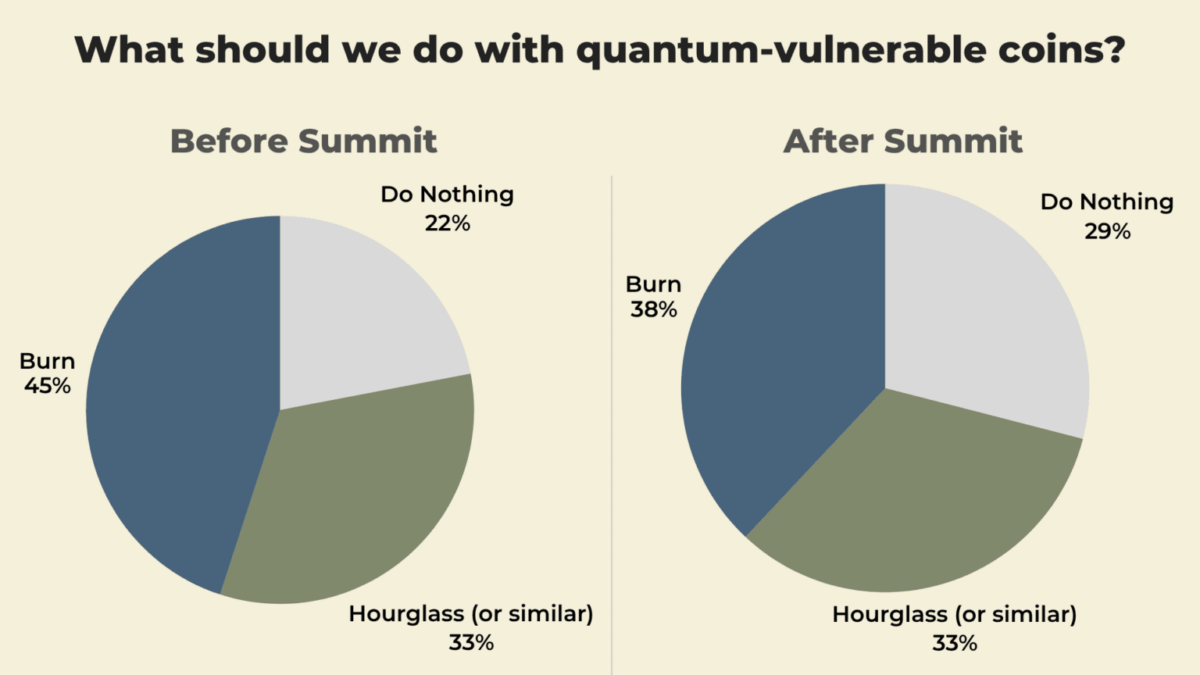
Presidio Bitcoin Survey | Source: Presidio Bitcoin

Presidio Bitcoin Survey | Source: Presidio Bitcoin

Multiple quantum-resistant signature schemes have been proposed, including lattice-based and hash-based approaches. However, these solutions are 10 to 38 times larger than current signatures, creating significant blockchain scaling challenges. The summit surfaced competing approaches, including SPHINCS+, Lifeboat, and BIP360 proposals, but participants did not converge on a single roadmap.

Experts reached consensus on one immediate action item: eliminating address reuse, particularly by exchanges and custodians. The summit emphasized that institutional custody solutions must adopt better operational practices to reduce vulnerability before quantum computers arrive.

next

The post HRF Warns Quantum Computers Could Break Bitcoin Encryption Within 5 Years appeared first on Coinspeaker.

Disclaimer: The articles reposted on this site are sourced from public platforms and are provided for informational purposes only. They do not necessarily reflect the views of MEXC. All rights remain with the original authors. If you believe any content infringes on third-party rights, please contact service@support.mexc.com for removal. MEXC makes no guarantees regarding the accuracy, completeness, or timeliness of the content and is not responsible for any actions taken based on the information provided. The content does not constitute financial, legal, or other professional advice, nor should it be considered a recommendation or endorsement by MEXC.

You May Also Like

The Channel Factories We’ve Been Waiting For

The Channel Factories We’ve Been Waiting For

The post The Channel Factories We’ve Been Waiting For appeared on BitcoinEthereumNews.com. Visions of future technology are often prescient about the broad strokes while flubbing the details. The tablets in “2001: A Space Odyssey” do indeed look like iPads, but you never see the astronauts paying for subscriptions or wasting hours on Candy Crush.  Channel factories are one vision that arose early in the history of the Lightning Network to address some challenges that Lightning has faced from the beginning. Despite having grown to become Bitcoin’s most successful layer-2 scaling solution, with instant and low-fee payments, Lightning’s scale is limited by its reliance on payment channels. Although Lightning shifts most transactions off-chain, each payment channel still requires an on-chain transaction to open and (usually) another to close. As adoption grows, pressure on the blockchain grows with it. The need for a more scalable approach to managing channels is clear. Channel factories were supposed to meet this need, but where are they? In 2025, subnetworks are emerging that revive the impetus of channel factories with some new details that vastly increase their potential. They are natively interoperable with Lightning and achieve greater scale by allowing a group of participants to open a shared multisig UTXO and create multiple bilateral channels, which reduces the number of on-chain transactions and improves capital efficiency. Achieving greater scale by reducing complexity, Ark and Spark perform the same function as traditional channel factories with new designs and additional capabilities based on shared UTXOs.  Channel Factories 101 Channel factories have been around since the inception of Lightning. A factory is a multiparty contract where multiple users (not just two, as in a Dryja-Poon channel) cooperatively lock funds in a single multisig UTXO. They can open, close and update channels off-chain without updating the blockchain for each operation. Only when participants leave or the factory dissolves is an on-chain transaction…
Share
BitcoinEthereumNews2025/09/18 00:09
American Bitcoin’s $5B Nasdaq Debut Puts Trump-Backed Miner in Crypto Spotlight

American Bitcoin’s $5B Nasdaq Debut Puts Trump-Backed Miner in Crypto Spotlight

The post American Bitcoin’s $5B Nasdaq Debut Puts Trump-Backed Miner in Crypto Spotlight appeared on BitcoinEthereumNews.com. Key Takeaways: American Bitcoin (ABTC) surged nearly 85% on its Nasdaq debut, briefly reaching a $5B valuation. The Trump family, alongside Hut 8 Mining, controls 98% of the newly merged crypto-mining entity. Eric Trump called Bitcoin “modern-day gold,” predicting it could reach $1 million per coin. American Bitcoin, a fast-rising crypto mining firm with strong political and institutional backing, has officially entered Wall Street. After merging with Gryphon Digital Mining, the company made its Nasdaq debut under the ticker ABTC, instantly drawing global attention to both its stock performance and its bold vision for Bitcoin’s future. Read More: Trump-Backed Crypto Firm Eyes Asia for Bold Bitcoin Expansion Nasdaq Debut: An Explosive First Day ABTC’s first day of trading proved as dramatic as expected. Shares surged almost 85% at the open, touching a peak of $14 before settling at lower levels by the close. That initial spike valued the company around $5 billion, positioning it as one of 2025’s most-watched listings. At the last session, ABTC has been trading at $7.28 per share, which is a small positive 2.97% per day. Although the price has decelerated since opening highs, analysts note that the company has been off to a strong start and early investor activity is a hard-to-find feat in a newly-launched crypto mining business. According to market watchers, the listing comes at a time of new momentum in the digital asset markets. With Bitcoin trading above $110,000 this quarter, American Bitcoin’s entry comes at a time when both institutional investors and retail traders are showing heightened interest in exposure to Bitcoin-linked equities. Ownership Structure: Trump Family and Hut 8 at the Helm Its management and ownership set up has increased the visibility of the company. The Trump family and the Canadian mining giant Hut 8 Mining jointly own 98 percent…
Share
BitcoinEthereumNews2025/09/18 01:33