This article applies game theory to a firm, demonstrating how a fair bonus distribution system can create a self-enforcing Nash equilibrium for teamwork.This article applies game theory to a firm, demonstrating how a fair bonus distribution system can create a self-enforcing Nash equilibrium for teamwork.

Game Theory in the Workplace: Using Bonuses to Ensure a Self-Enforcing Equilibrium

Abstract and 1. Introduction

  1. A free and fair economy: definition, existence and uniqueness

    2.1 A free economy

    2.2 A free and fair economy

  2. Equilibrium existence in a free and fair economy

    3.1 A free and fair economy as a strategic form game

    3.2 Existence of an equilibrium

  3. Equilibrium efficiency in a free and fair economy

  4. A free economy with social justice and inclusion

    5.1 Equilibrium existence and efficiency in a free economy with social justice

    5.2 Choosing a reference point to achieve equilibrium efficiency

  5. Some applications

    6.1 Teamwork: surplus distribution in a firm

    6.2 Contagion and self-enforcing lockdown in a networked economy

    6.3 Bias in academic publishing

    6.4 Exchange economies

  6. Contributions to the closely related literature

  7. Conclusion and References

Appendix

6 Some applications

There a wide variety of applications of our theory. In this section, we provide applications to the distribution of surplus in a firm, exchange economies, self-enforcing lockdowns in a networked economy facing a pandemic, and publication bias in the academic peer-review system.

6.1 Teamwork: surplus distribution in a firm

In this first application, we use our theory to show how bonuses can be distributed among workers in a way that incentivizes them to work efficiently.

\
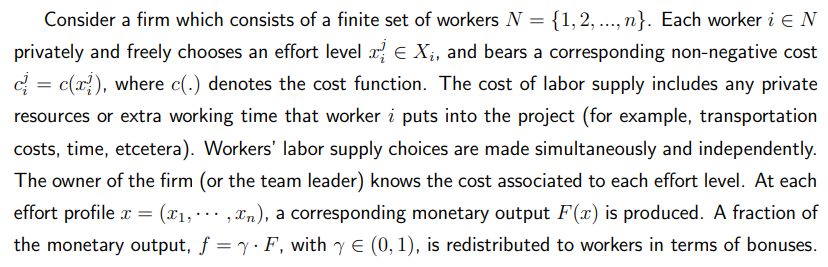
\ The existence of a pure strategy Nash equilibrium in this teamwork game follows from Lemma 1. To see this, observe that the payoff function of a worker can be decomposed in two parts: the bonus that is determined by the Shapley payoff and the cost function. Lemma 1 shows that the sum of excess payoffs in any cycle of deviations equals 0 in any free and fair economy (or any strategic game with Shapley payoffs). The reader can check that the sum of excess costs in any cycle of strategy profiles is zero as well in the game. The latter implies that the sum of excess payoffs in any cycle of strategy profiles of the teamwork game is equal to 0. Therefore, the teamwork game admits no cycle of deviations. As the game is finite, we conclude that it admits at least a Nash equilibrium profile in pure strategies. (Recall that the total output of the firm, F, and the total bonus, f, are perfectly correlated.) We should point out that a pure strategy Nash equilibrium always exists in the teamwork game, even if costs are high. In the latter case, some workers, if not all, might find it optimal to remain inactive at the equilibrium. In such a situation, the owner might want to raise the total bonus to be redistributed to workers.

\
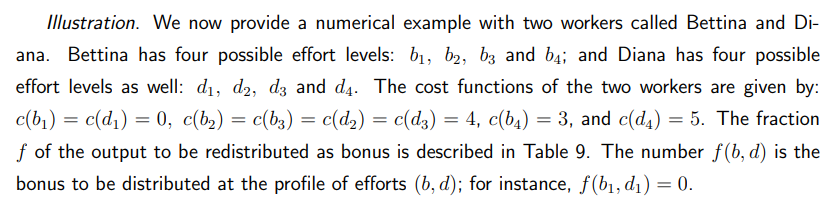
\ Table 9: Total bonus function in a teamwork game
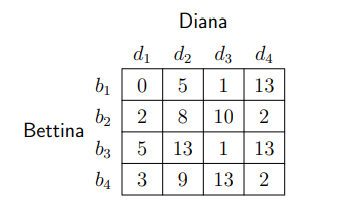
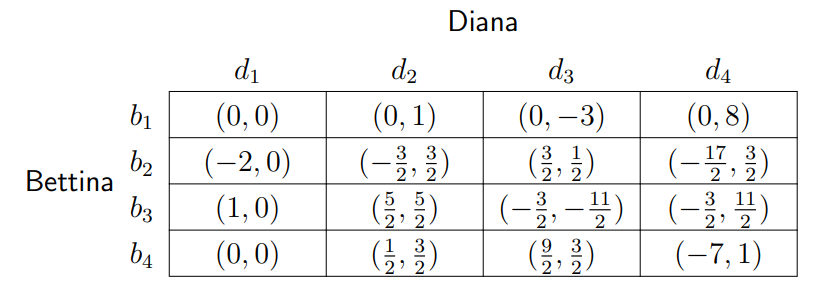
\ The corresponding Shapley payoffs are described in Table 10 and the net payoffs of Bettina and Diana in the teamwork game are described in Table 11.

\ The profile (b4, d3) is a pure strategy Nash equilibrium. Therefore, the owner of the firm can implement the profile (b4, d3) without any need of monitoring the actions of Bettina and Diana, as (b4, d3) is self-enforcing. The owner can implement the profile (b1, d4) as well. Note that the set of equilibrium effort profiles depend on the cost functions, and that no worker receives a non

\ Table 10: Shapley payoffs: redistribution of total bonus in a teamwork game
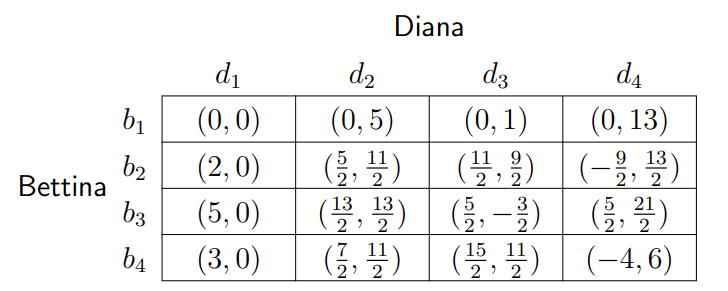
\ Table 11: Bettina and Diana’s net payoffs in a teamwork game

\ positive bonus at the equilibrium. The reason is that each worker i always has the option to remain inactive, which is equivalent to Bettina choosing b1 or Diana choosing d1 in this illustration. The two equilibria in this teamwork game are Pareto-efficient.

\

:::info Authors:

(1) Ghislain H. Demeze-Jouatsa, Center for Mathematical Economics, University of Bielefeld (demeze jouatsa@uni-bielefeld.de);

(2) Roland Pongou, Department of Economics, University of Ottawa (rpongou@uottawa.ca);

(3) Jean-Baptiste Tondji, Department of Economics and Finance, The University of Texas Rio Grande Valley (jeanbaptiste.tondji@utrgv.edu).

:::


:::info This paper is available on arxiv under CC BY 4.0 DEED license.

:::

\

Market Opportunity
SQUID MEME Logo
SQUID MEME Price(GAME)
$32.0669
$32.0669$32.0669
-18.46%
USD
SQUID MEME (GAME) Live Price Chart
Disclaimer: The articles reposted on this site are sourced from public platforms and are provided for informational purposes only. They do not necessarily reflect the views of MEXC. All rights remain with the original authors. If you believe any content infringes on third-party rights, please contact service@support.mexc.com for removal. MEXC makes no guarantees regarding the accuracy, completeness, or timeliness of the content and is not responsible for any actions taken based on the information provided. The content does not constitute financial, legal, or other professional advice, nor should it be considered a recommendation or endorsement by MEXC.

You May Also Like

Google's AP2 protocol has been released. Does encrypted AI still have a chance?

Google's AP2 protocol has been released. Does encrypted AI still have a chance?

Following the MCP and A2A protocols, the AI Agent market has seen another blockbuster arrival: the Agent Payments Protocol (AP2), developed by Google. This will clearly further enhance AI Agents' autonomous multi-tasking capabilities, but the unfortunate reality is that it has little to do with web3AI. Let's take a closer look: What problem does AP2 solve? Simply put, the MCP protocol is like a universal hook, enabling AI agents to connect to various external tools and data sources; A2A is a team collaboration communication protocol that allows multiple AI agents to cooperate with each other to complete complex tasks; AP2 completes the last piece of the puzzle - payment capability. In other words, MCP opens up connectivity, A2A promotes collaboration efficiency, and AP2 achieves value exchange. The arrival of AP2 truly injects "soul" into the autonomous collaboration and task execution of Multi-Agents. Imagine AI Agents connecting Qunar, Meituan, and Didi to complete the booking of flights, hotels, and car rentals, but then getting stuck at the point of "self-payment." What's the point of all that multitasking? So, remember this: AP2 is an extension of MCP+A2A, solving the last mile problem of AI Agent automated execution. What are the technical highlights of AP2? The core innovation of AP2 is the Mandates mechanism, which is divided into real-time authorization mode and delegated authorization mode. Real-time authorization is easy to understand. The AI Agent finds the product and shows it to you. The operation can only be performed after the user signs. Delegated authorization requires the user to set rules in advance, such as only buying the iPhone 17 when the price drops to 5,000. The AI Agent monitors the trigger conditions and executes automatically. The implementation logic is cryptographically signed using Verifiable Credentials (VCs). Users can set complex commission conditions, including price ranges, time limits, and payment method priorities, forming a tamper-proof digital contract. Once signed, the AI Agent executes according to the conditions, with VCs ensuring auditability and security at every step. Of particular note is the "A2A x402" extension, a technical component developed by Google specifically for crypto payments, developed in collaboration with Coinbase and the Ethereum Foundation. This extension enables AI Agents to seamlessly process stablecoins, ETH, and other blockchain assets, supporting native payment scenarios within the Web3 ecosystem. What kind of imagination space can AP2 bring? After analyzing the technical principles, do you think that's it? Yes, in fact, the AP2 is boring when it is disassembled alone. Its real charm lies in connecting and opening up the "MCP+A2A+AP2" technology stack, completely opening up the complete link of AI Agent's autonomous analysis+execution+payment. From now on, AI Agents can open up many application scenarios. For example, AI Agents for stock investment and financial management can help us monitor the market 24/7 and conduct independent transactions. Enterprise procurement AI Agents can automatically replenish and renew without human intervention. AP2's complementary payment capabilities will further expand the penetration of the Agent-to-Agent economy into more scenarios. Google obviously understands that after the technical framework is established, the ecological implementation must be relied upon, so it has brought in more than 60 partners to develop it, almost covering the entire payment and business ecosystem. Interestingly, it also involves major Crypto players such as Ethereum, Coinbase, MetaMask, and Sui. Combined with the current trend of currency and stock integration, the imagination space has been doubled. Is web3 AI really dead? Not entirely. Google's AP2 looks complete, but it only achieves technical compatibility with Crypto payments. It can only be regarded as an extension of the traditional authorization framework and belongs to the category of automated execution. There is a "paradigm" difference between it and the autonomous asset management pursued by pure Crypto native solutions. The Crypto-native solutions under exploration are taking the "decentralized custody + on-chain verification" route, including AI Agent autonomous asset management, AI Agent autonomous transactions (DeFAI), AI Agent digital identity and on-chain reputation system (ERC-8004...), AI Agent on-chain governance DAO framework, AI Agent NPC and digital avatars, and many other interesting and fun directions. Ultimately, once users get used to AI Agent payments in traditional fields, their acceptance of AI Agents autonomously owning digital assets will also increase. And for those scenarios that AP2 cannot reach, such as anonymous transactions, censorship-resistant payments, and decentralized asset management, there will always be a time for crypto-native solutions to show their strength? The two are more likely to be complementary rather than competitive, but to be honest, the key technological advancements behind AI Agents currently all come from web2AI, and web3AI still needs to keep up the good work!
Share
PANews2025/09/18 07:00
Zama to Conduct Sealed-Bid Dutch Auction Using Encryption Tech

Zama to Conduct Sealed-Bid Dutch Auction Using Encryption Tech

Zama unveils innovative public token auction, using proprietary encryption. Bidding begins January 21, 2026. Key details on protocol and market impact.Read more
Share
Coinstats2026/01/20 18:13
Fed Finally Cuts Interest Rates – Crypto Boom is About to Begin

Fed Finally Cuts Interest Rates – Crypto Boom is About to Begin

The federal funds rate now stands in a range of 4.00% to 4.25%, a level that reflects a delicate balancing […] The post Fed Finally Cuts Interest Rates – Crypto Boom is About to Begin appeared first on Coindoo.
Share
Coindoo2025/09/18 02:01