Vitalik Buterin defended the 43-day Ethereum unstaking delays amid growing industry criticism over trapped validator funds. Currently, 2,489,358 ETH sits in the exit queue facing a 43-day wait, while 35.6 million ETH are staked across 1,048,413 active validators earning 2.87% APR, as per ValidatorQueue’s data. Buterin responded to developer Robert Sags’ criticism that withdrawal delays exceed traditional banking timeframes and harm user experience for retail investors. “It’s more like a soldier deciding to quit the army. Staking is about taking on a solemn duty to defend the chain,” Buterin wrote on X, emphasizing that “friction in quitting is part of the deal.”Ethereum Validator Queue (Source: ValidatorQueue) Developer Tensions Over User Experience The exchange highlighted growing tensions between Ethereum’s technical design priorities and mainstream user expectations for digital asset liquidity. Sags criticized the disconnect between wallet messaging that promotes “easy yield” and the reality of unpredictable withdrawal delays that can trap funds when users need them most. “What about the average user who is suffering with the delay and needs to pay bills?” Sags questioned, arguing that clearer disclosure about redemption periods would help users make informed decisions. Buterin acknowledged these UX concerns, admitting the Ethereum Foundation “needs to be more active at the UX layer” and has been working to address usability issues over recent months. The Ethereum founder argued that reducing exit delays would make the chain “much less trustworthy from the PoV of any node that does not go online very frequently,” positioning the delays as essential for maintaining network stability. Queue Dynamics Create Market Tension The current validator queue mechanics operate through strict churn limits of 256 validators per epoch, creating bottlenecks when exit demand surges beyond the network’s processing capacity. Recent market data shows the exit queue peaked at over 1 million ETH worth approximately $5 billion in late August, before settling to current levels, still requiring 43 days to clear completely. Meanwhile, the entry queue containing 432,077 ETH faces just a 7-day wait, creating an asymmetric dynamic that traps more supply than it releases in the short term.Ethereum Queue Wait Time (Source: ValidatorQueue) This imbalance has created what analysts describe as artificial supply shortages, with previous Cryptonews reports highlighting how 833,000 ETH trapped in queues reduced available trading supply. The 9.1-day sweep delay adds additional friction to the exit process, meaning validators face multiple layers of waiting even after initiating unstaking requests. Exchange flow data reveals these queue dynamics are reducing sell pressure, with Bitcoin and Ethereum inflows hitting 1-year lows as larger holders avoid moving assets to trading platforms. Staking demand has continued growing despite the exit delays, with the queue reaching $3.7 billion in early September, its highest level since the Shanghai upgrade enabled withdrawals in 2023. Security Versus Liquidity Trade-offs Spark Broader Debate Notably, the unstaking controversy is a fundamental tension between blockchain security models and modern financial expectations for asset liquidity. Buterin’s military analogy reflects Ethereum’s proof-of-stake design philosophy, where validator commitments must be sticky enough to prevent coordinated attacks or mass exodus events that could destabilize consensus. Critics argue this creates a dangerous precedent where large holders face material liquidity constraints, potentially amplifying sell pressure when exits do occur or forcing investors toward liquid staking derivatives. The debate has sparked discussions about potential protocol modifications, including proposals for faster validator key switching that would allow repositioning without full exits. One X user suggested implementing “a faster process to unstake and restake with different clients that’s not adding to the queue” to improve client diversity without compromising security guarantees. Buterin responded favorably to a “switch your keys” function where validators would remain vulnerable to slashing from old keys temporarily while continuing to stake, describing it as something that “would only help, and would not hurt any guarantees.” However, any changes to the current queue system would require broad consensus among Ethereum developers and stakeholders, given the security implications of reducing validator commitment frictionVitalik Buterin defended the 43-day Ethereum unstaking delays amid growing industry criticism over trapped validator funds. Currently, 2,489,358 ETH sits in the exit queue facing a 43-day wait, while 35.6 million ETH are staked across 1,048,413 active validators earning 2.87% APR, as per ValidatorQueue’s data. Buterin responded to developer Robert Sags’ criticism that withdrawal delays exceed traditional banking timeframes and harm user experience for retail investors. “It’s more like a soldier deciding to quit the army. Staking is about taking on a solemn duty to defend the chain,” Buterin wrote on X, emphasizing that “friction in quitting is part of the deal.”Ethereum Validator Queue (Source: ValidatorQueue) Developer Tensions Over User Experience The exchange highlighted growing tensions between Ethereum’s technical design priorities and mainstream user expectations for digital asset liquidity. Sags criticized the disconnect between wallet messaging that promotes “easy yield” and the reality of unpredictable withdrawal delays that can trap funds when users need them most. “What about the average user who is suffering with the delay and needs to pay bills?” Sags questioned, arguing that clearer disclosure about redemption periods would help users make informed decisions. Buterin acknowledged these UX concerns, admitting the Ethereum Foundation “needs to be more active at the UX layer” and has been working to address usability issues over recent months. The Ethereum founder argued that reducing exit delays would make the chain “much less trustworthy from the PoV of any node that does not go online very frequently,” positioning the delays as essential for maintaining network stability. Queue Dynamics Create Market Tension The current validator queue mechanics operate through strict churn limits of 256 validators per epoch, creating bottlenecks when exit demand surges beyond the network’s processing capacity. Recent market data shows the exit queue peaked at over 1 million ETH worth approximately $5 billion in late August, before settling to current levels, still requiring 43 days to clear completely. Meanwhile, the entry queue containing 432,077 ETH faces just a 7-day wait, creating an asymmetric dynamic that traps more supply than it releases in the short term.Ethereum Queue Wait Time (Source: ValidatorQueue) This imbalance has created what analysts describe as artificial supply shortages, with previous Cryptonews reports highlighting how 833,000 ETH trapped in queues reduced available trading supply. The 9.1-day sweep delay adds additional friction to the exit process, meaning validators face multiple layers of waiting even after initiating unstaking requests. Exchange flow data reveals these queue dynamics are reducing sell pressure, with Bitcoin and Ethereum inflows hitting 1-year lows as larger holders avoid moving assets to trading platforms. Staking demand has continued growing despite the exit delays, with the queue reaching $3.7 billion in early September, its highest level since the Shanghai upgrade enabled withdrawals in 2023. Security Versus Liquidity Trade-offs Spark Broader Debate Notably, the unstaking controversy is a fundamental tension between blockchain security models and modern financial expectations for asset liquidity. Buterin’s military analogy reflects Ethereum’s proof-of-stake design philosophy, where validator commitments must be sticky enough to prevent coordinated attacks or mass exodus events that could destabilize consensus. Critics argue this creates a dangerous precedent where large holders face material liquidity constraints, potentially amplifying sell pressure when exits do occur or forcing investors toward liquid staking derivatives. The debate has sparked discussions about potential protocol modifications, including proposals for faster validator key switching that would allow repositioning without full exits. One X user suggested implementing “a faster process to unstake and restake with different clients that’s not adding to the queue” to improve client diversity without compromising security guarantees. Buterin responded favorably to a “switch your keys” function where validators would remain vulnerable to slashing from old keys temporarily while continuing to stake, describing it as something that “would only help, and would not hurt any guarantees.” However, any changes to the current queue system would require broad consensus among Ethereum developers and stakeholders, given the security implications of reducing validator commitment friction

Buterin Justifies Long Ethereum Unstaking Process Amid Criticism Over 43-Day Delays

2025/09/19 02:13
4 min read
For feedback or concerns regarding this content, please contact us at crypto.news@mexc.com

Vitalik Buterin defended the 43-day Ethereum unstaking delays amid growing industry criticism over trapped validator funds.

Currently, 2,489,358 ETH sits in the exit queue facing a 43-day wait, while 35.6 million ETH are staked across 1,048,413 active validators earning 2.87% APR, as per ValidatorQueue’s data.

Buterin responded to developer Robert Sags’ criticism that withdrawal delays exceed traditional banking timeframes and harm user experience for retail investors.

“It’s more like a soldier deciding to quit the army. Staking is about taking on a solemn duty to defend the chain,” Buterin wrote on X, emphasizing that “friction in quitting is part of the deal.”
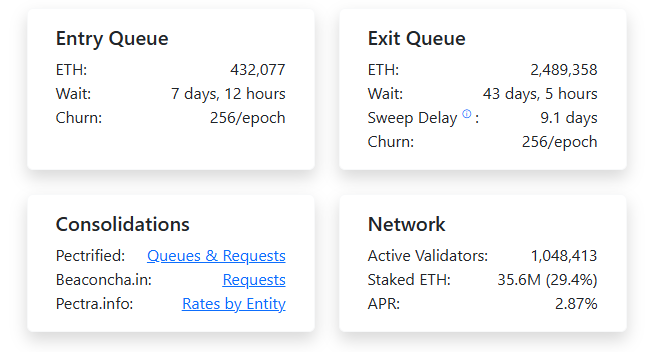
Buterin Justifies Long Ethereum Unstaking Process Amid Criticism Over 43-Day Delays.Ethereum Validator Queue (Source: ValidatorQueue)

Developer Tensions Over User Experience

The exchange highlighted growing tensions between Ethereum’s technical design priorities and mainstream user expectations for digital asset liquidity.

Sags criticized the disconnect between wallet messaging that promotes “easy yield” and the reality of unpredictable withdrawal delays that can trap funds when users need them most.

“What about the average user who is suffering with the delay and needs to pay bills?” Sags questioned, arguing that clearer disclosure about redemption periods would help users make informed decisions.

Buterin acknowledged these UX concerns, admitting the Ethereum Foundation “needs to be more active at the UX layer” and has been working to address usability issues over recent months.

The Ethereum founder argued that reducing exit delays would make the chain “much less trustworthy from the PoV of any node that does not go online very frequently,” positioning the delays as essential for maintaining network stability.

Queue Dynamics Create Market Tension

The current validator queue mechanics operate through strict churn limits of 256 validators per epoch, creating bottlenecks when exit demand surges beyond the network’s processing capacity.

Recent market data shows the exit queue peaked at over 1 million ETH worth approximately $5 billion in late August, before settling to current levels, still requiring 43 days to clear completely.

Meanwhile, the entry queue containing 432,077 ETH faces just a 7-day wait, creating an asymmetric dynamic that traps more supply than it releases in the short term.

Buterin Justifies Long Ethereum Unstaking Process Amid Criticism Over 43-Day Delays.Ethereum Queue Wait Time (Source: ValidatorQueue)

This imbalance has created what analysts describe as artificial supply shortages, with previous Cryptonews reports highlighting how 833,000 ETH trapped in queues reduced available trading supply.

The 9.1-day sweep delay adds additional friction to the exit process, meaning validators face multiple layers of waiting even after initiating unstaking requests.

Exchange flow data reveals these queue dynamics are reducing sell pressure, with Bitcoin and Ethereum inflows hitting 1-year lows as larger holders avoid moving assets to trading platforms.

Staking demand has continued growing despite the exit delays, with the queue reaching $3.7 billion in early September, its highest level since the Shanghai upgrade enabled withdrawals in 2023.

Security Versus Liquidity Trade-offs Spark Broader Debate

Notably, the unstaking controversy is a fundamental tension between blockchain security models and modern financial expectations for asset liquidity.

Buterin’s military analogy reflects Ethereum’s proof-of-stake design philosophy, where validator commitments must be sticky enough to prevent coordinated attacks or mass exodus events that could destabilize consensus.

Critics argue this creates a dangerous precedent where large holders face material liquidity constraints, potentially amplifying sell pressure when exits do occur or forcing investors toward liquid staking derivatives.

The debate has sparked discussions about potential protocol modifications, including proposals for faster validator key switching that would allow repositioning without full exits.

One X user suggested implementing “a faster process to unstake and restake with different clients that’s not adding to the queue” to improve client diversity without compromising security guarantees.

Buterin responded favorably to a “switch your keys” function where validators would remain vulnerable to slashing from old keys temporarily while continuing to stake, describing it as something that “would only help, and would not hurt any guarantees.”

However, any changes to the current queue system would require broad consensus among Ethereum developers and stakeholders, given the security implications of reducing validator commitment friction.

Disclaimer: The articles reposted on this site are sourced from public platforms and are provided for informational purposes only. They do not necessarily reflect the views of MEXC. All rights remain with the original authors. If you believe any content infringes on third-party rights, please contact crypto.news@mexc.com for removal. MEXC makes no guarantees regarding the accuracy, completeness, or timeliness of the content and is not responsible for any actions taken based on the information provided. The content does not constitute financial, legal, or other professional advice, nor should it be considered a recommendation or endorsement by MEXC.

You May Also Like

US Treasury Turns to AI to Combat Crypto Fraud After $9B in Losses

US Treasury Turns to AI to Combat Crypto Fraud After $9B in Losses

The United States Department of the Treasury is looking at artificial intelligence technology to help prevent cryptocurrency fraud in digital markets. The officials
Share
Thenewscrypto2026/03/09 22:10
‘Great Progress’: Cardano Founder Shares Update After CLARITY Act Roundtable

‘Great Progress’: Cardano Founder Shares Update After CLARITY Act Roundtable

                         Read the full article at                             coingape.com.                         
Share
Coinstats2025/09/18 03:18
Ethereum koers toont zeldzaam dubbel koopsignaal en richt zich op $4.550

Ethereum koers toont zeldzaam dubbel koopsignaal en richt zich op $4.550

Connect met Like-minded Crypto Enthusiasts! Connect op Discord! Check onze Discord   Ethereum laat op de uurgrafiek twee opeenvolgende TD Sequential koopsignalen zien. Deze indicator meet uitputting in een trend en geeft vaak een signaal dat de verkoopdruk kan afnemen. Dit dubbele signaal verschijnt rond het niveau van $4.516, waar de ETH prijs kortstondig steun vindt. Dit type formatie komt zelden voor en wordt daarom extra nauwlettend gevolgd. Wat gaat de Ethereum koers hiermee doen? Ethereum koers test steun rond $4.516 De scherpe daling van de Ethereum koers vanaf de prijszone rond $4.800 bracht de ETH prijs in korte tijd naar ongeveer $4.516. Op dit niveau trad duidelijke koopactiviteit op, waardoor de neerwaartse beweging tijdelijk werd gestopt. Het dubbele signaal dat door de TD Sequential indicator is gegenereerd, viel precies samen met dit prijspunt. De TD Sequential is opgebouwd uit negen candles die een trend meetellen. Wanneer de negende candle verschijnt, kan dit duiden op een trendomslag. In dit geval verschenen zelfs twee signalen kort na elkaar, wat aangeeft dat de verkoopdruk mogelijk uitgeput is. Het feit dat dit gebeurde in een zone waar ETH kopers actief bleven, maakt het patroon extra opvallend. TD Sequential just flashed two buy signals for Ethereum $ETH! pic.twitter.com/JPO8EhiEPi — Ali (@ali_charts) September 16, 2025 Welke crypto nu kopen?Lees onze uitgebreide gids en leer welke crypto nu kopen verstandig kan zijn! Welke crypto nu kopen? Fed-voorzitter Jerome Powell heeft aangekondigd dat de rentes binnenkort zomaar eens omlaag zouden kunnen gaan, en tegelijkertijd blijft BlackRock volop crypto kopen, en dus lijkt de markt klaar om te gaan stijgen. Eén vraag komt telkens terug: welke crypto moet je nu kopen? In dit artikel bespreken we de munten die… Continue reading Ethereum koers toont zeldzaam dubbel koopsignaal en richt zich op $4.550 document.addEventListener('DOMContentLoaded', function() { var screenWidth = window.innerWidth; var excerpts = document.querySelectorAll('.lees-ook-description'); excerpts.forEach(function(description) { var excerpt = description.getAttribute('data-description'); var wordLimit = screenWidth wordLimit) { var trimmedDescription = excerpt.split(' ').slice(0, wordLimit).join(' ') + '...'; description.textContent = trimmedDescription; } }); }); Technische indicatoren schetsen herstelkans voor ETH Naast de dubbele koopsignalen verstrekken ook andere indicatoren belangrijke aanwijzingen. Tijdens de daling van de ETH koers waren grote rode candles zichtbaar, maar na de test van $4.516 stabiliseerde de Ethereum koers. Dit wijst op een mogelijke verschuiving in het evenwicht tussen de bears en bulls. Als deze opwaartse beweging doorzet, liggen de eerste weerstanden rond $4.550. Daarboven wacht een sterkere zone rond $4.650. Deze niveaus zijn in eerdere Ethereum sessies al meerdere keren getest. Een doorbraak zou ruimte openen richting de all-time high van ETH rond $4.953. Wanneer de prijs toch opnieuw onder $4.516 zakt, liggen er zones rond $4.500 en $4.450 waar grotere kooporders worden verwacht. Deze niveaus kunnen als een vangnet fungeren, mocht de druk opnieuw toenemen. Marktdynamiek bevestigt technische indicatoren De huidige situatie volgt op een bredere correctie in de cryptomarkt. Verschillende vooraanstaande crypto tokens zagen scherpe koersdalingen, waarna traders op zoek gingen naar signalen voor een mogelijke ommekeer. Dat juist Ethereum nu een dubbel TD Sequential signaal toont, versterkt de interesse in dit scenario. Fundamenteel blijft Ethereum sterk. Het aantal ETH tokens dat via staking is vastgezet, blijft groeien. Dat verkleint de vrije circulatie en vermindert verkoopdruk. Tegelijk blijft het netwerk intensief gebruikt voor DeFi, NFT’s en stablecoins. Deze activiteiten zorgen voor een stabiele vraag naar ETH, ook wanneer de prijs tijdelijk onder druk staat. Fundamentele drijfveren achter de Ethereum koers De Ethereum koers wordt echter niet alleen bepaald door candles en patronen, maar ook door bredere factoren. Een stijgend percentage van de totale ETH supply staat vast in staking contracten. Hierdoor neemt de liquiditeit op exchanges af. Dit kan prijsschommelingen versterken wanneer er plotseling meer koopdruk ontstaat. Daarnaast is Ethereum nog steeds het grootste smart contract platform. Nieuwe standaarden zoals ERC-8004 en ontwikkelingen rond layer-2 oplossingen houden de activiteit hoog. Deze technologische vooruitgang kan de waardepropositie ondersteunen en zo indirect bijdragen aan een ETH prijsherstel. Het belang van de korte termijn dynamiek De komende handelsdagen zullen duidelijk maken of de bulls genoeg kracht hebben om door de weerstandszone rond $4.550 te breken. Voor de bears ligt de focus juist op het verdedigen van de prijsregio rond $4.516. De whales, die met grote handelsorders opereren, kunnen hierin een beslissende rol spelen. Het dubbele TD Sequential signaal blijft hoe dan ook een zeldzame gebeurtenis. Voor cryptoanalisten vormt het een objectief aanknopingspunt om de kracht van de huidige Ethereum trend te toetsen. Vooruitblik op de ETH koers Ethereum liet twee opeenvolgende TD Sequential signalen zien op de uurgrafiek, iets wat zelden voorkomt. Deze formatie viel samen met steun rond $4.516, waar de bulls actief werden. Als de Ethereum koers boven dit niveau blijft, kan er ruimte ontstaan richting $4.550 en mogelijk $4.650. Zakt de prijs toch opnieuw onder $4.516, dan komen $4.500 en $4.450 in beeld als nieuwe steunzones. De combinatie van zeldzame indicatoren en een sterke fundamentele basis maakt Ethereum interessant voor zowel technische als fundamentele analyses. Of de bulls het momentum echt kunnen overnemen, zal blijken zodra de Ethereum koers de eerstvolgende weerstanden opnieuw test. Koop je crypto via Best Wallet Best wallet is een topklasse crypto wallet waarmee je anoniem crypto kan kopen. Met meer dan 60 chains gesupport kan je al je main crypto coins aanschaffen via Best Wallet. Best wallet - betrouwbare en anonieme wallet Best wallet - betrouwbare en anonieme wallet Meer dan 60 chains beschikbaar voor alle crypto Vroege toegang tot nieuwe projecten Hoge staking belongingen Lage transactiekosten Best wallet review Koop nu via Best Wallet Let op: cryptocurrency is een zeer volatiele en ongereguleerde investering. Doe je eigen onderzoek. Het bericht Ethereum koers toont zeldzaam dubbel koopsignaal en richt zich op $4.550 is geschreven door Dirk van Haaster en verscheen als eerst op Bitcoinmagazine.nl.
Share
Coinstats2025/09/17 23:31