South Korea made history this week by launching its first Korean won-backed stablecoin.South Korea made history this week by launching its first Korean won-backed stablecoin.

South Korea Launches First Won-Backed Stablecoin KRW1 on Avalanche

South Korea Launches First Won-Backed Stablecoin KRW1 on Avalanche

The digital currency, called KRW1, runs on the Avalanche blockchain and marks a major step forward for the country’s digital finance sector.

BDACS, a South Korean crypto custody firm, announced the launch after successfully completing technical testing with Woori Bank, one of the country’s largest financial institutions. Each KRW1 token is backed by actual Korean won held safely at the bank.

The launch comes at a time when South Korea lacks clear rules for stablecoins. However, the government is working on new laws that could change this soon.

What Makes KRW1 Different

KRW1 stands out because it connects traditional banking with modern blockchain technology. Every digital token is backed 1:1 by Korean won stored at Woori Bank. This means users can trust that their digital money has real value behind it.

The stablecoin uses real-time banking connections to prove its reserves exist. This transparency helps build trust between users and the platform. Harry Ryoo, CEO of BDACS, said his company is “building the backbone of the digital asset market, serving corporate, institutional, and public-sector partners.”
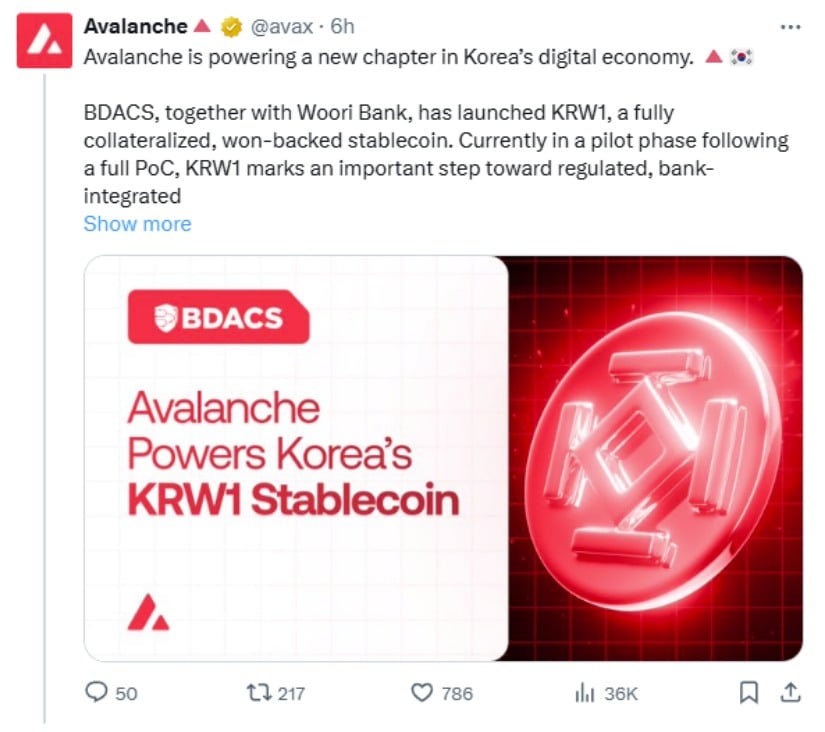
@avax

Source: @avax

BDACS chose Avalanche for its speed and security. The Korea Internet & Security Agency has recognized Avalanche as reliable for public sector use. Justin Kim, Head of Asia at Ava Labs, noted that KRW1 shows “the need for a highly-performant and reliable blockchain tailored for a regulatory-compliant stablecoin.”

Government and Public Sector Plans

KRW1 was designed with government use in mind. BDACS plans to offer it as a low-cost payment system for public programs. This could significantly reduce fees when the government distributes emergency relief money or processes other payments.

The company has already built systems for issuing tokens, managing reserves, and verifying transactions. They also created a user app that lets people send money to each other and check transaction details.

Currently, KRW1 operates as a proof-of-concept project. This means it’s not available to the general public yet. This careful approach helps the company avoid breaking any current laws while they wait for new regulations.

Regulatory Landscape Taking Shape

South Korea’s government is moving quickly to create rules for digital currencies. President Lee Jae-myung has promised to support won-backed stablecoins as part of his plan to strengthen the country’s financial independence.

The ruling Democratic Party proposed the Digital Asset Basic Act, which would allow Korean companies to issue stablecoins. Companies would need at least 500 million won (about $368,000) in capital and must keep enough reserves to guarantee refunds.

The Financial Services Commission plans to submit a government bill to lawmakers in October 2025. This new law would create the country’s first official framework for stablecoins.

However, recent political events have slowed progress. The National Assembly postponed discussions about virtual asset rules until at least 2025 following martial law declarations and impeachment proceedings.

Market Competition Heating Up

BDACS isn’t the only company preparing for South Korea’s stablecoin future. At least three major banks – Kakao Bank, Kookmin Bank, and Industrial Bank of Korea – have filed trademark applications for their own Korean won stablecoins.

This competition shows how seriously financial institutions take the stablecoin opportunity. South Korea has one of the world’s most active crypto markets, with over 18 million people – more than one-third of the population – involved in digital assets.

The numbers are impressive. In the first quarter of 2025 alone, USD stablecoin transactions reached 57 trillion won ($42 billion) on South Korean exchanges. This shows there’s strong demand for stable digital currencies.

BDACS believes it has an advantage because KRW1 is already working. The company said that while big tech companies might enter the market later, “KRW1 is already operational with strong institutional backing from Woori Bank and global blockchain partners.”

Global Implications

South Korea’s move could influence other countries considering their own national stablecoins. The combination of blockchain technology with traditional banking oversight creates a model that balances innovation with safety.

BDACS plans to expand KRW1 to other blockchains to improve compatibility. The company is also exploring partnerships with dollar-based stablecoins like USDT and USDC.

The success of KRW1 will be closely watched by regulators and companies worldwide. It could become a template for how other nations create their own digital versions of national currencies.

The Digital Won Revolution

KRW1 represents more than just a new digital currency. It shows how South Korea is positioning itself as a leader in the global shift toward digital finance. By combining the stability of traditional banking with the efficiency of blockchain technology, the country is creating a new model for digital money.

The careful, regulated approach taken by BDACS and Woori Bank could help other countries feel more comfortable about creating their own national stablecoins. As regulations become clearer and more companies enter the market, South Korea’s digital finance sector looks set for significant growth.


Disclaimer: The articles reposted on this site are sourced from public platforms and are provided for informational purposes only. They do not necessarily reflect the views of MEXC. All rights remain with the original authors. If you believe any content infringes on third-party rights, please contact service@support.mexc.com for removal. MEXC makes no guarantees regarding the accuracy, completeness, or timeliness of the content and is not responsible for any actions taken based on the information provided. The content does not constitute financial, legal, or other professional advice, nor should it be considered a recommendation or endorsement by MEXC.

You May Also Like

XRP and SOL ETFs Attract Inflows Amid BTC, ETH Outflows

XRP and SOL ETFs Attract Inflows Amid BTC, ETH Outflows

Spot XRP and SOL ETFs gain inflows as BTC and ETH face outflows, signaling a market shift.
Share
CoinLive2025/12/26 05:14
SEC Backs Nasdaq, CBOE, NYSE Push to Simplify Crypto ETF Rules

SEC Backs Nasdaq, CBOE, NYSE Push to Simplify Crypto ETF Rules

The US SEC on Wednesday approved new listing rules for major exchanges, paving the way for a surge of crypto spot exchange-traded funds. On Wednesday, the regulator voted to let Nasdaq, Cboe BZX and NYSE Arca adopt generic listing standards for commodity-based trust shares. The decision clears the final hurdle for asset managers seeking to launch spot ETFs tied to cryptocurrencies beyond Bitcoin and Ether. In July, the SEC outlined how exchanges could bring new products to market under the framework. Asset managers and exchanges must now meet specific criteria, but will no longer need to undergo drawn-out case-by-case reviews. Solana And XRP Funds Seen to Be First In Line Under the new system, the time from filing to launch can shrink to as little as 75 days, compared with up to 240 days or more under the old rules. “This is the crypto ETP framework we’ve been waiting for,” Bloomberg research analyst James Seyffart said on X, predicting a wave of new products in the coming months. The first filings likely to benefit are those tracking Solana and XRP, both of which have sat in limbo for more than a year. SEC Chair Paul Atkins said the approval reflects a commitment to reduce barriers and foster innovation while maintaining investor protections. The move comes under the administration of President Donald Trump, which has signaled strong support for digital assets after years of hesitation during the Biden era. New Standards Replace Lengthy Reviews And Repeated Denials Until now, the commission reviewed each application separately, requiring one filing from the exchange and another from the asset manager. This dual process often dragged on for months and led to repeated denials. Even Bitcoin spot ETFs, finally approved in Jan. 2024, arrived only after years of resistance and a legal battle with Grayscale. According to Bloomberg ETF analyst Eric Balchunas, the streamlined rules could apply to any cryptocurrency with at least six months of futures trading on the Coinbase Derivatives Exchange. That means more than a dozen tokens may now qualify for listing, potentially unleashing a new wave of altcoin ETFs. SEC Clears Grayscale Large Cap Fund Tracking CoinDesk 5 Index The SEC also approved the Grayscale Digital Large Cap Fund, which tracks the CoinDesk 5 Index, including Bitcoin, Ether, XRP, Solana and Cardano. Alongside this, it cleared the launch of options linked to the Cboe Bitcoin US ETF Index and its mini contract, broadening the set of crypto-linked derivatives on regulated US markets. Analysts say the shift shows how far US policy has moved. Where once regulators resisted digital assets, the latest changes show a growing willingness to bring them into the mainstream financial system under established safeguards
Share
CryptoNews2025/09/18 12:40
New Trump appointee Miran calls for half-point cut in only dissent as rest of Fed bands together

New Trump appointee Miran calls for half-point cut in only dissent as rest of Fed bands together

The post New Trump appointee Miran calls for half-point cut in only dissent as rest of Fed bands together appeared on BitcoinEthereumNews.com. Stephen Miran, chairman of the Council of Economic Advisers and US Federal Reserve governor nominee for US President Donald Trump, arrives for a Senate Banking, Housing, and Urban Affairs Committee confirmation hearing in Washington, DC, US, on Thursday, Sept. 4, 2025. The Senate Banking Committee’s examination of Stephen Miran’s appointment will provide the first extended look at how prominent Republican senators balance their long-standing support of an independent central bank against loyalty to their party leader. Photographer: Daniel Heuer/Bloomberg via Getty Images Daniel Heuer | Bloomberg | Getty Images Newly-confirmed Federal Reserve Governor Stephen Miran dissented from the central bank’s decision to lower the federal funds rate by a quarter percentage point on Wednesday, choosing instead to call for a half-point cut. Miran, who was confirmed by the Senate to the Fed Board of Governors on Monday, was the sole dissenter in the Federal Open Market Committee’s statement. Governors Michelle Bowman and Christopher Waller, who had dissented at the Fed’s prior meeting in favor of a quarter-point move, were aligned with Fed Chair Jerome Powell and the others besides Miran this time. Miran was selected by Trump back in August to fill the seat that was vacated by former Governor Adriana Kugler after she suddenly announced her resignation without stating a reason for doing so. He has said that he will take an unpaid leave of absence as chair of the White House’s Council of Economic Advisors rather than fully resign from the position. Miran’s place on the board, which will last until Jan. 31, 2026 when Kugler’s term was due to end, has been viewed by critics as a threat from Trump to the Fed’s independence, as the president has nominated three of the seven members. Trump also said in August that he had fired Federal Reserve Board Governor…
Share
BitcoinEthereumNews2025/09/18 02:26