Coral Protocol launches Coral v1 with Remote Agents, a production-ready platform letting developers rent, combine and monetize multi-agent systems.Coral Protocol launches Coral v1 with Remote Agents, a production-ready platform letting developers rent, combine and monetize multi-agent systems.

Coral Protocol Releases Coral v1 With Remote Agents to Reduce Dev Time and Infrastructure Overhead
coral protocol

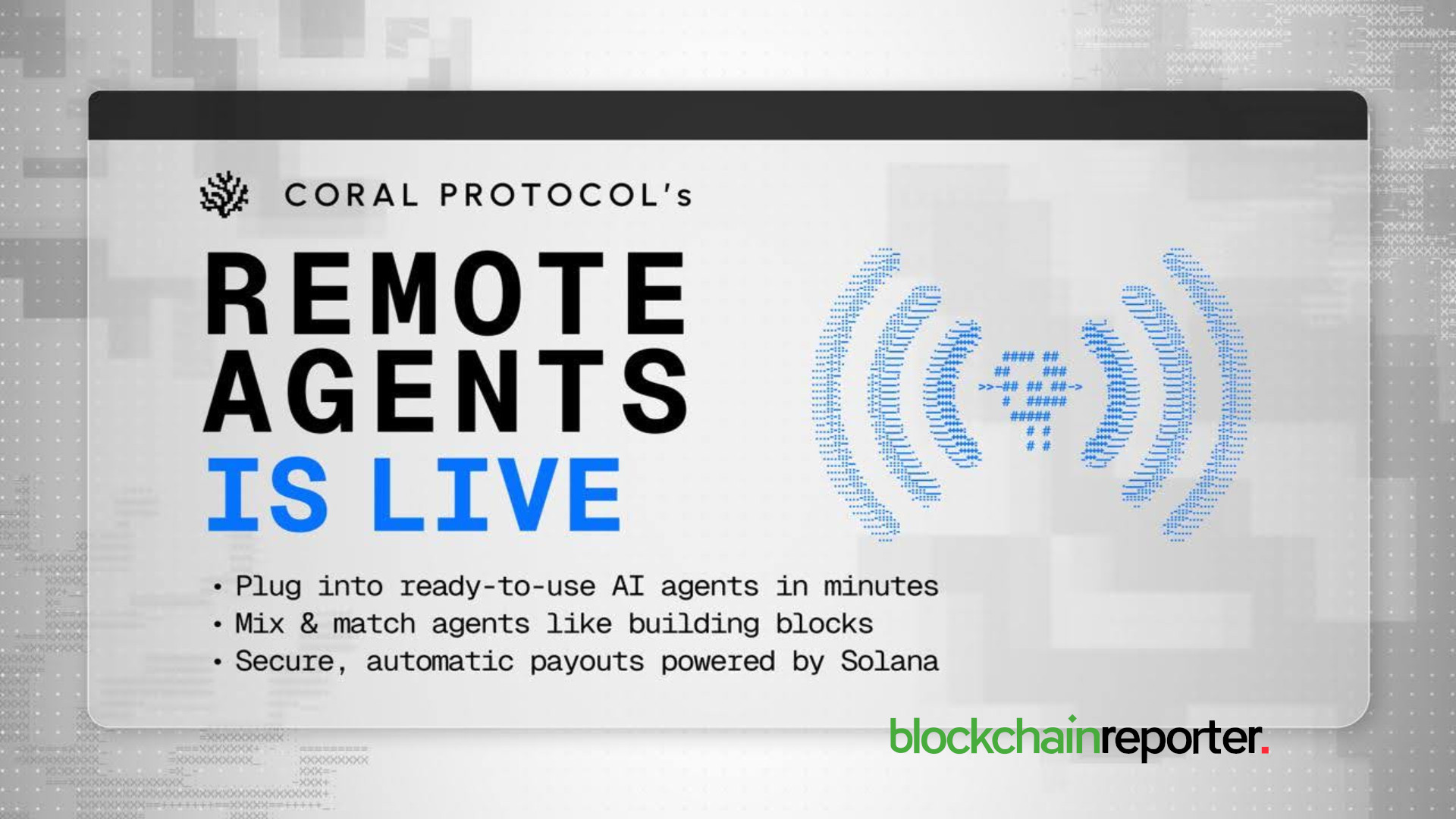
Coral Protocol today unveiled Coral v1 with Remote Agents, a production-ready system that lets developers deploy multi-agent software in minutes. The release promises to simplify how teams build, combine and monetize autonomous agents, and to do so with on-chain payments and cross-chain interoperability baked in.

Coral v1 allows developers to rent ready-to-use agents from Coral’s growing library and run them alongside their own local agents within a single session. Every decision an agent makes is tracked and optimized inside Coral Studio using threads and telemetry, giving teams visibility into agent behavior and performance while speeding iteration.

For agent creators, there’s a clear payday: developers can list agents in the Coral Registry and receive automatic payouts whenever their agents are used. Coral says the marketplace model makes it straightforward to reward creators fairly for the value their agents add.

Roman Georgio, Co-Founder & CEO of Coral Protocol, said: “The launch of Coral v1 with Remote Agents embodies everything Coral has been working towards up until now: an AI ecosystem that can accomplish virtually anything through combining distinct agents, each with their own sphere of expertise. We’re excited to see how developers harness Remote Agents to develop solutions that raise the bar in terms of what can be achieved onchain.”

Solana-Powered Transactions

Technically, v1 supports agent creation, acquisition and customization, and uses Coral’s secure on-chain payment system, powered by Solana, to settle transactions. Coral positions the feature set as especially valuable for Web3 builders who want to mix agents that specialize in different domains (for example: data retrieval, analytics, on-chain settlement) to form more capable, efficient systems.

Coral argues that Remote Agents solves several practical pain points in existing multi-agent frameworks. Rather than treating agents as simple function calls dictated by an algorithm, a model Coral says can be limiting, Remote Agents enables teams to design multi-agent workflows with an organizational structure: separate teams, defined processes and configurable rules that govern how agents interact. The company contrasts this approach with frameworks like LangChain, saying Remote Agents makes interaction rules easier to configure and reason about.

Interoperability is another focus. v1 is built to let agents operate across multiple blockchain ecosystems so they can collaborate toward shared goals without heavy engineering overhead. Coral says this reduces infrastructure demands and compression of development timelines, letting teams deploy multi-agent solutions rapidly and iterate faster.

The company frames Remote Agents as a stepping stone toward a larger vision: an open, decentralized collaboration infrastructure for “The Internet of Agents,” a world in which communication, coordination, trust and payments between autonomous systems are standard. Coral v1, Coral says, makes advanced multi-agent systems open-source, composable and ripe for wider adoption.

Coral Protocol describes itself as an open and decentralized collaboration infrastructure that enables communication, coordination, trust and payments for The Internet of Agents, laying the foundation for safe AGI. With Coral v1 with Remote Agents now live, Coral is positioning itself at the center of a nascent market for composable, monetizable agent ecosystems.

Market Opportunity
READY Logo
READY Price(READY)
$0.010847
$0.010847$0.010847
+17.97%
USD
READY (READY) Live Price Chart
Disclaimer: The articles reposted on this site are sourced from public platforms and are provided for informational purposes only. They do not necessarily reflect the views of MEXC. All rights remain with the original authors. If you believe any content infringes on third-party rights, please contact service@support.mexc.com for removal. MEXC makes no guarantees regarding the accuracy, completeness, or timeliness of the content and is not responsible for any actions taken based on the information provided. The content does not constitute financial, legal, or other professional advice, nor should it be considered a recommendation or endorsement by MEXC.

You May Also Like

Shocking OpenVPP Partnership Claim Draws Urgent Scrutiny

Shocking OpenVPP Partnership Claim Draws Urgent Scrutiny

The post Shocking OpenVPP Partnership Claim Draws Urgent Scrutiny appeared on BitcoinEthereumNews.com. The cryptocurrency world is buzzing with a recent controversy surrounding a bold OpenVPP partnership claim. This week, OpenVPP (OVPP) announced what it presented as a significant collaboration with the U.S. government in the innovative field of energy tokenization. However, this claim quickly drew the sharp eye of on-chain analyst ZachXBT, who highlighted a swift and official rebuttal that has sent ripples through the digital asset community. What Sparked the OpenVPP Partnership Claim Controversy? The core of the issue revolves around OpenVPP’s assertion of a U.S. government partnership. This kind of collaboration would typically be a monumental endorsement for any private cryptocurrency project, especially given the current regulatory climate. Such a partnership could signify a new era of mainstream adoption and legitimacy for energy tokenization initiatives. OpenVPP initially claimed cooperation with the U.S. government. This alleged partnership was said to be in the domain of energy tokenization. The announcement generated considerable interest and discussion online. ZachXBT, known for his diligent on-chain investigations, was quick to flag the development. He brought attention to the fact that U.S. Securities and Exchange Commission (SEC) Commissioner Hester Peirce had directly addressed the OpenVPP partnership claim. Her response, delivered within hours, was unequivocal and starkly contradicted OpenVPP’s narrative. How Did Regulatory Authorities Respond to the OpenVPP Partnership Claim? Commissioner Hester Peirce’s statement was a crucial turning point in this unfolding story. She clearly stated that the SEC, as an agency, does not engage in partnerships with private cryptocurrency projects. This response effectively dismantled the credibility of OpenVPP’s initial announcement regarding their supposed government collaboration. Peirce’s swift clarification underscores a fundamental principle of regulatory bodies: maintaining impartiality and avoiding endorsements of private entities. Her statement serves as a vital reminder to the crypto community about the official stance of government agencies concerning private ventures. Moreover, ZachXBT’s analysis…
Share
BitcoinEthereumNews2025/09/18 02:13
[OPINION] Honduras’ election turmoil offers a warning — and a mirror — for the Philippines

[OPINION] Honduras’ election turmoil offers a warning — and a mirror — for the Philippines

IN PROTEST. Supporters of the Liberty and Refoundation party protest in front of the presidential palace in support of Honduran President Xiomara Castro in what
Share
Rappler2025/12/19 20:00
UST honors ‘heaven-sent’ Pastrana, Soriano as Tigresses reignite UAAP contender fire

UST honors ‘heaven-sent’ Pastrana, Soriano as Tigresses reignite UAAP contender fire

After crossing paths in UST for the first time in UAAP Season 86, Kent Pastrana and Eka Soriano leave the Growling Tigresses' lair as two-time champions, reigniting
Share
Rappler2025/12/19 20:21