This article demonstrates a proof-of-concept for training neural networks with JAX to solve PDEs, focusing on shock wave problems. The authors propose NDNN (Novel Deep Neural Networks) as a more accurate alternative to PINNs, running experiments with tanh networks and validating convergence through 1- and 2-shock wave tests. Results show NDNN produces stable, reliable approximations where PINNs fail, highlighting JAX’s ease of implementation and robustness in practical low-dimensional setups.This article demonstrates a proof-of-concept for training neural networks with JAX to solve PDEs, focusing on shock wave problems. The authors propose NDNN (Novel Deep Neural Networks) as a more accurate alternative to PINNs, running experiments with tanh networks and validating convergence through 1- and 2-shock wave tests. Results show NDNN produces stable, reliable approximations where PINNs fail, highlighting JAX’s ease of implementation and robustness in practical low-dimensional setups.

How Scientists Taught AI to Handle Shock Waves

Abstract and 1. Introduction

1.1. Introductory remarks

1.2. Basics of neural networks

1.3. About the entropy of direct PINN methods

1.4. Organization of the paper

  1. Non-diffusive neural network solver for one dimensional scalar HCLs

    2.1. One shock wave

    2.2. Arbitrary number of shock waves

    2.3. Shock wave generation

    2.4. Shock wave interaction

    2.5. Non-diffusive neural network solver for one dimensional systems of CLs

    2.6. Efficient initial wave decomposition

  2. Gradient descent algorithm and efficient implementation

    3.1. Classical gradient descent algorithm for HCLs

    3.2. Gradient descent and domain decomposition methods

  3. Numerics

    4.1. Practical implementations

    4.2. Basic tests and convergence for 1 and 2 shock wave problems

    4.3. Shock wave generation

    4.4. Shock-Shock interaction

    4.5. Entropy solution

    4.6. Domain decomposition

    4.7. Nonlinear systems

  4. Conclusion and References

4.1. Practical implementations

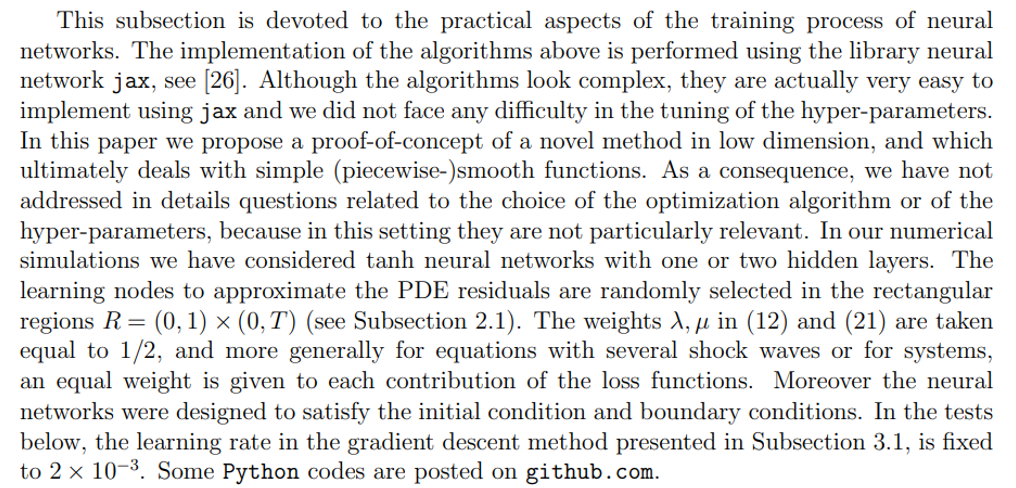
This subsection is devoted to the practical aspects of the training process of neural networks. The implementation of the algorithms above is performed using the library neural network jax, see [26]. Although the algorithms look complex, they are actually very easy to implement using jax and we did not face any difficulty in the tuning of the hyper-parameters. In this paper we propose a proof-of-concept of a novel method in low dimension, and which ultimately deals with simple (piecewise-)smooth functions. As a consequence, we have not addressed in details questions related to the choice of the optimization algorithm or of the hyper-parameters, because in this setting they are not particularly relevant. In our numerical simulations we have considered tanh neural networks with one or two hidden layers. The learning nodes to approximate the PDE residuals are randomly selected in the rectangular regions R = (0, 1) × (0, T) (see Subsection 2.1). The weights λ, µ in (12) and (21) are taken equal to 1/2, and more generally for equations with several shock waves or for systems, an equal weight is given to each contribution of the loss functions. Moreover the neural

\
\ In all the numerical experiments below we consider the problem (1a)-(1b), and in the following experiments we only specify Ω × [0, T], f(u) and u0. We refer to the results with our algorithms as NDNN solution.

4.2. Basic tests and convergence for 1 and 2 shock wave problems

In this subsection, we do not consider any domain decomposition, so that only one global loss function is minimized as described in Subsections 2.1, 2.2.

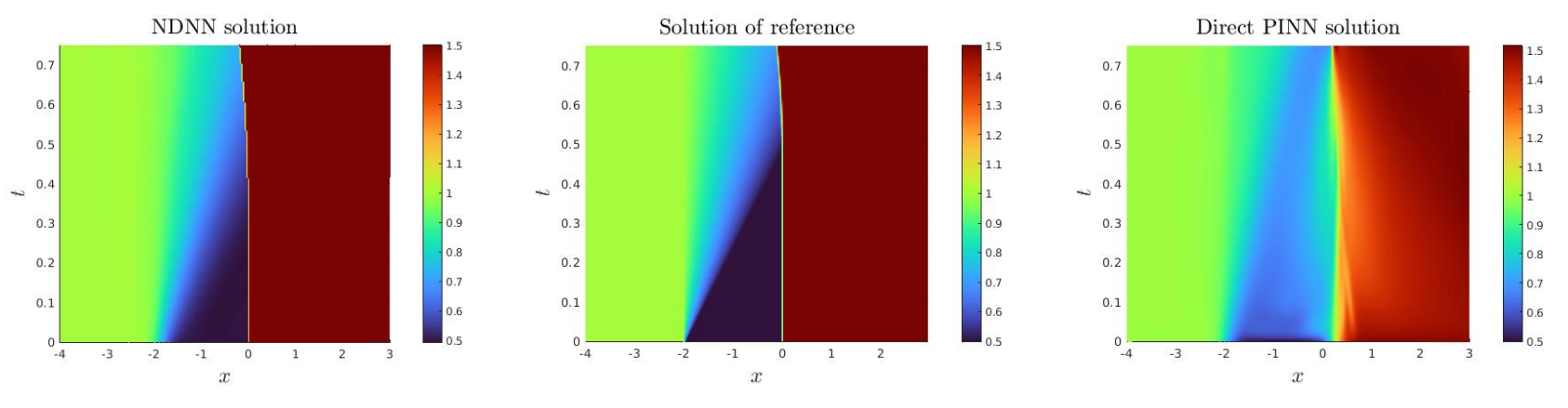
\ Experiment 1. In this experiment we consider Ω × [0, T] = (−4, 1) × [0, 3/4] with f(u) = 4u(2 − u). The initial data is given by

\ \
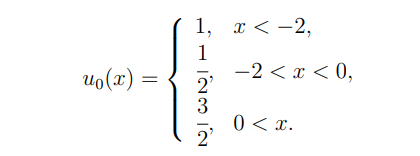
\ \ In the time interval [0, 1/2], it is constituted by a rarefaction and a shock wave with constant velocity. Then, in the time interval [1/2, 3/4] the initial shock wave interacts with the rarefaction wave to produce a new shock with non-constant velocity. More specifically the solution is given by

\ \
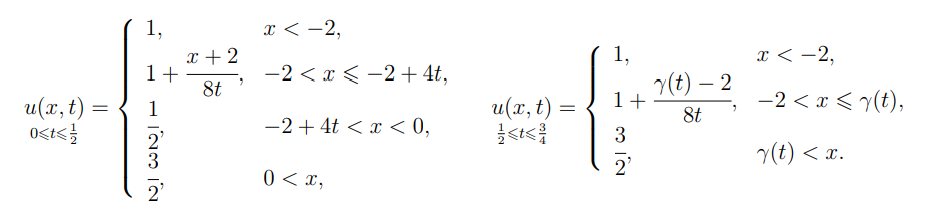
\ \ Here γ is the DL and it solves

\ \

\ \ for t ∈ [1/2, 1] and γ(1/2) = 0.

\ \
\ \ \ Figure 1: Experiment 1. (Left) Neural network solution. (Middle) Solution of reference. (Right) Direct PINN solution.
\ \ \ Figure 2: Experiment 1. Loss function.

\ \ Let us mention that using the same numerical data, a direct PINN algorithm provides a very inaccurate approximation of the stationary then non-stationary shock waves, while our algorithm provides accurate approximations. This last point is discussed in the 2 following tests.

\ \
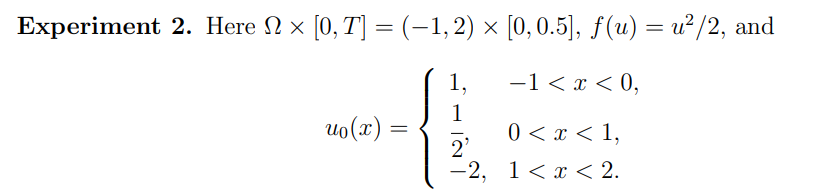
\ \ \
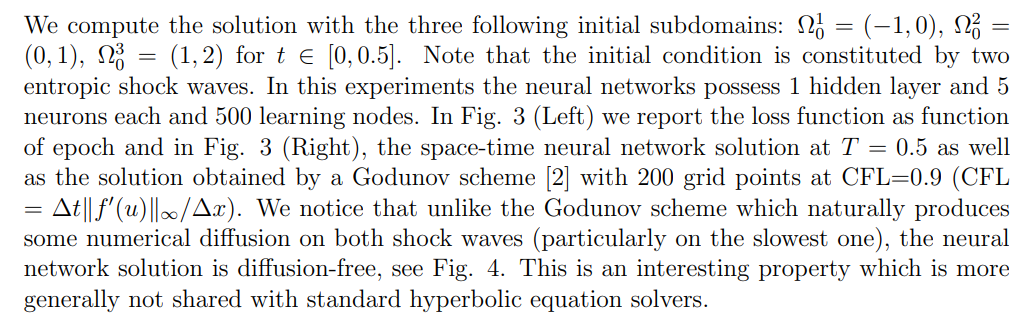
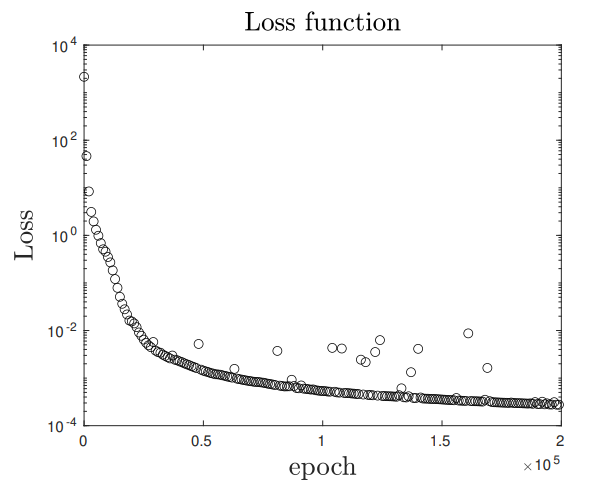
\ \ \ Figure 3: Experiment 2.(Left) Loss function. (Right) Space-time solution.
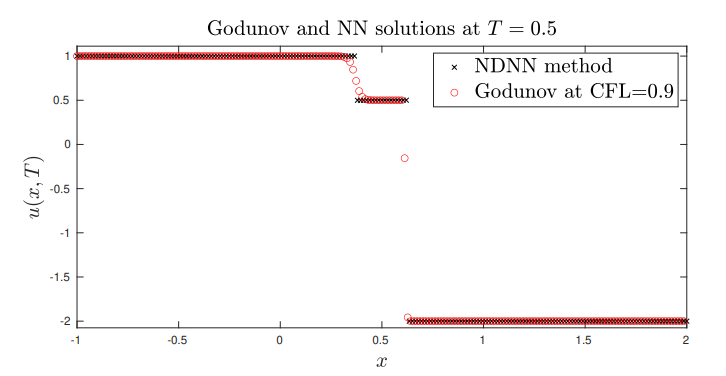
\ \ \ Figure 4: Experiment 2. (Left) Godunov scheme solution at CFL=0.9 and neural network solution at time T = 0.5.

\ \ \

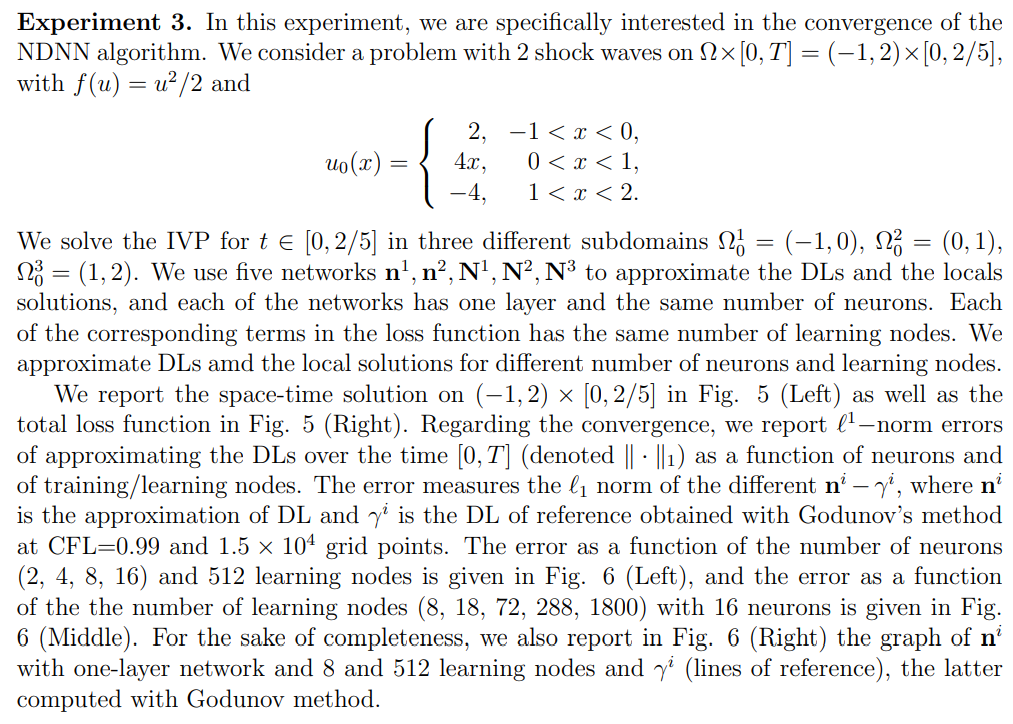
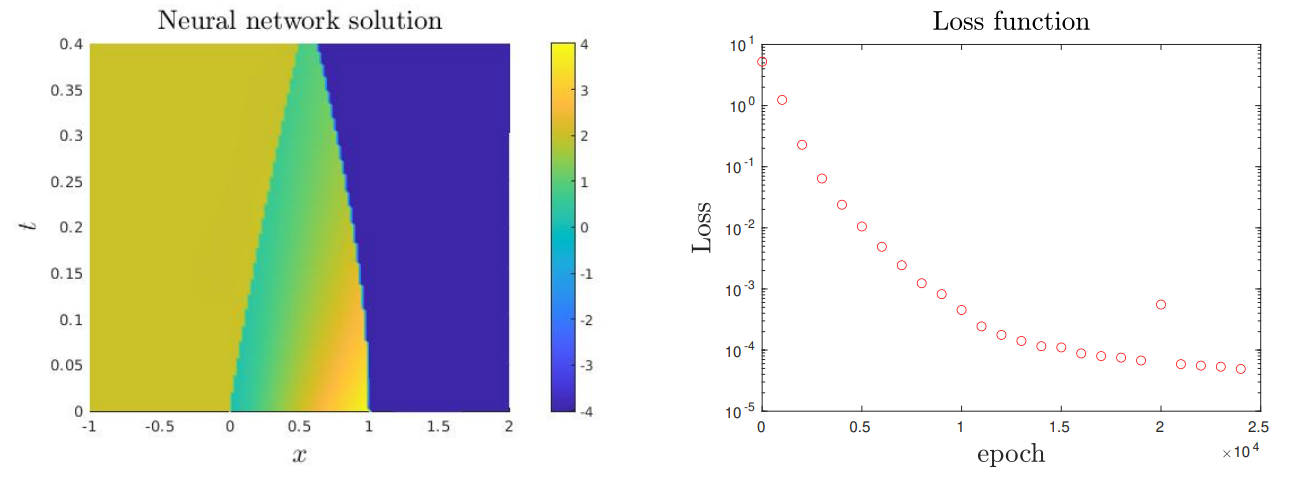
\ \ \ Figure 5: Experiment 3. (Left)

\ \ These experiments allow to validate the convergence of the proposed approach.

\

:::info Authors:

(1) Emmanuel LORIN, School of Mathematics and Statistics, Carleton University, Ottawa, Canada, K1S 5B6 and Centre de Recherches Mathematiques, Universit´e de Montr´eal, Montreal, Canada, H3T 1J4 (elorin@math.carleton.ca);

(2) Arian NOVRUZI, a Corresponding Author from Department of Mathematics and Statistics, University of Ottawa, Ottawa, ON K1N 6N5, Canada (novruzi@uottawa.ca).

:::


:::info This paper is available on arxiv under CC by 4.0 Deed (Attribution 4.0 International) license.

:::

\

Market Opportunity
Waves Logo
Waves Price(WAVES)
$0,6592
$0,6592$0,6592
+0,15%
USD
Waves (WAVES) Live Price Chart
Disclaimer: The articles reposted on this site are sourced from public platforms and are provided for informational purposes only. They do not necessarily reflect the views of MEXC. All rights remain with the original authors. If you believe any content infringes on third-party rights, please contact service@support.mexc.com for removal. MEXC makes no guarantees regarding the accuracy, completeness, or timeliness of the content and is not responsible for any actions taken based on the information provided. The content does not constitute financial, legal, or other professional advice, nor should it be considered a recommendation or endorsement by MEXC.

You May Also Like

BFX Presale Raises $7.5M as Solana Holds $243 and Avalanche Eyes $1B Treasury — Best Cryptos to Buy in 2025

BFX Presale Raises $7.5M as Solana Holds $243 and Avalanche Eyes $1B Treasury — Best Cryptos to Buy in 2025

BFX presale hits $7.5M with tokens at $0.024 and 30% bonus code BLOCK30, while Solana holds $243 and Avalanche builds a $1B treasury to attract institutions.
Share
Blockchainreporter2025/09/18 01:07
Trading time: Tonight, the US GDP and the upcoming non-farm data will become the market focus. Institutions are bullish on BTC to $120,000 in the second quarter.

Trading time: Tonight, the US GDP and the upcoming non-farm data will become the market focus. Institutions are bullish on BTC to $120,000 in the second quarter.

Daily market key data review and trend analysis, produced by PANews.
Share
PANews2025/04/30 13:50
Franklin Templeton CEO Dismisses 50bps Rate Cut Ahead FOMC

Franklin Templeton CEO Dismisses 50bps Rate Cut Ahead FOMC

The post Franklin Templeton CEO Dismisses 50bps Rate Cut Ahead FOMC appeared on BitcoinEthereumNews.com. Franklin Templeton CEO Jenny Johnson has weighed in on whether the Federal Reserve should make a 25 basis points (bps) Fed rate cut or 50 bps cut. This comes ahead of the Fed decision today at today’s FOMC meeting, with the market pricing in a 25 bps cut. Bitcoin and the broader crypto market are currently trading flat ahead of the rate cut decision. Franklin Templeton CEO Weighs In On Potential FOMC Decision In a CNBC interview, Jenny Johnson said that she expects the Fed to make a 25 bps cut today instead of a 50 bps cut. She acknowledged the jobs data, which suggested that the labor market is weakening. However, she noted that this data is backward-looking, indicating that it doesn’t show the current state of the economy. She alluded to the wage growth, which she remarked is an indication of a robust labor market. She added that retail sales are up and that consumers are still spending, despite inflation being sticky at 3%, which makes a case for why the FOMC should opt against a 50-basis-point Fed rate cut. In line with this, the Franklin Templeton CEO said that she would go with a 25 bps rate cut if she were Jerome Powell. She remarked that the Fed still has the October and December FOMC meetings to make further cuts if the incoming data warrants it. Johnson also asserted that the data show a robust economy. However, she noted that there can’t be an argument for no Fed rate cut since Powell already signaled at Jackson Hole that they were likely to lower interest rates at this meeting due to concerns over a weakening labor market. Notably, her comment comes as experts argue for both sides on why the Fed should make a 25 bps cut or…
Share
BitcoinEthereumNews2025/09/18 00:36