As the European Union approaches a decision on the contentious “Chat Control” legislation, privacy advocates voice concerns that the proposed measures could undermine public confidence in digital communication and drive users toward Web3 platforms. The debate centers on the EU’s draft Regulation to Prevent and Combat Child Sexual Abuse, which would require online platforms to [...]As the European Union approaches a decision on the contentious “Chat Control” legislation, privacy advocates voice concerns that the proposed measures could undermine public confidence in digital communication and drive users toward Web3 platforms. The debate centers on the EU’s draft Regulation to Prevent and Combat Child Sexual Abuse, which would require online platforms to [...]

EU’s Chat Control Sparks Privacy Concerns Amid Web3 Transformation

Eu’s Chat Control Sparks Privacy Concerns Amid Web3 Transformation

As the European Union approaches a decision on the contentious “Chat Control” legislation, privacy advocates voice concerns that the proposed measures could undermine public confidence in digital communication and drive users toward Web3 platforms.

The debate centers on the EU’s draft Regulation to Prevent and Combat Child Sexual Abuse, which would require online platforms to scan private messages for illegal content before they are encrypted. Critics argue this effectively introduces backdoors into encrypted systems, contradicting the EU’s commitment to robust privacy protections.

“Granting entities with the capacity to monitor private messages nearly unlimited access is incompatible with the fundamental value of digital privacy,” said Hans Rempel, CEO of Diode. He considers the legislation a dangerous overreach that threatens user rights and security.

Elisenda Fabrega, general counsel at Brickken, highlighted the legal inconsistencies, noting that current EU jurisprudence—particularly Articles 7 and 8 of the EU Charter of Fundamental Rights—safeguards the confidentiality of communications and personal data. She explained that client-side scanning could enable content monitoring on user devices, even absent any suspicion of illegal activity, raising serious privacy concerns.
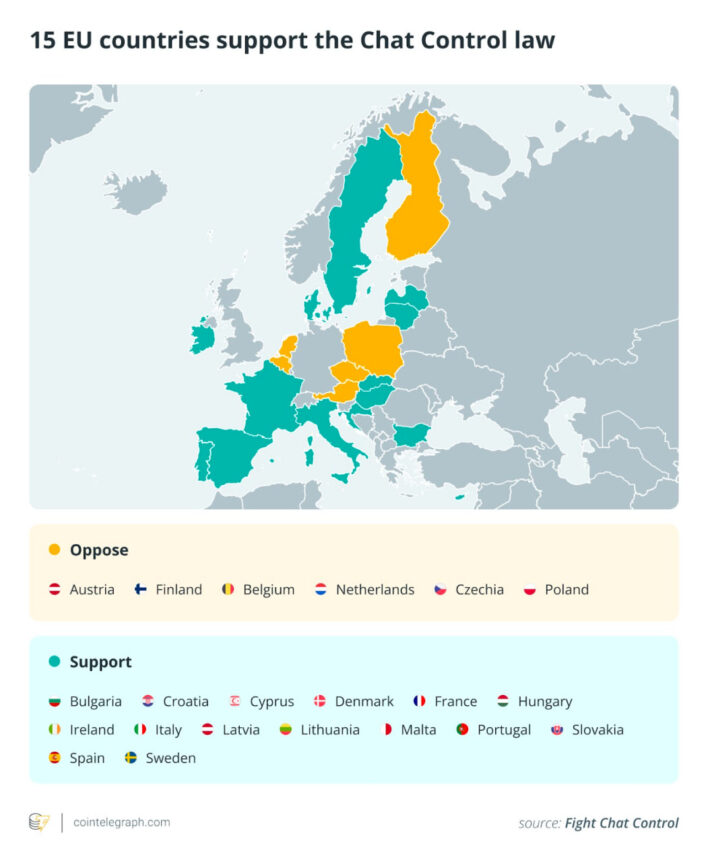
15 EU countries support the law. Source: Fight Chat Control

Related: US Treasury’s DeFi ID plan likened to placing cameras in every home

EU regulation sets a risky precedent

Experts warn that the legislation establishes a concerning precedent for both legal and technological reasons. “There are no guarantees,” Rempel cautioned, especially given that over 10% of all data breaches occur within government systems. The potential for misuse of such surveillance tools remains a major concern,” he added.

Fabrega emphasized that encryption is more than a technical feature; it embodies a promise of privacy to users. The erosion of trust in traditional messaging services could encourage many to seek refuge in decentralized Web3 alternatives, platforms designed with encryption at their core to preserve user sovereignty.

“Web3 champions privacy with the mantra ‘Not your keys, not your data,’” Rempel stated. “This approach ensures users maintain full control over their information from start to finish.”

Fabrega likewise expressed concern that if the Chat Control law passes, privacy-conscious users will increasingly migrate toward decentralized platforms, fragmenting the European digital market and complicating the EU’s efforts to influence global privacy standards.

Related: EU’s plan to scan private messages gains momentum

The final decision now hinges on Germany

Germany, holding the decisive vote, has yet to make a final stance on the legislation. While support among EU countries is strong, they do not yet meet the 65% population threshold necessary for approval. A favorable vote from Germany could pave the way for the law’s passage; opposition or abstention, however, could halt it.

“I believe the likelihood of approval is relatively low,” Rempel remarked. “But history shows that attempts to infringe on fundamental rights in the name of safety are likely to continue.”

With ongoing debates around crypto regulation, privacy, and digital rights, the outcome of the EU’s Chat Control proposal remains critical for shaping the future landscape of the crypto markets and decentralized technology adoption.

This article was originally published as EU’s Chat Control Sparks Privacy Concerns Amid Web3 Transformation on Crypto Breaking News – your trusted source for crypto news, Bitcoin news, and blockchain updates.

Market Opportunity
PUBLIC Logo
PUBLIC Price(PUBLIC)
$0.01835
$0.01835$0.01835
+1.88%
USD
PUBLIC (PUBLIC) Live Price Chart
Disclaimer: The articles reposted on this site are sourced from public platforms and are provided for informational purposes only. They do not necessarily reflect the views of MEXC. All rights remain with the original authors. If you believe any content infringes on third-party rights, please contact service@support.mexc.com for removal. MEXC makes no guarantees regarding the accuracy, completeness, or timeliness of the content and is not responsible for any actions taken based on the information provided. The content does not constitute financial, legal, or other professional advice, nor should it be considered a recommendation or endorsement by MEXC.

You May Also Like

Microsoft Corp. $MSFT blue box area offers a buying opportunity

Microsoft Corp. $MSFT blue box area offers a buying opportunity

The post Microsoft Corp. $MSFT blue box area offers a buying opportunity appeared on BitcoinEthereumNews.com. In today’s article, we’ll examine the recent performance of Microsoft Corp. ($MSFT) through the lens of Elliott Wave Theory. We’ll review how the rally from the April 07, 2025 low unfolded as a 5-wave impulse followed by a 3-swing correction (ABC) and discuss our forecast for the next move. Let’s dive into the structure and expectations for this stock. Five wave impulse structure + ABC + WXY correction $MSFT 8H Elliott Wave chart 9.04.2025 In the 8-hour Elliott Wave count from Sep 04, 2025, we saw that $MSFT completed a 5-wave impulsive cycle at red III. As expected, this initial wave prompted a pullback. We anticipated this pullback to unfold in 3 swings and find buyers in the equal legs area between $497.02 and $471.06 This setup aligns with a typical Elliott Wave correction pattern (ABC), in which the market pauses briefly before resuming its primary trend. $MSFT 8H Elliott Wave chart 7.14.2025 The update, 10 days later, shows the stock finding support from the equal legs area as predicted allowing traders to get risk free. The stock is expected to bounce towards 525 – 532 before deciding if the bounce is a connector or the next leg higher. A break into new ATHs will confirm the latter and can see it trade higher towards 570 – 593 area. Until then, traders should get risk free and protect their capital in case of a WXY double correction. Conclusion In conclusion, our Elliott Wave analysis of Microsoft Corp. ($MSFT) suggested that it remains supported against April 07, 2025 lows and bounce from the blue box area. In the meantime, keep an eye out for any corrective pullbacks that may offer entry opportunities. By applying Elliott Wave Theory, traders can better anticipate the structure of upcoming moves and enhance risk management in volatile markets. Source: https://www.fxstreet.com/news/microsoft-corp-msft-blue-box-area-offers-a-buying-opportunity-202509171323
Share
BitcoinEthereumNews2025/09/18 03:50
WTI drifts higher above $59.50 on Kazakh supply disruptions

WTI drifts higher above $59.50 on Kazakh supply disruptions

The post WTI drifts higher above $59.50 on Kazakh supply disruptions appeared on BitcoinEthereumNews.com. West Texas Intermediate (WTI), the US crude oil benchmark
Share
BitcoinEthereumNews2026/01/21 11:24
Fed forecasts only one rate cut in 2026, a more conservative outlook than expected

Fed forecasts only one rate cut in 2026, a more conservative outlook than expected

The post Fed forecasts only one rate cut in 2026, a more conservative outlook than expected appeared on BitcoinEthereumNews.com. Federal Reserve Chairman Jerome Powell talks to reporters following the regular Federal Open Market Committee meetings at the Fed on July 30, 2025 in Washington, DC. Chip Somodevilla | Getty Images The Federal Reserve is projecting only one rate cut in 2026, fewer than expected, according to its median projection. The central bank’s so-called dot plot, which shows 19 individual members’ expectations anonymously, indicated a median estimate of 3.4% for the federal funds rate at the end of 2026. That compares to a median estimate of 3.6% for the end of this year following two expected cuts on top of Wednesday’s reduction. A single quarter-point reduction next year is significantly more conservative than current market pricing. Traders are currently pricing in at two to three more rate cuts next year, according to the CME Group’s FedWatch tool, updated shortly after the decision. The gauge uses prices on 30-day fed funds futures contracts to determine market-implied odds for rate moves. Here are the Fed’s latest targets from 19 FOMC members, both voters and nonvoters: Zoom In IconArrows pointing outwards The forecasts, however, showed a large difference of opinion with two voting members seeing as many as four cuts. Three officials penciled in three rate reductions next year. “Next year’s dot plot is a mosaic of different perspectives and is an accurate reflection of a confusing economic outlook, muddied by labor supply shifts, data measurement concerns, and government policy upheaval and uncertainty,” said Seema Shah, chief global strategist at Principal Asset Management. The central bank has two policy meetings left for the year, one in October and one in December. Economic projections from the Fed saw slightly faster economic growth in 2026 than was projected in June, while the outlook for inflation was updated modestly higher for next year. There’s a lot of uncertainty…
Share
BitcoinEthereumNews2025/09/18 02:59