The push for greater stability and international utility in cryptocurrency markets has led to the launch of the first regulated stablecoins tied to national fiat currencies designed specifically for cross-border transactions. This week, AnchorX introduced its AxCNH stablecoin, pegged to the Chinese yuan (CNH), at the Belt and Road Summit in Hong Kong. The stablecoin [...]The push for greater stability and international utility in cryptocurrency markets has led to the launch of the first regulated stablecoins tied to national fiat currencies designed specifically for cross-border transactions. This week, AnchorX introduced its AxCNH stablecoin, pegged to the Chinese yuan (CNH), at the Belt and Road Summit in Hong Kong. The stablecoin [...]

China Launches New Stablecoin Amid Global Digital Currency Race

China Launches New Stablecoin Amid Global Digital Currency Race

The push for greater stability and international utility in cryptocurrency markets has led to the launch of the first regulated stablecoins tied to national fiat currencies designed specifically for cross-border transactions. This week, AnchorX introduced its AxCNH stablecoin, pegged to the Chinese yuan (CNH), at the Belt and Road Summit in Hong Kong. The stablecoin aims to enhance trade and investment flows within the Belt and Road Initiative, a major infrastructure project connecting China to the Middle East, Europe, and maritime trade routes.

Following a regulatory shift in China favoring the use of stablecoins for international markets, AxCNH enters a growing sector of geo-strategically significant digital assets. Additionally, BDACS, a digital infrastructure firm, announced the launch of KRW1, a Korean won-pegged stablecoin, further fueling the global stablecoin race. Both these tokens are overcollateralized, meaning each is fully backed 1:1 by fiat deposits or government debt, ensuring stability and trustworthiness in cross-border dealings.
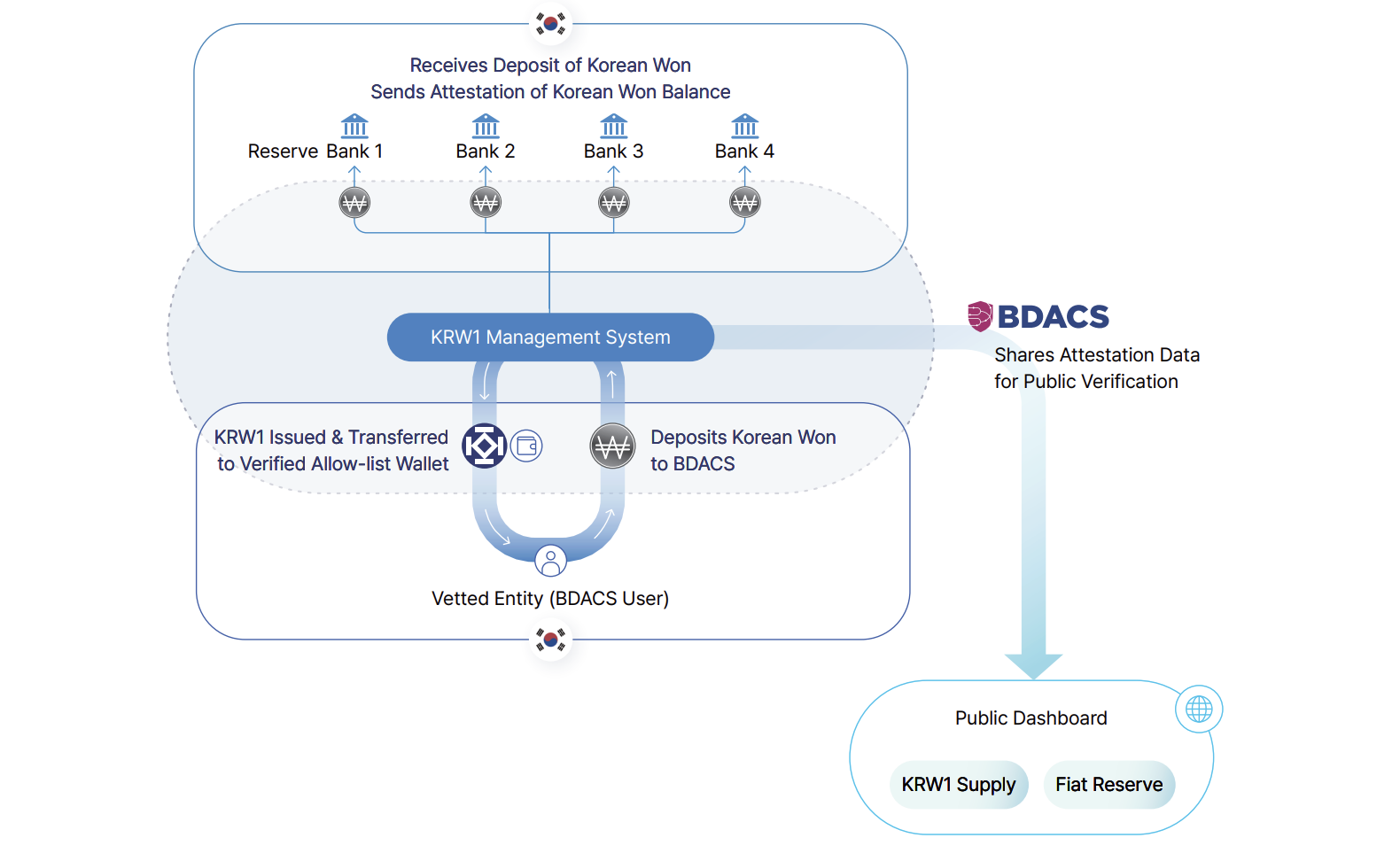
Diagram of KRW1 managementA visual outline of how the KRW1 stablecoin is managed. Source: BDACS

Currency stablecoins, especially those backed by fiat, are now gaining geopolitical significance. Governments worldwide are increasingly placing their national currencies on blockchain to position them within the expanding crypto ecosystem. By doing so, they aim to offset inflation and boost demand for their currencies internationally, as digital stablecoins facilitate near-instant, borderless settlements — a stark contrast to slower legacy financial systems.

US national debtThe US government’s national debt has exceeded $37 trillion amid global economic pressures. Source: US Debt Clock

Inflation driven by excess currency supply diminishes fiat value, prompting the need for stablecoins that are overcollateralized with government debt and cash assets. Companies like Tether and Circle are pivotal in this movement, helping to convert government bonds into digital tokens accessible via mobile devices. This process effectively turns individual users into indirect bondholders, potentially lowering yields on sovereign debt and easing the government’s debt burden.

Notably, Tether has become one of the largest holders of US Treasury bills globally, surpassing many developed nations. Experts have pointed out that stablecoins could serve as a hedge in times of economic uncertainty, with some analysts suggesting that the US is leveraging stablecoins and gold to counteract soaring national debt and dollar depreciation, reinforcing the strategic importance of digital assets in the broader financial landscape.

The role of stablecoins in the evolving financial system

As stablecoins gain prominence in the global financial ecosystem, their integration with traditional fiat currencies, influence on inflation, and impact on government debt are increasingly scrutinized. Their capacity to provide seamless, affordable cross-border transactions could reshape international trade and investment, fueling the transformation of blockchain’s role in finance.

This article was originally published as China Launches New Stablecoin Amid Global Digital Currency Race on Crypto Breaking News – your trusted source for crypto news, Bitcoin news, and blockchain updates.


Market Opportunity
CROSS Logo
CROSS Price(CROSS)
$0.12982
$0.12982$0.12982
+1.95%
USD
CROSS (CROSS) Live Price Chart
Disclaimer: The articles reposted on this site are sourced from public platforms and are provided for informational purposes only. They do not necessarily reflect the views of MEXC. All rights remain with the original authors. If you believe any content infringes on third-party rights, please contact service@support.mexc.com for removal. MEXC makes no guarantees regarding the accuracy, completeness, or timeliness of the content and is not responsible for any actions taken based on the information provided. The content does not constitute financial, legal, or other professional advice, nor should it be considered a recommendation or endorsement by MEXC.

You May Also Like

Qatar wealth fund commits $25bn to Goldman investments

Qatar wealth fund commits $25bn to Goldman investments

The Qatar Investment Authority (QIA) has signed a preliminary agreement with Goldman Sachs, committing $25 billion in investments to US managed funds and co-investment
Share
Agbi2026/01/21 13:38
Positive view remains intact above 185.00, with bullish RSI momentum

Positive view remains intact above 185.00, with bullish RSI momentum

The post Positive view remains intact above 185.00, with bullish RSI momentum appeared on BitcoinEthereumNews.com. The EUR/JPY cross loses ground near 185.25 during
Share
BitcoinEthereumNews2026/01/21 13:24
Cryptos Signal Divergence Ahead of Fed Rate Decision

Cryptos Signal Divergence Ahead of Fed Rate Decision

The post Cryptos Signal Divergence Ahead of Fed Rate Decision appeared on BitcoinEthereumNews.com. Crypto assets send conflicting signals ahead of the Federal Reserve’s September rate decision. On-chain data reveals a clear decrease in Bitcoin and Ethereum flowing into centralized exchanges, but a sharp increase in altcoin inflows. The findings come from a Tuesday report by CryptoQuant, an on-chain data platform. The firm’s data shows a stark divergence in coin volume, which has been observed in movements onto centralized exchanges over the past few weeks. Bitcoin and Ethereum Inflows Drop to Multi-Month Lows Sponsored Sponsored Bitcoin has seen a dramatic drop in exchange inflows, with the 7-day moving average plummeting to 25,000 BTC, its lowest level in over a year. The average deposit per transaction has fallen to 0.57 BTC as of September. This suggests that smaller retail investors, rather than large-scale whales, are responsible for the recent cash-outs. Ethereum is showing a similar trend, with its daily exchange inflows decreasing to a two-month low. CryptoQuant reported that the 7-day moving average for ETH deposits on exchanges is around 783,000 ETH, the lowest in two months. Other Altcoins See Renewed Selling Pressure In contrast, other altcoin deposit activity on exchanges has surged. The number of altcoin deposit transactions on centralized exchanges was quite steady in May and June of this year, maintaining a 7-day moving average of about 20,000 to 30,000. Recently, however, that figure has jumped to 55,000 transactions. Altcoins: Exchange Inflow Transaction Count. Source: CryptoQuant CryptoQuant projects that altcoins, given their increased inflow activity, could face relatively higher selling pressure compared to BTC and ETH. Meanwhile, the balance of stablecoins on exchanges—a key indicator of potential buying pressure—has increased significantly. The report notes that the exchange USDT balance, around $273 million in April, grew to $379 million by August 31, marking a new yearly high. CryptoQuant interprets this surge as a reflection of…
Share
BitcoinEthereumNews2025/09/18 01:01