This article explains contextuality within General Probabilistic Theories (GPTs), focusing on prepare-and-measure scenarios that describe how systems like qubits behave under different states and measurements. By outlining GPT systems as convex sets of states and effects, it highlights how contextuality emerges, why composites and tensor products matter, and how these frameworks extend beyond classical systems to capture quantum-like behaviors.This article explains contextuality within General Probabilistic Theories (GPTs), focusing on prepare-and-measure scenarios that describe how systems like qubits behave under different states and measurements. By outlining GPT systems as convex sets of states and effects, it highlights how contextuality emerges, why composites and tensor products matter, and how these frameworks extend beyond classical systems to capture quantum-like behaviors.

Understanding Contextuality in General Probabilistic Theories

Abstract and 1. Introduction

  1. Operational theories, ontological models and contextuality

  2. Contextuality for general probabilistic theories

    3.1 GPT systems

    3.2 Operational theory associated to a GPT system

    3.3 Simulations of GPT systems

    3.4 Properties of univalent simulations

  3. Hierarchy of contextuality and 4.1 Motivation and the resource theory

    4.2 Contextuality of composite systems

    4.3 Quantifying contextuality via the classical excess

    4.4 Parity oblivious multiplexing success probability with free classical resources as a measure of contextuality

  4. Discussion

    5.1 Contextuality and information erasure

    5.2 Relation with previous works on contextuality and GPTs

  5. Conclusion, Acknowledgments, and References

A Physicality of the Holevo projection

3 Contextuality for general probabilistic theories

One can often prove contextuality of a theory by studying statistical behaviours of an individual system A (such as a qubit) in prepare-and-measure scenarios. The information that suffices to describe the possible behaviours constitutes of

\ • a set Ω of possible states that A can be prepared in, according to the theory in question,

\ • a set of possible measurements that can be applied to A, each consisting of a collection of effects associated with the measurement outcomes, and

\ • for every state ω ∈ Ω and every effect e the probability of obtaining e when measurement M is applied to system A prepared in state ω.

\ This information is commonly expressed as a system in a general probabilistic theory— a GPT system.

\ In the following we omit any mention of dynamics that the system may undergo. This simplification has no consequence on our discussion of preparation and measurement contextuality.

3.1 GPT systems

Let us now discuss the mathematical description of GPT systems [54–57] and the definition of contextuality in this context.

\ Definition 1. A GPT system A is specified by two non-empty convex sets

\ \
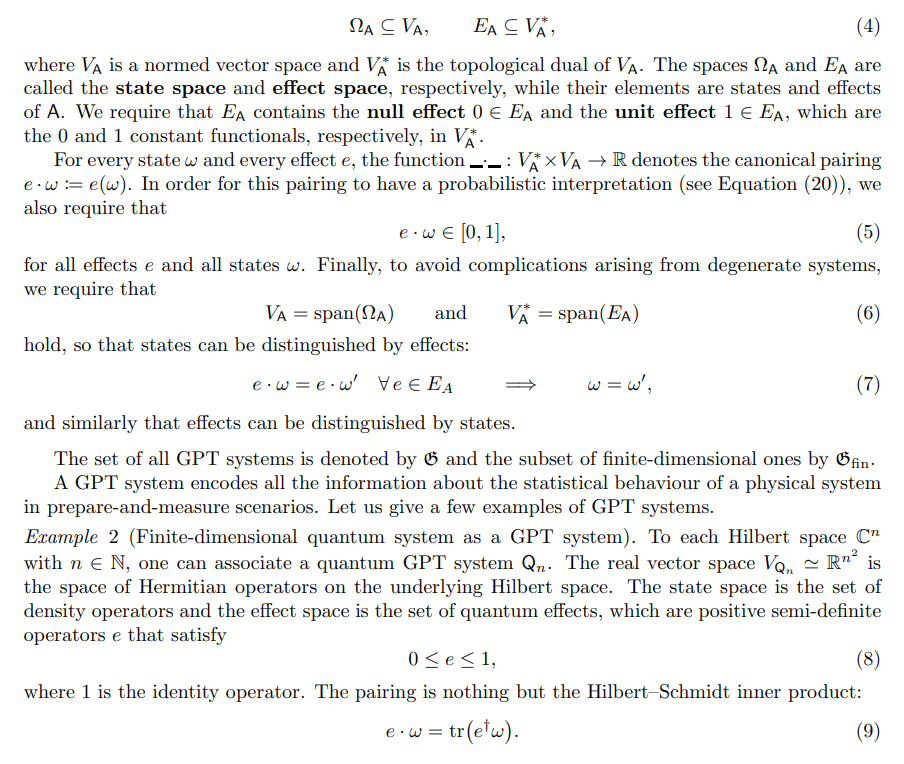
\ \ Likewise, every classical probabilistic system is a GPT system [54, §4].

\ \
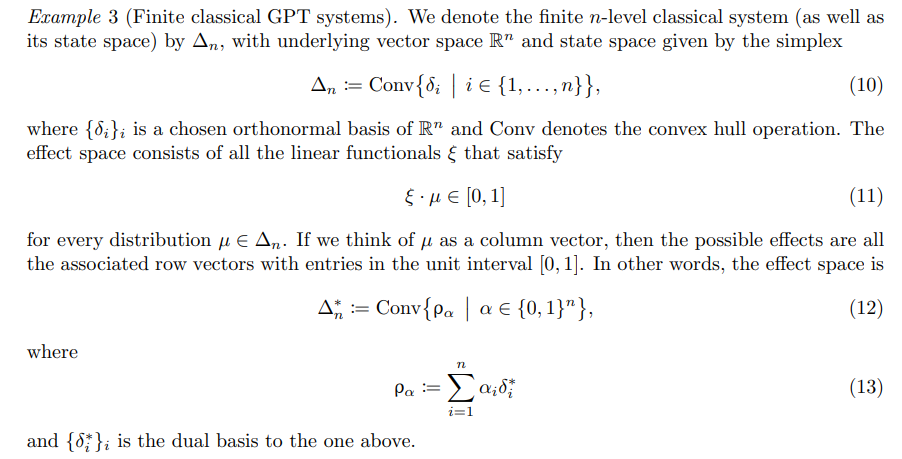
\ \ Besides finite classical systems, we will also need the notion of a countably infinite one.

\ \

\ \ Besides individual systems, we will occasionally also need to refer to composite ones. In general, the composite of two GPT systems is not unique – see [58, Section 5] for an in-depth discussion of tensor products of GPT systems. However, among all the possible choices, there is a ‘minimal composite’ of two GPT systems A and B, whose state and effect space merely contain the separable ones. Any meaningful composite of two GPT systems necessarily contains their minimal composite as a subsystem.

\ \
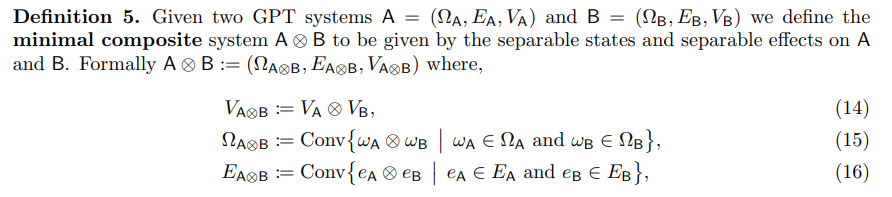
\ \ Of particular interest is the tensor product of an arbitrary GPT system and a classical GPT system, in which case there is a unique choice of a sensible tensor product corresponding to the minimal composite of GPT systems.

\

:::info Authors:

(1) Lorenzo Catani, International Iberian Nanotechnology Laboratory, Av. Mestre Jose Veiga s/n, 4715-330 Braga, Portugal (lorenzo.catani4@gmail.com);

(2) Thomas D. Galley, Institute for Quantum Optics and Quantum Information, Austrian Academy of Sciences, Boltzmanngasse 3, A-1090 Vienna, Austria and Vienna Center for Quantum Science and Technology (VCQ), Faculty of Physics, University of Vienna, Vienna, Austria (thomas.galley@oeaw.ac.at);

(3) Tomas Gonda, Institute for Theoretical Physics, University of Innsbruck, Austria (tomas.gonda@uibk.ac.at).

:::


:::info This paper is available on arxiv under CC BY 4.0 DEED license.

:::

\

Market Opportunity
Wink Logo
Wink Price(LIKE)
$0.003909
$0.003909$0.003909
+1.00%
USD
Wink (LIKE) Live Price Chart
Disclaimer: The articles reposted on this site are sourced from public platforms and are provided for informational purposes only. They do not necessarily reflect the views of MEXC. All rights remain with the original authors. If you believe any content infringes on third-party rights, please contact service@support.mexc.com for removal. MEXC makes no guarantees regarding the accuracy, completeness, or timeliness of the content and is not responsible for any actions taken based on the information provided. The content does not constitute financial, legal, or other professional advice, nor should it be considered a recommendation or endorsement by MEXC.

You May Also Like

Tether CEO Delivers Rare Bitcoin Price Comment

Tether CEO Delivers Rare Bitcoin Price Comment

Bitcoin price receives rare acknowledgement from Tether CEO Ardoino
Share
Coinstats2025/09/17 23:39
Zepto Life Technology Launches Plasma-Based FungiFlex® Mold Panel as CLIA Reference Laboratory Test

Zepto Life Technology Launches Plasma-Based FungiFlex® Mold Panel as CLIA Reference Laboratory Test

ST. PAUL, Minn., Jan. 21, 2026 /PRNewswire/ — Zepto Life Technology has announced the launch of the FungiFlex® Mold Panel, a plasma-based molecular diagnostic test
Share
AI Journal2026/01/21 23:47
Polygon Tops RWA Rankings With $1.1B in Tokenized Assets

Polygon Tops RWA Rankings With $1.1B in Tokenized Assets

The post Polygon Tops RWA Rankings With $1.1B in Tokenized Assets appeared on BitcoinEthereumNews.com. Key Notes A new report from Dune and RWA.xyz highlights Polygon’s role in the growing RWA sector. Polygon PoS currently holds $1.13 billion in RWA Total Value Locked (TVL) across 269 assets. The network holds a 62% market share of tokenized global bonds, driven by European money market funds. The Polygon POL $0.25 24h volatility: 1.4% Market cap: $2.64 B Vol. 24h: $106.17 M network is securing a significant position in the rapidly growing tokenization space, now holding over $1.13 billion in total value locked (TVL) from Real World Assets (RWAs). This development comes as the network continues to evolve, recently deploying its major “Rio” upgrade on the Amoy testnet to enhance future scaling capabilities. This information comes from a new joint report on the state of the RWA market published on Sept. 17 by blockchain analytics firm Dune and data platform RWA.xyz. The focus on RWAs is intensifying across the industry, coinciding with events like the ongoing Real-World Asset Summit in New York. Sandeep Nailwal, CEO of the Polygon Foundation, highlighted the findings via a post on X, noting that the TVL is spread across 269 assets and 2,900 holders on the Polygon PoS chain. The Dune and https://t.co/W6WSFlHoQF report on RWA is out and it shows that RWA is happening on Polygon. Here are a few highlights: – Leading in Global Bonds: Polygon holds 62% share of tokenized global bonds (driven by Spiko’s euro MMF and Cashlink euro issues) – Spiko U.S.… — Sandeep | CEO, Polygon Foundation (※,※) (@sandeepnailwal) September 17, 2025 Key Trends From the 2025 RWA Report The joint publication, titled “RWA REPORT 2025,” offers a comprehensive look into the tokenized asset landscape, which it states has grown 224% since the start of 2024. The report identifies several key trends driving this expansion. According to…
Share
BitcoinEthereumNews2025/09/18 00:40