Does Quantum Theory Hide a Secret Heat Signature?

Table of Links
Abstract and 1. Introduction
-
Operational theories, ontological models and contextuality
-
Contextuality for general probabilistic theories
3.1 GPT systems
3.2 Operational theory associated to a GPT system
3.3 Simulations of GPT systems
3.4 Properties of univalent simulations
-
Hierarchy of contextuality and 4.1 Motivation and the resource theory
4.2 Contextuality of composite systems
4.3 Quantifying contextuality via the classical excess
4.4 Parity oblivious multiplexing success probability with free classical resources as a measure of contextuality
-
Discussion
5.1 Contextuality and information erasure
5.2 Relation with previous works on contextuality and GPTs
-
Conclusion, Acknowledgments, and References
A Physicality of the Holevo projection
5 Discussion
5.1 Contextuality and information erasure
The fine-tuning problem of contextuality. Contextuality of a theory implies the existence of distinctions at the ontological level which are not present at the operational level. If a contextual ontological model truly describes the physical reality underlying the observed behaviours predicted by the theory, then there are operationally indistinguishable behaviours that have distinct ontological origins. In other words, such operational equivalences would result from a fine-tuning of the corresponding distinct ontological representations [4]. How do these distinctions disappear between the ontological and operational descriptions of the physical system, though? The presence of such fine-tunings provides a conspiratorial connotation to the realist explanation of the theory and we believe that it requires an explanation. In this section, we explore the possibility that the fine-tuning associated with contextuality can be explained as emergent from a yet undiscovered physical mechanism that supplements the description provided by the ontological model.
\ Explaining fine-tunings as emergent from yet undiscovered physical mechanisms. Explaining the origin of fine-tunings of this kind by searching for new physical mechanisms dates back to Valentini’s veriant of Bohmian mechanics [75]. There, he introduces a notion of quantum equilibrium as the reason why superluminal signaling does not manifest in quantum theory, despite the nonlocality of its underlying ontological model. This picture predicts that outside of the quantum equilibrium, it is possible to observe faster than light signaling. Therefore, the fine-tuned nature of no-signaling in Bohmian mechanics is explained just as an emergent feature of the quantum equilibrium and it is not universally valid. We cannot avoid noticing how radical such explanations of fine-tunings rooted in undiscovered physical mechanisms are. They imply that an established physical principle, such as the principle of no-signaling, is violated at the fundamental level. In the case of contextuality, the physical mechanism explaining the emergence of the operational equivalences would entail the existence of measurements that can distinguish behaviours that are deemed indistinguishable by quantum theory.
\ Explaining contextuality through information erasure. In Valentini’s work the quantum equilibration process is responsible for the emergence of no-signalling— the fine-tuned feature associated with nonlocality. What hypothetical physical mechanism could be responsible for the emergence of operational equivalences— the fine-tuned feature associated with contextuality?
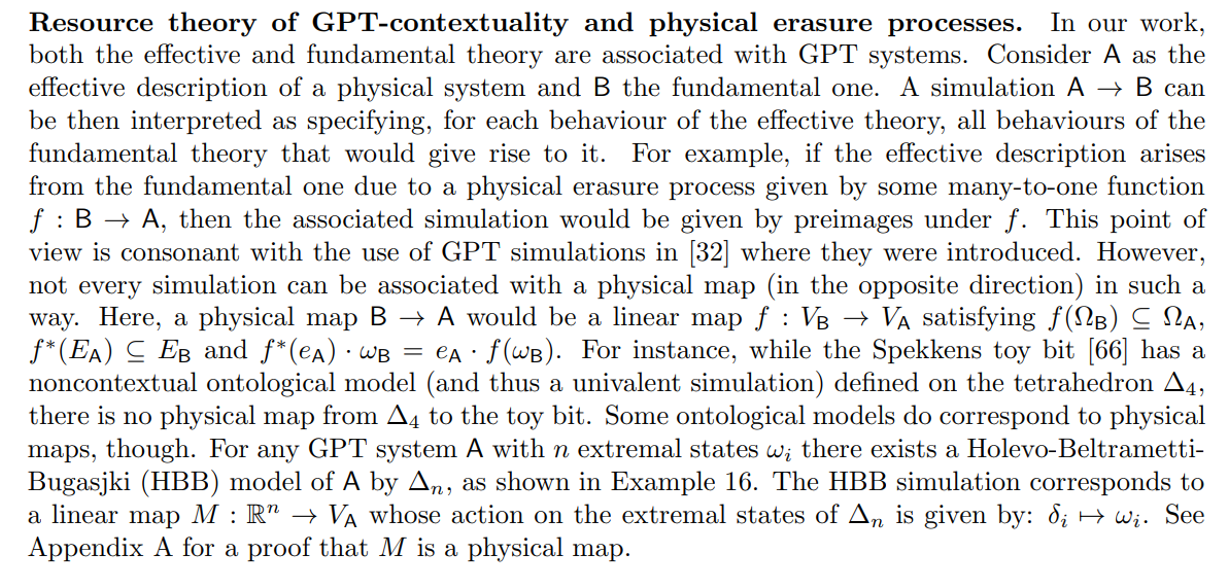
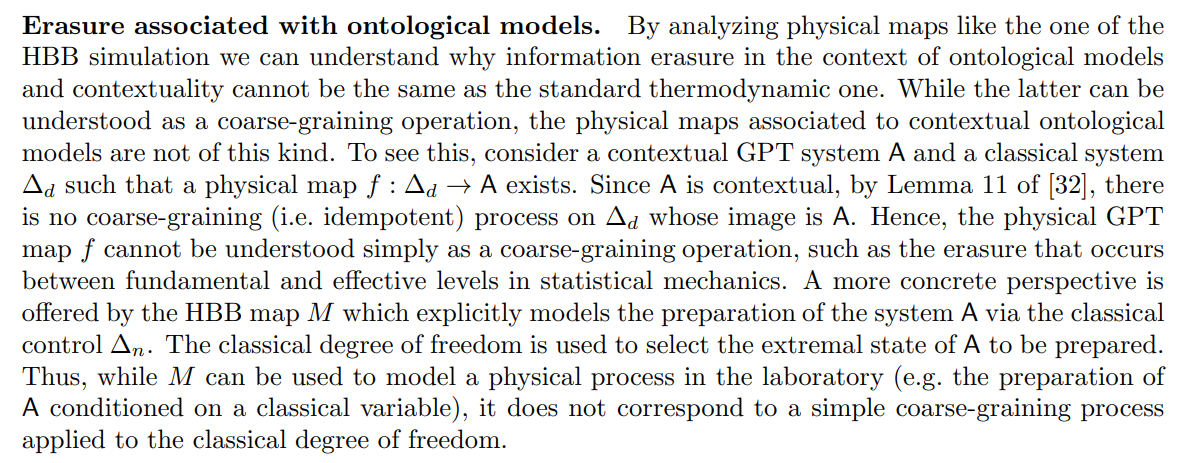
\ It would have to be a process that involves a kind of information erasure. The information erased is the information about distinctions at the ontological (e.g. fundamental) level, which cannot be stored in systems of the operational (e.g. effective) theory that lacks these distinctions. By Landauer’s principle, we can then associate an increase in entropy between the fundamental and effective levels. Such a process of information erasure would not only provide an explanation for the problematic fine-tuning associated with contextuality but would also be associated to a potentially detectable heat dissipation. This heat would signify that, indeed, there are distinctions at the fundamental level which are not present at the effective level. One could even hypothesise that the information erasure is a physical process occuring over time. That is, during the preparation of a quantum system there may be a timescale before which the system is described by the fundamental (and noncontextual) theory. At longer timescales, once the erasure has occured, the system can only be described by the effective (contextual) theory.
\ Ontological model as a fundamental theory. The above account treats an ontological model as specifying a yet unfalsified fundamental theory, in accordance with [32]. This departs from the standard use of ontological models to study contextuality [2]. In the latter, the ontological distinctions (which are not present in the operational theory) are in principle indistinguishable. On the other hand, the fundamental theory we posit here contains no such requirement. In particular, the in-principle-indistinguishability of its distinctions would also mean that there is no entropy increase and no heat resulting from erasure to be detected. Examples of effective theories arising from more fundamental ones include thermodynamics, which emerges from statistical mechanics via coarse-graining, and classical information theory, which emerges from quantum information theory via decoherence. The difference between the two interpretations of ontological models does not prevent us from using the approach of [32] to provide an explanation of generalized contextuality as defined in [2]. If the fine-tuning associated with generalized contextuality is explained through a process information erasure, then the problematic aspect of contextuality in quantum theory disappears. Instead, one is then led to search for an in principle accessible more fundamental theory, from which quantum theory emerges.
\ 
\ 
\
:::info Authors:
(1) Lorenzo Catani, International Iberian Nanotechnology Laboratory, Av. Mestre Jose Veiga s/n, 4715-330 Braga, Portugal (lorenzo.catani4@gmail.com);
(2) Thomas D. Galley, Institute for Quantum Optics and Quantum Information, Austrian Academy of Sciences, Boltzmanngasse 3, A-1090 Vienna, Austria and Vienna Center for Quantum Science and Technology (VCQ), Faculty of Physics, University of Vienna, Vienna, Austria (thomas.galley@oeaw.ac.at);
(3) Tomas Gonda, Institute for Theoretical Physics, University of Innsbruck, Austria (tomas.gonda@uibk.ac.at).
:::
:::info This paper is available on arxiv under CC BY 4.0 DEED license.
:::
\


You May Also Like

Bitcoin Down While Oil Climbs After Trump Signals Continued Iran Strikes

Vodacom Tanzania Modernises M-Pesa With $28m Infrastructure Upgrade