Pantera Capital founder Dan Morehead believes a geopolitical shift in reserve management will push adversaries of the United States into Bitcoin at massive scale, calling it “inevitable” that China and Russia eventually hold “trillions of dollars” worth of the asset. Speaking on Blockworks’ Empire podcast released this week, the billionaire framed the prediction as part of a longer-term rotation in global reserve assets and a response to sanction risk embedded in dollar-denominated holdings. “I think it’ll take a decade or two,” Morehead said, adding that the first movers will likely include US-aligned Gulf states before “the big one” arrives with countries “antagonistic to the United States, like China or Russia.” Why Russia And China Will Adopt Bitcoin Morehead anchored his argument in the historical cadence of reserve transitions and the vulnerability of holding claims on a rival’s financial system. “You gotta remember, the reserve currency’s changed every 80 or 100 years… no one’s ever really lasted for more than, let’s call it 100, 110 years,” he said. While calling it “inconceivable that the dollar will be supplanted” overnight, he warned that countries with large US Treasury positions face concentrated political risk. Citing China’s portfolio, he argued: “It’s really pretty crazy to have your entire country’s life savings in an asset that your potential adversary could literally just cancel.” In his view, that calculus makes it “inevitable” that such countries “will have started to save in Bitcoin and other cryptocurrencies” within the next decade. Related Reading: Bitcoin Dip-Buy Calls Spike: Why This Could Actually Be Bearish The provocation lands amid measurable changes in how major economies hold US debt. Official Treasury data for July 2025 show China’s reported Treasury holdings at $730.7 billion, the lowest since 2008 and down markedly over the past decade, a decline often read as gradual diversification of reserves rather than abrupt abandonment. JUST IN: BILLIONAIRE DAN MOREHEAD JUST SAID IT’S “INEVITABLE” CHINA AND RUSSIA WILL HOLD TRILLIONS OF DOLLARS IN #BITCOIN NATION STATE GAME THEORY. IT’S HERE 🚀 pic.twitter.com/tOQO9tHYNi — The Bitcoin Historian (@pete_rizzo_) September 23, 2025 Japan remains the largest holder at roughly $1.15 trillion, with the United Kingdom near $900 billion. The broader pool of foreign-held Treasuries nonetheless hit a record in July. These figures illustrate that while the dollar system remains deep and liquid, China’s share is slipping at the margin—the exact dynamic Morehead argues could accelerate alternative reserve strategies over time. Morehead’s timeline also intersects with a flurry of policy proposals that, if enacted, would normalize sovereign Bitcoin exposure. In March, US President Donald Trump signed an executive order establishing a Strategic Bitcoin Reserve and a national digital asset stockpile. Wyoming legislators separately advanced a bill to permit limited Bitcoin investments—capped at 3%—within certain state funds, an incremental step toward institutional reserve management in digital assets at the state level. Related Reading: Bitcoin Falls Below $113,000, But This Indicator Says It’s Time To Buy Outside the US, Gulf governments are already experimenting at the edges of sovereign crypto exposure—another plank in Morehead’s thesis. The United Arab Emirates’ has launched state-backed mining initiatives and disclosures suggesting several thousand BTC accumulated on the balance sheet via those operations. Skeptics will note that moving “trillions” of dollars into Bitcoin would require not only policy shifts but also market structure capable of absorbing sustained sovereign demand without disorderly volatility. Liquidity depth has improved with US spot ETF adoption and growing derivatives markets, yet Bitcoin’s free float, custody frameworks, and cross-border payment rails still face periodic stress. Morehead, however, situates the thesis in a long arc rather than a short-term trade. “I don’t think it’s gonna happen overnight,” he said, emphasizing a horizon of “a decade or two” and a phased path in which US-aligned adopters pave the way for politically non-aligned states that prize censorship resistance and sanction insulation. For China and Russia specifically, the impetus would be as much strategic as financial. China’s willingness to chip away at Treasuries aligns with its broader push to diversify reserves into gold and other assets, while Russia’s post-2014 and 2022 sanctions experience has already driven a dramatic reconfiguration of its reserve composition. At press time, Bitcoin traded at $112,639. Featured image created with DALL.E, chart from TradingView.comPantera Capital founder Dan Morehead believes a geopolitical shift in reserve management will push adversaries of the United States into Bitcoin at massive scale, calling it “inevitable” that China and Russia eventually hold “trillions of dollars” worth of the asset. Speaking on Blockworks’ Empire podcast released this week, the billionaire framed the prediction as part of a longer-term rotation in global reserve assets and a response to sanction risk embedded in dollar-denominated holdings. “I think it’ll take a decade or two,” Morehead said, adding that the first movers will likely include US-aligned Gulf states before “the big one” arrives with countries “antagonistic to the United States, like China or Russia.” Why Russia And China Will Adopt Bitcoin Morehead anchored his argument in the historical cadence of reserve transitions and the vulnerability of holding claims on a rival’s financial system. “You gotta remember, the reserve currency’s changed every 80 or 100 years… no one’s ever really lasted for more than, let’s call it 100, 110 years,” he said. While calling it “inconceivable that the dollar will be supplanted” overnight, he warned that countries with large US Treasury positions face concentrated political risk. Citing China’s portfolio, he argued: “It’s really pretty crazy to have your entire country’s life savings in an asset that your potential adversary could literally just cancel.” In his view, that calculus makes it “inevitable” that such countries “will have started to save in Bitcoin and other cryptocurrencies” within the next decade. Related Reading: Bitcoin Dip-Buy Calls Spike: Why This Could Actually Be Bearish The provocation lands amid measurable changes in how major economies hold US debt. Official Treasury data for July 2025 show China’s reported Treasury holdings at $730.7 billion, the lowest since 2008 and down markedly over the past decade, a decline often read as gradual diversification of reserves rather than abrupt abandonment. JUST IN: BILLIONAIRE DAN MOREHEAD JUST SAID IT’S “INEVITABLE” CHINA AND RUSSIA WILL HOLD TRILLIONS OF DOLLARS IN #BITCOIN NATION STATE GAME THEORY. IT’S HERE 🚀 pic.twitter.com/tOQO9tHYNi — The Bitcoin Historian (@pete_rizzo_) September 23, 2025 Japan remains the largest holder at roughly $1.15 trillion, with the United Kingdom near $900 billion. The broader pool of foreign-held Treasuries nonetheless hit a record in July. These figures illustrate that while the dollar system remains deep and liquid, China’s share is slipping at the margin—the exact dynamic Morehead argues could accelerate alternative reserve strategies over time. Morehead’s timeline also intersects with a flurry of policy proposals that, if enacted, would normalize sovereign Bitcoin exposure. In March, US President Donald Trump signed an executive order establishing a Strategic Bitcoin Reserve and a national digital asset stockpile. Wyoming legislators separately advanced a bill to permit limited Bitcoin investments—capped at 3%—within certain state funds, an incremental step toward institutional reserve management in digital assets at the state level. Related Reading: Bitcoin Falls Below $113,000, But This Indicator Says It’s Time To Buy Outside the US, Gulf governments are already experimenting at the edges of sovereign crypto exposure—another plank in Morehead’s thesis. The United Arab Emirates’ has launched state-backed mining initiatives and disclosures suggesting several thousand BTC accumulated on the balance sheet via those operations. Skeptics will note that moving “trillions” of dollars into Bitcoin would require not only policy shifts but also market structure capable of absorbing sustained sovereign demand without disorderly volatility. Liquidity depth has improved with US spot ETF adoption and growing derivatives markets, yet Bitcoin’s free float, custody frameworks, and cross-border payment rails still face periodic stress. Morehead, however, situates the thesis in a long arc rather than a short-term trade. “I don’t think it’s gonna happen overnight,” he said, emphasizing a horizon of “a decade or two” and a phased path in which US-aligned adopters pave the way for politically non-aligned states that prize censorship resistance and sanction insulation. For China and Russia specifically, the impetus would be as much strategic as financial. China’s willingness to chip away at Treasuries aligns with its broader push to diversify reserves into gold and other assets, while Russia’s post-2014 and 2022 sanctions experience has already driven a dramatic reconfiguration of its reserve composition. At press time, Bitcoin traded at $112,639. Featured image created with DALL.E, chart from TradingView.com
Bitcoin Will Soak Up Trillions From China And Russia, Billionaire Predicts

2025/09/24 16:00

Pantera Capital founder Dan Morehead believes a geopolitical shift in reserve management will push adversaries of the United States into Bitcoin at massive scale, calling it “inevitable” that China and Russia eventually hold “trillions of dollars” worth of the asset.

Speaking on Blockworks’ Empire podcast released this week, the billionaire framed the prediction as part of a longer-term rotation in global reserve assets and a response to sanction risk embedded in dollar-denominated holdings. “I think it’ll take a decade or two,” Morehead said, adding that the first movers will likely include US-aligned Gulf states before “the big one” arrives with countries “antagonistic to the United States, like China or Russia.”

Why Russia And China Will Adopt Bitcoin

Morehead anchored his argument in the historical cadence of reserve transitions and the vulnerability of holding claims on a rival’s financial system. “You gotta remember, the reserve currency’s changed every 80 or 100 years… no one’s ever really lasted for more than, let’s call it 100, 110 years,” he said.

While calling it “inconceivable that the dollar will be supplanted” overnight, he warned that countries with large US Treasury positions face concentrated political risk. Citing China’s portfolio, he argued: “It’s really pretty crazy to have your entire country’s life savings in an asset that your potential adversary could literally just cancel.” In his view, that calculus makes it “inevitable” that such countries “will have started to save in Bitcoin and other cryptocurrencies” within the next decade.

The provocation lands amid measurable changes in how major economies hold US debt. Official Treasury data for July 2025 show China’s reported Treasury holdings at $730.7 billion, the lowest since 2008 and down markedly over the past decade, a decline often read as gradual diversification of reserves rather than abrupt abandonment.

Japan remains the largest holder at roughly $1.15 trillion, with the United Kingdom near $900 billion. The broader pool of foreign-held Treasuries nonetheless hit a record in July. These figures illustrate that while the dollar system remains deep and liquid, China’s share is slipping at the margin—the exact dynamic Morehead argues could accelerate alternative reserve strategies over time.

Morehead’s timeline also intersects with a flurry of policy proposals that, if enacted, would normalize sovereign Bitcoin exposure. In March, US President Donald Trump signed an executive order establishing a Strategic Bitcoin Reserve and a national digital asset stockpile. Wyoming legislators separately advanced a bill to permit limited Bitcoin investments—capped at 3%—within certain state funds, an incremental step toward institutional reserve management in digital assets at the state level.

Outside the US, Gulf governments are already experimenting at the edges of sovereign crypto exposure—another plank in Morehead’s thesis. The United Arab Emirates’ has launched state-backed mining initiatives and disclosures suggesting several thousand BTC accumulated on the balance sheet via those operations.

Skeptics will note that moving “trillions” of dollars into Bitcoin would require not only policy shifts but also market structure capable of absorbing sustained sovereign demand without disorderly volatility. Liquidity depth has improved with US spot ETF adoption and growing derivatives markets, yet Bitcoin’s free float, custody frameworks, and cross-border payment rails still face periodic stress.

Morehead, however, situates the thesis in a long arc rather than a short-term trade. “I don’t think it’s gonna happen overnight,” he said, emphasizing a horizon of “a decade or two” and a phased path in which US-aligned adopters pave the way for politically non-aligned states that prize censorship resistance and sanction insulation.

For China and Russia specifically, the impetus would be as much strategic as financial. China’s willingness to chip away at Treasuries aligns with its broader push to diversify reserves into gold and other assets, while Russia’s post-2014 and 2022 sanctions experience has already driven a dramatic reconfiguration of its reserve composition.

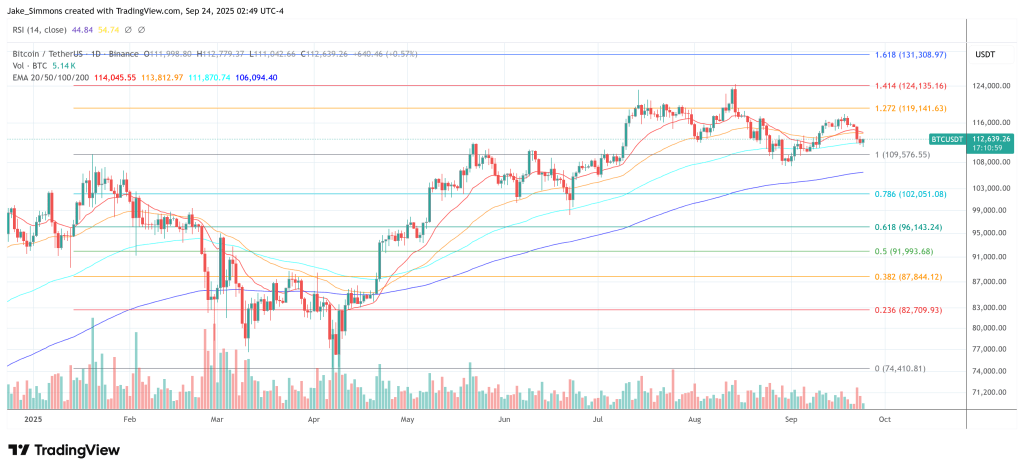
At press time, Bitcoin traded at $112,639.

Bitcoin price
Market Opportunity
NEAR Logo
NEAR Price(NEAR)
$1.173
$1.173$1.173
+0.25%
USD
NEAR (NEAR) Live Price Chart
Disclaimer: The articles reposted on this site are sourced from public platforms and are provided for informational purposes only. They do not necessarily reflect the views of MEXC. All rights remain with the original authors. If you believe any content infringes on third-party rights, please contact service@support.mexc.com for removal. MEXC makes no guarantees regarding the accuracy, completeness, or timeliness of the content and is not responsible for any actions taken based on the information provided. The content does not constitute financial, legal, or other professional advice, nor should it be considered a recommendation or endorsement by MEXC.

You May Also Like

This Bitcoin Metric Has Never Been This Wrong: BTC Price Prediction

This Bitcoin Metric Has Never Been This Wrong: BTC Price Prediction

Bitcoin trades 35.5% below its power-law trend, marking the largest statistical pricing deviation in its history. Backtests since 2010 show every similar oversold
Share
LiveBitcoinNews2026/02/01 23:15
ProFX Summit Dubai 2026

ProFX Summit Dubai 2026

The post ProFX Summit Dubai 2026 appeared on BitcoinEthereumNews.com. ProFX Summit Dubai 2026 is a premium financial industry event bringing together the global
Share
BitcoinEthereumNews2026/02/01 22:58
Vitalik Buterin Reveals Ethereum’s Bold Plan to Stay Quantum-Secure and Simple!

Vitalik Buterin Reveals Ethereum’s Bold Plan to Stay Quantum-Secure and Simple!

Buterin unveils Ethereum’s strategy to tackle quantum security challenges ahead. Ethereum focuses on simplifying architecture while boosting security for users. Ethereum’s market stability grows as Buterin’s roadmap gains investor confidence. Ethereum founder Vitalik Buterin has unveiled his long-term vision for the blockchain, focusing on making Ethereum quantum-secure while maintaining its simplicity for users. Buterin presented his roadmap at the Japanese Developer Conference, and splits the future of Ethereum into three phases: short-term, mid-term, and long-term. Buterin’s most ambitious goal for Ethereum is to safeguard the blockchain against the threats posed by quantum computing.  The danger of such future developments is that the future may call into question the cryptographic security of most blockchain systems, and Ethereum will be able to remain ahead thanks to more sophisticated mathematical techniques to ensure the safety and integrity of its protocols. Buterin is committed to ensuring that Ethereum evolves in a way that not only meets today’s security challenges but also prepares for the unknowns of tomorrow. Also Read: Ethereum Giant The Ether Machine Takes Major Step Toward Going Public! However, in spite of such high ambitions, Buterin insisted that Ethereum also needed to simplify its architecture. An important aspect of this vision is to remove unnecessary complexity and make Ethereum more accessible and maintainable without losing its strong security capabilities. Security and simplicity form the core of Buterin’s strategy, as they guarantee that the users of Ethereum experience both security and smooth processes. Focus on Speed and Efficiency in the Short-Term In the short term, Buterin aims to enhance Ethereum’s transaction efficiency, a crucial step toward improving scalability and reducing transaction costs. These advantages are attributed to the fact that, within the mid-term, Ethereum is planning to enhance the speed of transactions in layer-2 networks. According to Butterin, this is part of Ethereum’s expansion, particularly because there is still more need to use blockchain technology to date. The other important aspect of Ethereum’s development is the layer-2 solutions. Buterin supports an approach in which the layer-2 networks are dependent on layer-1 to perform some essential tasks like data security, proof, and censorship resistance. This will enable the layer-2 systems of Ethereum to be concerned with verifying and sequencing transactions, which will improve the overall speed and efficiency of the network. Ethereum’s Market Stability Reflects Confidence in Long-Term Strategy Ethereum’s market performance has remained solid, with the cryptocurrency holding steady above $4,000. Currently priced at $4,492.15, Ethereum has experienced a slight 0.93% increase over the last 24 hours, while its trading volume surged by 8.72%, reaching $34.14 billion. These figures point to growing investor confidence in Ethereum’s long-term vision. The crypto community remains optimistic about Ethereum’s future, with many predicting the price could rise to $5,500 by mid-October. Buterin’s clear, forward-thinking strategy continues to build trust in Ethereum as one of the most secure and scalable blockchain platforms in the market. Also Read: Whales Dump 200 Million XRP in Just 2 Weeks – Is XRP’s Price on the Verge of Collapse? The post Vitalik Buterin Reveals Ethereum’s Bold Plan to Stay Quantum-Secure and Simple! appeared first on 36Crypto.
Share
Coinstats2025/09/18 01:22