Franklin Templeton's $1.6 trillion asset manager integrates its Benji Technology Platform with BNB Chain, enabling tokenized fund shares alongside existing partnerships with Ethereum, Avalanche, Stellar, and Polygon. The post $1.6 Trillion Franklin Templeton Picks BNB Chain for RWA Platform Expansion appeared first on Coinspeaker.Franklin Templeton's $1.6 trillion asset manager integrates its Benji Technology Platform with BNB Chain, enabling tokenized fund shares alongside existing partnerships with Ethereum, Avalanche, Stellar, and Polygon. The post $1.6 Trillion Franklin Templeton Picks BNB Chain for RWA Platform Expansion appeared first on Coinspeaker.

$1.6 Trillion Franklin Templeton Picks BNB Chain for RWA Platform Expansion

US-based asset manager Franklin Templeton, with $1.6 trillion in assets under management, announced on Wednesday, Sept. 24, that it will expand its Benji Technology Platform to the BNB Chain, marking another significant institutional integration for the blockchain network.

The partnership positions BNB Chain as a key destination for tokenized financial products, as Franklin Templeton joins the growing list of traditional finance giants embracing blockchain technology for real-world asset tokenization.

The Benji Technology Platform is a blockchain protocol designed to bring traditional funds on-chain. It allows Franklin Templeton’s OnChain US Government Money Fund shares to be represented by BENJI tokens, while keeping transaction records across multiple blockchains. BNB Chain now joins Franklin Templeton’s existing partners, Ethereum ETH $4 179 24h volatility: 0.4% Market cap: $504.18 B Vol. 24h: $29.73 B , Avalanche AVAX $34.58 24h volatility: 0.8% Market cap: $14.60 B Vol. 24h: $1.37 B , Stellar XLM $0.38 24h volatility: 3.5% Market cap: $12.12 B Vol. 24h: $185.40 M , and Polygon to mint and trade the BENJI tokens globally.

The announcement comes as BNB BNB $1 015 24h volatility: 0.2% Market cap: $141.17 B Vol. 24h: $2.57 B price continues to trade above the $1,000 mark, consolidating after hitting a new all-time high above $1,080 on Sunday, Sept. 21.

BNB Set to Lock Horns With Solana in RWA Adoption Race

The integration allows Franklin Templeton to expand client access to tokenized investment products through BNB Chain. BNB Chain has emerged as a clear destination for dollar-pegged tokenized financial products, ranging from money market funds to credit instruments.

With fast settlement, low fees, and compliant data tooling, BNB Chain provides a strong foundation for tokenizing and trading real-world assets. However, it still trails early-movers like Solana SOL $214.3 24h volatility: 1.2% Market cap: $116.39 B Vol. 24h: $8.79 B in terms of adoption. At press time, Solana’s RWA assets have crossed $670 million, marking an all-time high, propelled by $150 million inflows from BlackRock’s BUIDL fund, according to Solana Floor.

BNB could be set for similar inflows as Franklin Templeton signals its long-term commitment with the Benji platform expansion, placing it firmly in the race for RWA dominance.

Maxi Doge Presale Gains Momentum as Traders Seek High-Risk Plays Beyond BNB

As megacap altcoins like BNB continue to attract large-scale institutional adoption, early-stage community-driven projects like Maxi Doge (MAXIDOGE) are also gaining traction.

Maxi Doge is positioning itself as a high-leverage speculative token, offering traders exposure to volatility and high-risk opportunities.
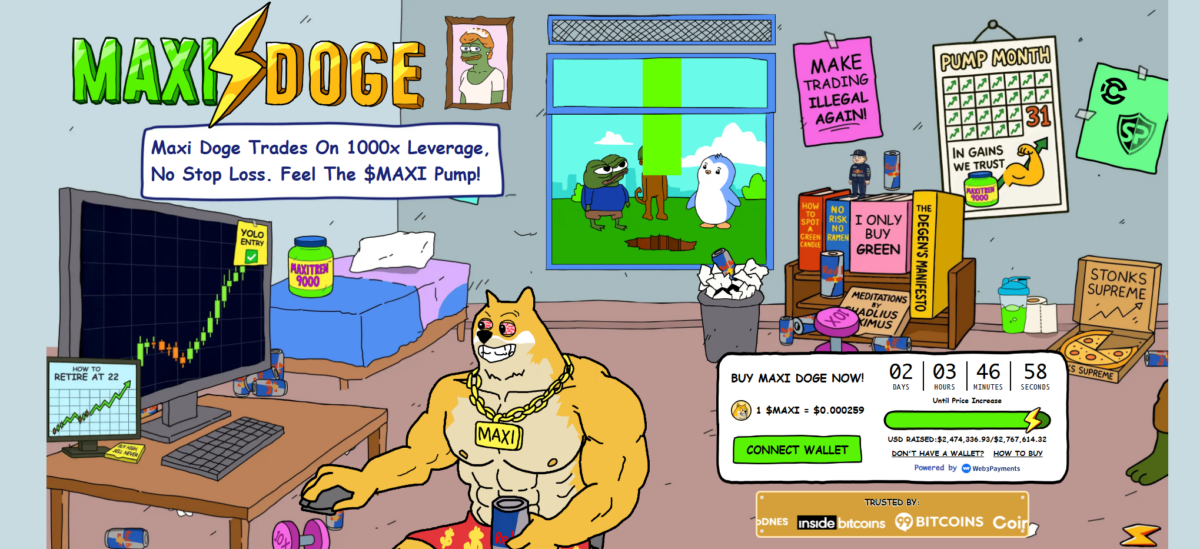
Currently priced at $0.000259, the Maxi Doge presale has already raised more than $2.5 million of its $2.8 million target. Prospective investors still have hours left to participate in the presale through the official Maxi Doge site before the next price adjustment.

next

The post $1.6 Trillion Franklin Templeton Picks BNB Chain for RWA Platform Expansion appeared first on Coinspeaker.


Market Opportunity
Binance Coin Logo
Binance Coin Price(BNB)
$885.25
$885.25$885.25
-0.83%
USD
Binance Coin (BNB) Live Price Chart
Disclaimer: The articles reposted on this site are sourced from public platforms and are provided for informational purposes only. They do not necessarily reflect the views of MEXC. All rights remain with the original authors. If you believe any content infringes on third-party rights, please contact service@support.mexc.com for removal. MEXC makes no guarantees regarding the accuracy, completeness, or timeliness of the content and is not responsible for any actions taken based on the information provided. The content does not constitute financial, legal, or other professional advice, nor should it be considered a recommendation or endorsement by MEXC.

You May Also Like

The Channel Factories We’ve Been Waiting For

The Channel Factories We’ve Been Waiting For

The post The Channel Factories We’ve Been Waiting For appeared on BitcoinEthereumNews.com. Visions of future technology are often prescient about the broad strokes while flubbing the details. The tablets in “2001: A Space Odyssey” do indeed look like iPads, but you never see the astronauts paying for subscriptions or wasting hours on Candy Crush.  Channel factories are one vision that arose early in the history of the Lightning Network to address some challenges that Lightning has faced from the beginning. Despite having grown to become Bitcoin’s most successful layer-2 scaling solution, with instant and low-fee payments, Lightning’s scale is limited by its reliance on payment channels. Although Lightning shifts most transactions off-chain, each payment channel still requires an on-chain transaction to open and (usually) another to close. As adoption grows, pressure on the blockchain grows with it. The need for a more scalable approach to managing channels is clear. Channel factories were supposed to meet this need, but where are they? In 2025, subnetworks are emerging that revive the impetus of channel factories with some new details that vastly increase their potential. They are natively interoperable with Lightning and achieve greater scale by allowing a group of participants to open a shared multisig UTXO and create multiple bilateral channels, which reduces the number of on-chain transactions and improves capital efficiency. Achieving greater scale by reducing complexity, Ark and Spark perform the same function as traditional channel factories with new designs and additional capabilities based on shared UTXOs.  Channel Factories 101 Channel factories have been around since the inception of Lightning. A factory is a multiparty contract where multiple users (not just two, as in a Dryja-Poon channel) cooperatively lock funds in a single multisig UTXO. They can open, close and update channels off-chain without updating the blockchain for each operation. Only when participants leave or the factory dissolves is an on-chain transaction…
Share
BitcoinEthereumNews2025/09/18 00:09
Ripple (XRP) CEO Brad Garlinghouse Makes Another Statement Regarding the Anticipated US Cryptocurrency Legislation

Ripple (XRP) CEO Brad Garlinghouse Makes Another Statement Regarding the Anticipated US Cryptocurrency Legislation

Ripple CEO Brad Garlinghouse, in his latest statement, once again expressed his support for the cryptocurrency legislation being debated in the US. Continue Reading
Share
Coinstats2026/01/22 05:30
Trump Dismisses Stock Market Dip as Minor While Solana and XRP Stand to Gain

Trump Dismisses Stock Market Dip as Minor While Solana and XRP Stand to Gain

Trump calls stock market dip “peanuts” and predicts big gains for Solana and XRP, despite recent market volatility and geopolitical tensions. President Donald Trump
Share
LiveBitcoinNews2026/01/22 06:00



