

Interstellar Travel in Games and the Scientific Perspective
Space is probably one of the most interesting and popular themes for video games. Especially since the entire industry began with Space Invaders. In this article, I provide several examples of such games, but more importantly, I look at the technologies used for space travel from a scientific perspective.
In this article: Space Rangers, Dead Space, Warhammer 40,000, Mass Effect, and Chorus with warp engines, zero elements, and jump gates.
Space Rangers

The game Space Rangers combines elements of RPG, quest, and arcade games. Here you can trade, transport goods, rob caravans and end up in prison, sell minerals obtained from asteroids at the market.
The player has access to upgrades for the ship. For example, a subspace engine.
The hyperdrive allows you to travel faster than the speed of light, literally appearing at another point in space regardless of the objects between the ship and the destination. Thanks to the subspace field generator, the ship falls out of the physical world.
Mass Effect
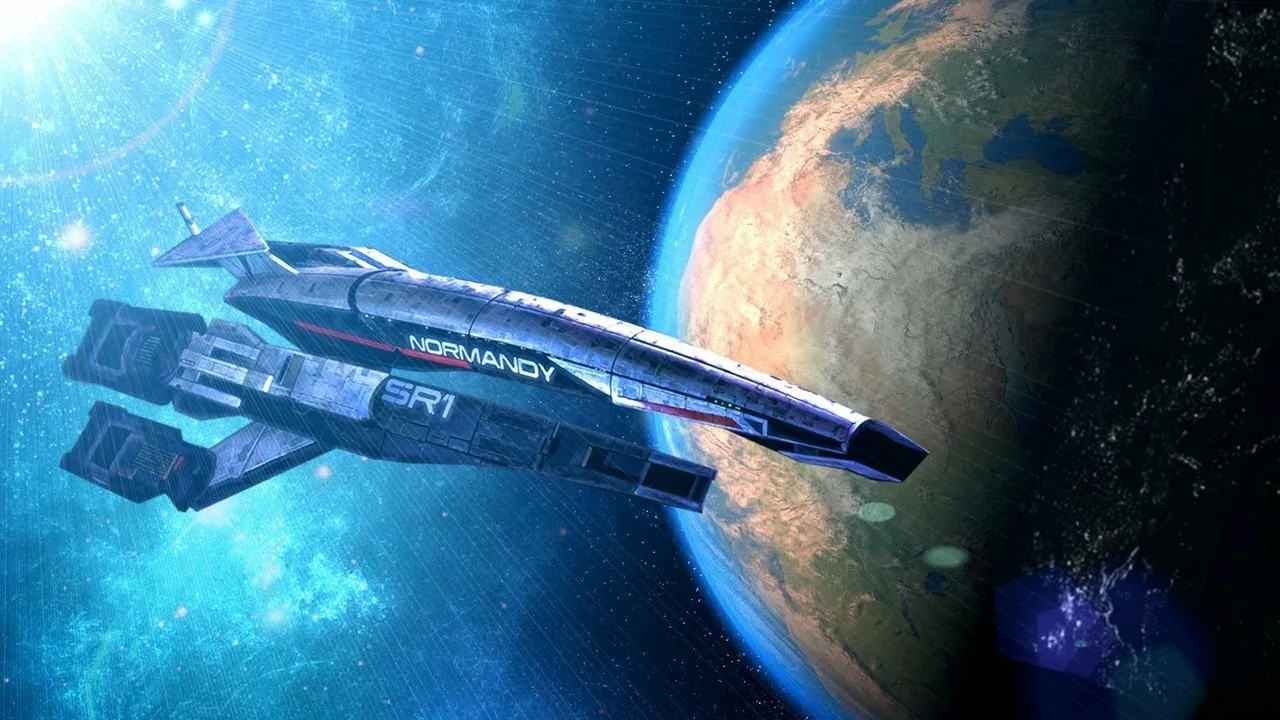
In the Mass Effect universe, two types of technology are used for fast space travel — and both work through mass control.
The so-called zero element is used in the operation of FTL-drive faster-than-light engines. This is a rare mineral through which an electric charge is passed, which helps to increase or decrease the mass of a physical object. In one day, a ship with an FTL drive can travel up to 13 light years. However, overuse of the technology can lead to temporal paradoxes, so the engines are only used in the game for travel between nearby systems.
A more powerful technology is ancient artifacts that act as mass relays. With their help, it is possible to jump thousands of light years. The action of the technologies is not explained, only the use of the same zero element is known.
Dead Space

The events in the Dead Space universe take place in the 26th century. Due to a lack of resources on Earth, “planetary reapers” were created — spaceships capable of destroying planets and transporting minerals to the Solar System.
To travel faster than the speed of light, humanity created the ShockPoint drive. According to the game's lore, in the 23rd century, astrophysicist Hideki Ishikawa formulated the theory of shock space, and the practical application of this theory was embodied in the form of the ShockPoint drive.
The ship travels through shock space because the engine warps space-time matter using a singularity core. A two-sided funnel is formed with expansion at the ship's entry and exit points. The description of the technology resembles a hypothetical warp engine.
Warhammer 40,000
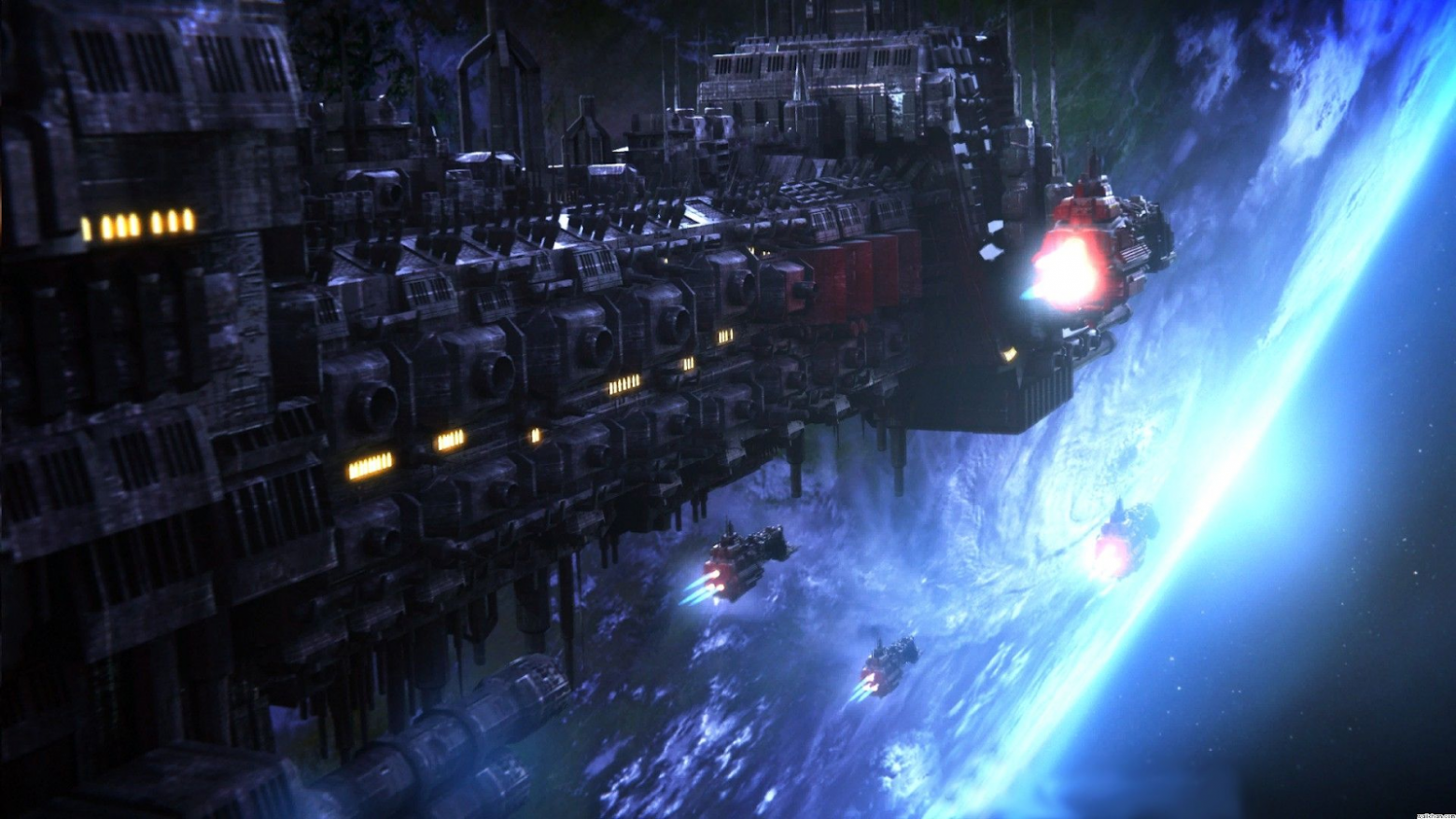
Warp engines are used in spaceships in Warhammer 40,000. Warp is a dimension of pure psychic power beyond reality. Ships use these complex Imperial devices to travel thousands of light years.
Chorus

In the 2021 game, the main character Nara controls the intelligent spaceship Forsaken, which has been imbued with artificial consciousness.
The ship is capable of moving in three different modes within a single location: normal, accelerated, and sublight speed — that is, at a speed close to the speed of light. This allows it to reach targets hundreds of kilometers away more quickly. There are also “acceleration gates” within star systems, which are useful for heavily loaded ships.
And between locations, “jump gates” come into play — they transport ships almost instantly to other gates. Not every system is equipped with them, as they are expensive to install and require time for delivery and assembly.
Reality
It's great when developers take a serious approach to creating the lore of a game and explaining the technologies and level of scientific development in a fictional world — this always adds depth and realism to games. It's important to understand that space games have made a huge contribution not only to the gaming industry, but also to the popularization of science and technology. Futuristic universes help introduce players to various concepts, and some are sure to be inspired to learn more about them from other sources. As part of the world of science fiction, games can also influence scientists — especially since they periodically admit that they get ideas for new inventions from books, films, and TV series. So the growth in the number of video game projects dedicated to space will also influence the development of this industry".
Humanity has not strayed far from its home planet. The Voyagers have traveled the furthest, flying beyond the boundaries of the solar system. Now look at this map of the Milky Way and try to find the point that marks Earth. At least try to find the Sun.
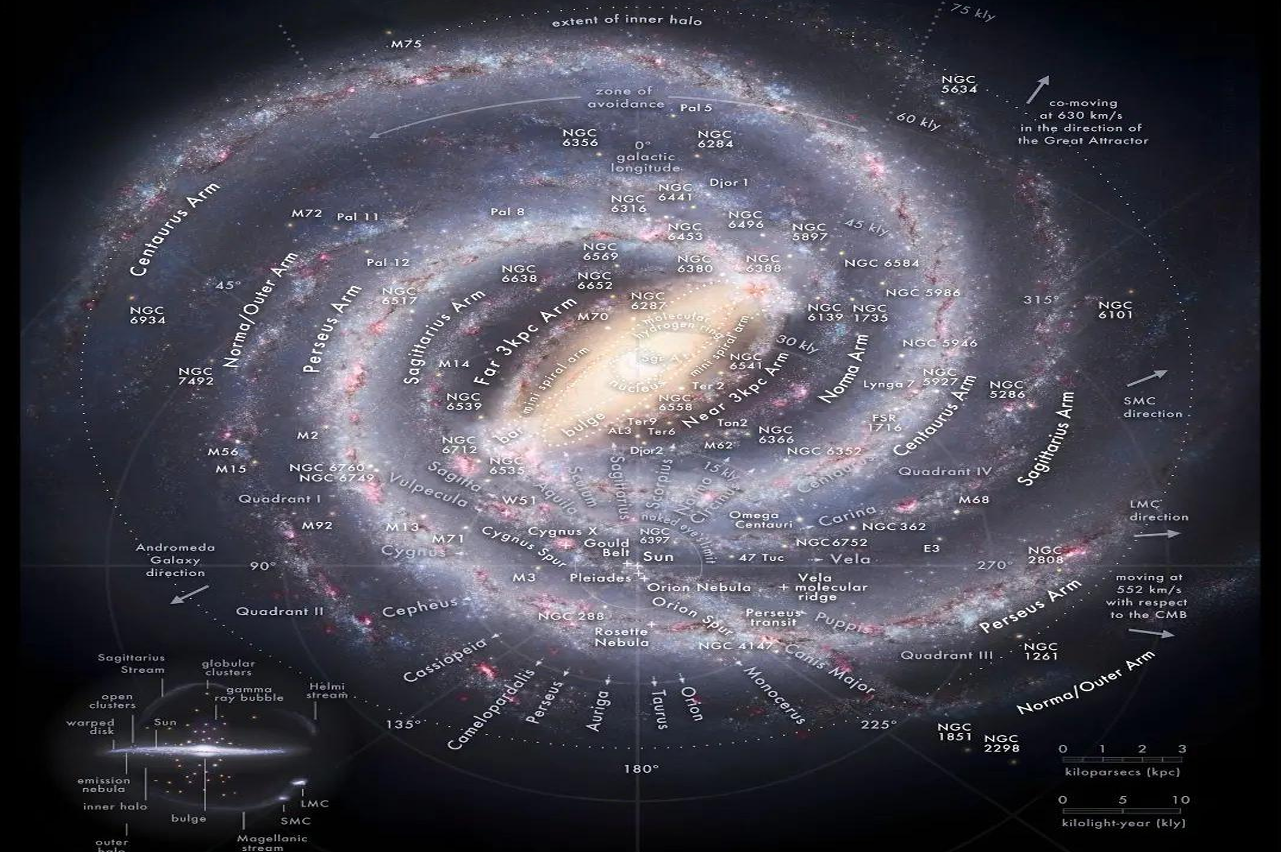
Earth is the cradle of reason, but one cannot live in a cradle forever. First, humans conquered the ocean, at least learning how to navigate it; then the sky, as airplanes have long ceased to be something unusual, and flights to the International Space Station are quite frequent. Humans have set foot on the Moon, but we have not flown any further; we have only sent spacecraft and rovers.
Conquering space will be the logical next step. But this step is unlikely to be possible using the same technologies that are suitable for orbital stations or even for sending people and cargo to the Moon.
In addition, it will take a year to fly to Mars one way. However, a laboratory prototype of a plasma electric rocket engine based on a magnetic plasma accelerator with increased thrust parameters (at least 6 N) and specific impulse (at least 100 km/s) has appeared. Plasma engines are capable of taking a spacecraft to the Moon or even further, but the duration of such a journey would still be too long. In order to reduce the duration of a mission, say, to Mars, i.e., the round trip, to 30-60 days, nuclear propulsion systems are currently being developed that will be used for “space nuclear tugs”.
Incidentally, lunar soil, which contains helium-3, could become a potential fuel for thermonuclear reactors and, subsequently, engines. Helion Energy wants to use this resource and has already raised $570 million, including from NASA.
The most reliable engines are those that can use fission or fusion energy. In the near future, powerful plasma engines based on superconductors in coils to hold plasma will most likely be developed. They will make it possible to explore the nearest planets.
Mars is not enough for us. We want to reach the stars. And it is 4.24 light-years to Proxima Centauri, the closest star to us. We will need a completely different approach to engines, fuel, or, in principle, to our understanding of space and time. In the book “The Three-Body Problem” by Liu Cixin, the use of matter and antimatter annihilation as an energy source is discussed.
Of the more distant but technically feasible engine options, particles or nuclei of substances accelerated to relativistic speeds can be used as a working fluid. Then they can be given maximum momentum. The devices can be accelerated to speeds close to the speed of light, and the journey to the stars can be reduced to a decade.
As in many games, humanity needs to look for loopholes that can be discovered by studying the fundamental characteristics of the physics of our universe. For example, gravity and the characteristics of black holes or their possible antipodes — white holes. This would be similar to the Chorus variant with “jump gates.” Or we will find a way to use the physics of space, dark matter, and energy in the search for the creation of local zones with special properties that will allow us to move faster. For example, Eric Lenz proposed his superluminal engine variant, while Alexei Bobrik and Giovanni Martir proposed a metric for subluminal engines capable of locally slowing down time inside a warp bubble.
You May Also Like

Is Putnam Global Technology A (PGTAX) a strong mutual fund pick right now?

Buterin pushes Layer 2 interoperability as cornerstone of Ethereum’s future
