

Bitcoin Will Go To $1 Million, Telegram Founder Durov Predicts
Pavel Durov, the founder and CEO of Telegram, used a wide-ranging conversation on the Lex Fridman Podcast to make one of his clearest long-term calls on Bitcoin yet: “I believe it will come to a point when Bitcoin is worth $1 million.” The remarks appear on Fridman’s newly released episode with Durov.
Why Bitcoin Will Reach $1 Million: Pavel Durov
Pressed by Fridman on why he kept accumulating Bitcoin and whether he sees further upside, Durov traced his conviction to the asset’s earliest days and to its monetary design. “I was a big believer in Bitcoin since more or less the start of it,” he said, recalling that he bought “my first few thousand of Bitcoin in 2013,” around “$700 per Bitcoin,” and refused to sell even as the price later fell toward $300.
“And my response to them was, I don’t care. I’m not going to sell it. I believe in this thing.” For Durov, the crux is Bitcoin’s censorship resistance and predictable issuance: “Nobody can confiscate your Bitcoin from you. Nobody can censor you for political reasons. This is the ultimate means of exchange… The governments keep printing money like no tomorrow. Nobody’s printing Bitcoin. There is a predictable inflation and then it stops at a certain point. Bitcoin is here to stay.”
Durov also drew a sharp line between his personal finances and Telegram’s operating economics, saying Bitcoin appreciation has effectively financed his lifestyle, not profits from the company. “Telegram is a money losing operation for me personally. Bitcoin is something that allowed me to stay afloat,” he noted, adding that his long-term horizon on the asset has not changed since his early purchases more than a decade ago.
The timing of Durov’s $1 million thesis is notable given Telegram’s expanding role at crypto’s consumer edge. The company has progressively integrated the TON ecosystem into its product and business model, committing to Toncoin-based ad payments and revenue sharing for channel owners and opening its advertising platform to a broad set of markets. That TON-denominated ad infrastructure has been credited with catalyzing user and developer activity across Telegram’s mini-app economy.
On the wallet side, Telegram’s crypto functionality—first rolled out internationally—extended to the United States in July 2025, with the TON community’s wallet mini-app enabling in-app transfers and payments. The US expansion followed what Telegram described as nine-figure global wallet activation metrics in 2024, underscoring the scale of a potential distribution channel for on-chain payments and games.
As for the $1 million number itself, Durov anchored it in supply discipline and fiat debasement rather than in short-term market catalysts. His reasoning tracks with hard-cap arguments long advanced by Bitcoin’s most committed holders: issuance is programmatic and terminal, while fiscal and monetary expansion remains discretionary.
Whether that macro narrative alone can deliver seven-figure prices is a market question; what Durov made clear is that his own positioning reflects a decade of conviction. “Just look at the trends,” he told Fridman. “Bitcoin is here to stay. All the fiat currencies remain to be seen.”
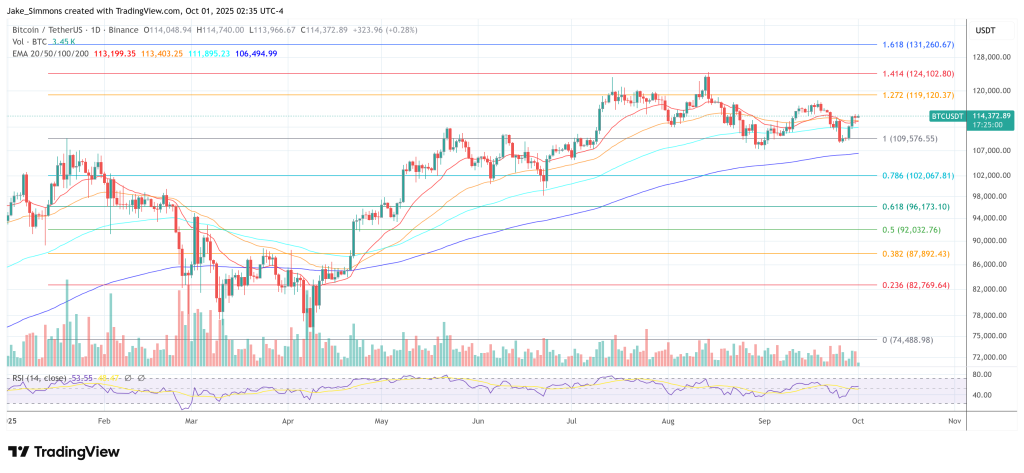
At press time, Bitcoin traded at $114,372.


You May Also Like
25th Amendment Trump Iran War: MTG, Alex Jones, and Candace Owens All Call for His Removal Today
![[Ask the Tax Whiz] New VAT rules for registered business enterprises in the Philippines](https://www.rappler.com/tachyon/2026/04/Screenshot-2026-04-20-at-11.30.39-AM.png?resize=75%2C75&crop_strategy=attention)
[Ask the Tax Whiz] New VAT rules for registered business enterprises in the Philippines




