AdaMix introduces a mixture-of-adapters approach to parameter-efficient fine-tuning that consistently beats state-of-the-art baselines across major NLP benchmarks. Tested on GLUE, E2E, WebNLG, and DART, AdaMix not only matches but often outperforms full model fine-tuning with BERT, RoBERTa, and GPT-2. Its advantage extends to few-shot learning, where AdaMix narrows the performance gap with full prompt-based fine-tuning, delivering strong results with fewer labeled examples.AdaMix introduces a mixture-of-adapters approach to parameter-efficient fine-tuning that consistently beats state-of-the-art baselines across major NLP benchmarks. Tested on GLUE, E2E, WebNLG, and DART, AdaMix not only matches but often outperforms full model fine-tuning with BERT, RoBERTa, and GPT-2. Its advantage extends to few-shot learning, where AdaMix narrows the performance gap with full prompt-based fine-tuning, delivering strong results with fewer labeled examples.

Smarter Fine-Tuning for NLU and NLG Tasks

Abstract and 1. Introduction

  1. Background

    2.1 Mixture-of-Experts

    2.2 Adapters

  2. Mixture-of-Adaptations

    3.1 Routing Policy

    3.2 Consistency regularization

    3.3 Adaptation module merging and 3.4 Adaptation module sharing

    3.5 Connection to Bayesian Neural Networks and Model Ensembling

  3. Experiments

    4.1 Experimental Setup

    4.2 Key Results

    4.3 Ablation Study

  4. Related Work

  5. Conclusions

  6. Limitations

  7. Acknowledgment and References

Appendix

A. Few-shot NLU Datasets B. Ablation Study C. Detailed Results on NLU Tasks D. Hyper-parameter

4 Experiments

4.1 Experimental Setup

Dataset. We perform experiments on a wide range of tasks including eight natural language understanding (NLU) tasks in the General Language Understanding Evaluation (GLUE) benchmark (Wang et al., 2019) and three natural language generation (NLG) tasks, namely, E2E (Novikova et al., 2017), WebNLG (Gardent et al., 2017) and DART (Nan et al., 2020). For the NLU and NLG tasks, we follow the same setup as (Houlsby et al., 2019) and (Li and Liang, 2021; Hu et al., 2021), respectively.

\ Baselines. We compare AdaMix to full model fine-tuning and several state-of-the-art parameterefficient fine-tuning (PEFT) methods, namely, Pfeiffer Adapter (Pfeiffer et al., 2021), Houlsby Adapter (Houlsby et al., 2019), BitFit (Zaken et al., 2021), Prefix-tuning (Li and Liang, 2021), UNIPELT (Mao et al., 2021) and LoRA (Hu et al., 2021). We use BERT-base (Devlin et al., 2019) and RoBERTa-large (Liu et al., 2019) as encoders for NLU tasks (results in Table 1 and Table 2), and GPT-2 (Brown et al., 2020) for NLG tasks (results in Table 3).

\ AdaMix implementation details. We implement AdaMix in Pytorch and use Tesla V100 gpus for experiments with detailed hyper-parameter configurations presented in Section D in Appendix. AdaMix with adapters uses a dimension of 16 and 48 using BERT-base and RoBERTa-large encoders following the setup of (Hu et al., 2021; Mao et al., 2021) for fair comparison. AdaMix with LoRA uses rank r = 4 following the setup of (Hu et al., 2021) to keep the same number of adaptation parameters during inference. The number of adaptation modules in AdaMix is set to 4 for all the tasks and encoders unless otherwise specified. The impact of adapter dimension and number of adaptation modules for NLU tasks are investigated in Table 9 and 10. For most of the experiments and ablation analysis, we report results from AdaMix with adapters for NLU tasks. For demonstrating the generalizability of our framework, we report results from AdaMix with LoRA (Hu et al., 2021) as the underlying PEFT mechanism for NLG tasks.

\

4.2 Key Results

4.2.1 NLU Tasks

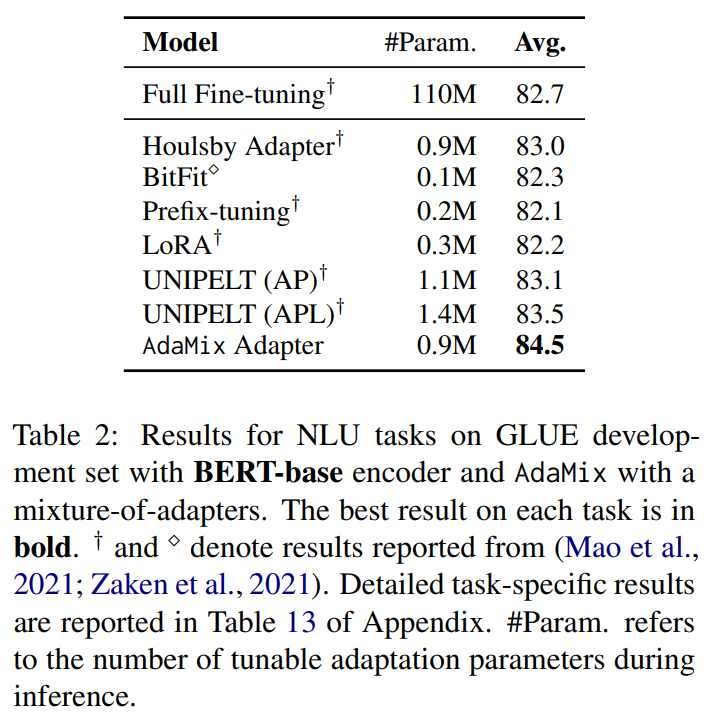
\ Tables 1 and 2 show the performance comparison among PEFT models with RoBERTa-large and BERT-base encoders respectively. Fully fine-tuned

\ \ Table 1: Results for NLU tasks on GLUE development set with RoBERTa-large encoder. The best result on each task is in bold and “-” denotes missing measure. AdaMix with a mixture of adapters outperforms all competing methods as well as fully fine-tuned large model with only 0.23% tunable parameters.† denotes results reported from (Hu et al., 2021). Mcc refers to Matthews correlation coefficient, and Pearson refers to Pearson correlation. #Param. denotes the number of tunable adaptation parameters used during inference.
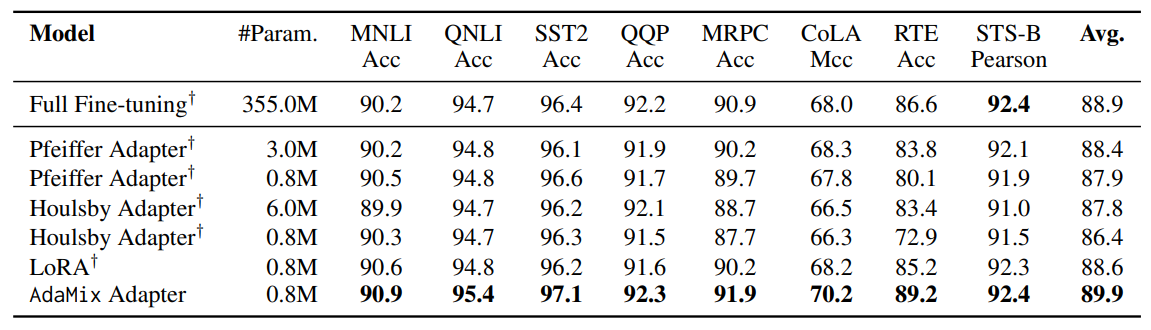
\ \ RoBERTa-large and BERT-base provide the ceiling performance. We observe AdaMix with a mixture-of-adapters to significantly outperform other state-of-the-art baselines on most tasks with different encoders. AdaMix with adapters is the only PEFT method which outperforms full model fine-tuning on all the tasks and on average score.

\ \
\ \ 4.2.2 NLG Tasks

\ AdaMix leverages mixture of adaptations to improve over underlying PEFT method as demonstrated in Table 3 for E2E NLG i.e. AdaMix with LoRA and AdaMix with adapters outperform LoRA (Hu et al., 2021) and adapters (Houlsby et al., 2019) respectively. We report results on DART and WebNLG in Tables 4 and 5 in Appendix.

\ 4.2.3 Few-shot NLU

\ In contrast to the fully supervised setting in the above experiments, we also perform few-shot experiments on six GLUE tasks following the same setup (e.g., shots, train and test splits) and evaluation as in (Wang et al., 2021). Detailed experimental configuration presented in Section A of Appendix. AdaMix uses a mixture-of-adapters with prompt-based fine-tuning (Gao et al., 2021).

\ Table 6 shows the performance comparison among different PEFT methods with |K| = 30 labeled examples with RoBERTa-large as frozen encoder. We observe significant performance gap for most PEFT methods with full model promptbased fine-tuning i.e. with all model parameters being updated. AdaMix with adapters outperforms full model tuning performance for few-shot NLU similar to that in the fully supervised setting. Note that AdaMix and LiST (Wang et al., 2021) use similar adapter design with prompt-based fine-tuning.

\

:::info Authors:

(1) Yaqing Wang, Purdue University (wang5075@purdue.edu);

(2) Sahaj Agarwal, Microsoft (sahagar@microsoft.com);

(3) Subhabrata Mukherjee, Microsoft Research (submukhe@microsoft.com);

(4) Xiaodong Liu, Microsoft Research (xiaodl@microsoft.com);

(5) Jing Gao, Purdue University (jinggao@purdue.edu);

(6) Ahmed Hassan Awadallah, Microsoft Research (hassanam@microsoft.com);

(7) Jianfeng Gao, Microsoft Research (jfgao@microsoft.com).

:::


:::info This paper is available on arxiv under CC BY 4.0 DEED license.

:::

\

Market Opportunity
LiveArt Logo
LiveArt Price(ART)
$0.0003938
$0.0003938$0.0003938
+4.56%
USD
LiveArt (ART) Live Price Chart
Disclaimer: The articles reposted on this site are sourced from public platforms and are provided for informational purposes only. They do not necessarily reflect the views of MEXC. All rights remain with the original authors. If you believe any content infringes on third-party rights, please contact service@support.mexc.com for removal. MEXC makes no guarantees regarding the accuracy, completeness, or timeliness of the content and is not responsible for any actions taken based on the information provided. The content does not constitute financial, legal, or other professional advice, nor should it be considered a recommendation or endorsement by MEXC.

You May Also Like

FCA komt in 2026 met aangepaste cryptoregels voor Britse markt

FCA komt in 2026 met aangepaste cryptoregels voor Britse markt

De Britse financiële waakhond, de FCA, komt in 2026 met nieuwe regels speciaal voor crypto bedrijven. Wat direct opvalt: de toezichthouder laat enkele klassieke financiële verplichtingen los om beter aan te sluiten op de snelle en grillige wereld van digitale activa. Tegelijkertijd wordt er extra nadruk gelegd op digitale beveiliging,... Het bericht FCA komt in 2026 met aangepaste cryptoregels voor Britse markt verscheen het eerst op Blockchain Stories.
Share
Coinstats2025/09/18 00:33
Liquidity Boost Stabilizes Solana-Based Stablecoin USX After Market Drop

Liquidity Boost Stabilizes Solana-Based Stablecoin USX After Market Drop

Solana's USX stablecoin experiences a significant market drop due to liquidity issues. Solstice Finance intervenes to stabilize the value.Read more...
Share
Coinstats2025/12/27 12:51
Edges higher ahead of BoC-Fed policy outcome

Edges higher ahead of BoC-Fed policy outcome

The post Edges higher ahead of BoC-Fed policy outcome appeared on BitcoinEthereumNews.com. USD/CAD gains marginally to near 1.3760 ahead of monetary policy announcements by the Fed and the BoC. Both the Fed and the BoC are expected to lower interest rates. USD/CAD forms a Head and Shoulder chart pattern. The USD/CAD pair ticks up to near 1.3760 during the late European session on Wednesday. The Loonie pair gains marginally ahead of monetary policy outcomes by the Bank of Canada (BoC) and the Federal Reserve (Fed) during New York trading hours. Both the BoC and the Fed are expected to cut interest rates amid mounting labor market conditions in their respective economies. Inflationary pressures in the Canadian economy have cooled down, emerging as another reason behind the BoC’s dovish expectations. However, the Fed is expected to start the monetary-easing campaign despite the United States (US) inflation remaining higher. Investors will closely monitor press conferences from both Fed Chair Jerome Powell and BoC Governor Tiff Macklem to get cues about whether there will be more interest rate cuts in the remainder of the year. According to analysts from Barclays, the Fed’s latest median projections for interest rates are likely to call for three interest rate cuts by 2025. Ahead of the Fed’s monetary policy, the US Dollar Index (DXY), which tracks the Greenback’s value against six major currencies, holds onto Tuesday’s losses near 96.60. USD/CAD forms a Head and Shoulder chart pattern, which indicates a bearish reversal. The neckline of the above-mentioned chart pattern is plotted near 1.3715. The near-term trend of the pair remains bearish as it stays below the 20-day Exponential Moving Average (EMA), which trades around 1.3800. The 14-day Relative Strength Index (RSI) slides to near 40.00. A fresh bearish momentum would emerge if the RSI falls below that level. Going forward, the asset could slide towards the round level of…
Share
BitcoinEthereumNews2025/09/18 01:23