

Uniswap (UNI) Explained 2025: How the Leading DEX is Shaping DeFi
 Table of Contents
- What Makes Uniswap a DeFi Giant?
- The Origins and Background of Uniswap
- Inside the Technology: How Uniswap Works
- Ecosystem & Strategic Partnerships
- Practical Use Cases of Uniswap
- UNI Tokenomics Explained
- Latest Uniswap News & Developments
- Final Thoughts on Uniswap
- FAQ: 10 Unanswered Questions About Uniswap
 What Makes Uniswap a DeFi Giant?
Uniswap is one of the largest decentralized exchanges (DEX) built on the Ethereum blockchain. It enables users worldwide to trade cryptocurrencies without centralized intermediaries or order books. Instead, Uniswap uses an Automated Market Maker (AMM) powered by liquidity pools. The governance token UNI allows holders to vote on protocol changes. Since its launch in 2018, Uniswap’s trading volume has exceeded $1.5 trillion, making it one of the most influential platforms in the DeFi space.
 The Origins and Background of Uniswap
Uniswap was founded in 2018 by engineer Hayden Adams, inspired by Ethereum co-founder Vitalik Buterin. In 2020, the UNI governance token was launched and distributed to more than 250,000 platform users. The project was funded by the Ethereum Foundation, Uniswap Labs, and various venture capital firms. Today, the platform manages assets worth between $4–5 billion, cementing its place among the largest DEXs in the DeFi ecosystem.
 Inside the Technology: How Uniswap Works
The core of Uniswap is the Automated Market Maker (AMM). Users deposit tokens into liquidity pools and receive a proportional share of the 0.3% fee generated by every swap. The system uses the constant product formula (x * y = k) to ensure liquidity is always available while determining token prices. Built on Ethereum, Uniswap also supports Layer-2 solutions such as Base, Arbitrum, and Optimism, significantly reducing fees. All operations are handled by smart contracts, ensuring that users retain full control of their wallets without centralized intermediaries.
Constant Product Formula:x * y = k
(Ensures liquidity and pricing across Uniswap pools)
 Ecosystem & Strategic Partnerships
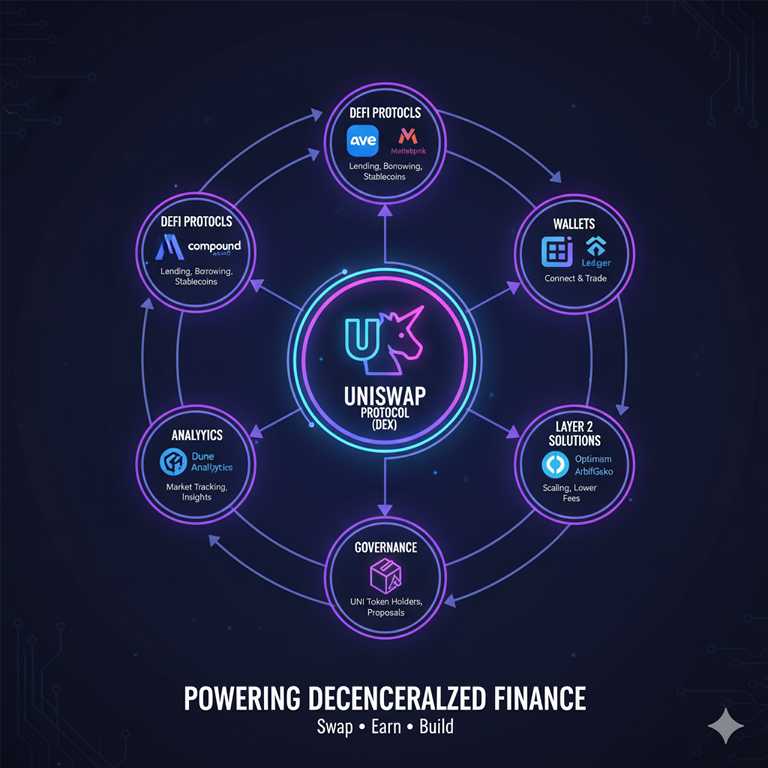
Uniswap and UNI tokens are deeply embedded in the DeFi sector. Leading protocols such as Compound, Aave, and MakerDAO leverage Uniswap’s liquidity pools for lending and stablecoin issuance. Major wallets like Coinbase, MetaMask, and Trust Wallet integrate Uniswap directly for token swaps. Through multi-chain deployment, millions of users worldwide can access Uniswap. Institutional adoption is growing too, with partnerships involving Fireblocks and Anchorage to offer secure access for regulated financial institutions.
 Practical Use Cases of Uniswap
Uniswap plays a vital role in the DeFi landscape, with multiple real-world applications:
- Token Swaps: Instantly exchange cryptocurrencies, with stablecoins like USDC, DAI, and USDT among the most traded pairs.
- Liquidity Provision: Users deposit assets into pools and earn fees and yield-farming rewards, with potential returns of up to 30% annually.
- Arbitrage Opportunities: Traders exploit price differences between centralized exchanges and DEX liquidity pools.
 UNI Tokenomics Explained
The UNI token has a fixed supply of 1 billion tokens distributed over four years. Allocation includes 60% to the community, 21.5% to the Uniswap team, 17.8% to investors, and 0.7% to advisors. Token holders vote on governance issues such as fee adjustments and new integrations. UNI also incentivizes liquidity providers, accelerating the growth of Uniswap’s pools and overall adoption.
| Category | Allocation |
|---|---|
| Community | 60% |
| Team | 21.5% |
| Investors | 17.8% |
| Advisors | 0.7% |
 Latest Uniswap News & Developments
Despite significant volatility in the UNI token price, Uniswap continues to grow thanks to multi-chain adoption. In 2024, Uniswap recorded daily trading volumes exceeding $1 billion on Arbitrum alone. However, regulatory scrutiny is rising. Both U.S. and European regulators are debating whether DEX operators should face the same regulatory frameworks as centralized exchanges, which could shape Uniswap’s future trajectory.
 FAQ: 10 Unanswered Questions About Uniswap
]]>

You May Also Like

Not a loophole: Singapore AI export controls let China tap US AI legally

Exclusive interview with Smokey The Bera, co-founder of Berachain: How the innovative PoL public chain solves the liquidity problem and may be launched in a few months

Chainlink Whale Activity Rises While Price Bleeds for 7 Straight Months



