In a wide-ranging interview with Anthony Pompliano published on October 2, Jeff Park, partner and Chief Investing Officer at ProCap BTC, argued that gold’s surging price and shifting global ownership patterns are not a threat to Bitcoin—but potentially the catalyst for its next structural leg higher. Park’s thesis centers on flows, geopolitics, and balance-sheet mechanics: if policymakers and large allocators learn to tap the paper gains embedded in sovereign gold holdings, they could redirect a meaningful slice of that liquidity into Bitcoin and ignite what he repeatedly framed as a supercycle. Why Gold’s Rally May Trigger A Bitcoin Supercycle “The math is pretty simple,” Park said. “What if we find a way to unlock the ability to build leverage on the paper gains of gold to take a call option on Bitcoin? There’s something incredible here that could happen.” In his back-of-the-envelope scenario, “a trillion dollars of Bitcoin is actually hugely impactful for the bitcoin market.” He contrasted the magnitude of such an impulse with the size of the US fiscal problem, suggesting that while a trillion dollars is small relative to public debt, it would be outsized in a young asset with finite supply and thin free float. Related Reading: Bitcoin Calm Is Over — ‘Every Time This Happened, Price Went Vertical,’ Says Analyst Park’s remarks were prompted by a simple question: why is gold ripping while Bitcoin has lagged on a relative basis? He did not dispute gold’s leadership—calling it “the story of the year”—but argued the drivers differ. Gold is presently the venue for acute geopolitical expression and central-bank rebalancing, while Bitcoin’s adoption curve hinges on institutional flows that are still ramping. “Ultimately [these markets] are driven by flows,” he said, adding that Bitcoin’s flows are “inevitable” so long as the institutional agenda advances with “focused deliberation.” A crucial plank of Park’s framework is the changing geography of gold. He pointed to two simultaneous realities: the headline that US gold reserves have reached a large notional value because of price—and the under-discussed fact that the US share of global official gold has sunk over decades. “At one point post-World War II the US had over 50% of the world’s global gold reserve supply as a central bank and now it’s less than 20%. So who’s making up for the compensation on their side? Likely China and many other BRIC countries in the lead.” That shift, Park argued, helps explain the persistence of gold’s bid. China, in his telling, is exerting influence not only through accumulation but also by building market infrastructure. He highlighted “the launch of the Shanghai Gold Exchange” and the rise of “the Shanghai Futures Exchange,” observing that “physical gold now actually trades in China” at a scale once associated with London. In a symbolic move earlier this year, “for the first time [they] opened up vaults in Hong Kong to allow offshore investors to put their gold in reserves,” a step Park sees as part of a longer-term strategy to enhance the creditworthiness of CNY-settled commodity trade. Will The US Act First? Park then connected this gold realignment to Bitcoin’s addressable demand. He referred to the scenario in which the US takes the massive unrealized gains on its gold if marked at market and either revalues or borrows against those gains to purchase Bitcoin for its strategic reserve under President Donald Trump. “Gold has been marked at the Treasury at $42 an ounce and we all know right now it’s trading at [roughly] 3850… There’s a trillion dollars of basically paper gains.” In that context, he argued that leveraging paper gains into a scarce digital reserve asset could be a high-beta upgrade to the sovereign balance sheet. Pressed on the political feasibility, Park distinguished between executive action and legislation. “The executive path is a great starting point to create a watershed moment,” he said, but “no democratic coalition is truly bought in until a legislative motion.” The former could demonstrate intent; the latter would make a Bitcoin reserve strategy “irreversible” and align it with the broader social mandate he associates with sound-money adoption. The crux of his “supercycle” framing is compounding. Park walked through return profiles to quantify why a large base allocation, even if financed, could matter over time. “If you own Bitcoin and you assume that it’s going to go up by 12% a year, you’ll make a 30x in 30 years… If you think it’s actually going to go up by 40% per year, which is what the [asset] has been otherwise annualizing, it’s 10 years.” He stressed that the point is not to promise those numbers, but to illustrate how modest annualized returns can cover meaningful fiscal gaps when the base is large enough and the asset is credibly scarce. Why Is Bitcoin Lagging Gold? Park also addressed why Bitcoin has not matched gold’s recent pace. Part of the answer, he suggested, is optics: Bitcoin is “living, breathing software” that evolves via open debate, whereas gold’s appeal is its millennia-long immutability. The transparency of Bitcoin’s governance can spook newcomers who only see the noise. “If I were outside and I was a BlackRock ETF buyer and I listened to the conversation that’s happening between the Bitcoin developers, I might say, ‘Hold on a second. This is crazy stuff.’” Even so, he framed current developer disputes—such as arguments over relay policy or spam-filter defaults—as hygiene issues, not existential ones. They matter for performance and propagation, but not for the core monetary assurances: “21 million or bust.” Related Reading: Bitcoin Breaks $119,000: Analyst Says $139,000 Could Be Next He invoked the lessons of the block-size war to explain why the system’s checks and balances are a feature, not a bug. “Ultimately, who is running consensus at Bitcoin?… The node clients are very valuable and they are in control versus miners and their self-interests. And that was a huge moment because it showed you decentralization was alive.” The line between hard-coded rules and socially enforced norms will always invite argument, he conceded, but in his view that process “future-proof[s] Bitcoin as the ultimate store of value.” Throughout, Park returned to flows. Gold’s flows, in his assessment, are being pulled by geopolitics and central-bank behavior—especially in Asia. Bitcoin’s flows will be pulled by institutional adoption and, potentially, by policy innovation that converts dormant balance-sheet strength into active demand. That is why he sees the assets as complements within the same macro problem set rather than rivals fighting for a single inflow. “Gold’s greatest cultural power is its impermanent fixture in our mindset and its durability for eons,” he said. Bitcoin, by contrast, offers sovereignty, portability, and programmability that younger cohorts find intuitive. “Young people are mentally more able to do things that older people can’t… the trend of young people understanding digital store of wealth… is the big picture.” I spoke with @dgt10011 on whether we should be worried about bitcoin lagging gold’s performance, durability of bitcoin vs gold, how to think about bitcoin as living software, and a new theme referencing the retardification of society. Enjoy! YouTube: https://t.co/kwCRnibemU… pic.twitter.com/0BckI7h7Eb — Anthony Pompliano 🌪 (@APompliano) October 3, 2025 If that generational shift meets a government-level balance-sheet pivot, Park believes the market structure can change quickly. “A trillion dollars of Bitcoin is hugely impactful,” he repeated, not because it solves everything overnight, but because it reorganizes incentives for issuers, custodians, and policymakers around a credibly scarce digital reserve. In that world, the present period—where gold leads and Bitcoin consolidates—may be remembered not as divergence, but as staging. “Bitcoin will catch up,” Park said. “These are ultimately driven by flows.” And if those flows are seeded by the very gold rally now commanding headlines, the supercycle label he’s willing to use may not be hyperbole, but simply a description of how compounding works when new liquidity finally meets hard caps. At press time, BTC traded at $120,313. Featured image created with DALL.E, chart from TradingView.comIn a wide-ranging interview with Anthony Pompliano published on October 2, Jeff Park, partner and Chief Investing Officer at ProCap BTC, argued that gold’s surging price and shifting global ownership patterns are not a threat to Bitcoin—but potentially the catalyst for its next structural leg higher. Park’s thesis centers on flows, geopolitics, and balance-sheet mechanics: if policymakers and large allocators learn to tap the paper gains embedded in sovereign gold holdings, they could redirect a meaningful slice of that liquidity into Bitcoin and ignite what he repeatedly framed as a supercycle. Why Gold’s Rally May Trigger A Bitcoin Supercycle “The math is pretty simple,” Park said. “What if we find a way to unlock the ability to build leverage on the paper gains of gold to take a call option on Bitcoin? There’s something incredible here that could happen.” In his back-of-the-envelope scenario, “a trillion dollars of Bitcoin is actually hugely impactful for the bitcoin market.” He contrasted the magnitude of such an impulse with the size of the US fiscal problem, suggesting that while a trillion dollars is small relative to public debt, it would be outsized in a young asset with finite supply and thin free float. Related Reading: Bitcoin Calm Is Over — ‘Every Time This Happened, Price Went Vertical,’ Says Analyst Park’s remarks were prompted by a simple question: why is gold ripping while Bitcoin has lagged on a relative basis? He did not dispute gold’s leadership—calling it “the story of the year”—but argued the drivers differ. Gold is presently the venue for acute geopolitical expression and central-bank rebalancing, while Bitcoin’s adoption curve hinges on institutional flows that are still ramping. “Ultimately [these markets] are driven by flows,” he said, adding that Bitcoin’s flows are “inevitable” so long as the institutional agenda advances with “focused deliberation.” A crucial plank of Park’s framework is the changing geography of gold. He pointed to two simultaneous realities: the headline that US gold reserves have reached a large notional value because of price—and the under-discussed fact that the US share of global official gold has sunk over decades. “At one point post-World War II the US had over 50% of the world’s global gold reserve supply as a central bank and now it’s less than 20%. So who’s making up for the compensation on their side? Likely China and many other BRIC countries in the lead.” That shift, Park argued, helps explain the persistence of gold’s bid. China, in his telling, is exerting influence not only through accumulation but also by building market infrastructure. He highlighted “the launch of the Shanghai Gold Exchange” and the rise of “the Shanghai Futures Exchange,” observing that “physical gold now actually trades in China” at a scale once associated with London. In a symbolic move earlier this year, “for the first time [they] opened up vaults in Hong Kong to allow offshore investors to put their gold in reserves,” a step Park sees as part of a longer-term strategy to enhance the creditworthiness of CNY-settled commodity trade. Will The US Act First? Park then connected this gold realignment to Bitcoin’s addressable demand. He referred to the scenario in which the US takes the massive unrealized gains on its gold if marked at market and either revalues or borrows against those gains to purchase Bitcoin for its strategic reserve under President Donald Trump. “Gold has been marked at the Treasury at $42 an ounce and we all know right now it’s trading at [roughly] 3850… There’s a trillion dollars of basically paper gains.” In that context, he argued that leveraging paper gains into a scarce digital reserve asset could be a high-beta upgrade to the sovereign balance sheet. Pressed on the political feasibility, Park distinguished between executive action and legislation. “The executive path is a great starting point to create a watershed moment,” he said, but “no democratic coalition is truly bought in until a legislative motion.” The former could demonstrate intent; the latter would make a Bitcoin reserve strategy “irreversible” and align it with the broader social mandate he associates with sound-money adoption. The crux of his “supercycle” framing is compounding. Park walked through return profiles to quantify why a large base allocation, even if financed, could matter over time. “If you own Bitcoin and you assume that it’s going to go up by 12% a year, you’ll make a 30x in 30 years… If you think it’s actually going to go up by 40% per year, which is what the [asset] has been otherwise annualizing, it’s 10 years.” He stressed that the point is not to promise those numbers, but to illustrate how modest annualized returns can cover meaningful fiscal gaps when the base is large enough and the asset is credibly scarce. Why Is Bitcoin Lagging Gold? Park also addressed why Bitcoin has not matched gold’s recent pace. Part of the answer, he suggested, is optics: Bitcoin is “living, breathing software” that evolves via open debate, whereas gold’s appeal is its millennia-long immutability. The transparency of Bitcoin’s governance can spook newcomers who only see the noise. “If I were outside and I was a BlackRock ETF buyer and I listened to the conversation that’s happening between the Bitcoin developers, I might say, ‘Hold on a second. This is crazy stuff.’” Even so, he framed current developer disputes—such as arguments over relay policy or spam-filter defaults—as hygiene issues, not existential ones. They matter for performance and propagation, but not for the core monetary assurances: “21 million or bust.” Related Reading: Bitcoin Breaks $119,000: Analyst Says $139,000 Could Be Next He invoked the lessons of the block-size war to explain why the system’s checks and balances are a feature, not a bug. “Ultimately, who is running consensus at Bitcoin?… The node clients are very valuable and they are in control versus miners and their self-interests. And that was a huge moment because it showed you decentralization was alive.” The line between hard-coded rules and socially enforced norms will always invite argument, he conceded, but in his view that process “future-proof[s] Bitcoin as the ultimate store of value.” Throughout, Park returned to flows. Gold’s flows, in his assessment, are being pulled by geopolitics and central-bank behavior—especially in Asia. Bitcoin’s flows will be pulled by institutional adoption and, potentially, by policy innovation that converts dormant balance-sheet strength into active demand. That is why he sees the assets as complements within the same macro problem set rather than rivals fighting for a single inflow. “Gold’s greatest cultural power is its impermanent fixture in our mindset and its durability for eons,” he said. Bitcoin, by contrast, offers sovereignty, portability, and programmability that younger cohorts find intuitive. “Young people are mentally more able to do things that older people can’t… the trend of young people understanding digital store of wealth… is the big picture.” I spoke with @dgt10011 on whether we should be worried about bitcoin lagging gold’s performance, durability of bitcoin vs gold, how to think about bitcoin as living software, and a new theme referencing the retardification of society. Enjoy! YouTube: https://t.co/kwCRnibemU… pic.twitter.com/0BckI7h7Eb — Anthony Pompliano 🌪 (@APompliano) October 3, 2025 If that generational shift meets a government-level balance-sheet pivot, Park believes the market structure can change quickly. “A trillion dollars of Bitcoin is hugely impactful,” he repeated, not because it solves everything overnight, but because it reorganizes incentives for issuers, custodians, and policymakers around a credibly scarce digital reserve. In that world, the present period—where gold leads and Bitcoin consolidates—may be remembered not as divergence, but as staging. “Bitcoin will catch up,” Park said. “These are ultimately driven by flows.” And if those flows are seeded by the very gold rally now commanding headlines, the supercycle label he’s willing to use may not be hyperbole, but simply a description of how compounding works when new liquidity finally meets hard caps. At press time, BTC traded at $120,313. Featured image created with DALL.E, chart from TradingView.com
Bitcoin Supercycle? Jeff Park Says Gold’s $1 Trillion Gains Could Spark It

2025/10/03 18:15

In a wide-ranging interview with Anthony Pompliano published on October 2, Jeff Park, partner and Chief Investing Officer at ProCap BTC, argued that gold’s surging price and shifting global ownership patterns are not a threat to Bitcoin—but potentially the catalyst for its next structural leg higher. Park’s thesis centers on flows, geopolitics, and balance-sheet mechanics: if policymakers and large allocators learn to tap the paper gains embedded in sovereign gold holdings, they could redirect a meaningful slice of that liquidity into Bitcoin and ignite what he repeatedly framed as a supercycle.

Why Gold’s Rally May Trigger A Bitcoin Supercycle

“The math is pretty simple,” Park said. “What if we find a way to unlock the ability to build leverage on the paper gains of gold to take a call option on Bitcoin? There’s something incredible here that could happen.” In his back-of-the-envelope scenario, “a trillion dollars of Bitcoin is actually hugely impactful for the bitcoin market.” He contrasted the magnitude of such an impulse with the size of the US fiscal problem, suggesting that while a trillion dollars is small relative to public debt, it would be outsized in a young asset with finite supply and thin free float.

Park’s remarks were prompted by a simple question: why is gold ripping while Bitcoin has lagged on a relative basis? He did not dispute gold’s leadership—calling it “the story of the year”—but argued the drivers differ. Gold is presently the venue for acute geopolitical expression and central-bank rebalancing, while Bitcoin’s adoption curve hinges on institutional flows that are still ramping. “Ultimately [these markets] are driven by flows,” he said, adding that Bitcoin’s flows are “inevitable” so long as the institutional agenda advances with “focused deliberation.”

A crucial plank of Park’s framework is the changing geography of gold. He pointed to two simultaneous realities: the headline that US gold reserves have reached a large notional value because of price—and the under-discussed fact that the US share of global official gold has sunk over decades. “At one point post-World War II the US had over 50% of the world’s global gold reserve supply as a central bank and now it’s less than 20%. So who’s making up for the compensation on their side? Likely China and many other BRIC countries in the lead.” That shift, Park argued, helps explain the persistence of gold’s bid.

China, in his telling, is exerting influence not only through accumulation but also by building market infrastructure. He highlighted “the launch of the Shanghai Gold Exchange” and the rise of “the Shanghai Futures Exchange,” observing that “physical gold now actually trades in China” at a scale once associated with London. In a symbolic move earlier this year, “for the first time [they] opened up vaults in Hong Kong to allow offshore investors to put their gold in reserves,” a step Park sees as part of a longer-term strategy to enhance the creditworthiness of CNY-settled commodity trade.

Will The US Act First?

Park then connected this gold realignment to Bitcoin’s addressable demand. He referred to the scenario in which the US takes the massive unrealized gains on its gold if marked at market and either revalues or borrows against those gains to purchase Bitcoin for its strategic reserve under President Donald Trump. “Gold has been marked at the Treasury at $42 an ounce and we all know right now it’s trading at [roughly] 3850… There’s a trillion dollars of basically paper gains.” In that context, he argued that leveraging paper gains into a scarce digital reserve asset could be a high-beta upgrade to the sovereign balance sheet.

Pressed on the political feasibility, Park distinguished between executive action and legislation. “The executive path is a great starting point to create a watershed moment,” he said, but “no democratic coalition is truly bought in until a legislative motion.” The former could demonstrate intent; the latter would make a Bitcoin reserve strategy “irreversible” and align it with the broader social mandate he associates with sound-money adoption.

The crux of his “supercycle” framing is compounding. Park walked through return profiles to quantify why a large base allocation, even if financed, could matter over time. “If you own Bitcoin and you assume that it’s going to go up by 12% a year, you’ll make a 30x in 30 years… If you think it’s actually going to go up by 40% per year, which is what the [asset] has been otherwise annualizing, it’s 10 years.” He stressed that the point is not to promise those numbers, but to illustrate how modest annualized returns can cover meaningful fiscal gaps when the base is large enough and the asset is credibly scarce.

Why Is Bitcoin Lagging Gold?

Park also addressed why Bitcoin has not matched gold’s recent pace. Part of the answer, he suggested, is optics: Bitcoin is “living, breathing software” that evolves via open debate, whereas gold’s appeal is its millennia-long immutability. The transparency of Bitcoin’s governance can spook newcomers who only see the noise. “If I were outside and I was a BlackRock ETF buyer and I listened to the conversation that’s happening between the Bitcoin developers, I might say, ‘Hold on a second. This is crazy stuff.’” Even so, he framed current developer disputes—such as arguments over relay policy or spam-filter defaults—as hygiene issues, not existential ones. They matter for performance and propagation, but not for the core monetary assurances: “21 million or bust.”

He invoked the lessons of the block-size war to explain why the system’s checks and balances are a feature, not a bug. “Ultimately, who is running consensus at Bitcoin?… The node clients are very valuable and they are in control versus miners and their self-interests. And that was a huge moment because it showed you decentralization was alive.” The line between hard-coded rules and socially enforced norms will always invite argument, he conceded, but in his view that process “future-proof[s] Bitcoin as the ultimate store of value.”

Throughout, Park returned to flows. Gold’s flows, in his assessment, are being pulled by geopolitics and central-bank behavior—especially in Asia. Bitcoin’s flows will be pulled by institutional adoption and, potentially, by policy innovation that converts dormant balance-sheet strength into active demand. That is why he sees the assets as complements within the same macro problem set rather than rivals fighting for a single inflow.

“Gold’s greatest cultural power is its impermanent fixture in our mindset and its durability for eons,” he said. Bitcoin, by contrast, offers sovereignty, portability, and programmability that younger cohorts find intuitive. “Young people are mentally more able to do things that older people can’t… the trend of young people understanding digital store of wealth… is the big picture.”

If that generational shift meets a government-level balance-sheet pivot, Park believes the market structure can change quickly. “A trillion dollars of Bitcoin is hugely impactful,” he repeated, not because it solves everything overnight, but because it reorganizes incentives for issuers, custodians, and policymakers around a credibly scarce digital reserve. In that world, the present period—where gold leads and Bitcoin consolidates—may be remembered not as divergence, but as staging.

“Bitcoin will catch up,” Park said. “These are ultimately driven by flows.” And if those flows are seeded by the very gold rally now commanding headlines, the supercycle label he’s willing to use may not be hyperbole, but simply a description of how compounding works when new liquidity finally meets hard caps.

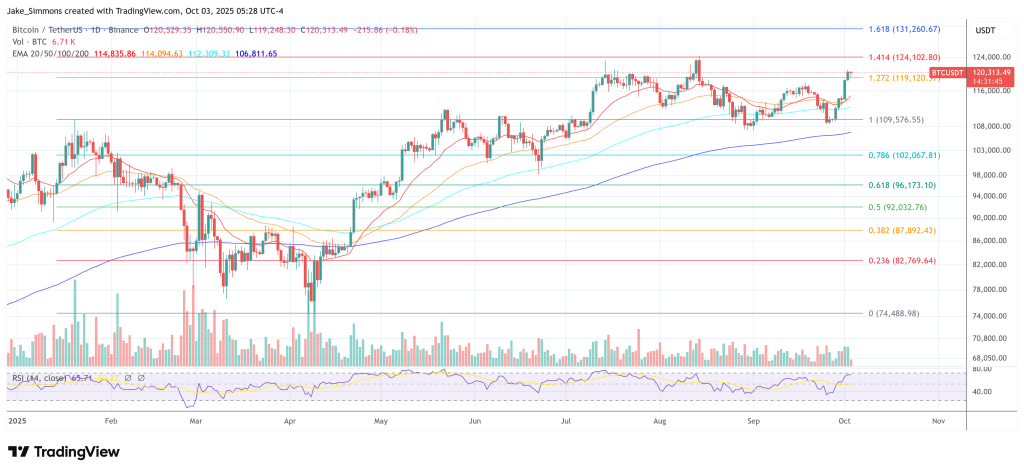
At press time, BTC traded at $120,313.

Bitcoin price
Market Opportunity
GAINS Logo
GAINS Price(GAINS)
$0.01231
$0.01231$0.01231
+0.40%
USD
GAINS (GAINS) Live Price Chart
Disclaimer: The articles reposted on this site are sourced from public platforms and are provided for informational purposes only. They do not necessarily reflect the views of MEXC. All rights remain with the original authors. If you believe any content infringes on third-party rights, please contact service@support.mexc.com for removal. MEXC makes no guarantees regarding the accuracy, completeness, or timeliness of the content and is not responsible for any actions taken based on the information provided. The content does not constitute financial, legal, or other professional advice, nor should it be considered a recommendation or endorsement by MEXC.

You May Also Like

Franklin Templeton CEO Dismisses 50bps Rate Cut Ahead FOMC

Franklin Templeton CEO Dismisses 50bps Rate Cut Ahead FOMC

The post Franklin Templeton CEO Dismisses 50bps Rate Cut Ahead FOMC appeared on BitcoinEthereumNews.com. Franklin Templeton CEO Jenny Johnson has weighed in on whether the Federal Reserve should make a 25 basis points (bps) Fed rate cut or 50 bps cut. This comes ahead of the Fed decision today at today’s FOMC meeting, with the market pricing in a 25 bps cut. Bitcoin and the broader crypto market are currently trading flat ahead of the rate cut decision. Franklin Templeton CEO Weighs In On Potential FOMC Decision In a CNBC interview, Jenny Johnson said that she expects the Fed to make a 25 bps cut today instead of a 50 bps cut. She acknowledged the jobs data, which suggested that the labor market is weakening. However, she noted that this data is backward-looking, indicating that it doesn’t show the current state of the economy. She alluded to the wage growth, which she remarked is an indication of a robust labor market. She added that retail sales are up and that consumers are still spending, despite inflation being sticky at 3%, which makes a case for why the FOMC should opt against a 50-basis-point Fed rate cut. In line with this, the Franklin Templeton CEO said that she would go with a 25 bps rate cut if she were Jerome Powell. She remarked that the Fed still has the October and December FOMC meetings to make further cuts if the incoming data warrants it. Johnson also asserted that the data show a robust economy. However, she noted that there can’t be an argument for no Fed rate cut since Powell already signaled at Jackson Hole that they were likely to lower interest rates at this meeting due to concerns over a weakening labor market. Notably, her comment comes as experts argue for both sides on why the Fed should make a 25 bps cut or…
Share
BitcoinEthereumNews2025/09/18 00:36
While Bitcoin Stagnates, Gold Breaks Record After Record! Is the Situation Too Bad for BTC? Bloomberg Analyst Explains!

While Bitcoin Stagnates, Gold Breaks Record After Record! Is the Situation Too Bad for BTC? Bloomberg Analyst Explains!

Jim Bianco argued that Bitcoin's adoption narrative has lost strength, while Bloomberg analyst Eric Balchunas maintained that BTC is still in good shape. Continue
Share
Coinstats2026/01/24 01:53
Your Closet Is Worth More Than You Think. Vinted Is Here to Prove It

Your Closet Is Worth More Than You Think. Vinted Is Here to Prove It

Europe’s leading fashion resale app, Vinted, has landed in New York, ready to help people turn their unworn clothes into cash and make space at home. One in five
Share
AI Journal2026/01/24 02:31
