Recent developments reveal that mainstream financial institutions are increasingly recognizing the strategic importance of the “debasement trade,” a move that could bolster assets like gold and Bitcoin amid ongoing concerns about fiat currency devaluation. As global monetary policies remain accommodative and debt levels rise, investors are seeking refuge in assets designed to preserve value in [...]Recent developments reveal that mainstream financial institutions are increasingly recognizing the strategic importance of the “debasement trade,” a move that could bolster assets like gold and Bitcoin amid ongoing concerns about fiat currency devaluation. As global monetary policies remain accommodative and debt levels rise, investors are seeking refuge in assets designed to preserve value in [...]

Bitcoin Surges as Dollar Weakness Sparks Debasement Trade Boom

Bitcoin Surges As Dollar Weakness Sparks Debasement Trade Boom
Recent developments reveal that mainstream financial institutions are increasingly recognizing the strategic importance of the “debasement trade,” a move that could bolster assets like gold and Bitcoin amid ongoing concerns about fiat currency devaluation. As global monetary policies remain accommodative and debt levels rise, investors are seeking refuge in assets designed to preserve value in a changing financial landscape.
  • Institutions are embracing the “debasement trade,” protecting portfolios against fiat currency devaluation.
  • Major assets like Bitcoin and gold are benefiting from the acknowledgment that money printing is unlikely to stop.
  • Experts describe the debasement trade as the “dark matter of finance,” affecting all markets indirectly.
  • Bitcoin is increasingly seen as more than just digital gold — a strategic hedge against currency debasement.
  • The U.S. dollar index shows significant decline, reflecting ongoing dollar debasement and international currency trends.

As fears over fiat currency devaluation grow, mainstream financial institutions are increasingly adopting the “debasement trade” as a core strategy, a shift that could have lasting implications for the cryptocurrency and precious metals markets. This approach involves positioning in assets like Bitcoin and gold, seen as safe havens amid ongoing monetary expansion. Experts suggest that this trend signals a major overhaul in how institutional investors view and incorporate hard assets in volatile economic conditions.

Debasement trade is the “dark matter of finance”

Bitwise’s chief investment officer, Matt Hougan, characterized the debasement trade as “the dark matter of finance,” pointing out that although it isn’t directly observable, it influences the entire financial ecosystem. Efforts to recognize and capitalize on the impending decline of fiat currencies are fueling inflows into Bitcoin, which is increasingly viewed as a reliable store of value in the era of persistent monetary expansion.

“Recognition of the ‘debasement trade’ is accelerating for a simple reason: deficits are mounting, debt is soaring, and accommodative policies suppress real yields,” said Brian Cubellis, chief strategy officer at Onramp Bitcoin. “Investors expecting ongoing currency dilution seek assets that won’t lose their value, which explains the rising interest in gold and Bitcoin.”

Fears about currency debasement are fueling a rally in crypto assets. Source: Bloomberg

Not just digital gold

Bitcoin’s role extends beyond being a digital version of gold, according to Enrique Ho, CFO of Blink Wallet. “Bitcoin is designed as an anti-debasement asset, with a fixed supply, transparent issuance, and trustless verification,” he explained. “It embodies the purest form of capital preservation in a financial landscape where currencies are constantly re-priced.”

U.S. dollar’s ongoing debasement

The weakening of the U.S. dollar is clearly reflected in the U.S. Dollar Index (DXY), which measures the dollar against a basket of currencies. This index has fallen approximately 12% this year, dropping from a high of 110 in January to a three-year low of 96.3 in mid-September, before recovering slightly in October, exemplifying the ongoing dollar debasement.
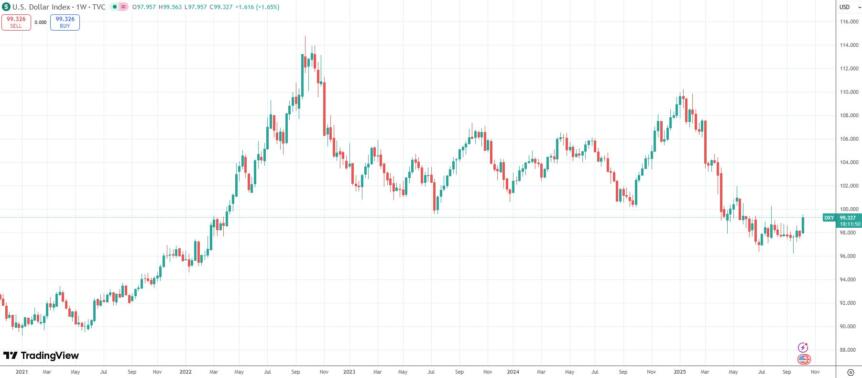
DXY in a sustained downtrend over the past three years. Source: TradingView

This article was originally published as Bitcoin Surges as Dollar Weakness Sparks Debasement Trade Boom on Crypto Breaking News – your trusted source for crypto news, Bitcoin news, and blockchain updates.


Market Opportunity
Polytrade Logo
Polytrade Price(TRADE)
$0.05354
$0.05354$0.05354
-0.66%
USD
Polytrade (TRADE) Live Price Chart
Disclaimer: The articles reposted on this site are sourced from public platforms and are provided for informational purposes only. They do not necessarily reflect the views of MEXC. All rights remain with the original authors. If you believe any content infringes on third-party rights, please contact service@support.mexc.com for removal. MEXC makes no guarantees regarding the accuracy, completeness, or timeliness of the content and is not responsible for any actions taken based on the information provided. The content does not constitute financial, legal, or other professional advice, nor should it be considered a recommendation or endorsement by MEXC.

You May Also Like

The Channel Factories We’ve Been Waiting For

The Channel Factories We’ve Been Waiting For

The post The Channel Factories We’ve Been Waiting For appeared on BitcoinEthereumNews.com. Visions of future technology are often prescient about the broad strokes while flubbing the details. The tablets in “2001: A Space Odyssey” do indeed look like iPads, but you never see the astronauts paying for subscriptions or wasting hours on Candy Crush.  Channel factories are one vision that arose early in the history of the Lightning Network to address some challenges that Lightning has faced from the beginning. Despite having grown to become Bitcoin’s most successful layer-2 scaling solution, with instant and low-fee payments, Lightning’s scale is limited by its reliance on payment channels. Although Lightning shifts most transactions off-chain, each payment channel still requires an on-chain transaction to open and (usually) another to close. As adoption grows, pressure on the blockchain grows with it. The need for a more scalable approach to managing channels is clear. Channel factories were supposed to meet this need, but where are they? In 2025, subnetworks are emerging that revive the impetus of channel factories with some new details that vastly increase their potential. They are natively interoperable with Lightning and achieve greater scale by allowing a group of participants to open a shared multisig UTXO and create multiple bilateral channels, which reduces the number of on-chain transactions and improves capital efficiency. Achieving greater scale by reducing complexity, Ark and Spark perform the same function as traditional channel factories with new designs and additional capabilities based on shared UTXOs.  Channel Factories 101 Channel factories have been around since the inception of Lightning. A factory is a multiparty contract where multiple users (not just two, as in a Dryja-Poon channel) cooperatively lock funds in a single multisig UTXO. They can open, close and update channels off-chain without updating the blockchain for each operation. Only when participants leave or the factory dissolves is an on-chain transaction…
Share
BitcoinEthereumNews2025/09/18 00:09
Franklin Templeton CEO Dismisses 50bps Rate Cut Ahead FOMC

Franklin Templeton CEO Dismisses 50bps Rate Cut Ahead FOMC

The post Franklin Templeton CEO Dismisses 50bps Rate Cut Ahead FOMC appeared on BitcoinEthereumNews.com. Franklin Templeton CEO Jenny Johnson has weighed in on whether the Federal Reserve should make a 25 basis points (bps) Fed rate cut or 50 bps cut. This comes ahead of the Fed decision today at today’s FOMC meeting, with the market pricing in a 25 bps cut. Bitcoin and the broader crypto market are currently trading flat ahead of the rate cut decision. Franklin Templeton CEO Weighs In On Potential FOMC Decision In a CNBC interview, Jenny Johnson said that she expects the Fed to make a 25 bps cut today instead of a 50 bps cut. She acknowledged the jobs data, which suggested that the labor market is weakening. However, she noted that this data is backward-looking, indicating that it doesn’t show the current state of the economy. She alluded to the wage growth, which she remarked is an indication of a robust labor market. She added that retail sales are up and that consumers are still spending, despite inflation being sticky at 3%, which makes a case for why the FOMC should opt against a 50-basis-point Fed rate cut. In line with this, the Franklin Templeton CEO said that she would go with a 25 bps rate cut if she were Jerome Powell. She remarked that the Fed still has the October and December FOMC meetings to make further cuts if the incoming data warrants it. Johnson also asserted that the data show a robust economy. However, she noted that there can’t be an argument for no Fed rate cut since Powell already signaled at Jackson Hole that they were likely to lower interest rates at this meeting due to concerns over a weakening labor market. Notably, her comment comes as experts argue for both sides on why the Fed should make a 25 bps cut or…
Share
BitcoinEthereumNews2025/09/18 00:36
Tom Lee’s Bitmine Scoops Up 3.4% of Ethereum, Triggering a Supply Squeeze

Tom Lee’s Bitmine Scoops Up 3.4% of Ethereum, Triggering a Supply Squeeze

Bitmine Immersion now controls 3.4% of Ethereum amid shrinking exchange supply and rising institutional accumulation.
Share
Crypto Breaking News2026/01/20 16:27