TLDR Citi stock climbs as investors await Q3 earnings and crypto custody plans. Citigroup eyes 2026 crypto custody rollout, stock rebounds pre-earnings. Citi stock bounces back; digital asset custody and stablecoin plans grow. Investors rally on Citi’s crypto push and stablecoin expansion by 2026. Citigroup surges on digital asset and stablecoin momentum ahead of Q3 [...] The post Citigroup (C) Stock: Pre-Market Rebound as Q3 Earnings and Crypto Custody Service Draw Attention appeared first on CoinCentral.TLDR Citi stock climbs as investors await Q3 earnings and crypto custody plans. Citigroup eyes 2026 crypto custody rollout, stock rebounds pre-earnings. Citi stock bounces back; digital asset custody and stablecoin plans grow. Investors rally on Citi’s crypto push and stablecoin expansion by 2026. Citigroup surges on digital asset and stablecoin momentum ahead of Q3 [...] The post Citigroup (C) Stock: Pre-Market Rebound as Q3 Earnings and Crypto Custody Service Draw Attention appeared first on CoinCentral.

Citigroup (C) Stock: Pre-Market Rebound as Q3 Earnings and Crypto Custody Service Draw Attention

TLDR

  • Citi stock climbs as investors await Q3 earnings and crypto custody plans.
  • Citigroup eyes 2026 crypto custody rollout, stock rebounds pre-earnings.
  • Citi stock bounces back; digital asset custody and stablecoin plans grow.
  • Investors rally on Citi’s crypto push and stablecoin expansion by 2026.
  • Citigroup surges on digital asset and stablecoin momentum ahead of Q3 call.

Citigroup’s stock rebounded in pre-market trading on October 11, 2025, following a previous day’s decline of over 2%. The stock rose to $95.50, up 1.67%, reflecting renewed interest as the market eyes the Q3 2025 earnings call. Analysts expect key updates on Citigroup’s financial outlook and crypto custody initiative, which is targeted for launch in 2026.
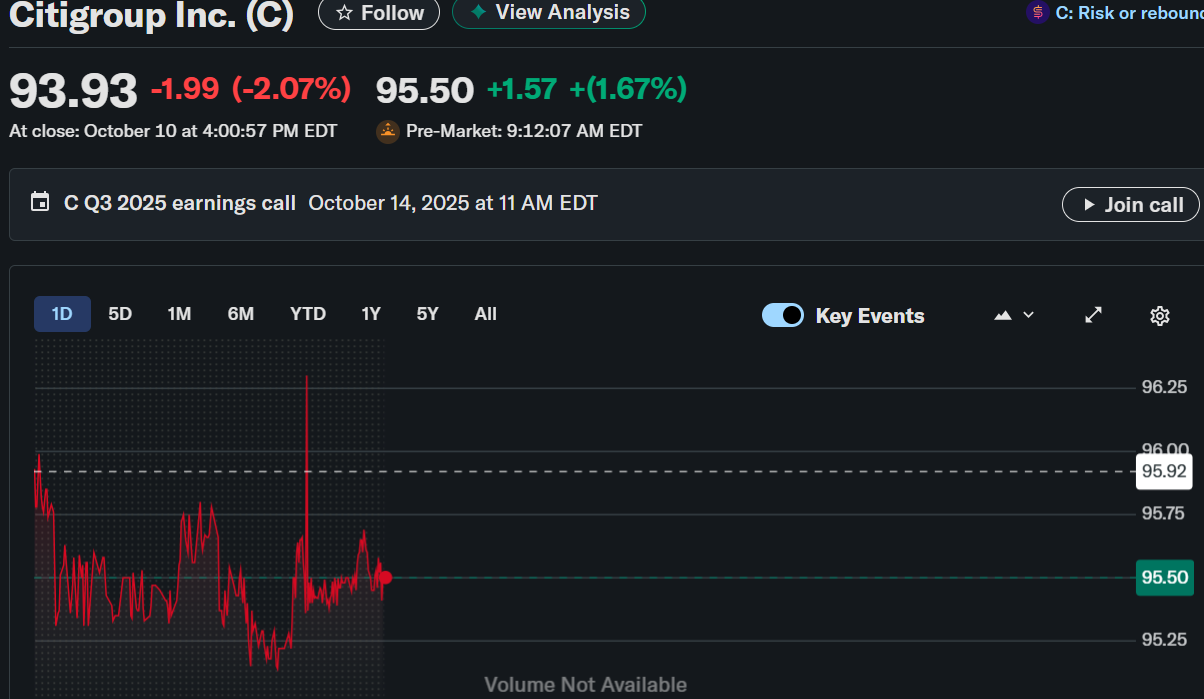
Citigroup (C)

Crypto Custody Rollout Planned for 2026

Citigroup is preparing to launch a digital asset custody service by 2026, expanding its footprint in the crypto infrastructure sector. The service will enable the bank to hold native digital currencies for its institutional clients securely. Development efforts over the past two years have positioned Citi to enter the market with an in-house and partner-driven solution.

The bank is considering multiple strategies to efficiently manage custody risks and asset classes. Some platforms may rely entirely on internal systems, while others could involve partnerships with smaller third-party tech firms. This hybrid model allows flexibility as digital asset demands evolve among clients.

Digital asset custody plays a crucial role in facilitating secure access to cryptocurrency markets. Citi’s move marks a shift as traditional financial firms begin offering more blockchain-based services. While some competitors remain hesitant, Citi is progressing toward formal product deployment.

Stablecoin Services Gain Traction

In parallel, Citi is exploring stablecoins as a cross-border payment tool for clients in emerging markets. These tokens, backed by real-world assets, enable quick settlements even when banks are closed. The initiative supports Citi’s broader aim to deliver uninterrupted transaction solutions globally.

The bank’s internal unit, Citi Token Services, already facilitates 24/7 money transfers. However, stablecoins could extend reach to areas with underdeveloped financial systems. Citi believes such technology can support growing client activity in high-demand international regions.

Last week, Citi invested in stablecoin firm BVNK, signaling its growing commitment. The bank is still testing its approach and evaluating regulatory frameworks. With demand expanding, more updates on stablecoin strategy are expected in future briefings.


The post Citigroup (C) Stock: Pre-Market Rebound as Q3 Earnings and Crypto Custody Service Draw Attention appeared first on CoinCentral.

Market Opportunity
Chainbase Logo
Chainbase Price(C)
$0.06873
$0.06873$0.06873
-0.63%
USD
Chainbase (C) Live Price Chart
Disclaimer: The articles reposted on this site are sourced from public platforms and are provided for informational purposes only. They do not necessarily reflect the views of MEXC. All rights remain with the original authors. If you believe any content infringes on third-party rights, please contact service@support.mexc.com for removal. MEXC makes no guarantees regarding the accuracy, completeness, or timeliness of the content and is not responsible for any actions taken based on the information provided. The content does not constitute financial, legal, or other professional advice, nor should it be considered a recommendation or endorsement by MEXC.

You May Also Like

The Channel Factories We’ve Been Waiting For

The Channel Factories We’ve Been Waiting For

The post The Channel Factories We’ve Been Waiting For appeared on BitcoinEthereumNews.com. Visions of future technology are often prescient about the broad strokes while flubbing the details. The tablets in “2001: A Space Odyssey” do indeed look like iPads, but you never see the astronauts paying for subscriptions or wasting hours on Candy Crush.  Channel factories are one vision that arose early in the history of the Lightning Network to address some challenges that Lightning has faced from the beginning. Despite having grown to become Bitcoin’s most successful layer-2 scaling solution, with instant and low-fee payments, Lightning’s scale is limited by its reliance on payment channels. Although Lightning shifts most transactions off-chain, each payment channel still requires an on-chain transaction to open and (usually) another to close. As adoption grows, pressure on the blockchain grows with it. The need for a more scalable approach to managing channels is clear. Channel factories were supposed to meet this need, but where are they? In 2025, subnetworks are emerging that revive the impetus of channel factories with some new details that vastly increase their potential. They are natively interoperable with Lightning and achieve greater scale by allowing a group of participants to open a shared multisig UTXO and create multiple bilateral channels, which reduces the number of on-chain transactions and improves capital efficiency. Achieving greater scale by reducing complexity, Ark and Spark perform the same function as traditional channel factories with new designs and additional capabilities based on shared UTXOs.  Channel Factories 101 Channel factories have been around since the inception of Lightning. A factory is a multiparty contract where multiple users (not just two, as in a Dryja-Poon channel) cooperatively lock funds in a single multisig UTXO. They can open, close and update channels off-chain without updating the blockchain for each operation. Only when participants leave or the factory dissolves is an on-chain transaction…
Share
BitcoinEthereumNews2025/09/18 00:09
‘Sinners’ Earns 16 Oscar Nominations, Shattering All-Time Record

‘Sinners’ Earns 16 Oscar Nominations, Shattering All-Time Record

The post ‘Sinners’ Earns 16 Oscar Nominations, Shattering All-Time Record appeared on BitcoinEthereumNews.com. Topline “Sinners” shattered a 75-year-old record
Share
BitcoinEthereumNews2026/01/23 02:34
‘Return To Silent Hill’ Is The Worst-Reviewed Video Game Movie In 19 Years

‘Return To Silent Hill’ Is The Worst-Reviewed Video Game Movie In 19 Years

The post ‘Return To Silent Hill’ Is The Worst-Reviewed Video Game Movie In 19 Years appeared on BitcoinEthereumNews.com. Return to Silent Hil Return to Silent Hil
Share
BitcoinEthereumNews2026/01/23 02:19