This paper examines how auction theory and randomized scheduling algorithms can improve transaction fee mechanisms (TFMs) in blockchain systems. It highlights a critical gap in current research: most models assume myopic miners and overlook transactions with finite lifetimes. By incorporating deadline-aware and non-myopic perspectives, the study draws parallels with fields like job scheduling and packet management, proposing a more robust, time-sensitive framework for blockchain resource allocation.This paper examines how auction theory and randomized scheduling algorithms can improve transaction fee mechanisms (TFMs) in blockchain systems. It highlights a critical gap in current research: most models assume myopic miners and overlook transactions with finite lifetimes. By incorporating deadline-aware and non-myopic perspectives, the study draws parallels with fields like job scheduling and packet management, proposing a more robust, time-sensitive framework for blockchain resource allocation.

How Auction Theory Shapes Smarter Blockchain Transaction Fee Models

Abstract and 1. Introduction

1.1 Our Approach

1.2 Our Results & Roadmap

1.3 Related Work

  1. Model and Warmup and 2.1 Blockchain Model

    2.2 The Miner

    2.3 Game Model

    2.4 Warm Up: The Greedy Allocation Function

  2. The Deterministic Case and 3.1 Deterministic Upper Bound

    3.2 The Immediacy-Biased Class Of Allocation Function

  3. The Randomized Case

  4. Discussion and References

  • A. Missing Proofs for Sections 2, 3
  • B. Missing Proofs for Section 4
  • C. Glossary

2 Model and Warmup

Our game proceeds in T ∈ N turns. At each one, a set of new transactions is broadcast to the network by users, and a miner is chosen to create the upcoming block. The miner, assumed to be profit-maximizing, has the sole authority to decide which transactions to allocate to its block, among the set of valid transactions which were not allocated beforehand.

\ We proceed to formally define the model. A summary of all notations appears in Appendix C.

2.1 Blockchain Model

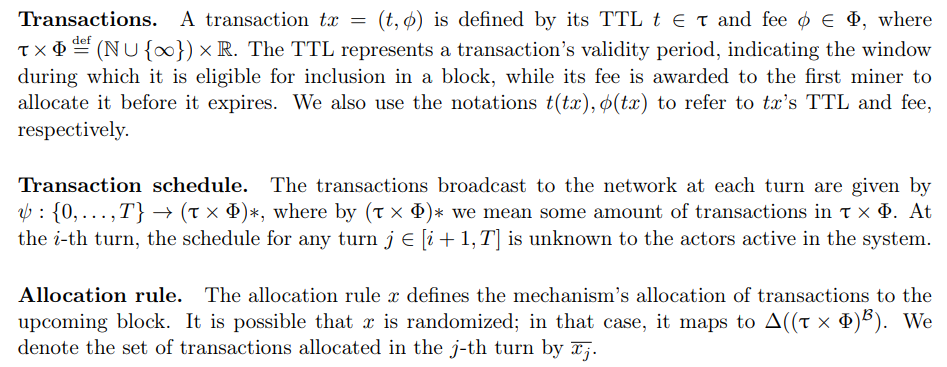
Blocks. Blocks have a predefined maximal capacity of B ∈ N∪ {∞} identically-sized transactions. We focus on the case where B = 1

\
2.2 The Miner

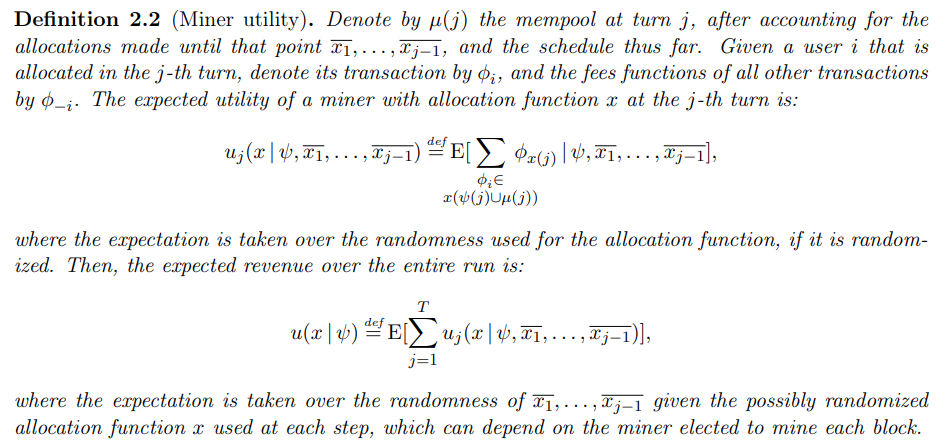
We examine a far-sighted miner who plans the allocation of transactions to the next T blocks.

\ Allocation strategy. The miner’s allocation strategy is given by its allocation function x.

\ Discount factor. Miners may prefer to receive revenue earlier rather than later, as dependent on the economy’s interest rate. For example, this could be due to the profit which a miner participating in a PoS mechanism can obtain by staking funds, or a Proof-of-Work (PoW) miner can make by using its funds to purchase additional mining equipment. This is captured by the miner’s discount factor, denoted by λ ≤ 1.

\ \

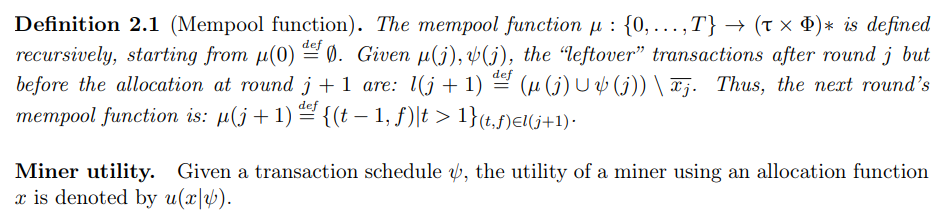
\ \ Mempool. The miner stores valid transactions that were not yet allocated to a block or expired in a data structure called the memory pool (mempool). Transactions which are not allocated to the upcoming block have to wait at least one more block until being mined, but some may become ineligible for inclusion as dependent on their TTL, which decreases by 1 with each passing turn. We define a mempool function that outputs the set of transactions viable for inclusion in each block.

\ \
\ \ \
\ \ \

\ \ \

:::info Authors:

(1) Yotam Gafni, Weizmann Institute (yotam.gafni@gmail.com);

(2) Aviv Yaish, The Hebrew University, Jerusalem (aviv.yaish@mail.huji.ac.il).

:::


:::info This paper is available on arxiv under CC BY 4.0 DEED license.

:::

\

Market Opportunity
BounceToken Logo
BounceToken Price(AUCTION)
$4.803
$4.803$4.803
+1.09%
USD
BounceToken (AUCTION) Live Price Chart
Disclaimer: The articles reposted on this site are sourced from public platforms and are provided for informational purposes only. They do not necessarily reflect the views of MEXC. All rights remain with the original authors. If you believe any content infringes on third-party rights, please contact service@support.mexc.com for removal. MEXC makes no guarantees regarding the accuracy, completeness, or timeliness of the content and is not responsible for any actions taken based on the information provided. The content does not constitute financial, legal, or other professional advice, nor should it be considered a recommendation or endorsement by MEXC.

You May Also Like

X3 Acquisition Corp. Ltd. Announces Closing of $200,000,000 Initial Public Offering

X3 Acquisition Corp. Ltd. Announces Closing of $200,000,000 Initial Public Offering

MINNEAPOLIS–(BUSINESS WIRE)–X3 Acquisition Corp. Ltd. (Nasdaq: XCBEU) (the “Company”), a newly organized special purpose acquisition company formed as a Cayman
Share
AI Journal2026/01/23 05:46
North America’s Largest RV Dealers Still Failing Google Core Web Vitals–Overfuel Reports Nearly 79% Failure Rate for Second Year

North America’s Largest RV Dealers Still Failing Google Core Web Vitals–Overfuel Reports Nearly 79% Failure Rate for Second Year

INDIANAPOLIS, Jan. 22, 2026 /PRNewswire/ — Overfuel, a website solutions provider for automotive, powersports and RV dealers, today announced the findings of its
Share
AI Journal2026/01/23 05:15
3 Paradoxes of Altcoin Season in September

3 Paradoxes of Altcoin Season in September

The post 3 Paradoxes of Altcoin Season in September appeared on BitcoinEthereumNews.com. Analyses and data indicate that the crypto market is experiencing its most active altcoin season since early 2025, with many altcoins outperforming Bitcoin. However, behind this excitement lies a paradox. Most retail investors remain uneasy as their portfolios show little to no profit. This article outlines the main reasons behind this situation. Altcoin Market Cap Rises but Dominance Shrinks Sponsored TradingView data shows that the TOTAL3 market cap (excluding BTC and ETH) reached a new high of over $1.1 trillion in September. Yet the share of OTHERS (excluding the top 10) has declined since 2022, now standing at just 8%. OTHERS Dominance And TOTAL3 Capitalization. Source: TradingView. In past cycles, such as 2017 and 2021, TOTAL3 and OTHERS.D rose together. That trend reflected capital flowing not only into large-cap altcoins but also into mid-cap and low-cap ones. The current divergence shows that capital is concentrated in stablecoins and a handful of top-10 altcoins such as SOL, XRP, BNB, DOG, HYPE, and LINK. Smaller altcoins receive far less liquidity, making it hard for their prices to return to levels where investors previously bought. This creates a situation where only a few win while most face losses. Retail investors also tend to diversify across many coins instead of adding size to top altcoins. That explains why many portfolios remain stagnant despite a broader market rally. Sponsored “Position sizing is everything. Many people hold 25–30 tokens at once. A 100x on a token that makes up only 1% of your portfolio won’t meaningfully change your life. It’s better to make a few high-conviction bets than to overdiversify,” analyst The DeFi Investor said. Altcoin Index Surges but Investor Sentiment Remains Cautious The Altcoin Season Index from Blockchain Center now stands at 80 points. This indicates that over 80% of the top 50 altcoins outperformed…
Share
BitcoinEthereumNews2025/09/18 01:43




