WormHole is a two-phase algorithm for answering many shortest-path queries on large, power-law (core-periphery) networks with limited node access. It first preprocesses just enough of the graph to extract a dense, sublinear “inner ring” core. At query time, it runs truncated BiBFS to detect same-community cases; otherwise it routes both ends to the outer ring, hops into the inner ring, and finds a path there—returning exact paths in common cases and near-shortest paths otherwise. The payoff: far fewer node queries and memory, fast responses, and low mean additive error across queries.WormHole is a two-phase algorithm for answering many shortest-path queries on large, power-law (core-periphery) networks with limited node access. It first preprocesses just enough of the graph to extract a dense, sublinear “inner ring” core. At query time, it runs truncated BiBFS to detect same-community cases; otherwise it routes both ends to the outer ring, hops into the inner ring, and finds a path there—returning exact paths in common cases and near-shortest paths otherwise. The payoff: far fewer node queries and memory, fast responses, and low mean additive error across queries.

Finding Shortest Paths Faster With Less Data

Abstract and 1. Introduction

1.1 Our Contribution

1.2 Setting

1.3 The algorithm

  1. Related Work

  2. Algorithm

    3.1 The Structural Decomposition Phase

    3.2 The Routing Phase

    3.3 Variants of WormHole

  3. Theoretical Analysis

    4.1 Preliminaries

    4.2 Sublinearity of Inner Ring

    4.3 Approximation Error

    4.4 Query Complexity

  4. Experimental Results

    5.1 WormHole𝐸, WormHole𝐻 and BiBFS

    5.2 Comparison with index-based methods

    5.3 WormHole as a primitive: WormHole𝑀

References

1.2 Setting

We consider the problem of constructing a data structure for approximately answering shortest-path inquiries between pairs

\
\ of vertices (𝑠,𝑡) in an undirected graph𝐺, given limited query access to the graph.

\ Query model. Access to the network is given through the standard node query model [10, 14], where we start with an arbitrary seed vertex as the “access point” to the network, and querying a node 𝑣 reveals its list of neighbors Γ(𝑣). Unlike existing index-based solutions, which perform preprocessing on the whole graph, we aim for a solution that queries and stores only a small fraction of the nodes in the network.

\ Objective. Following the initialization of the data structure, the task is to answer multiple shortest path inquiries, where each inquiry SP(𝑠,𝑡) needs to be answered with a valid path 𝑝0𝑝1 …𝑝ℓ between 𝑠 = 𝑝0 and 𝑡 = 𝑝ℓ , and the objective is to minimize the mean additive error measured over all inquiries. The additive error for an inquiry SP(𝑠,𝑡) is the difference between the length of the returned𝑠–𝑡 path and the actual shortest distance between 𝑠 and 𝑡 in 𝐺. Depending on the specific application, one would like to minimize (a subset of) the additive error, running time, memory and/or node queries.

\ Core-periphery structure. The degree distribution in social and information networks often follows a power-law distribution with exponent 2<𝛽 <3, which results in a core-periphery structure [9, 43, 50, 52, 63], where the core is a highly connected component with good expansion properties, consisting of higher degree nodes, while the periphery is a collection of small, poorly connected components of low degree.

\ Our data structure is designed for networks exhibiting these structural characteristics. It takes advantage of the structure by first performing a preprocessing step to acquire (parts of) the core of the network, and then answering approximate shortest path inquiries by routing through the core. The working hypothesis is that pairs of nodes that are sufficiently far apart will typically have the shortest path between them (or close to it) routed through the higher degree parts of the network. This is somewhat reminiscent of approaches based on the highway dimension [1–3] for routing in road networks, although the structural characteristics of these network types differ considerably

\

1.3 The algorithm

WormHole builds an explicit hierarchical core-periphery type structure with a sublinear inner ring and provides a framework which uses this structure to answer shortest path inquiries. There are two phases:

\ • A preprocessing step where we decompose the graph into three partitions, storing only the smallest one: a highly dense subgraph of sublinear size.

\ • The phase where we answer inquiries: here the algorithm (approximately) answers shortest path inquiries of the form SP(𝑠,𝑡) for arbitrary vertex pairs (𝑠,𝑡).

\ We elaborate on the two phases.

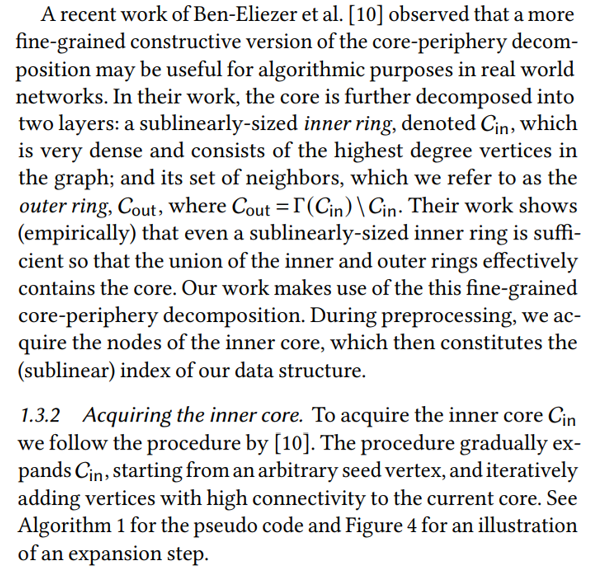
\ 1.3.1 The decomposition. It is well-documented that social networks exhibit a core-periphery structure; see, e.g., [43, 50, 52, 63] and the many references within. The core is a highly-connected component with good expansion properties and smaller effective diameter. The periphery, denoted P, consists of smaller isolated communities that connect to the core, but are sparsely connected internally, and whose union is of linear size [16]. Therefore, when answering shortest path inquiries, it is reasonable to first check if the two vertices are in the same peripheral community, and otherwise route through the core.

\ \
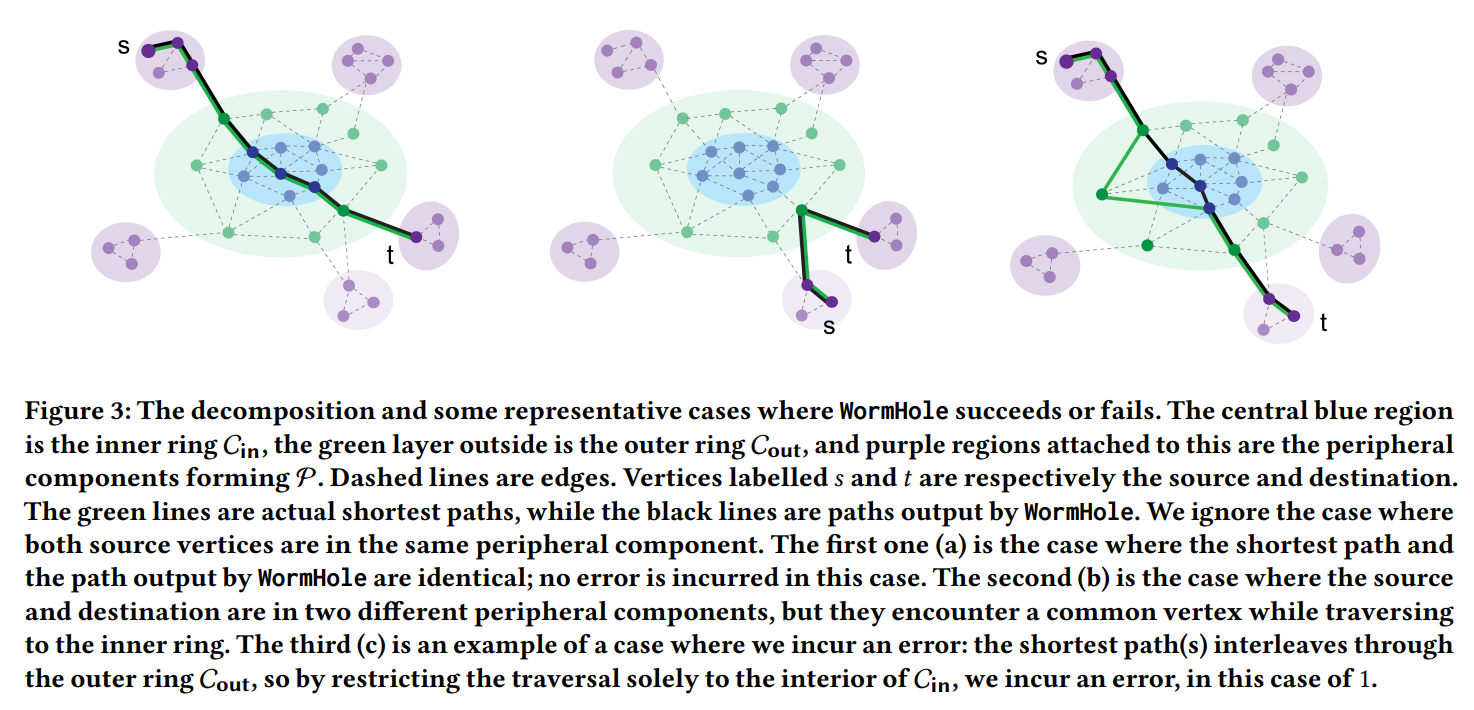
\ \ 1.3.3 Answering shortest-path queries. In the second phase, given a query SP(𝑠,𝑡), WormHole does the following. First, it checks if the two vertices are in the same peripheral component, by performing a truncated BiBFS from both 𝑠 and 𝑡 up to depth two. If the two trees collide, it returns the shortest path between 𝑠 and 𝑡. Otherwise, WormHole continues both BFS traversals until it reaches the outer ring (from both 𝑠 and 𝑡). From here, it takes a single step to reach the inner ring, and then performs a restricted BiBFS on the subgraph induced by the inner ring vertices. We note that the choice of BiBFS here is arbitrary, and we can use any shortest-path algorithm (including modern index-based approaches, initialized only on the inner core) as a black-box to find a shortest path in the inner ring.

\ Figure 3 illustrates a few typical cases encountered by the algorithm; in the first two cases the algorithm returns a true shortest path, and in the third case the returned path is not a shortest path (thus incurring a nonzero additive error).

\ We stress that a single decomposition is subsequently used to answer all shortest path queries. Theorem 1.1 provides a strong theoretical guarantee on the performance of WormHole. It is worth emphasizing that our notion of approximation is inspired by practical relaxations, and is distinct from the one usually considered in theoretical works.

\

:::info Authors:

(1) Talya Eden, Bar-Ilan University (talyaa01@gmail.com);

(2) Omri Ben-Eliezer, MIT (omrib@mit.edu);

(3) C. Seshadhri, UC Santa Cruz (sesh@ucsc.edu).

:::


:::info This paper is available on arxiv under CC BY 4.0 license.

:::

\

Market Opportunity
Core DAO Logo
Core DAO Price(CORE)
$0.1162
$0.1162$0.1162
+1.66%
USD
Core DAO (CORE) Live Price Chart
Disclaimer: The articles reposted on this site are sourced from public platforms and are provided for informational purposes only. They do not necessarily reflect the views of MEXC. All rights remain with the original authors. If you believe any content infringes on third-party rights, please contact service@support.mexc.com for removal. MEXC makes no guarantees regarding the accuracy, completeness, or timeliness of the content and is not responsible for any actions taken based on the information provided. The content does not constitute financial, legal, or other professional advice, nor should it be considered a recommendation or endorsement by MEXC.

You May Also Like

House Judiciary Rejects Vote To Subpoena Banks CEOs For Epstein Case

House Judiciary Rejects Vote To Subpoena Banks CEOs For Epstein Case

The post House Judiciary Rejects Vote To Subpoena Banks CEOs For Epstein Case appeared on BitcoinEthereumNews.com. Topline House Judiciary Committee Republicans blocked a Democrat effort Wednesday to subpoena a group of major banks as part of a renewed investigation into late sex offender Jeffrey Epstein’s financial ties. Congressman Jim Jordan, R-OH, is the chairman of the committee. (Photo by Nathan Posner/Anadolu via Getty Images) Anadolu via Getty Images Key Facts A near party-line vote squashed the effort to vote on a subpoena, with Rep. Thomas Massie, R-Ky., who is leading a separate effort to force the Justice Department to release more Epstein case materials, voting alongside Democrats. The vote, if successful, would have resulted in the issuing of subpoenas to JPMorgan Chase CEO Jamie Dimon, Bank of America CEO Brian Moynihan, Deutsche Bank CEO Christian Sewing and Bank of New York Mellon CEO Robin Vince. The subpoenas would have specifically looked into multiple reports that claimed the four banks flagged $1.5 billion in suspicious transactions linked to Epstein. The failed effort from Democrats followed an FBI oversight hearing in which agency director Kash Patel misleadingly claimed the FBI cannot release many of the files it has on Epstein. Get Forbes Breaking News Text Alerts: We’re launching text message alerts so you’ll always know the biggest stories shaping the day’s headlines. Text “Alerts” to (201) 335-0739 or sign up here. Crucial Quote Dimon, who attended a lunch with Senate Republicans before the vote, according to Politico, told reporters, “We regret any association with that man at all. And, of course, if it’s a legal requirement, we would conform to it. We have no issue with that.” Chief Critic “Republicans had the chance to subpoena the CEOs of JPMorgan, Bank of America, Deutsche Bank, and Bank of New York Mellon to expose Epstein’s money trail,” the House Judiciary Democrats said in a tweet. “Instead, they tried to bury…
Share
BitcoinEthereumNews2025/09/18 08:02
Polygon Tops RWA Rankings With $1.1B in Tokenized Assets

Polygon Tops RWA Rankings With $1.1B in Tokenized Assets

The post Polygon Tops RWA Rankings With $1.1B in Tokenized Assets appeared on BitcoinEthereumNews.com. Key Notes A new report from Dune and RWA.xyz highlights Polygon’s role in the growing RWA sector. Polygon PoS currently holds $1.13 billion in RWA Total Value Locked (TVL) across 269 assets. The network holds a 62% market share of tokenized global bonds, driven by European money market funds. The Polygon POL $0.25 24h volatility: 1.4% Market cap: $2.64 B Vol. 24h: $106.17 M network is securing a significant position in the rapidly growing tokenization space, now holding over $1.13 billion in total value locked (TVL) from Real World Assets (RWAs). This development comes as the network continues to evolve, recently deploying its major “Rio” upgrade on the Amoy testnet to enhance future scaling capabilities. This information comes from a new joint report on the state of the RWA market published on Sept. 17 by blockchain analytics firm Dune and data platform RWA.xyz. The focus on RWAs is intensifying across the industry, coinciding with events like the ongoing Real-World Asset Summit in New York. Sandeep Nailwal, CEO of the Polygon Foundation, highlighted the findings via a post on X, noting that the TVL is spread across 269 assets and 2,900 holders on the Polygon PoS chain. The Dune and https://t.co/W6WSFlHoQF report on RWA is out and it shows that RWA is happening on Polygon. Here are a few highlights: – Leading in Global Bonds: Polygon holds 62% share of tokenized global bonds (driven by Spiko’s euro MMF and Cashlink euro issues) – Spiko U.S.… — Sandeep | CEO, Polygon Foundation (※,※) (@sandeepnailwal) September 17, 2025 Key Trends From the 2025 RWA Report The joint publication, titled “RWA REPORT 2025,” offers a comprehensive look into the tokenized asset landscape, which it states has grown 224% since the start of 2024. The report identifies several key trends driving this expansion. According to…
Share
BitcoinEthereumNews2025/09/18 00:40
transcosmos helping Chinese lingerie brand LING LINGERIE’s full-fledged entry into Japan

transcosmos helping Chinese lingerie brand LING LINGERIE’s full-fledged entry into Japan

Executing strategies to help LING LINGERIE, a Chinese brand meeting Gen Z needs, boost awareness TOKYO, Jan. 23, 2026 /PRNewswire/ — transcosmos today announced
Share
AI Journal2026/01/23 19:30