The cryptocurrency Fear & Greed Index has plummeted into the extreme fear territory following the crash in Bitcoin and other assets. Bitcoin Fear & Greed Index Is Now Pointing At “Extreme Fear” The “Fear & Greed Index” is an indicator created by Alternative that uses the data of several factors to determine the net sentiment present among traders in the Bitcoin and wider cryptocurrency markets. The factors in question include volatility, trading volume, market cap dominance, social media sentiment, and Google Trends. The index makes use of a scale running from 0-100 for representing the investor mentality. All values above 53 imply the traders are greedy, while those below 47 suggest a fearful market. Values lying between the two cutoffs correspond to a net neutral sentiment. Related Reading: Next Dogecoin Stop Could Be $0.33 If This Level Holds, Analyst Says Besides these three main sentiments, there are also two “extreme” zones called the extreme fear (below 25) and extreme greed (above 75). Currently, the market is in the former of the two. As displayed above, the Fear & Greed Index has a value of 22 at the moment, which is just inside the extreme fear zone. This is a deterioration compared to the last few days, when the indicator held normal fear values. The reason behind the slide into the extreme fear territory naturally lies in the bearish action that Bitcoin and other cryptocurrencies have faced recently. In particular, the market has suffered a sharp move down during the past day. Last week also ended with a rapid drawdown in BTC and company, and then too sentiment took a large hit, with the index registering a low of 24. This previous turnaround in sentiment was also much more drastic than the latest one, as it took the metric from greed values all the way down into the extreme fear zone in a flash. Historically, the extreme sentiments have held much importance for Bitcoin and other digital assets, as major tops and bottoms have often occurred in these regions. The relationship has been an inverse one, however, meaning that extreme fear can result in a bottom, while extreme greed can lead to a top. Related Reading: Bitcoin Back Under $111,000 As Key Holders Shed 17,500 BTC The plunge into extreme fear earlier also paved the way to a bottom, although it proved to be only a temporary one. With the Fear & Greed Index back in the zone, it will be interesting to see how the Bitcoin price will develop in the coming days. BTC Price At the time of writing, Bitcoin is trading around $105,600, down 13% over the last week. Featured image from Dall-E, Alternative.me, chart from TradingView.comThe cryptocurrency Fear & Greed Index has plummeted into the extreme fear territory following the crash in Bitcoin and other assets. Bitcoin Fear & Greed Index Is Now Pointing At “Extreme Fear” The “Fear & Greed Index” is an indicator created by Alternative that uses the data of several factors to determine the net sentiment present among traders in the Bitcoin and wider cryptocurrency markets. The factors in question include volatility, trading volume, market cap dominance, social media sentiment, and Google Trends. The index makes use of a scale running from 0-100 for representing the investor mentality. All values above 53 imply the traders are greedy, while those below 47 suggest a fearful market. Values lying between the two cutoffs correspond to a net neutral sentiment. Related Reading: Next Dogecoin Stop Could Be $0.33 If This Level Holds, Analyst Says Besides these three main sentiments, there are also two “extreme” zones called the extreme fear (below 25) and extreme greed (above 75). Currently, the market is in the former of the two. As displayed above, the Fear & Greed Index has a value of 22 at the moment, which is just inside the extreme fear zone. This is a deterioration compared to the last few days, when the indicator held normal fear values. The reason behind the slide into the extreme fear territory naturally lies in the bearish action that Bitcoin and other cryptocurrencies have faced recently. In particular, the market has suffered a sharp move down during the past day. Last week also ended with a rapid drawdown in BTC and company, and then too sentiment took a large hit, with the index registering a low of 24. This previous turnaround in sentiment was also much more drastic than the latest one, as it took the metric from greed values all the way down into the extreme fear zone in a flash. Historically, the extreme sentiments have held much importance for Bitcoin and other digital assets, as major tops and bottoms have often occurred in these regions. The relationship has been an inverse one, however, meaning that extreme fear can result in a bottom, while extreme greed can lead to a top. Related Reading: Bitcoin Back Under $111,000 As Key Holders Shed 17,500 BTC The plunge into extreme fear earlier also paved the way to a bottom, although it proved to be only a temporary one. With the Fear & Greed Index back in the zone, it will be interesting to see how the Bitcoin price will develop in the coming days. BTC Price At the time of writing, Bitcoin is trading around $105,600, down 13% over the last week. Featured image from Dall-E, Alternative.me, chart from TradingView.com

Bitcoin Crashes To $105,000, Sentiment Sinks Into Extreme Fear

2025/10/18 16:00

The cryptocurrency Fear & Greed Index has plummeted into the extreme fear territory following the crash in Bitcoin and other assets.

Bitcoin Fear & Greed Index Is Now Pointing At “Extreme Fear”

The “Fear & Greed Index” is an indicator created by Alternative that uses the data of several factors to determine the net sentiment present among traders in the Bitcoin and wider cryptocurrency markets. The factors in question include volatility, trading volume, market cap dominance, social media sentiment, and Google Trends.

The index makes use of a scale running from 0-100 for representing the investor mentality. All values above 53 imply the traders are greedy, while those below 47 suggest a fearful market. Values lying between the two cutoffs correspond to a net neutral sentiment.

Besides these three main sentiments, there are also two “extreme” zones called the extreme fear (below 25) and extreme greed (above 75). Currently, the market is in the former of the two.
Bitcoin Crypto Fear & Greed Index

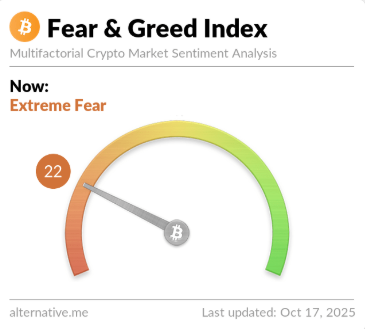
As displayed above, the Fear & Greed Index has a value of 22 at the moment, which is just inside the extreme fear zone. This is a deterioration compared to the last few days, when the indicator held normal fear values.
Bitcoin Extreme Fear

The reason behind the slide into the extreme fear territory naturally lies in the bearish action that Bitcoin and other cryptocurrencies have faced recently. In particular, the market has suffered a sharp move down during the past day.

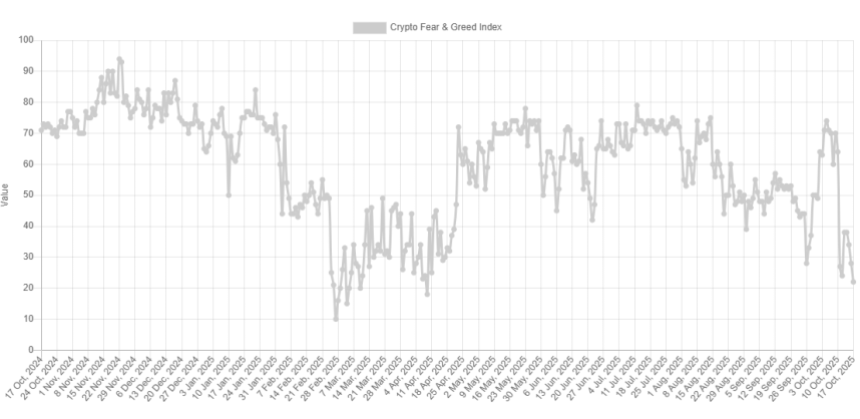
Last week also ended with a rapid drawdown in BTC and company, and then too sentiment took a large hit, with the index registering a low of 24. This previous turnaround in sentiment was also much more drastic than the latest one, as it took the metric from greed values all the way down into the extreme fear zone in a flash.

Historically, the extreme sentiments have held much importance for Bitcoin and other digital assets, as major tops and bottoms have often occurred in these regions. The relationship has been an inverse one, however, meaning that extreme fear can result in a bottom, while extreme greed can lead to a top.

The plunge into extreme fear earlier also paved the way to a bottom, although it proved to be only a temporary one. With the Fear & Greed Index back in the zone, it will be interesting to see how the Bitcoin price will develop in the coming days.

BTC Price

At the time of writing, Bitcoin is trading around $105,600, down 13% over the last week.

Bitcoin Price Chart
Market Opportunity
Index Cooperative Logo
Index Cooperative Price(INDEX)
$0.4922
$0.4922$0.4922
+0.12%
USD
Index Cooperative (INDEX) Live Price Chart
Disclaimer: The articles reposted on this site are sourced from public platforms and are provided for informational purposes only. They do not necessarily reflect the views of MEXC. All rights remain with the original authors. If you believe any content infringes on third-party rights, please contact service@support.mexc.com for removal. MEXC makes no guarantees regarding the accuracy, completeness, or timeliness of the content and is not responsible for any actions taken based on the information provided. The content does not constitute financial, legal, or other professional advice, nor should it be considered a recommendation or endorsement by MEXC.

You May Also Like

XRP Hits ‘Extreme Fear’ Levels - Why This Is Secretly Bullish

XRP Hits ‘Extreme Fear’ Levels - Why This Is Secretly Bullish

Ripple’s native token XRP is still battling out with the bears at the $1.90 territory on Friday afternoon. The support-turned-resistance at $1.90 is particularly
Share
Coinstats2026/01/24 03:25
Tokyo’s Metaplanet Launches Miami Subsidiary to Amplify Bitcoin Income

Tokyo’s Metaplanet Launches Miami Subsidiary to Amplify Bitcoin Income

Metaplanet Inc., the Japanese public company known for its bitcoin treasury, is launching a Miami subsidiary to run a dedicated derivatives and income strategy aimed at turning holdings into steady, U.S.-based cash flow. Japanese Bitcoin Treasury Player Metaplanet Opens Miami Outpost The new entity, Metaplanet Income Corp., sits under Metaplanet Holdings, Inc. and is based […]
Share
Coinstats2025/09/18 00:32
The GENIUS Act Is Already Law. Banks Shouldn’t Try to Rewrite It Now

The GENIUS Act Is Already Law. Banks Shouldn’t Try to Rewrite It Now

The post The GENIUS Act Is Already Law. Banks Shouldn’t Try to Rewrite It Now appeared on BitcoinEthereumNews.com. Healthy competition drives innovation and better products for consumers; it is at the center of American economic leadership. Unfortunately, now that the bipartisan GENIUS Act has been signed into law, major legacy financial institutions seem to be having second thoughts about the innovations that stablecoins can bring to financial markets. Bank lobbying groups and public affairs teams have been peppering Congress with complaints about the law, urging members to reopen debate and introduce changes to the legislation that will ensure the stablecoin market doesn’t grow too quickly, protecting banks’ profits and stifling consumer choice. This reactionary response is both overblown and unnecessary. What legacy financial firms should do instead is embrace competition and offer exciting new products and services that consumers want, not try to kneecap emerging players through anti-innovation rules and regulations. The GENIUS Act was carefully designed with a thorough bipartisan process to strengthen consumer safeguards, ensure regulatory oversight, and preserve financial stability. Efforts to roll back its provisions are less about protecting families and more about protecting entrenched banking interests from the competition that helps ensure the U.S. banking system stays the strongest and most innovative in the world. Critics warn that allowing stablecoins to provide rewards could lead to massive deposit outflows from community banks, with figures as high as $6.6 trillion cited. But closer examination shows this fear is unfounded. A July 2025 analysis by consulting firm Charles River Associates found no statistically significant relationship between stablecoin adoption and community bank deposit outflows. In fact, the overwhelming majority of stablecoin reserves remain in the traditional financial system — either in commercial bank accounts or in short-term Treasuries — where they continue to support liquidity and credit in the broader U.S. economy. The dire estimates rely on unrealistic assumptions that every dollar of stablecoin issuance permanently…
Share
BitcoinEthereumNews2025/09/18 09:39