The Financial Services Agency (FSA) plans to allow Japanese banks to offer crypto investment services, which includes Bitcoin.The Financial Services Agency (FSA) plans to allow Japanese banks to offer crypto investment services, which includes Bitcoin.

Japanese Banks Hint at Bitcoin Adoption as Saylor Eyes More Buys and Bitcoin Hyper Becomes the Next to Explode

KEY POINTS:
➡ The Financial Services Agency (FSA) aims to allow Japanese banks to register as crypto asset exchange companies and offer crypto services
➡ Strategy’s Michael Saylor hints at new future Bitcoin buys to fuel the company’s $74B-strong Bitcoin treasury
➡ Bitcoin is seeing historically-low volatility as adoption increases, with over 4M $BTC already trapped in treasuries
➡ Bitcoin Hyper’s ($HYPER) presale reaches $24.3M

According to the initial Livedoor news article, banks that receive the green light would also need to register as ‘crypto asset exchange companies’ to qualify for their new position.

The move follows a surge in crypto support and adoption throughout the country, with 12M registered crypto accounts and over $34B in crypto assets reported in February 2025.

Bitcoin penetrating Asian markets at the banking level could represent a massive catalyst for 2025’s Q4 and beyond, especially with Bitcoin Hyper ($HYPER) also targeting a Q1 2026 release.

Michael Saylor Hints at New Bitcoin Purchases

Michael Saylor just hinted at new Bitcoin purchases with a short but suggestive ‘The most important orange dot is always the next.”

The X post also featured Strategy’s $BTC purchase history, sprinkled with multiple orange dots of different sizes over the last five years.
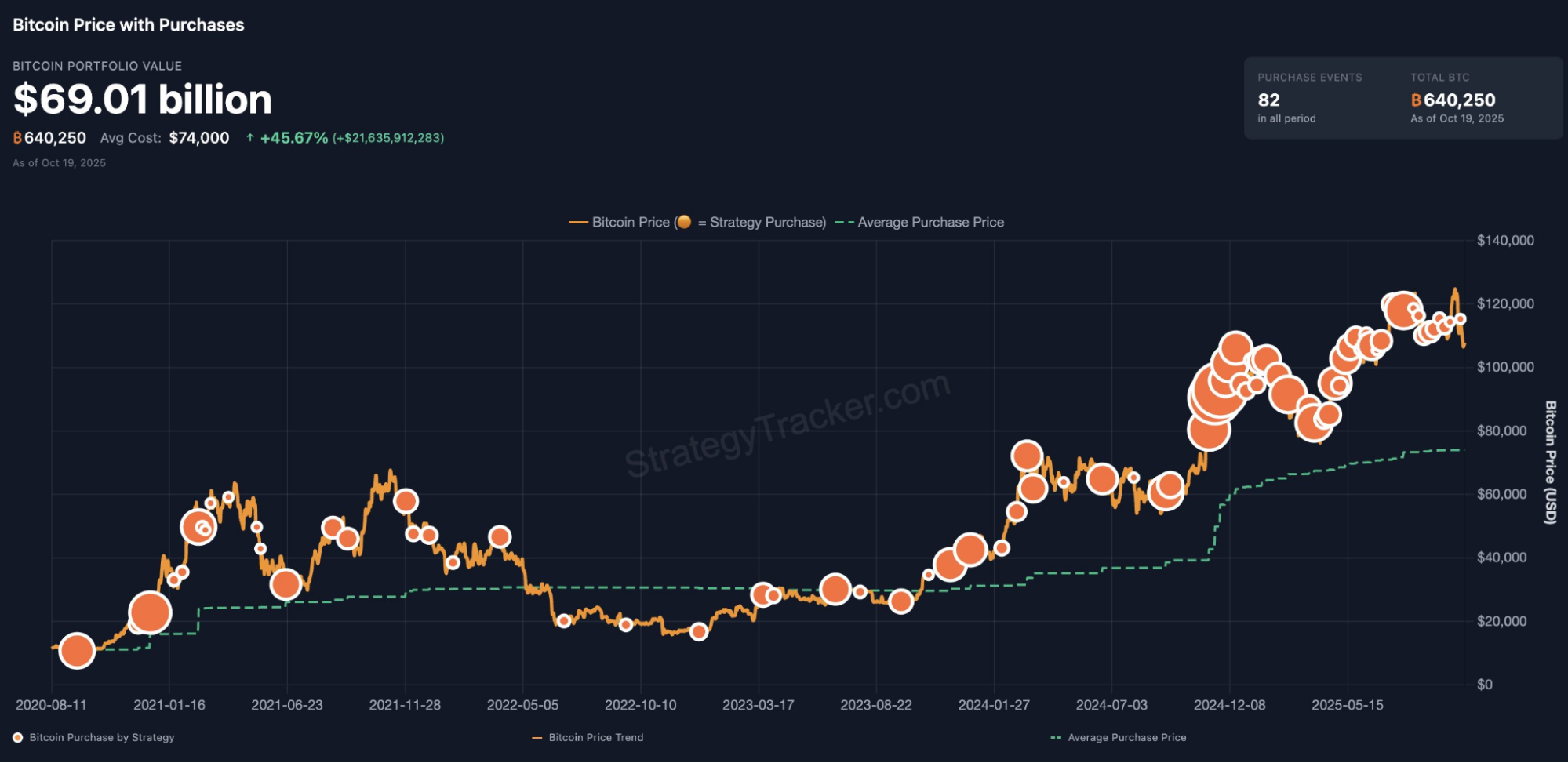
Strategy’s Bitcoin purchase history chart

Michael Saylor is a long-term proponent of Bitcoin, and Strategy’s hoarding plan showcases just that. It’s been less than a month since Saylor’s interview with Mark Moss, where Saylor called Bitcoin ‘inevitable’ and explained how its refinery model could spark the next industrial revolution.

During that same interview, he also made the case that governments and corporates will eventually find themselves forced to invest in Bitcoin, and we’re already seeing that today.

According to data from Bitcoin Treasuries, 4.04M $BTC is already trapped in treasuries, between entities like governments, public and private companies, ETFs, and exchanges. 205 of them are public companies which, together, hold 1,048,269 bitcoins.
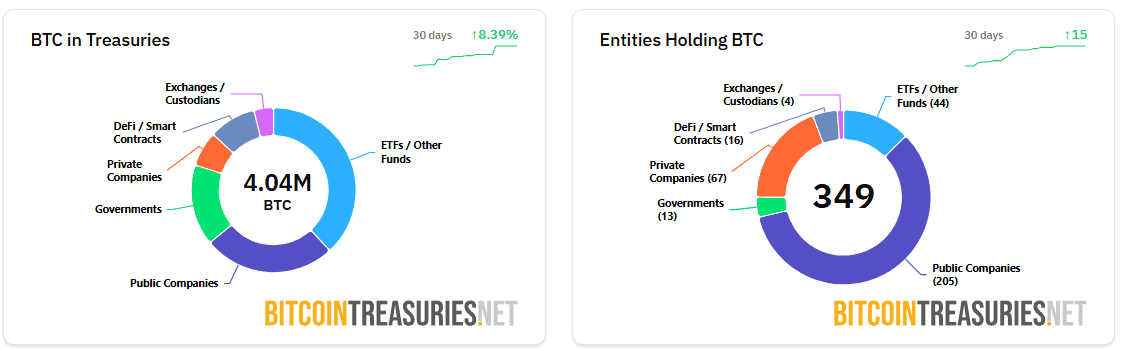
Bitcoin in treasuries across multiple sectors

As expected, Michael Saylor’s Strategy is leading the adoption race, with a 640,250 Bitcoin-strong treasury, worth $74B.

But this is just the beginning, as the adoption rate increases by the day, primarily thanks to Bitcoin’s lower volatility and stronger financial presence.

Deribit’s Volatility Index shows a volatility pattern below the 46.27 critical indicator for the June-October 2025 window. This is the lowest and most stable Bitcoin’s volatility has been over the last two years.

Part of that is thanks to Trump’s GENIUS Act, which establishes a clearer and safer regulatory ecosystem for issuers and investors alike.

The low volatility, combined with the rampant adoption rate and more proactive regulations, has turned Bitcoin into a feasible hedge against inflation and depreciating fiat assets.

MacroMicro’s Bitcoin vs. Dollar Index speaks volumes to that, seeing how every time the US dollar dipped, Bitcoin went the opposite way.
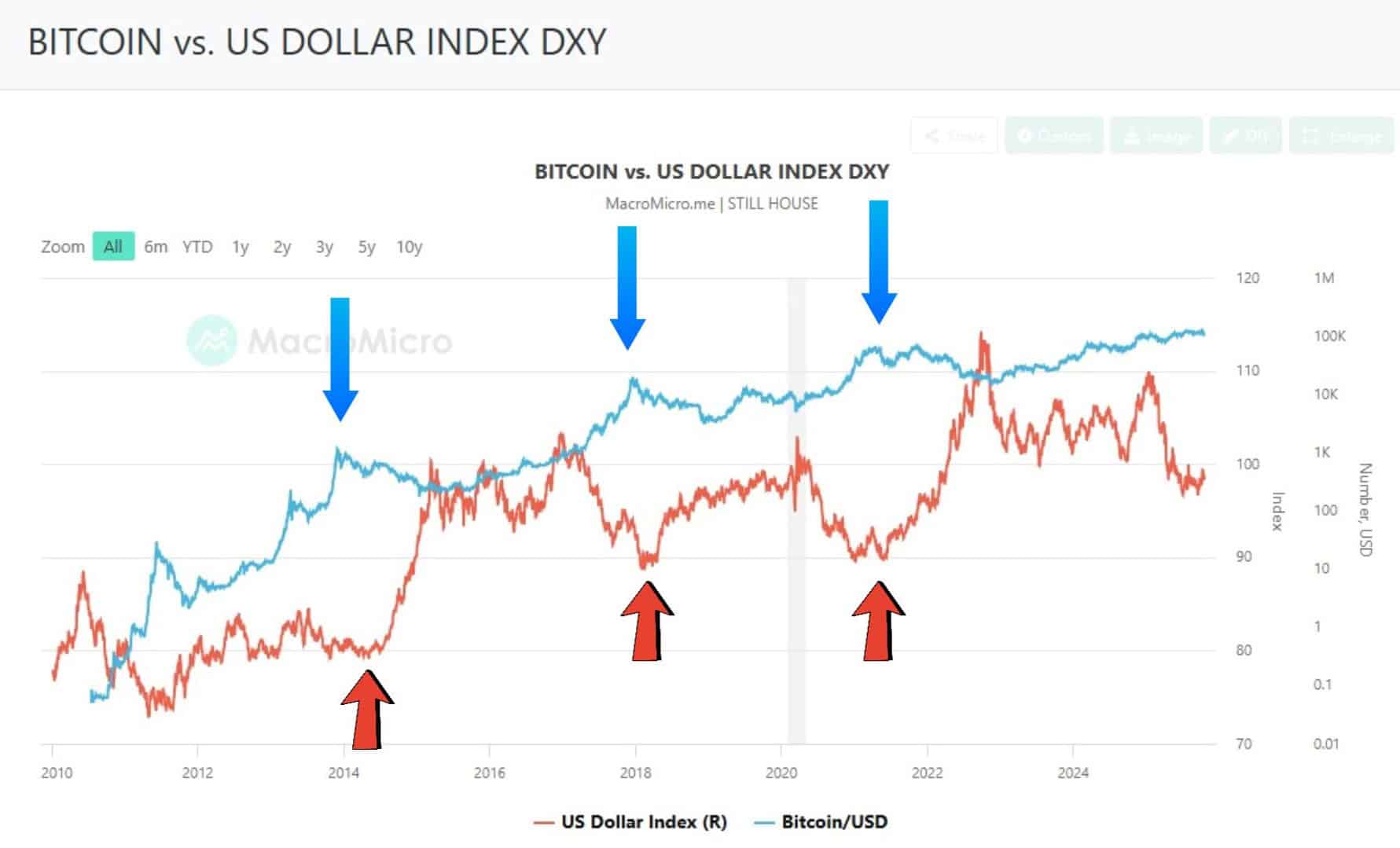
Bitcoin vs. US Dollar all-time performance

The conclusion is clear: the market trusts Bitcoin more by the day, and Bitcoin Hyper ($HYPER) will contribute to that in 2026 and beyond.

How Bitcoin Hyper Promises to Change Bitcoin

Bitcoin Hyper ($HYPER) is a Layer 2 solution that promises to enhance the Bitcoin ecosystem by making it faster, cheaper, and more scalable, thereby increasing its institutional and retail appeal.

The project targets Bitcoin’s most pressing issue: its performance limitation.

The Bitcoin network is now capped at seven transactions per second, which explains why Bitcoin is at the 31st spot on the list of the fastest blockchains by TPS. This is far behind industry standards. For context, Solana is second on the same list, BNB is fourth, and Ethereum is 19th.

Hyper seeks to change that with the help of tools like the Solana Virtual Machine (SVM) and the Canonical Bridge.

SVM is responsible for increasing the network’s responsiveness and throughput, allowing for the ultra-fast execution of DeFi apps and smart contracts. The Canonical Bridge, however, addresses the network’s finality times directly.

Once the Bitcoin Relay Program has confirmed the incoming transaction, which happens in seconds, the Canonical Bridge mints the tokens into the Hyper layer. You can then use your $HYPERs within Hyper’s Layer 2 or withdraw them to the native layer at will.
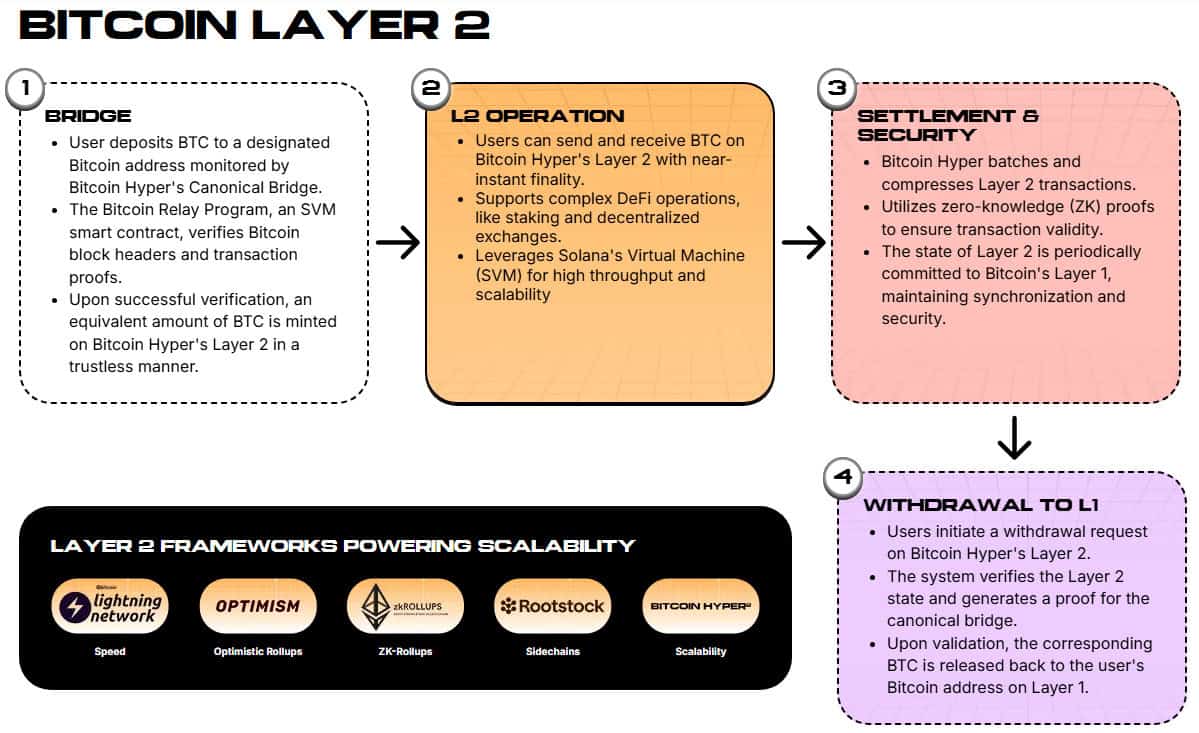
How Hyper’s Canonical Bridge works

Hyper remains synchronized to Bitcoin’s Layer 1 constantly, as well, to ensure optimal feedback and security.

In the long term, Hyper plans to enhance the scalability and performance of the Bitcoin ecosystem, offering near-instant finality and lower fees. This would make the network more feasible for institutional investors with a high TPS throughput.

The presale garnered $24.3M so far, making it one of the best presales of 2025. Now sitting at its presale price of $0.013145, $HYPER stands as the next crypto to explode in 2026, given the release date estimated for Q1.

Based on the project’s utility, a realistic price prediction for $HYPER puts the token at $0.15 in 2026 and $1.2 by 2030, for an ROI of 1,041% and 9,028% respectively.

If you want to invest, check $HYPER’s official presale page and buy your stack today.

This isn’t financial advice. Do your own research (DYOR) and invest wisely.

Market Opportunity
Hive Intelligence Logo
Hive Intelligence Price(HINT)
$0.001563
$0.001563$0.001563
-0.38%
USD
Hive Intelligence (HINT) Live Price Chart
Disclaimer: The articles reposted on this site are sourced from public platforms and are provided for informational purposes only. They do not necessarily reflect the views of MEXC. All rights remain with the original authors. If you believe any content infringes on third-party rights, please contact service@support.mexc.com for removal. MEXC makes no guarantees regarding the accuracy, completeness, or timeliness of the content and is not responsible for any actions taken based on the information provided. The content does not constitute financial, legal, or other professional advice, nor should it be considered a recommendation or endorsement by MEXC.

You May Also Like

The US dollar's share of global foreign exchange reserves has fallen below 60%.

The US dollar's share of global foreign exchange reserves has fallen below 60%.

PANews reported on January 24th that, according to Jinshi, international gold prices are projected to rise by over 64% in 2025, marking the largest annual increase
Share
PANews2026/01/24 14:30
Younger Americans Back Crypto Survey: Why Digitap ($TAP) is the Best Crypto Presale for the Next Generation

Younger Americans Back Crypto Survey: Why Digitap ($TAP) is the Best Crypto Presale for the Next Generation

The post Younger Americans Back Crypto Survey: Why Digitap ($TAP) is the Best Crypto Presale for the Next Generation appeared first on Coinpedia Fintech News A
Share
CoinPedia2026/01/24 14:42
MetaMask Token: Exciting Launch Could Be Sooner Than Expected

MetaMask Token: Exciting Launch Could Be Sooner Than Expected

BitcoinWorld MetaMask Token: Exciting Launch Could Be Sooner Than Expected The cryptocurrency community is buzzing with exciting news: a native MetaMask token might arrive sooner than many anticipated. This development could reshape how users interact with the popular Web3 wallet and the broader decentralized ecosystem. It signals a significant step forward for one of the most widely used tools in the blockchain space. What’s Fueling the MetaMask Token Buzz? Joseph Lubin, the CEO of ConsenSys, the company behind MetaMask, recently shared insights that ignited this excitement. According to reports from The Block, Lubin indicated that a MetaMask token could launch ahead of previous expectations. This isn’t the first time the idea has surfaced; Dan Finlay, one of MetaMask’s founders, had previously mentioned the possibility of issuing such a token. ConsenSys has been a pivotal player in the Ethereum ecosystem, developing essential infrastructure and applications. MetaMask, their flagship wallet, serves millions of users, providing a gateway to decentralized applications (dApps), NFTs, and various blockchain networks. Therefore, any move to introduce a native token is a major event for the entire Web3 community. Why is a MetaMask Token So Anticipated? The prospect of a MetaMask token generates immense interest because it could introduce new layers of utility and community governance. Users often speculate about the benefits such a token could offer. Here are some key reasons for the high anticipation: Governance Rights: A token could empower users to participate in the future direction and development of MetaMask. This means voting on new features, upgrades, or even changes to the platform’s policies. Ecosystem Rewards: Tokens might be distributed as rewards for active participation, using certain features, or contributing to the MetaMask community. This incentivizes engagement and loyalty. Enhanced Utility: The token could unlock premium features, reduce transaction fees, or provide exclusive access to services within the MetaMask ecosystem or partnered dApps. Decentralization: Introducing a token often aligns with the broader Web3 ethos of decentralization, distributing control and ownership among its users rather than centralizing it within ConsenSys. Consequently, a token launch is seen as a way to deepen user involvement and foster a more robust, community-driven ecosystem around the wallet. Exploring the Potential Impact of a MetaMask Token The introduction of a MetaMask token could have far-reaching implications for the decentralized finance (DeFi) and Web3 landscape. Firstly, it could set a new standard for how popular infrastructure tools engage with their user base. By providing a tangible stake, MetaMask might strengthen its position as a community-governed platform. Moreover, a token could significantly boost the wallet’s visibility and adoption, attracting new users eager to participate in its governance or benefit from its utility. This could also lead to innovative integrations with other blockchain projects, creating a more interconnected and efficient Web3 experience. Ultimately, the success of such a token will depend on its design, utility, and how effectively it engages the global MetaMask community. What Challenges Could a MetaMask Token Face? While the excitement is palpable, launching a MetaMask token also presents several challenges that ConsenSys must navigate carefully. One primary concern is regulatory scrutiny. The classification of cryptocurrency tokens varies across jurisdictions, and ensuring compliance is crucial for long-term success. Furthermore, designing a fair and equitable distribution model is paramount. Ensuring that the token provides genuine utility beyond mere speculation will be another hurdle. A token must integrate seamlessly into the MetaMask experience and offer clear value to its holders. Additionally, managing community expectations and preventing market manipulation will require robust strategies. Addressing these challenges effectively will be key to the token’s sustainable growth and positive reception. What’s Next for the MetaMask Ecosystem? The prospect of a MetaMask token signals an evolving strategy for ConsenSys and the future of Web3 wallets. It reflects a growing trend where foundational tools seek to empower their communities through tokenization. Users are keenly watching for official announcements regarding the token’s mechanics, distribution, and launch timeline. This development could solidify MetaMask’s role not just as a wallet, but as a central pillar of decentralized identity and interaction. The potential for a sooner-than-expected launch adds an element of urgency and excitement, encouraging users to stay informed about every new detail. It represents a significant milestone for a platform that has become synonymous with accessing the decentralized web. Conclusion The hints from ConsenSys CEO Joseph Lubin regarding an earlier launch for the MetaMask token have undoubtedly captured the attention of the entire crypto world. This potential development promises to bring enhanced governance, utility, and community engagement to millions of MetaMask users. While challenges exist, the underlying potential for a more decentralized and user-driven ecosystem is immense. The coming months will likely reveal more about this highly anticipated token, marking a new chapter for one of Web3’s most vital tools. Frequently Asked Questions (FAQs) Q1: What is a MetaMask token? A MetaMask token would be a native cryptocurrency issued by ConsenSys, the company behind the MetaMask wallet. It is expected to offer various utilities, including governance rights, rewards, and access to special features within the MetaMask ecosystem. Q2: Why is ConsenSys considering launching a MetaMask token? ConsenSys is likely exploring a token launch to further decentralize the MetaMask platform, empower its user community with governance rights, incentivize active participation, and potentially unlock new forms of utility and growth for the ecosystem. Q3: What benefits could users gain from a MetaMask token? Users could gain several benefits, such as the ability to vote on MetaMask’s future developments, earn rewards for using the wallet, access exclusive features, or potentially reduce transaction fees. It also provides a direct stake in the platform’s success. Q4: When is the MetaMask token expected to launch? While no official launch date has been confirmed, ConsenSys CEO Joseph Lubin has indicated that the launch could happen sooner than previously expected. The exact timeline remains subject to official announcements from ConsenSys. Q5: How would a MetaMask token impact the broader Web3 ecosystem? A MetaMask token could significantly impact Web3 by setting a precedent for user-owned and governed infrastructure tools. It could drive further decentralization, foster innovation, and strengthen the connection between users and the platforms they rely on, ultimately contributing to a more robust and participatory decentralized internet. To learn more about the latest crypto market trends, explore our article on key developments shaping Ethereum institutional adoption. This post MetaMask Token: Exciting Launch Could Be Sooner Than Expected first appeared on BitcoinWorld.
Share
Coinstats2025/09/19 15:40




