Shiba Inu’s core contributors and the K9 Finance DAO have escalated their recovery campaign with an on-chain ultimatum to the Shibarium bridge exploiter, deploying a new bounty contract funded with 20 ETH and broadcasting the terms directly to the attacker via Ethereum Input Data Messages (IDM). Shiba Inu Team Drops Final 20 ETH Deal The […]Shiba Inu’s core contributors and the K9 Finance DAO have escalated their recovery campaign with an on-chain ultimatum to the Shibarium bridge exploiter, deploying a new bounty contract funded with 20 ETH and broadcasting the terms directly to the attacker via Ethereum Input Data Messages (IDM). Shiba Inu Team Drops Final 20 ETH Deal The […]

Shiba Inu Team Issues Last Chance To Shibarium Hacker Before Time Runs Out

2025/11/05 02:00

Shiba Inu’s core contributors and the K9 Finance DAO have escalated their recovery campaign with an on-chain ultimatum to the Shibarium bridge exploiter, deploying a new bounty contract funded with 20 ETH and broadcasting the terms directly to the attacker via Ethereum Input Data Messages (IDM).

Shiba Inu Team Drops Final 20 ETH Deal

The latest IDM, sent on November 3, 2025 at 06:32 UTC from a K9 developer-labeled account, lays out a trustless path to return frozen KNINE tokens and claim the reward before the offer decays and then expires. “Dear Shibarium Bridge Hacker… New 20 ETH bounty to return stolen KNINE tokens,” the message reads, specifying the bounty contract address and the atomic settlement flow: “Settlement is atomic when we call recoverKnine(). KNINE is transferred back to Shibarium bridge and ETH is transferred to you.” It also sets explicit time parameters: “Bounty will start to decrease in 21-days (Nov 18)… [and] will expire in 28 days (Nov 25).”

The 20 ETH bounty is escrowed on Ethereum at 0x5EA2…D4d0, a verified contract titled “KnineRecoveryBountyDecayAcceptMultiFunder,” which shows a current balance of 20 ETH and identifies k9dev.eth as the creator five days earlier. The contract’s read/write interfaces and verified source enable the attacker to permission the bounty contract to spend KNINE and, if desired, call an explicit accept() function to lock the deal before the team triggers the recoverKnine() settlement.

Public messaging from Shiba Inu developer Kaal Dhairya has amplified the urgency. In a post on X, Dhairya pressed the exploiter to take the on-chain offer: “Yo, Shibarium bridge attacker, wake up—grab free cash before the offer expires this time and do something right.” The remark follows weeks of damage-control updates about validator-key compromise and a multi-firm investigation.

K9 Finance confirms this is the final structured attempt to resolve the episode without litigation or further escalation. In an ecosystem post published by The Shib Magazine, the team states that the 20 ETH contract “makes good on a public promise… to extend one final, larger bounty offer to the entity behind the Shibarium Bridge exploit,” after an initial on-chain 5 ETH proposal in mid-September was rebuffed.

According to that account, the exploiter counter-demanded 50 ETH; K9 declined, reiterating that the KNINE at issue is blacklisted and unusable. The new contract, they add, is designed to close the loop “without direct communication” through an atomic exchange once approval is granted.

K9 has also warned the community to ignore opportunistic scams around the bounty discourse. “Watch out for scams, imposters, and malicious links. This is the last post in the thread,” the DAO wrote on X as it wrapped a public update sequence, underscoring there will be no token migration or “v2” related to this incident. The caution aims to preempt fake claim portals and phishing that often proliferate after high-profile exploits and bounty announcements.

The “last chance” framing reflects the arc of the incident since mid-September, when a flash-loan-aided validator capture enabled the attacker to authorize a malicious state and drain bridge assets, sparking a series of containment steps and an initial bounty. Contemporary coverage documented the 5 ETH on-chain offer and its 7-day decay/30-day expiry schedule; the new 20 ETH contract iterates on the same “code is law” design but with higher stakes and a shorter fuse on the decaying component.

At press time, Shiba Inu traded at $0.00000907.
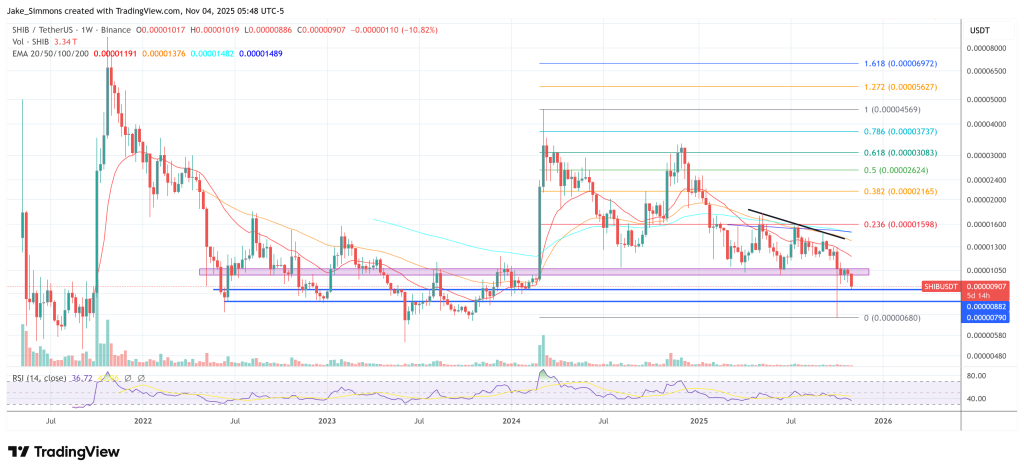
Shiba Inu price
Disclaimer: The articles reposted on this site are sourced from public platforms and are provided for informational purposes only. They do not necessarily reflect the views of MEXC. All rights remain with the original authors. If you believe any content infringes on third-party rights, please contact service@support.mexc.com for removal. MEXC makes no guarantees regarding the accuracy, completeness, or timeliness of the content and is not responsible for any actions taken based on the information provided. The content does not constitute financial, legal, or other professional advice, nor should it be considered a recommendation or endorsement by MEXC.

You May Also Like

Grayscale debuts first US spot crypto ETPs with staking

Grayscale debuts first US spot crypto ETPs with staking

The post Grayscale debuts first US spot crypto ETPs with staking appeared on BitcoinEthereumNews.com. Grayscale Investments has just launched the first US-listed spot crypto exchange-traded products (ETPs) offering staking. The Grayscale Ethereum Trust ETF (ETHE) and Grayscale Ethereum Mini Trust ETF (ETH) now enable Ether staking, while the Grayscale Solana Trust (GSOL) has activated staking capabilities ahead of its proposed uplisting as a spot Solana ETP. The move provides traditional brokerage investors with access to staking rewards — previously confined to native crypto platforms — through regulated vehicles. The products are not registered under the Investment Company Act of 1940, meaning they operate outside the framework governing traditional mutual funds and ETFs. Staking, the process of locking up tokens to secure proof-of-stake blockchains like Ethereum and Solana in exchange for rewards, introduces yield potential but also adds operational and network risks.  Grayscale said staking will be managed through institutional custodians and diversified validator networks to reduce single-party risk. This marks the first time US investors can access staking yield through exchange-traded exposure to Ethereum and Solana, expanding upon regulatory acceptance that began with spot Bitcoin ETFs in January 2024 and spot Ether ETFs in July 2024.  Grayscale CEO Peter Mintzberg called the initiative “first mover innovation,” underscoring the firm’s role in shaping institutional crypto access. This is a developing story. This article was generated with the assistance of AI and reviewed by editor Jeffrey Albus before publication. Get the news in your inbox. Explore Blockworks newsletters: Source: https://blockworks.co/news/grayscale-us-spot-crypto-etps-staking
Share
BitcoinEthereumNews2025/10/06 21:29
Spot XRP ETFs Nears $1B AUM Milestone as Streak of No Outflows Continues

Spot XRP ETFs Nears $1B AUM Milestone as Streak of No Outflows Continues

The post Spot XRP ETFs Nears $1B AUM Milestone as Streak of No Outflows Continues appeared on BitcoinEthereumNews.com. The U.S. Spot XRP ETFs is now near the $1 billion mark of assets under management in less than a month since their launch. This follows from the product maintaining consistent inflows with no single outflow recorded yet. XRP ETFs See Continuous Inflows Since Launch Since its first launch on November 14, spot XRP funds have seen continued inflows. According to data from SoSoValue, the total inflows into these funds have now risen to $881.25 million. The funds attracted $12.84 million of new money yesterday. The daily trading volumes remained stable at $26.74 million. Source: SoSoValue Reaching nearly $1 billion in less than 30 days makes the product among the fastest growing crypto investment products in the United States. Notably, Spot Solana ETFs also accumulated over $600 million since their launch. On the other hand, Bitcoin and Ethereum ETFs are holding about $58 billion and about $13 billion in assets under management respectively. Much of the early growth traces back to the first Canary Capital’s XRP ETF. Its opening on November 13 brought one of the strongest crypto ETF openings to date. It saw more than $59 million in first-day trading volume and $245 million in net inflows. Shortly after Canary’s launch, firms like Grayscale, Bitwise, and Franklin Templeton introduced their own XRP products. Bitwise’s fund also did well on its launch, recording over $105 million in early inflows. Meanwhile, the market is getting ready for yet another addition. 21Shares’ U.S. spot XRP fund also got the green light from the SEC. It will trade under the ticker TOXR on the Cboe BZX Exchange. XRP Products Keep Gaining Momentum in the Market The token’s funds continued to expand this week. REX Shares and Tuttle Capital have launched the T-REX 2X Long XRP Daily Target ETF. This new ETF allows traders…
Share
BitcoinEthereumNews2025/12/05 14:11
Headwind Helps Best Wallet Token

Headwind Helps Best Wallet Token

The post Headwind Helps Best Wallet Token appeared on BitcoinEthereumNews.com. Google has announced the launch of a new open-source protocol called Agent Payments Protocol (AP2) in partnership with Coinbase, the Ethereum Foundation, and 60 other organizations. This allows AI agents to make payments on behalf of users using various methods such as real-time bank transfers, credit and debit cards, and, most importantly, stablecoins. Let’s explore in detail what this could mean for the broader cryptocurrency markets, and also highlight a presale crypto (Best Wallet Token) that could explode as a result of this development. Google’s Push for Stablecoins Agent Payments Protocol (AP2) uses digital contracts known as ‘Intent Mandates’ and ‘Verifiable Credentials’ to ensure that AI agents undertake only those payments authorized by the user. Mandates, by the way, are cryptographically signed, tamper-proof digital contracts that act as verifiable proof of a user’s instruction. For example, let’s say you instruct an AI agent to never spend more than $200 in a single transaction. This instruction is written into an Intent Mandate, which serves as a digital contract. Now, whenever the AI agent tries to make a payment, it must present this mandate as proof of authorization, which will then be verified via the AP2 protocol. Alongside this, Google has also launched the A2A x402 extension to accelerate support for the Web3 ecosystem. This production-ready solution enables agent-based crypto payments and will help reshape the growth of cryptocurrency integration within the AP2 protocol. Google’s inclusion of stablecoins in AP2 is a massive vote of confidence in dollar-pegged cryptocurrencies and a huge step toward making them a mainstream payment option. This widens stablecoin usage beyond trading and speculation, positioning them at the center of the consumption economy. The recent enactment of the GENIUS Act in the U.S. gives stablecoins more structure and legal support. Imagine paying for things like data crawls, per-task…
Share
BitcoinEthereumNews2025/09/18 01:27