Traditional KPIs like ticket counts or lines of code harm developer productivity. Focus on measuring Cycle Time (how quickly tasks are delivered) and Story Points (task complexity) instead. Use metrics to support, not punish, teams. Consider context, team health, and collaboration to truly boost efficiency and morale.Traditional KPIs like ticket counts or lines of code harm developer productivity. Focus on measuring Cycle Time (how quickly tasks are delivered) and Story Points (task complexity) instead. Use metrics to support, not punish, teams. Consider context, team health, and collaboration to truly boost efficiency and morale.

KPIs Are Destroying IT Teams: How to Actually Measure Developer Performance

The effectiveness of an IT team directly impacts a company's success, but measuring that effectiveness can be really difficult. Counting output is tempting and simple, but that is not what really works with software, because our tasks are mostly unique and require a creative approach. Developers can fix a single bug both in 10 lines of quality code or write a hundred lines and accidentally create a technical debt. Ticket counts and lines of code encourage ‘closing for the record’ rather than closing for value.

As the CTO of a global gifting marketplace Flowwow, I mostly rely not on vanity data, but on those metrics that measure the result and its value to the business. Thus, I can feel the team health, conduct in-depth performance reviews, and track growth.

The Two Metrics To Track Productivity

To get the most of my teams' work, I mostly rely on Cycle Time and Story Points. The first shows me how quickly we're delivering value, and the second helps the team to estimate complexity of the work ahead.

Measure Flow, Not Hours

==Cycle Time== is the time from starting work on a ticket or task to the change being deployed to production.

The Cycle Time calculation consists of:

  • Grooming: Defining the task and estimating it in Story Points.

  • Coding: The actual writing of the software.

  • Code Review: Peer or team lead review of the written code.

  • Testing: Checking for bugs and overall functionality.

Every company has its ==own ideal targets.== At Flowwow, for instance, teams with highly optimised value delivery processes hit around 10–11 days. Our average teams typically take 11–15 days to implement a solution. If it's more than 15 days, then, probably, it’s time to overlook the flow or pay attention to the team’s moods.

I remember reading about a large tech company that wanted to boost developer output without sacrificing quality. They implemented the SPACE framework and focused on reducing Cycle Time. By improving code reviews and automating testing, they saw their average Cycle Time drop from 8 to 6 days in just six months. As a result, a 30% reduction in customer-facing defects and a huge jump in satisfaction rates.

Focus On Complexity

==Story Points== are our way of estimating the relative complexity of a task. This assessment is given by the team collectively during the grooming phase, before coding begins. Instead of trying to guess how many hours a task will take (a game everyone loses), developers compare tasks to build a complexity score. Usually, Story Points are estimated similar to the Fibonacci sequence: 1, 2, 3, 5, 8, 13, etc – the higher the number, the harder the task.
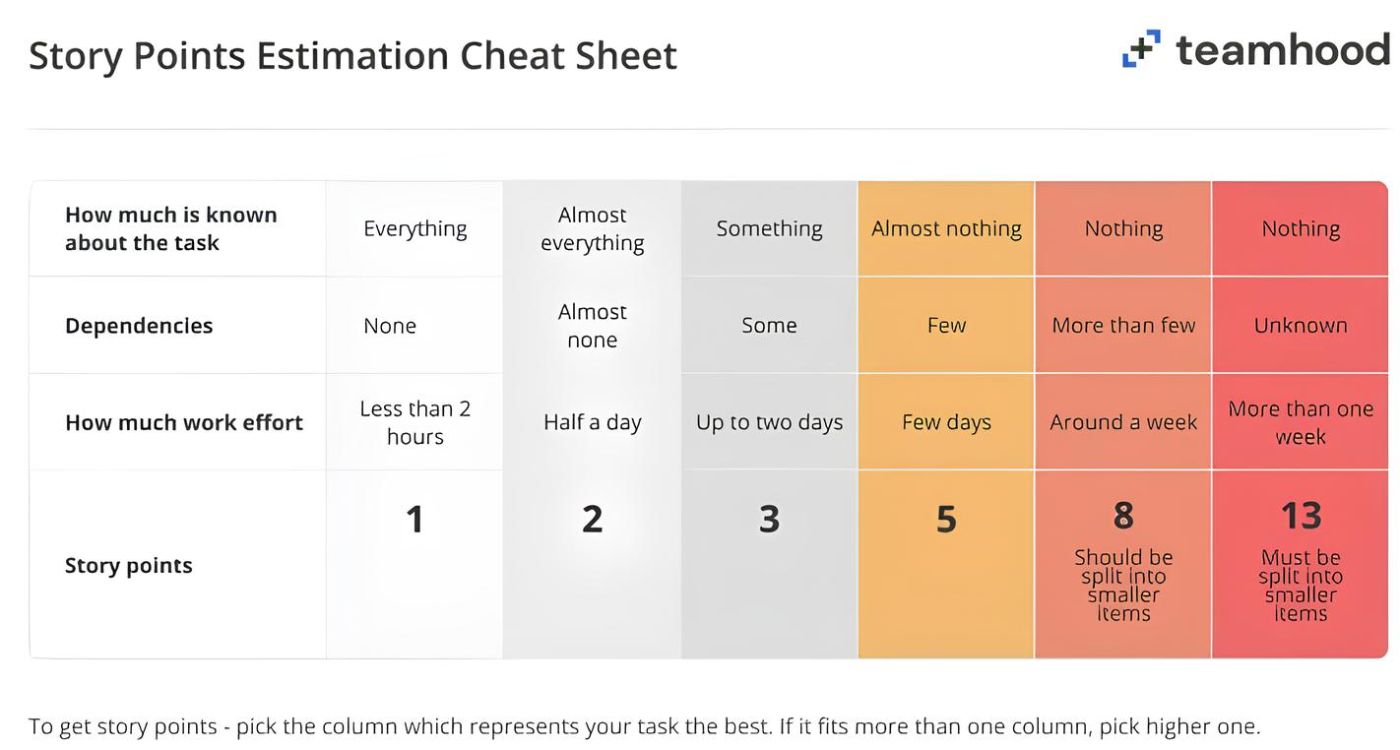
How to estimate tasks. Source: TeamhoodThe estimate takes into account:

  • The sheer volume of work.
  • Any uncertainty in the requirements.
  • Potential risks.
  • The core technical difficulty involved.

This method helps to understand how much work the team can realistically take on in an upcoming sprint. Crucially, it’s low-stress because the estimates are collaborative and non-punitive. Developers focus on writing the code, and managers get a clearer picture of the team’s capacity with an ability to optimize processes when needed.

I believe that breaking down large tasks is what makes a huge difference in productivity and spirits. ==Split it== into smaller, manageable milestones, so ==the developer can see the results== more frequently.

Usually, the total number of closed Story Points per month is pretty predictable for the whole team and for each developer. So, if I get the numbers that are lower than expected, it's a warning flag to me. Is everything fine with the person or the spirits in the team?

Checklist: How To Interpret Metrics Wisely

When it comes to measuring effectiveness, there’s one final point to highlight: Context is often more important than the numbers themselves. It’s easy to look at metrics and jump to a negative conclusion when something goes wrong. But the 'low' volume developer might be the one tackling the most ambiguous, complex tasks or spending crucial time mentoring others. The real lesson is that a metric should always become an opportunity for support and discussion about balancing the workload.

Here’s my ==checklist== for an honest measurement system:

  • Start with a problem: what do we want to improve?
  • Separate metrics from rewards: your performance metrics must not directly influence a developer's income. Good programmers will simply game the numbers.
  • Automate data collection, because no one likes complex bureaucracy for the sake of bureaucracy.
  • Make dashboards transparent for the whole team, and highlight it’s all done for the team itself.
  • Always look behind the numbers for the context.
  • Review your metrics with the team regularly.
  • Overlook the environment within the team. People achieve more when they are surrounded by supportive and friendly professionals.

Make a transparent system that is interpreted with context and is based on mutual respect and focus on value. Add engaging tasks and supportive colleagues. That’s how a strong performing team is done.

\n

Market Opportunity
Wink Logo
Wink Price(LIKE)
$0.002689
$0.002689$0.002689
-0.29%
USD
Wink (LIKE) Live Price Chart
Disclaimer: The articles reposted on this site are sourced from public platforms and are provided for informational purposes only. They do not necessarily reflect the views of MEXC. All rights remain with the original authors. If you believe any content infringes on third-party rights, please contact service@support.mexc.com for removal. MEXC makes no guarantees regarding the accuracy, completeness, or timeliness of the content and is not responsible for any actions taken based on the information provided. The content does not constitute financial, legal, or other professional advice, nor should it be considered a recommendation or endorsement by MEXC.

You May Also Like

Tokyo’s Metaplanet Launches Miami Subsidiary to Amplify Bitcoin Income

Tokyo’s Metaplanet Launches Miami Subsidiary to Amplify Bitcoin Income

Metaplanet Inc., the Japanese public company known for its bitcoin treasury, is launching a Miami subsidiary to run a dedicated derivatives and income strategy aimed at turning holdings into steady, U.S.-based cash flow. Japanese Bitcoin Treasury Player Metaplanet Opens Miami Outpost The new entity, Metaplanet Income Corp., sits under Metaplanet Holdings, Inc. and is based […]
Share
Coinstats2025/09/18 00:32
How A 130-Year-Old Course Reimagined The Golf Experience

How A 130-Year-Old Course Reimagined The Golf Experience

The post How A 130-Year-Old Course Reimagined The Golf Experience appeared on BitcoinEthereumNews.com. An aerial view of Storm King Golf Club, a reimagined golf experience that’s scheduled to open in 2026. Erik Matuszewski In the rolling hills of New York’s Hudson Valley, just 56 miles from Manhattan and minutes from West Point, a revolutionary new golf course is reimagining how golf can be played, experienced, and shared. Named after the nearby mountain that overlooks the property, Storm King Golf Club packs more variety and possibility in 63 acres than many courses four times its size, offering 40 distinct hole configurations, five different 9-hole routing options, and a 19-hole par 3 layout. “The idea was to create a unique place where people could experience golf in a way that’s fun and interesting to them,” said founder David Gang, a software executive who purchased the course about five years ago with a vision to reimagine golf and challenge convention along the way. Storm King is a far cry from the original facility that opened in 1894; today, it’s a wild looking, choose-your-own-adventure playground where golfers can craft their journey based on skill level, mood, or simple curiosity about what lies around the next bend. The facility boasts 12 green complexes totaling 225,000 square feet of putting surface, nearly four times that of an iconic property like Pebble Beach Golf Links, which has 63,000 square feet across all 18 holes. “Our brains have been wired for golf in a very traditional way forever,” says Gang, an avid golfer who co-founded Brightspot, a leading content management system. There are unusual design shapes and unique routing options at Storm King, which was built to focus on versatility, playability and sustainability. Erik Matuszewski “We think about 9 holes, 18 holes, par 3s, par 4s, and par 5s. They’re very set in our minds,” he added. “So, when you come…
Share
BitcoinEthereumNews2025/09/18 18:44
IP Hits $11.75, HYPE Climbs to $55, BlockDAG Surpasses Both with $407M Presale Surge!

IP Hits $11.75, HYPE Climbs to $55, BlockDAG Surpasses Both with $407M Presale Surge!

The post IP Hits $11.75, HYPE Climbs to $55, BlockDAG Surpasses Both with $407M Presale Surge! appeared on BitcoinEthereumNews.com. Crypto News 17 September 2025 | 18:00 Discover why BlockDAG’s upcoming Awakening Testnet launch makes it the best crypto to buy today as Story (IP) price jumps to $11.75 and Hyperliquid hits new highs. Recent crypto market numbers show strength but also some limits. The Story (IP) price jump has been sharp, fueled by big buybacks and speculation, yet critics point out that revenue still lags far behind its valuation. The Hyperliquid (HYPE) price looks solid around the mid-$50s after a new all-time high, but questions remain about sustainability once the hype around USDH proposals cools down. So the obvious question is: why chase coins that are either stretched thin or at risk of retracing when you could back a network that’s already proving itself on the ground? That’s where BlockDAG comes in. While other chains are stuck dealing with validator congestion or outages, BlockDAG’s upcoming Awakening Testnet will be stress-testing its EVM-compatible smart chain with real miners before listing. For anyone looking for the best crypto coin to buy, the choice between waiting on fixes or joining live progress feels like an easy one. BlockDAG: Smart Chain Running Before Launch Ethereum continues to wrestle with gas congestion, and Solana is still known for network freezes, yet BlockDAG is already showing a different picture. Its upcoming Awakening Testnet, set to launch on September 25, isn’t just a demo; it’s a live rollout where the chain’s base protocols are being stress-tested with miners connected globally. EVM compatibility is active, account abstraction is built in, and tools like updated vesting contracts and Stratum integration are already functional. Instead of waiting for fixes like other networks, BlockDAG is proving its infrastructure in real time. What makes this even more important is that the technology is operational before the coin even hits exchanges. That…
Share
BitcoinEthereumNews2025/09/18 00:32