What If Quantum Computing Cracks the Code? Satoshi’s Bitcoin at Risk?
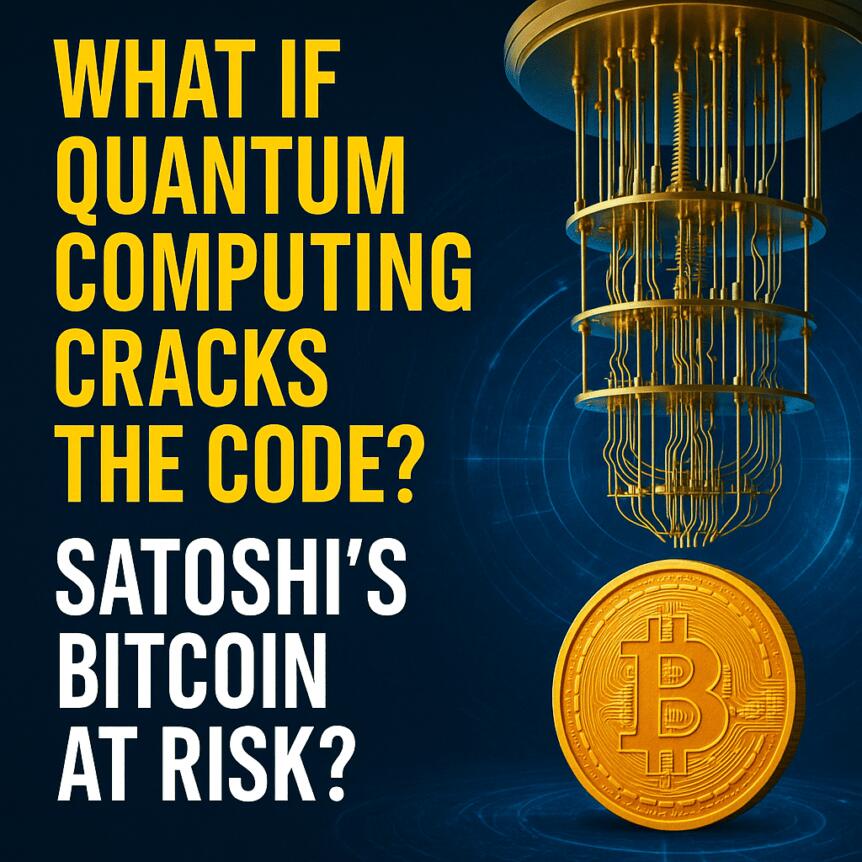
Certainly! Here’s a rewritten version of the article with the requested SEO considerations and flow, including a brief introduction and key takeaways:
—
Crypto enthusiasts and blockchain experts are increasingly concerned about the potential risks posed by quantum computing to the security of Bitcoin and other cryptocurrencies. Notably, Satoshi Nakamoto’s estimated 1.1 million BTC remains untouched on the blockchain, but its legacy addresses may be vulnerable to future quantum attacks. As quantum technology advances, the crypto community is assessing how to safeguard the millions of coins that could become exposed, emphasizing the urgent need for quantum-resistant cryptography.
- Satoshi’s early Bitcoin wallets are at risk due to exposed public keys, making them prime targets for quantum attacks.
- Quantum algorithms, particularly Shor’s algorithm, could potentially break Bitcoin’s current cryptographic security, if sufficiently powerful quantum computers are developed.
- Many vulnerable addresses contain millions of BTC, including Satoshi’s, which could be compromised if quantum computing reaches Q-Day.
- The crypto industry is actively developing post-quantum cryptography standards to protect against this emerging threat.
- A network upgrade or hard fork will likely be necessary for Bitcoin to migrate to quantum-resistant protocols in the future.
Why Satoshi’s wallet is a prime quantum target
Satoshi Nakamoto’s 1.1 million Bitcoins are often called the “ultimate lost treasure” in the crypto world. While dormant for over a decade, these coins pose a looming security concern due to potential quantum vulnerabilities.
Satoshi’s Bitcoin wallet has never moved, but this silent stash exemplifies a cryptographic challenge. As quantum computers evolve from theoretical models to practical prototypes, they threaten to undermine existing cryptographic safeguards that protect Bitcoin and other blockchain networks.
This isn’t a speculative threat; it’s an urgent crisis of cryptography, with significant implications for the security of global financial infrastructure and the integrity of the cryptocurrency ecosystem.
Why Satoshi’s early wallets are easy quantum targets
Modern Bitcoin wallets typically hide public keys until a transaction occurs, but Satoshi’s address published the public key openly on the blockchain, making it an easy target for quantum attacks.
Bitcoin addresses are generally created as either pay-to-public-key-hash (P2PKH) addresses, which start with “1,” or newer SegWit addresses starting with “bc1.” These address types store only a hash of the public key until the funds are spent, revealing the full public key only at the moment of transaction. This approach offers some security against quantum threats.
However, Satoshi’s addresses used the legacy pay-to-public-key (P2PK) format, which exposes the public key permanently onchain. While a classical computer finds it nearly impossible to reverse-engineer the private key from the public key, a quantum computer could potentially do so by exploiting this exposed information, effectively unlocking the coins.
How Shor’s algorithm lets quantum machines break Bitcoin
Bitcoin’s security relies on elliptic curve cryptography (ECDSA), which is designed to be computationally infeasible to break with classical computers. However, Shor’s algorithm, a groundbreaking quantum algorithm, could threaten this security.
Shor’s algorithm is capable of solving the elliptic curve discrete logarithm problem efficiently on a sufficiently powerful quantum computer. This would allow an attacker to reverse the public-private key relationship by analyzing exposed public keys, quickly deriving the private key.
By harvesting exposed public keys from the blockchain and running them through a quantum computer, an attacker could instantly access Satoshi’s coins, raising an existential threat to Bitcoin’s security. Experts estimate that approximately 2,330 stable logical qubits would be necessary to break the encryption—a formidable challenge given current quantum technology.
How close are we to a Q-Day?
The race to develop powerful quantum computers is accelerating. Tech firms like Rigetti, Google, IBM, and others are racing to demonstrate quantum machines capable of breaking current cryptography, shrinking the timeline for “Q-Day.”
Initially anticipated as a 10-20 year horizon, the advent of a quantum computer capable of threatening Bitcoin’s security may happen sooner than expected. Such a machine would need to create error-corrected logical qubits, which require hundreds or thousands of physical qubits each—an enormous engineering feat.
- Companies aim to reach the 1,000+ qubit milestone by 2027.
- The fight against quantum threats involves ongoing research into fault-tolerant quantum systems and error correction.
- The first nation to achieve a quantum computer capable of Q-Day could gain access to vast global financial and intelligence data.
Proactively addressing this threat is critical for the future security of the crypto industry.
Why millions of Bitcoin are exposed to quantum attacks
A 2025 report from the Human Rights Foundation estimates that over 6.5 million BTC are vulnerable to quantum hacking, with nearly 1.7 million being deemed lost or unmovable, including Satoshi’s coins.
The report emphasizes that many early Bitcoin addresses have been compromised through address reuse practices. When users spend funds from their addresses, the public key becomes exposed. If funds are transferred back to the same addresses, their security is permanently compromised, making them targets for future quantum attacks.

If a malicious actor reaches Q-Day first, moving Satoshi’s coins would serve as undeniable proof that Bitcoin’s cryptography was defeated, likely causing market chaos and eroding trust in crypto assets.
Discussions around “harvest now, decrypt later” tactics reveal that adversaries are already capturing encrypted data, aiming to decrypt it once quantum computing becomes feasible in the future.
How Bitcoin could switch to quantum-safe protection
To defend against the quantum threat, Bitcoin would likely need a major network upgrade or soft fork based on new cryptographic standards.
The cryptography community is actively developing post-quantum algorithms, based on lattice structures that are believed to withstand quantum attacks. The National Institute of Standards and Technology (NIST) announced final standards in 2024, including the ML-DSA, part of the CRYSTALS-Dilithium suite.
Already, the tech industry is adopting PQC algorithms; by late 2025, systems like OpenSSH and Cloudflare are integrating these standards into their security protocols. For Bitcoin, this transition would involve a network-wide upgrade that introduces new, quantum-resistant address types, such as “P2PQC,” allowing users to migrate funds voluntarily while maintaining network stability.
—
This comprehensive overview highlights the emerging quantum risks for Bitcoin and the urgent need for the crypto sector to prepare for a future where quantum computers could redefine digital security.
This article was originally published as What If Quantum Computing Cracks the Code? Satoshi’s Bitcoin at Risk? on Crypto Breaking News – your trusted source for crypto news, Bitcoin news, and blockchain updates.


You May Also Like

Top 6 Crypto PR Agencies for Stablecoin Projects in 2026

The Quiet Revolution in Battery R&D: Why the Lab Comes Before the Breakthrough