On Tuesday, the market’s leading cryptocurrency, Bitcoin (BTC), experienced a notable decline, dropping toward the $89,000 mark, its lowest price in seven months, resulting in over $1 billion in liquidations across the crypto market within the past 24 hours.  However, despite this downturn, altcoins have exhibited significant stability when compared to the performance of BTC. Analysts from the Bull Theory have provided insights into why altcoins are holding strong during this period. Bitcoin Dominance Falls In a recent social media post on social media site X (previously Twitter), the analysts asserted that the recent decline in BTC’s value was not characterized by typical selling pressure; instead, it is seen as a result of structured institutional selling.  This was reflected in negative flows from Coinbase and the manner in which the candlestick patterns formed. Following this structured selling, panic selling ensued as traders who were already facing losses began to exit their positions hastily.  Related Reading: Bitcoin Price Alert: This Indicator Signals SELL, Could History Repeat With A 67% Drop? This panic selling led to rapid declines in BTC’s price; however, altcoins, having already approached a state of seller exhaustion, did not experience significant drops. In previous scenarios where BTC has faced downturns, its dominance in the market typically surges as traders flock to Bitcoin for safety. Yet, the current situation is different.  Bitcoin’s dominance remains below the 50-week Exponential Moving Average (EMA), and the market has recently seen a series of red candles. Such a decline in dominance while BTC is in a downward spiral is unusual, suggesting that altcoins are not being entirely abandoned by traders. Ethereum (ETH) has lost its 50-week EMA but is making attempts to reclaim it. Throughout this month, BTC and ETH have experienced nearly identical declines, yet ETH has shown quicker recovery patterns.  The analysts highlighted that during previous cycles, whenever Ethereum holds its ground better than Bitcoin during similar downturns, altcoins tend to demonstrate strength as well. Altcoins Show Strength Amid BTC’s Decline The Bull Theory analysts also noted that many altcoin pairs against BTC have rebounded to levels seen before the significant crash that occurred on October 10th, with some even trading above those thresholds.  This, according to their analysis, indicates a few key points: altcoins are outperforming BTC, the current pressure feels isolated rather than widespread, and the sell-off lacks broader implications across the market. Related Reading: Crypto Market Wipes Out $1 Trillion Since October: Analyzing The Forces Behind The Crash The Analysts suggest that this combination of factors is one of the strongest signals of a market bottom. When BTC is experiencing a downturn, dominance is declining, and alt/BTC pairs are on the rise, it often points to a capitulation phase for altcoins. As of this writing, Bitcoin has recovered above the $93,000 mark. However, the leading cryptocurrency has erased all of its year-to-date gains, while extending the gap to record levels by 26%.  Featured image from DALL-E, chart from TradingView.comOn Tuesday, the market’s leading cryptocurrency, Bitcoin (BTC), experienced a notable decline, dropping toward the $89,000 mark, its lowest price in seven months, resulting in over $1 billion in liquidations across the crypto market within the past 24 hours.  However, despite this downturn, altcoins have exhibited significant stability when compared to the performance of BTC. Analysts from the Bull Theory have provided insights into why altcoins are holding strong during this period. Bitcoin Dominance Falls In a recent social media post on social media site X (previously Twitter), the analysts asserted that the recent decline in BTC’s value was not characterized by typical selling pressure; instead, it is seen as a result of structured institutional selling.  This was reflected in negative flows from Coinbase and the manner in which the candlestick patterns formed. Following this structured selling, panic selling ensued as traders who were already facing losses began to exit their positions hastily.  Related Reading: Bitcoin Price Alert: This Indicator Signals SELL, Could History Repeat With A 67% Drop? This panic selling led to rapid declines in BTC’s price; however, altcoins, having already approached a state of seller exhaustion, did not experience significant drops. In previous scenarios where BTC has faced downturns, its dominance in the market typically surges as traders flock to Bitcoin for safety. Yet, the current situation is different.  Bitcoin’s dominance remains below the 50-week Exponential Moving Average (EMA), and the market has recently seen a series of red candles. Such a decline in dominance while BTC is in a downward spiral is unusual, suggesting that altcoins are not being entirely abandoned by traders. Ethereum (ETH) has lost its 50-week EMA but is making attempts to reclaim it. Throughout this month, BTC and ETH have experienced nearly identical declines, yet ETH has shown quicker recovery patterns.  The analysts highlighted that during previous cycles, whenever Ethereum holds its ground better than Bitcoin during similar downturns, altcoins tend to demonstrate strength as well. Altcoins Show Strength Amid BTC’s Decline The Bull Theory analysts also noted that many altcoin pairs against BTC have rebounded to levels seen before the significant crash that occurred on October 10th, with some even trading above those thresholds.  This, according to their analysis, indicates a few key points: altcoins are outperforming BTC, the current pressure feels isolated rather than widespread, and the sell-off lacks broader implications across the market. Related Reading: Crypto Market Wipes Out $1 Trillion Since October: Analyzing The Forces Behind The Crash The Analysts suggest that this combination of factors is one of the strongest signals of a market bottom. When BTC is experiencing a downturn, dominance is declining, and alt/BTC pairs are on the rise, it often points to a capitulation phase for altcoins. As of this writing, Bitcoin has recovered above the $93,000 mark. However, the leading cryptocurrency has erased all of its year-to-date gains, while extending the gap to record levels by 26%.  Featured image from DALL-E, chart from TradingView.com

Bitcoin Dips Below $90,000—Yet Altcoins Remain Unscathed: Here’s Why

2025/11/19 13:00
3 min read
For feedback or concerns regarding this content, please contact us at crypto.news@mexc.com

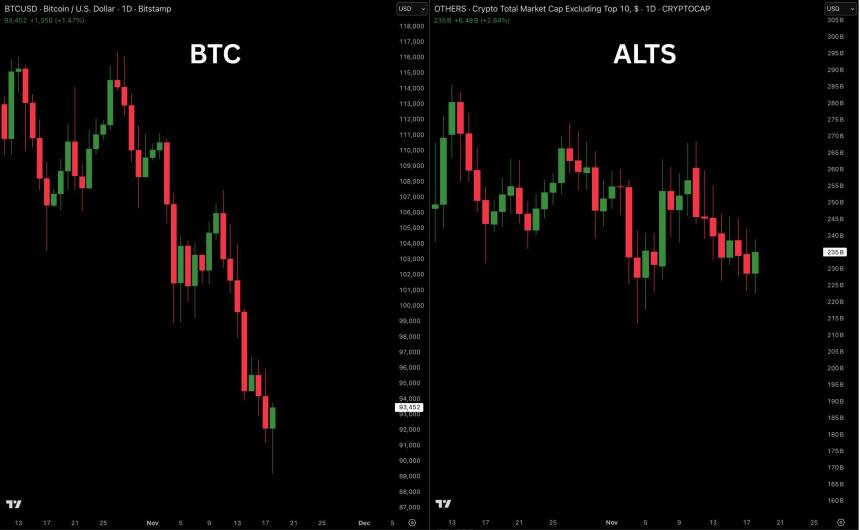
On Tuesday, the market’s leading cryptocurrency, Bitcoin (BTC), experienced a notable decline, dropping toward the $89,000 mark, its lowest price in seven months, resulting in over $1 billion in liquidations across the crypto market within the past 24 hours. 

However, despite this downturn, altcoins have exhibited significant stability when compared to the performance of BTC. Analysts from the Bull Theory have provided insights into why altcoins are holding strong during this period.

Bitcoin Dominance Falls

In a recent social media post on social media site X (previously Twitter), the analysts asserted that the recent decline in BTC’s value was not characterized by typical selling pressure; instead, it is seen as a result of structured institutional selling. 

This was reflected in negative flows from Coinbase and the manner in which the candlestick patterns formed. Following this structured selling, panic selling ensued as traders who were already facing losses began to exit their positions hastily. 

This panic selling led to rapid declines in BTC’s price; however, altcoins, having already approached a state of seller exhaustion, did not experience significant drops.
Bitcoin

In previous scenarios where BTC has faced downturns, its dominance in the market typically surges as traders flock to Bitcoin for safety. Yet, the current situation is different. 

Bitcoin’s dominance remains below the 50-week Exponential Moving Average (EMA), and the market has recently seen a series of red candles. Such a decline in dominance while BTC is in a downward spiral is unusual, suggesting that altcoins are not being entirely abandoned by traders.

Ethereum (ETH) has lost its 50-week EMA but is making attempts to reclaim it. Throughout this month, BTC and ETH have experienced nearly identical declines, yet ETH has shown quicker recovery patterns. 

The analysts highlighted that during previous cycles, whenever Ethereum holds its ground better than Bitcoin during similar downturns, altcoins tend to demonstrate strength as well.

Altcoins Show Strength Amid BTC’s Decline

The Bull Theory analysts also noted that many altcoin pairs against BTC have rebounded to levels seen before the significant crash that occurred on October 10th, with some even trading above those thresholds. 

This, according to their analysis, indicates a few key points: altcoins are outperforming BTC, the current pressure feels isolated rather than widespread, and the sell-off lacks broader implications across the market.

The Analysts suggest that this combination of factors is one of the strongest signals of a market bottom. When BTC is experiencing a downturn, dominance is declining, and alt/BTC pairs are on the rise, it often points to a capitulation phase for altcoins.

Bitcoin

As of this writing, Bitcoin has recovered above the $93,000 mark. However, the leading cryptocurrency has erased all of its year-to-date gains, while extending the gap to record levels by 26%. 

Featured image from DALL-E, chart from TradingView.com 

Market Opportunity
Bitcoin Logo
Bitcoin Price(BTC)
$70,339.53
$70,339.53$70,339.53
+1.34%
USD
Bitcoin (BTC) Live Price Chart
Disclaimer: The articles reposted on this site are sourced from public platforms and are provided for informational purposes only. They do not necessarily reflect the views of MEXC. All rights remain with the original authors. If you believe any content infringes on third-party rights, please contact crypto.news@mexc.com for removal. MEXC makes no guarantees regarding the accuracy, completeness, or timeliness of the content and is not responsible for any actions taken based on the information provided. The content does not constitute financial, legal, or other professional advice, nor should it be considered a recommendation or endorsement by MEXC.

You May Also Like

Fed Decides On Interest Rates Today—Here’s What To Watch For

Fed Decides On Interest Rates Today—Here’s What To Watch For

The post Fed Decides On Interest Rates Today—Here’s What To Watch For appeared on BitcoinEthereumNews.com. Topline The Federal Reserve on Wednesday will conclude a two-day policymaking meeting and release a decision on whether to lower interest rates—following months of pressure and criticism from President Donald Trump—and potentially signal whether additional cuts are on the way. President Donald Trump has urged the central bank to “CUT INTEREST RATES, NOW, AND BIGGER” than they might plan to. Getty Images Key Facts The central bank is poised to cut interest rates by at least a quarter-point, down from the 4.25% to 4.5% range where they have been held since December to between 4% and 4.25%, as Wall Street has placed 100% odds of a rate cut, according to CME’s FedWatch, with higher odds (94%) on a quarter-point cut than a half-point (6%) reduction. Fed governors Christopher Waller and Michelle Bowman, both Trump appointees, voted in July for a quarter-point reduction to rates, and they may dissent again in favor of a large cut alongside Stephen Miran, Trump’s Council of Economic Advisers’ chair, who was sworn in at the meeting’s start on Tuesday. It’s unclear whether other policymakers, including Kansas City Fed President Jeffrey Schmid and St. Louis Fed President Alberto Musalem, will favor larger cuts or opt for no reduction. Fed Chair Jerome Powell said in his Jackson Hole, Wyoming, address last month the central bank would likely consider a looser monetary policy, noting the “shifting balance of risks” on the U.S. economy “may warrant adjusting our policy stance.” David Mericle, an economist for Goldman Sachs, wrote in a note the “key question” for the Fed’s meeting is whether policymakers signal “this is likely the first in a series of consecutive cuts” as the central bank is anticipated to “acknowledge the softening in the labor market,” though they may not “nod to an October cut.” Mericle said he…
Share
BitcoinEthereumNews2025/09/18 00:23
Tips to Optimise Particle Size Distribution in Milling

Tips to Optimise Particle Size Distribution in Milling

The Significance of Particle Size in Milling Processes In milling processes, achieving the right particle size is very important. It affects product quality, performance
Share
Techbullion2026/03/20 01:06
Senate Republicans Hold Closed-Door Meeting on Cryptocurrency Yield Regulation

Senate Republicans Hold Closed-Door Meeting on Cryptocurrency Yield Regulation

Senate Republicans held a closed-door meeting to discuss cryptocurrency yield regulation, signaling a critical and sensitive phase in broader digital asset legislation
Share
coinlineup2026/03/20 01:30