Bitcoin is trading at critical price levels as the market enters one of its most tense and uncertain stages of the year. The crypto market is showing clear signs of stress, and new data from CryptoQuant confirms that Bitcoin is now moving into one of the most severe short-term capitulation phases of this cycle. According to the latest on-chain metrics, short-term holders (STHs) are realizing losses at a scale typically seen only near major market turning points. Related Reading: XRP Supply In Profit Falls to 58.5% – Lowest Since 2024 Despite Higher Price The key indicator driving this analysis is STH-SOPR, which has plunged to deeply depressed readings around 0.97. This means STHs are selling coins at a clear loss, often driven by fear rather than strategy. Even more importantly, this metric has spent several consecutive weeks below the critical 1.0 threshold, forming what analysts refer to as a structural “capitulation band.” Historically, whenever STH-SOPR remained under 1.0 for extended periods, it signaled heavy emotional selling—typically from the most reactive and least informed market participants. These episodes have repeatedly aligned with late-stage corrections, market reversals, and shifts in long-term holder dominance. With Bitcoin now sitting at a crucial technical and psychological zone, the next phase could determine whether this becomes a deeper bear trend or a major reset before recovery. Short-Term Holders Under Extreme Stress as Capitulation Deepens According to XWIN Research on CryptoQuant, the current selloff is being amplified by the behavior of short-term holders, with the STH-MVRV ratio now sitting far below 1.0. This indicates that nearly all recent buyers are holding Bitcoin at a loss, placing short-term profitability in one of the weakest conditions in the entire dataset. Historically, these deep unrealized-loss phases are extremely rare and tend to compress selling pressure quickly, as weak hands eventually run out of coins to sell. This pattern is clearly visible in real market flows. A striking 65,200 BTC were recently sent to exchanges at a loss, showing that fear is not an abstract sentiment but is materializing in real, loss-driven capitulation. This kind of behavior aligns with classical capitulation structures: unrealized losses surge, panic selling intensifies, and eventually selling pressure becomes unsustainable. Once that happens, stronger hands begin absorbing supply quietly in the background. While this setup doesn’t guarantee an immediate rebound, the broader structure is shifting toward conditions that have historically preceded cyclical recoveries. STH losses remain at extreme levels, STH-SOPR is still below 1.0, and the pressure fueling exchange inflows is rooted in panic rather than fundamentals. Volatility is likely to persist, but the ongoing cleansing of weak hands is a process often seen near the end of major corrections — not at the start. Related Reading: Galaxy Digital Dumps 2,800 BTC as Bitcoin Crashes Below $90K Testing Weekly Support as Momentum Weakens Bitcoin’s weekly chart shows the market approaching a critical turning point as price trades just above $91,000 following a sharp multi-week decline. The recent breakdown from the $110,000–$105,000 range has confirmed a loss of bullish momentum, with sellers gaining control and pushing BTC toward its next major weekly support cluster near the 50-week moving average around $88,000–$90,000. This zone has historically acted as a key pivot level, often signaling whether a corrective phase deepens or stabilizes. Volume adds important context. The past several weekly candles show rising sell-side activity, reflecting panic-driven exits rather than orderly distribution. However, this surge in volume also indicates that the market may be approaching a capitulation threshold, where forced selling begins to exhaust itself — a setup often seen before stronger hands step in. Related Reading: Ethereum Approaches Historical Accumulation Level – Just 8% Away From LTH Cost Basis Structurally, Bitcoin is still trading above the 100-week and 200-week moving averages, both of which continue to trend upward. This suggests the aggressive downside move has not yet broken the broader macrotrend. But the loss of mid-term support levels and the sustained downward pressure highlight a market struggling to find confidence. Featured image from ChatGPT, chart from TradingView.comBitcoin is trading at critical price levels as the market enters one of its most tense and uncertain stages of the year. The crypto market is showing clear signs of stress, and new data from CryptoQuant confirms that Bitcoin is now moving into one of the most severe short-term capitulation phases of this cycle. According to the latest on-chain metrics, short-term holders (STHs) are realizing losses at a scale typically seen only near major market turning points. Related Reading: XRP Supply In Profit Falls to 58.5% – Lowest Since 2024 Despite Higher Price The key indicator driving this analysis is STH-SOPR, which has plunged to deeply depressed readings around 0.97. This means STHs are selling coins at a clear loss, often driven by fear rather than strategy. Even more importantly, this metric has spent several consecutive weeks below the critical 1.0 threshold, forming what analysts refer to as a structural “capitulation band.” Historically, whenever STH-SOPR remained under 1.0 for extended periods, it signaled heavy emotional selling—typically from the most reactive and least informed market participants. These episodes have repeatedly aligned with late-stage corrections, market reversals, and shifts in long-term holder dominance. With Bitcoin now sitting at a crucial technical and psychological zone, the next phase could determine whether this becomes a deeper bear trend or a major reset before recovery. Short-Term Holders Under Extreme Stress as Capitulation Deepens According to XWIN Research on CryptoQuant, the current selloff is being amplified by the behavior of short-term holders, with the STH-MVRV ratio now sitting far below 1.0. This indicates that nearly all recent buyers are holding Bitcoin at a loss, placing short-term profitability in one of the weakest conditions in the entire dataset. Historically, these deep unrealized-loss phases are extremely rare and tend to compress selling pressure quickly, as weak hands eventually run out of coins to sell. This pattern is clearly visible in real market flows. A striking 65,200 BTC were recently sent to exchanges at a loss, showing that fear is not an abstract sentiment but is materializing in real, loss-driven capitulation. This kind of behavior aligns with classical capitulation structures: unrealized losses surge, panic selling intensifies, and eventually selling pressure becomes unsustainable. Once that happens, stronger hands begin absorbing supply quietly in the background. While this setup doesn’t guarantee an immediate rebound, the broader structure is shifting toward conditions that have historically preceded cyclical recoveries. STH losses remain at extreme levels, STH-SOPR is still below 1.0, and the pressure fueling exchange inflows is rooted in panic rather than fundamentals. Volatility is likely to persist, but the ongoing cleansing of weak hands is a process often seen near the end of major corrections — not at the start. Related Reading: Galaxy Digital Dumps 2,800 BTC as Bitcoin Crashes Below $90K Testing Weekly Support as Momentum Weakens Bitcoin’s weekly chart shows the market approaching a critical turning point as price trades just above $91,000 following a sharp multi-week decline. The recent breakdown from the $110,000–$105,000 range has confirmed a loss of bullish momentum, with sellers gaining control and pushing BTC toward its next major weekly support cluster near the 50-week moving average around $88,000–$90,000. This zone has historically acted as a key pivot level, often signaling whether a corrective phase deepens or stabilizes. Volume adds important context. The past several weekly candles show rising sell-side activity, reflecting panic-driven exits rather than orderly distribution. However, this surge in volume also indicates that the market may be approaching a capitulation threshold, where forced selling begins to exhaust itself — a setup often seen before stronger hands step in. Related Reading: Ethereum Approaches Historical Accumulation Level – Just 8% Away From LTH Cost Basis Structurally, Bitcoin is still trading above the 100-week and 200-week moving averages, both of which continue to trend upward. This suggests the aggressive downside move has not yet broken the broader macrotrend. But the loss of mid-term support levels and the sustained downward pressure highlight a market struggling to find confidence. Featured image from ChatGPT, chart from TradingView.com

Bitcoin Capitulation Deepens Around $90K Level: Classic Late-Stage Fear Structure Emerging

2025/11/20 07:00
4 min read

Bitcoin is trading at critical price levels as the market enters one of its most tense and uncertain stages of the year. The crypto market is showing clear signs of stress, and new data from CryptoQuant confirms that Bitcoin is now moving into one of the most severe short-term capitulation phases of this cycle. According to the latest on-chain metrics, short-term holders (STHs) are realizing losses at a scale typically seen only near major market turning points.

The key indicator driving this analysis is STH-SOPR, which has plunged to deeply depressed readings around 0.97. This means STHs are selling coins at a clear loss, often driven by fear rather than strategy. Even more importantly, this metric has spent several consecutive weeks below the critical 1.0 threshold, forming what analysts refer to as a structural “capitulation band.”

Historically, whenever STH-SOPR remained under 1.0 for extended periods, it signaled heavy emotional selling—typically from the most reactive and least informed market participants. These episodes have repeatedly aligned with late-stage corrections, market reversals, and shifts in long-term holder dominance. With Bitcoin now sitting at a crucial technical and psychological zone, the next phase could determine whether this becomes a deeper bear trend or a major reset before recovery.

Short-Term Holders Under Extreme Stress as Capitulation Deepens

According to XWIN Research on CryptoQuant, the current selloff is being amplified by the behavior of short-term holders, with the STH-MVRV ratio now sitting far below 1.0. This indicates that nearly all recent buyers are holding Bitcoin at a loss, placing short-term profitability in one of the weakest conditions in the entire dataset. Historically, these deep unrealized-loss phases are extremely rare and tend to compress selling pressure quickly, as weak hands eventually run out of coins to sell.

This pattern is clearly visible in real market flows. A striking 65,200 BTC were recently sent to exchanges at a loss, showing that fear is not an abstract sentiment but is materializing in real, loss-driven capitulation. This kind of behavior aligns with classical capitulation structures: unrealized losses surge, panic selling intensifies, and eventually selling pressure becomes unsustainable. Once that happens, stronger hands begin absorbing supply quietly in the background.

While this setup doesn’t guarantee an immediate rebound, the broader structure is shifting toward conditions that have historically preceded cyclical recoveries. STH losses remain at extreme levels, STH-SOPR is still below 1.0, and the pressure fueling exchange inflows is rooted in panic rather than fundamentals. Volatility is likely to persist, but the ongoing cleansing of weak hands is a process often seen near the end of major corrections — not at the start.

Bitcoin Short-Term Holder SOPR | Source: CryptoQuant

Testing Weekly Support as Momentum Weakens

Bitcoin’s weekly chart shows the market approaching a critical turning point as price trades just above $91,000 following a sharp multi-week decline. The recent breakdown from the $110,000–$105,000 range has confirmed a loss of bullish momentum, with sellers gaining control and pushing BTC toward its next major weekly support cluster near the 50-week moving average around $88,000–$90,000. This zone has historically acted as a key pivot level, often signaling whether a corrective phase deepens or stabilizes.
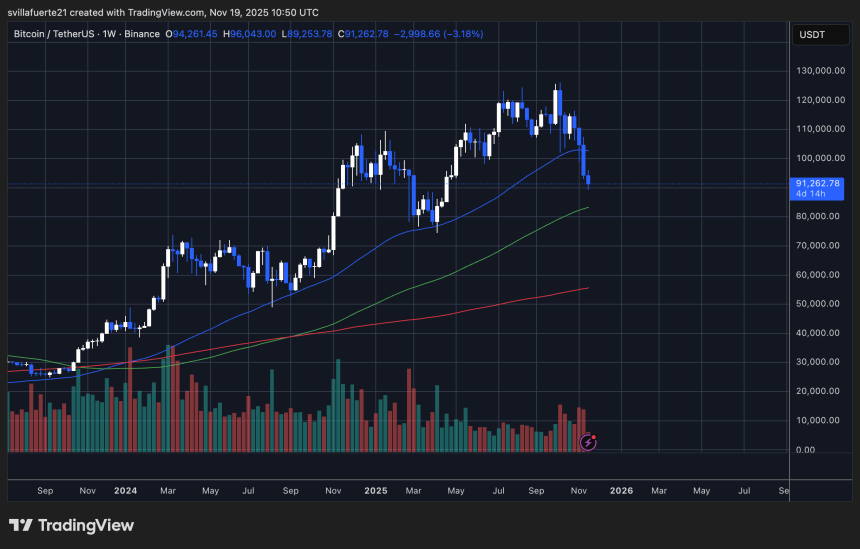
BTC testing key demand levels | Source: BTCUSDT chart on TradingView

Volume adds important context. The past several weekly candles show rising sell-side activity, reflecting panic-driven exits rather than orderly distribution. However, this surge in volume also indicates that the market may be approaching a capitulation threshold, where forced selling begins to exhaust itself — a setup often seen before stronger hands step in.

Structurally, Bitcoin is still trading above the 100-week and 200-week moving averages, both of which continue to trend upward. This suggests the aggressive downside move has not yet broken the broader macrotrend. But the loss of mid-term support levels and the sustained downward pressure highlight a market struggling to find confidence.

Featured image from ChatGPT, chart from TradingView.com

Market Opportunity
Nowchain Logo
Nowchain Price(NOW)
$0.0040933
$0.0040933$0.0040933
+157.08%
USD
Nowchain (NOW) Live Price Chart
Disclaimer: The articles reposted on this site are sourced from public platforms and are provided for informational purposes only. They do not necessarily reflect the views of MEXC. All rights remain with the original authors. If you believe any content infringes on third-party rights, please contact service@support.mexc.com for removal. MEXC makes no guarantees regarding the accuracy, completeness, or timeliness of the content and is not responsible for any actions taken based on the information provided. The content does not constitute financial, legal, or other professional advice, nor should it be considered a recommendation or endorsement by MEXC.

You May Also Like

FCA komt in 2026 met aangepaste cryptoregels voor Britse markt

FCA komt in 2026 met aangepaste cryptoregels voor Britse markt

De Britse financiële waakhond, de FCA, komt in 2026 met nieuwe regels speciaal voor crypto bedrijven. Wat direct opvalt: de toezichthouder laat enkele klassieke financiële verplichtingen los om beter aan te sluiten op de snelle en grillige wereld van digitale activa. Tegelijkertijd wordt er extra nadruk gelegd op digitale beveiliging,... Het bericht FCA komt in 2026 met aangepaste cryptoregels voor Britse markt verscheen het eerst op Blockchain Stories.
Share
Coinstats2025/09/18 00:33
United States Building Permits Change dipped from previous -2.8% to -3.7% in August

United States Building Permits Change dipped from previous -2.8% to -3.7% in August

The post United States Building Permits Change dipped from previous -2.8% to -3.7% in August appeared on BitcoinEthereumNews.com. Information on these pages contains forward-looking statements that involve risks and uncertainties. Markets and instruments profiled on this page are for informational purposes only and should not in any way come across as a recommendation to buy or sell in these assets. You should do your own thorough research before making any investment decisions. FXStreet does not in any way guarantee that this information is free from mistakes, errors, or material misstatements. It also does not guarantee that this information is of a timely nature. Investing in Open Markets involves a great deal of risk, including the loss of all or a portion of your investment, as well as emotional distress. All risks, losses and costs associated with investing, including total loss of principal, are your responsibility. The views and opinions expressed in this article are those of the authors and do not necessarily reflect the official policy or position of FXStreet nor its advertisers. The author will not be held responsible for information that is found at the end of links posted on this page. If not otherwise explicitly mentioned in the body of the article, at the time of writing, the author has no position in any stock mentioned in this article and no business relationship with any company mentioned. The author has not received compensation for writing this article, other than from FXStreet. FXStreet and the author do not provide personalized recommendations. The author makes no representations as to the accuracy, completeness, or suitability of this information. FXStreet and the author will not be liable for any errors, omissions or any losses, injuries or damages arising from this information and its display or use. Errors and omissions excepted. The author and FXStreet are not registered investment advisors and nothing in this article is intended…
Share
BitcoinEthereumNews2025/09/18 02:20
Pi Network Tech Upgrade Unlocks Mainnet Migration for 2.5 Million Users and Introduces Palm Print Security

Pi Network Tech Upgrade Unlocks Mainnet Migration for 2.5 Million Users and Introduces Palm Print Security

Pi Network has announced a major technological breakthrough that marks a new chapter in its evolution. According to information shared by Twitter user @strong3
Share
Hokanews2026/02/07 12:28




