Ryan Rasmussen, Head of Research at Bitwise, used a Yahoo Finance appearance to restate Bitwise’s view that Bitcoin is headed to $200,000 in 2026, while simultaneously characterizing the current sell-off as a maturing-market shakeout rather than a trend break. Is The Bottom In For Bitcoin? He opened with a near-term assessment that “we’re closer to the bottom here today than we have been for the past few weeks,” linking the drawdown to sharply risk-off conditions and to ETF-era flow dynamics. In his framing, Bitcoin “really was a leader of this risk-off move starting in mid-October,” and he expects it to “be a leader to the upside once things start to turn around,” adding that the market feels nearer to that inflection than it did “a week or two weeks ago.” When asked whether spot Bitcoin ETFs have become a double-edged sword, Rasmussen agreed, describing a market that now has deeper liquidity but more cross-currents. “Bitcoin, in our view, is one of the biggest technological developments of the past 15 years,” he said, before explaining that institutionalization brings “new investors and adds more liquidity to the market,” yet also means “we’re seeing a lot more choppiness in times where risk-off moves happen.” He pointed to hedge funds rotating in and out via basis trades and emphasized that “you just have more market participants.” Over time, he expects that shift to damp volatility, but not in a straight line: “throughout that journey, we’re going to see some choppiness, and certainly over the past month, we’ve seen that.” Related Reading: Will Bitcoin Bottom At $56,000? CryptoQuant CEO Presents The Data Pressed on why volatility still looks elevated, Rasmussen separated short-horizon spikes from long-run trend. “If you look at the trend over the past 10 years, volatility has certainly been falling,” he said, but conceded that “over this short-term period, you do see spikes in volatility.” The composition of buyers is, in his view, changing in a stabilizing direction. “The buyers for Bitcoin that we’re seeing come into the market today are more long-term buyers than we’ve seen in the past,” he said, naming wealth managers and financial advisors who “are adding Bitcoin to model portfolios” and “rebalancing on a standard basis.” That institutional style of demand “should all reduce volatility, add more long-term demand,” though he also noted a counterweight: corporate treasury buying that was strong earlier in the year has faded. “The corporate treasuries that are purchasing Bitcoin were coming in in size earlier this year, and that’s really dried up,” he said, arguing that this demand pause is “in part due to this sell-off that we’ve seen in October.” Bitcoin Still Set for $200,000 By 2026 Rasmussen acknowledged the pain of lower prices for recent buyers, but insisted the medium-term path remains higher. “Lower prices are a gift and a curse, of course,” he said. “A lot of investors are feeling pain right now who bought Bitcoin above $100,000 or closer to the $125,000 mark, but we believe that Bitcoin’s going to end the year higher than it is today.” He reiterated that the short-term bottoming process is likely advanced, and then pivoted to his structural thesis: “Institutions are finally here.” He stressed that adoption is gradual rather than instantaneous: “That doesn’t mean that right away they deploy all of their capital.” Even so, he cited early signals such as endowment participation: “even Harvard, we saw with their recent filing, is buying Bitcoin in their endowment.” Related Reading: Bitcoin Capitulation Deepens Around $90K Level: Classic Late-Stage Fear Structure Emerging On macro, Rasmussen conceded an irony that an asset marketed as sovereign and untethered now reacts to central-bank expectations. Post-COVID, he said, Bitcoin has traded in a “fiscally-dominated environment where rate cuts and other macro elements do play more of a role,” and correlations to equities have “spike[d] or raise[d].” Still, he argued correlations are drifting back toward historical lows, and he emphasized Bitcoin’s tendency to do well in “low rate environments and risk on environments.” Regarding the December Fed meeting, he said “no cut in December is largely priced into the market,” and suggested investors have “already started to turn to 2026.” The price target itself was stated unambiguously. “So this year, we had a price target of $200,000. And I think it’s safe to say that come December, that’s not going to happen. But we do believe that in 2026, Bitcoin will hit $200,000,” Rasmussen said. He attributed that forecast to institutional inflows arriving “in waves,” spanning “wealth managers or endowments or pensions or corporations or governments,” which he believes are creating “a systemic imbalance of demand versus supply.” At press time, BTC traded at $91,205. Featured image created with DALL.E, chart from TradingView.comRyan Rasmussen, Head of Research at Bitwise, used a Yahoo Finance appearance to restate Bitwise’s view that Bitcoin is headed to $200,000 in 2026, while simultaneously characterizing the current sell-off as a maturing-market shakeout rather than a trend break. Is The Bottom In For Bitcoin? He opened with a near-term assessment that “we’re closer to the bottom here today than we have been for the past few weeks,” linking the drawdown to sharply risk-off conditions and to ETF-era flow dynamics. In his framing, Bitcoin “really was a leader of this risk-off move starting in mid-October,” and he expects it to “be a leader to the upside once things start to turn around,” adding that the market feels nearer to that inflection than it did “a week or two weeks ago.” When asked whether spot Bitcoin ETFs have become a double-edged sword, Rasmussen agreed, describing a market that now has deeper liquidity but more cross-currents. “Bitcoin, in our view, is one of the biggest technological developments of the past 15 years,” he said, before explaining that institutionalization brings “new investors and adds more liquidity to the market,” yet also means “we’re seeing a lot more choppiness in times where risk-off moves happen.” He pointed to hedge funds rotating in and out via basis trades and emphasized that “you just have more market participants.” Over time, he expects that shift to damp volatility, but not in a straight line: “throughout that journey, we’re going to see some choppiness, and certainly over the past month, we’ve seen that.” Related Reading: Will Bitcoin Bottom At $56,000? CryptoQuant CEO Presents The Data Pressed on why volatility still looks elevated, Rasmussen separated short-horizon spikes from long-run trend. “If you look at the trend over the past 10 years, volatility has certainly been falling,” he said, but conceded that “over this short-term period, you do see spikes in volatility.” The composition of buyers is, in his view, changing in a stabilizing direction. “The buyers for Bitcoin that we’re seeing come into the market today are more long-term buyers than we’ve seen in the past,” he said, naming wealth managers and financial advisors who “are adding Bitcoin to model portfolios” and “rebalancing on a standard basis.” That institutional style of demand “should all reduce volatility, add more long-term demand,” though he also noted a counterweight: corporate treasury buying that was strong earlier in the year has faded. “The corporate treasuries that are purchasing Bitcoin were coming in in size earlier this year, and that’s really dried up,” he said, arguing that this demand pause is “in part due to this sell-off that we’ve seen in October.” Bitcoin Still Set for $200,000 By 2026 Rasmussen acknowledged the pain of lower prices for recent buyers, but insisted the medium-term path remains higher. “Lower prices are a gift and a curse, of course,” he said. “A lot of investors are feeling pain right now who bought Bitcoin above $100,000 or closer to the $125,000 mark, but we believe that Bitcoin’s going to end the year higher than it is today.” He reiterated that the short-term bottoming process is likely advanced, and then pivoted to his structural thesis: “Institutions are finally here.” He stressed that adoption is gradual rather than instantaneous: “That doesn’t mean that right away they deploy all of their capital.” Even so, he cited early signals such as endowment participation: “even Harvard, we saw with their recent filing, is buying Bitcoin in their endowment.” Related Reading: Bitcoin Capitulation Deepens Around $90K Level: Classic Late-Stage Fear Structure Emerging On macro, Rasmussen conceded an irony that an asset marketed as sovereign and untethered now reacts to central-bank expectations. Post-COVID, he said, Bitcoin has traded in a “fiscally-dominated environment where rate cuts and other macro elements do play more of a role,” and correlations to equities have “spike[d] or raise[d].” Still, he argued correlations are drifting back toward historical lows, and he emphasized Bitcoin’s tendency to do well in “low rate environments and risk on environments.” Regarding the December Fed meeting, he said “no cut in December is largely priced into the market,” and suggested investors have “already started to turn to 2026.” The price target itself was stated unambiguously. “So this year, we had a price target of $200,000. And I think it’s safe to say that come December, that’s not going to happen. But we do believe that in 2026, Bitcoin will hit $200,000,” Rasmussen said. He attributed that forecast to institutional inflows arriving “in waves,” spanning “wealth managers or endowments or pensions or corporations or governments,” which he believes are creating “a systemic imbalance of demand versus supply.” At press time, BTC traded at $91,205. Featured image created with DALL.E, chart from TradingView.com
Why Bitwise Thinks Bitcoin Still Hits $200,000 In 2026

2025/11/21 13:00

Ryan Rasmussen, Head of Research at Bitwise, used a Yahoo Finance appearance to restate Bitwise’s view that Bitcoin is headed to $200,000 in 2026, while simultaneously characterizing the current sell-off as a maturing-market shakeout rather than a trend break.

Is The Bottom In For Bitcoin?

He opened with a near-term assessment that “we’re closer to the bottom here today than we have been for the past few weeks,” linking the drawdown to sharply risk-off conditions and to ETF-era flow dynamics. In his framing, Bitcoin “really was a leader of this risk-off move starting in mid-October,” and he expects it to “be a leader to the upside once things start to turn around,” adding that the market feels nearer to that inflection than it did “a week or two weeks ago.”

When asked whether spot Bitcoin ETFs have become a double-edged sword, Rasmussen agreed, describing a market that now has deeper liquidity but more cross-currents. “Bitcoin, in our view, is one of the biggest technological developments of the past 15 years,” he said, before explaining that institutionalization brings “new investors and adds more liquidity to the market,” yet also means “we’re seeing a lot more choppiness in times where risk-off moves happen.”

He pointed to hedge funds rotating in and out via basis trades and emphasized that “you just have more market participants.” Over time, he expects that shift to damp volatility, but not in a straight line: “throughout that journey, we’re going to see some choppiness, and certainly over the past month, we’ve seen that.”

Pressed on why volatility still looks elevated, Rasmussen separated short-horizon spikes from long-run trend. “If you look at the trend over the past 10 years, volatility has certainly been falling,” he said, but conceded that “over this short-term period, you do see spikes in volatility.” The composition of buyers is, in his view, changing in a stabilizing direction. “The buyers for Bitcoin that we’re seeing come into the market today are more long-term buyers than we’ve seen in the past,” he said, naming wealth managers and financial advisors who “are adding Bitcoin to model portfolios” and “rebalancing on a standard basis.”

That institutional style of demand “should all reduce volatility, add more long-term demand,” though he also noted a counterweight: corporate treasury buying that was strong earlier in the year has faded. “The corporate treasuries that are purchasing Bitcoin were coming in in size earlier this year, and that’s really dried up,” he said, arguing that this demand pause is “in part due to this sell-off that we’ve seen in October.”

Bitcoin Still Set for $200,000 By 2026

Rasmussen acknowledged the pain of lower prices for recent buyers, but insisted the medium-term path remains higher. “Lower prices are a gift and a curse, of course,” he said. “A lot of investors are feeling pain right now who bought Bitcoin above $100,000 or closer to the $125,000 mark, but we believe that Bitcoin’s going to end the year higher than it is today.”

He reiterated that the short-term bottoming process is likely advanced, and then pivoted to his structural thesis: “Institutions are finally here.” He stressed that adoption is gradual rather than instantaneous: “That doesn’t mean that right away they deploy all of their capital.” Even so, he cited early signals such as endowment participation: “even Harvard, we saw with their recent filing, is buying Bitcoin in their endowment.”

On macro, Rasmussen conceded an irony that an asset marketed as sovereign and untethered now reacts to central-bank expectations. Post-COVID, he said, Bitcoin has traded in a “fiscally-dominated environment where rate cuts and other macro elements do play more of a role,” and correlations to equities have “spike[d] or raise[d].”

Still, he argued correlations are drifting back toward historical lows, and he emphasized Bitcoin’s tendency to do well in “low rate environments and risk on environments.” Regarding the December Fed meeting, he said “no cut in December is largely priced into the market,” and suggested investors have “already started to turn to 2026.”

The price target itself was stated unambiguously. “So this year, we had a price target of $200,000. And I think it’s safe to say that come December, that’s not going to happen. But we do believe that in 2026, Bitcoin will hit $200,000,” Rasmussen said. He attributed that forecast to institutional inflows arriving “in waves,” spanning “wealth managers or endowments or pensions or corporations or governments,” which he believes are creating “a systemic imbalance of demand versus supply.”

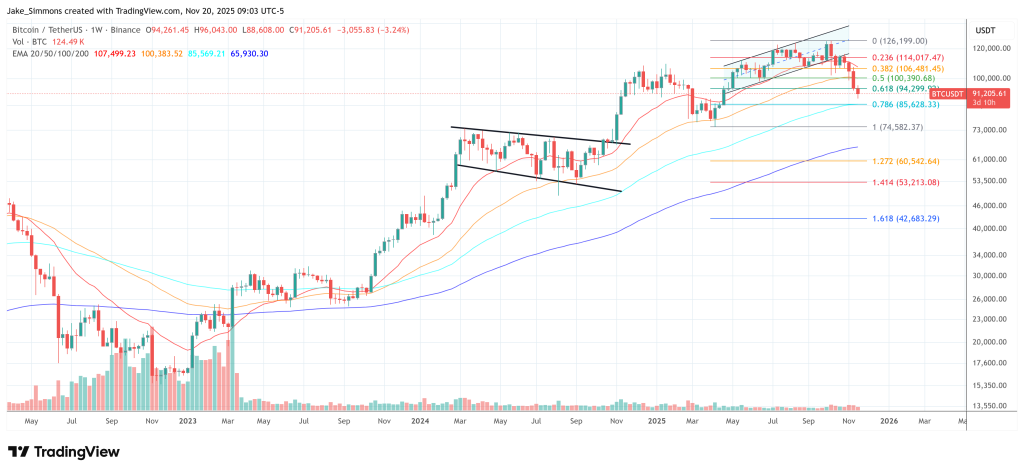
At press time, BTC traded at $91,205.

Bitcoin price
Market Opportunity
WHY Logo
WHY Price(WHY)
$0.00000001433
$0.00000001433$0.00000001433
0.00%
USD
WHY (WHY) Live Price Chart
Disclaimer: The articles reposted on this site are sourced from public platforms and are provided for informational purposes only. They do not necessarily reflect the views of MEXC. All rights remain with the original authors. If you believe any content infringes on third-party rights, please contact service@support.mexc.com for removal. MEXC makes no guarantees regarding the accuracy, completeness, or timeliness of the content and is not responsible for any actions taken based on the information provided. The content does not constitute financial, legal, or other professional advice, nor should it be considered a recommendation or endorsement by MEXC.

You May Also Like

Gold edges higher as Fed easing outlook cushions downside

Gold edges higher as Fed easing outlook cushions downside

The post Gold edges higher as Fed easing outlook cushions downside appeared on BitcoinEthereumNews.com. Gold trades near $3,670 on Friday, snapping a two-day losing streak after the Fed’s interest rate cut. The US Dollar and Treasury yields extend post-Fed rebound as Powell’s tone proved less dovish than expected. Gold remains cushioned as markets anticipate two more Fed rate cuts by year-end. Gold (XAU/USD) regains ground on Friday, snapping a two-day losing streak after a volatile midweek reaction to the Federal Reserve’s (Fed) interest rate decision. At the time of writing, XAU/USD is trading around $3,668 during the American session, up nearly 0.65%. On Wednesday, the US central bank lowered the federal funds rate by 25 basis points (bps) to the 4.00%-4.25% range, a move that was fully priced in. The metal briefly spiked to a fresh all-time high near $3,707 in the immediate aftermath, but the gains quickly faded as Fed Chair Jerome Powell’s press conference struck a less dovish tone, triggering a sharp recovery in the US Dollar (USD) and Treasury yields. Chair Jerome Powell said the Fed does not feel the need to move quickly on rates, describing the latest move as a “risk-management cut” aimed at cushioning the economy amid signs of a slowing labor market. He added that policy is “not on a preset course” and will remain data-dependent, signaling a cautious approach rather than an aggressive easing cycle. Friday’s rebound in XAU/USD comes in spite of a firmer US Dollar and rising Treasury yields, as traders weigh the implications of the Fed’s monetary policy outlook. Markets are already pricing in the possibility of two more cuts by year-end, which in turn cushions downside risks for bullion, but elevated yields and a resilient Greenback keep the near-term outlook capped, limiting room for further gains. Market movers: US Dollar firms with higher yields, Fed projects gradual easing Minneapolis Fed President Neel…
Share
BitcoinEthereumNews2025/09/20 04:28
Flare Mainnet Launches FXRP, Bringing XRP Into DeFi

Flare Mainnet Launches FXRP, Bringing XRP Into DeFi

The post Flare Mainnet Launches FXRP, Bringing XRP Into DeFi appeared on BitcoinEthereumNews.com. Flare’s FAssets protocol converts cryptocurrencies like XRP that aren’t smart contract enabled into assets that can be utilized in DeFi on Flare and other applications. To guarantee FAssets maintain the highest levels of safety, trust, and dependability for both institutions and the XRP community, the Flare Foundation will keep making investments in strong, scalable security mechanisms. FAssets, beginning with FXRP v1.2, are now live on the Flare mainnet. Now that the first FAsset has finally been launched, holders of XRP may mint FXRP on Flare and begin using XRP throughout Flare DeFi. The XRP DeFi awakening is just getting started. A quick refresher on FAssets Flare’s FAssets protocol converts cryptocurrencies like XRP that aren’t smart contract enabled into assets that can be utilized in DeFi on Flare and other applications. They are one-to-one copies of the original asset (XRP to FXRP, for example), protected by Flare’s codified data standards and an overcollateralized structure of independent agents. As a consequence, Flare’s composable decentralized financial ecosystem, which includes DEX trading, lending, stablecoin minting, liquid staking, and other use cases, becomes fully accessible to non-smart contract assets. FAssets are built for composability. FXRP may travel freely within Flare’s DeFi ecosystem when it is minted. This eliminates the need for unique workarounds and enables protocols to use FXRP directly as a native building block. How is FXRP secured? FAsset security is a continuous effort rather than a one-time achievement. In addition to Immunefi-powered bug bounties and community-driven evaluations like Code4rena, the system has already completed at least four independent audits by reputable companies like Zellic and Coinspect. Additionally, Hypernative keeps a close eye on the FAssets system and the DeFi apps on Flare around-the-clock. Comprehensive security and fast reaction procedures are also in place. Why are there so many layers? Because FAssets oversee high-value, intricate processes…
Share
BitcoinEthereumNews2025/09/25 04:24
FET Price Prediction: Can Bulls Break $0.70 Resistance to Approach $1.60?

FET Price Prediction: Can Bulls Break $0.70 Resistance to Approach $1.60?

Artificial Superintelligence Alliance (FET) is trading under increasing bearish pressure with the overall market. The FET price over the last 24 hours is down by 4.58%, and over the last week it is also down by 4.66%. At the time of writing, FET is trading at $0.6479 with a 24-hour trading volume of $105.46 million, […]
Share
Tronweekly2025/09/20 20:00