What to Know: Saylor’s ‘I Won’t Back Down’ message comes as Bitcoin slides toward $80K–$85K, pressuring leveraged players and reigniting crash warnings. Strategy’s 649K+ BTC stack remains profitable on paper, but the stock premium has nearly vanished, testing investor patience with the treasury bet. U.Today+1 Bitcoin Hyper aims to solve Bitcoin’s throughput, fees, and programmability issues with an SVM-based Layer-2 that keeps Bitcoin as the settlement layer. The $HYPER presale has raised over $28M, offers around 41% staking rewards, and targets multi-X upside if its Layer-2 roadmap and ecosystem delivery succeed. Bitcoin just pulled off one of the nastiest rug-pull-looking dips of the entire cycle. In a matter of hours, the price fell from above $120K to sub-$90K and even wicked into the $80,600 zone, wiping out billions in longs and reigniting the classic “it’s over, lads” chorus across Crypto X. And right in the middle of the chaos, Michael Saylor dropped four words that could basically be printed on his business card: “I won’t back down.” This time, the line carried extra weight. His company, Strategy, is now sitting on roughly 649,870 BTC at an average price near $74,430, still in profit despite the crash, even as the stock gets punished and critics wonder how long a leveraged Bitcoin maxi can stare down this kind of volatility. Strategy even ran a poll that showed nearly 78% of respondents were simply HODLing through the sell-off. Hardcore Bitcoiners still see turbulence, not terminal failure, but not everyone’s built for that degree of mark-to-market pain. Retail, smaller funds, and DeFi traders are increasingly searching for ways to keep Bitcoin exposure without just holding spot and praying. That’s where the new rotation narrative comes in. If Bitcoin stays the monetary backbone of crypto, the best altcoins this cycle may be the ones solving what Bitcoin can’t: throughput, fees, and programmability. Bitcoin Hyper ($HYPER) fits that thesis almost too well, positioning itself as a Bitcoin Layer-2 designed to make BTC behave like a fast, flexible, programmable asset, all without compromising the base layer. Bitcoin Hyper Turns Bitcoin Volatility Into Layer-2 Utility Behind the branding, Bitcoin Hyper is targeting a very real structural gap in the Bitcoin ecosystem. BTC still handles only a handful of transactions per second, and fees spike whenever activity increases, which is why most of today’s DeFi, NFTs, and on-chain experimentation have migrated to faster environments, such as Solana. Bitcoin Hyper’s solution is a rollup-style Layer-2 anchored to Bitcoin but powered by an SVM (Solana Virtual Machine) execution layer. Users send BTC to a monitored main-chain address, a canonical bridge verifies the deposit, and the network mints an equivalent amount of wrapped BTC on Hyper. From there, transactions run on a high-throughput chain with near-instant finality and low fees, while zero-knowledge proofs periodically settle back to Bitcoin L1. The architecture aims to preserve Bitcoin’s security while moving actual activity, payments, DEX trades, lending, NFT markets, even meme-coin chaos, onto a chain that feels Solana-fast. Because it uses SVM, existing Rust developers can port their apps with minimal friction, giving Hyper a realistic shot at building an ecosystem instead of becoming another pretty but empty L2. Of course, there are risks. $HYPER is still in presale, and the roadmap is ambitious: audits and presale throughout 2025, mainnet and SVM+dApp integration between late 2025 and early 2026, then token listings, SDKs, and a DAO rollout in 2026. Execution needs to hit those milestones for the L2 thesis to play out. Security is at least trending positively. The contracts have already cleared audits from Coinsult and SpyWolf, with no hidden mint functions or obvious backdoors flagged, a good start, even if it doesn’t eliminate the typical smart-contract and market risks associated with new chains. For anyone who wants to stay structurally long Bitcoin while also capturing upside from where the next wave of blockspace demand might land, $HYPER offers a clean play. If Bitcoin activity increases and DeFi migrates toward BTC-secured infrastructure, a functioning Bitcoin-anchored Layer-2 could absorb a disproportionate share of that value. Inside the Bitcoin Hyper Presale and $HYPER Token Economics While Bitcoin has been violently whipsawing, the Bitcoin Hyper presale has been doing the opposite, grinding steadily upward. It has now crossed $28.3M raised, with the current stage pricing $HYPER around $0.013325. That still puts it in micro-cap range, but the raise is now large enough that this is no longer a small degen side-quest. Real capital is flowing in. Presale buyers can also stake $HYPER at 41% rewards, with more than a billion tokens already locked. Those yields will naturally taper off as more wallets join in, but the intent is clear: early participants are encouraged to behave like long-term network partners, not short-term flippers. It aligns neatly with the idea of $HYPER acting as a “beta on Bitcoin’s evolution” rather than just another momentum meme. On the valuation side, upside scenarios being circulated are bold but at least mathematically grounded. One widely shared fundamental review puts a potential 2025 high near $0.02595 once mainnet is live and liquidity deepens, roughly a 2x from the current presale range if the thesis holds. More aggressive models project further out, mapping a possible 2026 high around $0.08625 and a 2030 target near $0.253, assuming the roadmap lands, the ecosystem fills in, and major exchanges eventually list the token. Relative to today’s pricing, that implies roughly 6–7x to the 2026 level and close to 19x by 2030. Nothing is guaranteed, but it explains why $HYPER keeps showing up in alt-rotation threads whenever traders discuss asymmetric setups tied to Bitcoin infrastructure instead of random meme noise. Crucially, $HYPER isn’t pitched as a hedge against Bitcoin; it’s pitched as a way to amplify it. If Saylor’s “I Won’t Back Down” stance represents the diamond-hands end of the spectrum, Bitcoin Hyper is where the more risk-tolerant crowd is rotating: still ideologically long BTC, but looking to high-beta Layer-2 infrastructure for bigger potential multiples as the cycle churns through volatility. This article is informational only; crypto, especially presales, is highly volatile. Always do your own research and never risk rent money. Authored by Aaron Walker, NewsBTC – https://www.newsbtc.com/news/best-altcoins-saylor-wont-back-down-bitcoin-hyper-presaleWhat to Know: Saylor’s ‘I Won’t Back Down’ message comes as Bitcoin slides toward $80K–$85K, pressuring leveraged players and reigniting crash warnings. Strategy’s 649K+ BTC stack remains profitable on paper, but the stock premium has nearly vanished, testing investor patience with the treasury bet. U.Today+1 Bitcoin Hyper aims to solve Bitcoin’s throughput, fees, and programmability issues with an SVM-based Layer-2 that keeps Bitcoin as the settlement layer. The $HYPER presale has raised over $28M, offers around 41% staking rewards, and targets multi-X upside if its Layer-2 roadmap and ecosystem delivery succeed. Bitcoin just pulled off one of the nastiest rug-pull-looking dips of the entire cycle. In a matter of hours, the price fell from above $120K to sub-$90K and even wicked into the $80,600 zone, wiping out billions in longs and reigniting the classic “it’s over, lads” chorus across Crypto X. And right in the middle of the chaos, Michael Saylor dropped four words that could basically be printed on his business card: “I won’t back down.” This time, the line carried extra weight. His company, Strategy, is now sitting on roughly 649,870 BTC at an average price near $74,430, still in profit despite the crash, even as the stock gets punished and critics wonder how long a leveraged Bitcoin maxi can stare down this kind of volatility. Strategy even ran a poll that showed nearly 78% of respondents were simply HODLing through the sell-off. Hardcore Bitcoiners still see turbulence, not terminal failure, but not everyone’s built for that degree of mark-to-market pain. Retail, smaller funds, and DeFi traders are increasingly searching for ways to keep Bitcoin exposure without just holding spot and praying. That’s where the new rotation narrative comes in. If Bitcoin stays the monetary backbone of crypto, the best altcoins this cycle may be the ones solving what Bitcoin can’t: throughput, fees, and programmability. Bitcoin Hyper ($HYPER) fits that thesis almost too well, positioning itself as a Bitcoin Layer-2 designed to make BTC behave like a fast, flexible, programmable asset, all without compromising the base layer. Bitcoin Hyper Turns Bitcoin Volatility Into Layer-2 Utility Behind the branding, Bitcoin Hyper is targeting a very real structural gap in the Bitcoin ecosystem. BTC still handles only a handful of transactions per second, and fees spike whenever activity increases, which is why most of today’s DeFi, NFTs, and on-chain experimentation have migrated to faster environments, such as Solana. Bitcoin Hyper’s solution is a rollup-style Layer-2 anchored to Bitcoin but powered by an SVM (Solana Virtual Machine) execution layer. Users send BTC to a monitored main-chain address, a canonical bridge verifies the deposit, and the network mints an equivalent amount of wrapped BTC on Hyper. From there, transactions run on a high-throughput chain with near-instant finality and low fees, while zero-knowledge proofs periodically settle back to Bitcoin L1. The architecture aims to preserve Bitcoin’s security while moving actual activity, payments, DEX trades, lending, NFT markets, even meme-coin chaos, onto a chain that feels Solana-fast. Because it uses SVM, existing Rust developers can port their apps with minimal friction, giving Hyper a realistic shot at building an ecosystem instead of becoming another pretty but empty L2. Of course, there are risks. $HYPER is still in presale, and the roadmap is ambitious: audits and presale throughout 2025, mainnet and SVM+dApp integration between late 2025 and early 2026, then token listings, SDKs, and a DAO rollout in 2026. Execution needs to hit those milestones for the L2 thesis to play out. Security is at least trending positively. The contracts have already cleared audits from Coinsult and SpyWolf, with no hidden mint functions or obvious backdoors flagged, a good start, even if it doesn’t eliminate the typical smart-contract and market risks associated with new chains. For anyone who wants to stay structurally long Bitcoin while also capturing upside from where the next wave of blockspace demand might land, $HYPER offers a clean play. If Bitcoin activity increases and DeFi migrates toward BTC-secured infrastructure, a functioning Bitcoin-anchored Layer-2 could absorb a disproportionate share of that value. Inside the Bitcoin Hyper Presale and $HYPER Token Economics While Bitcoin has been violently whipsawing, the Bitcoin Hyper presale has been doing the opposite, grinding steadily upward. It has now crossed $28.3M raised, with the current stage pricing $HYPER around $0.013325. That still puts it in micro-cap range, but the raise is now large enough that this is no longer a small degen side-quest. Real capital is flowing in. Presale buyers can also stake $HYPER at 41% rewards, with more than a billion tokens already locked. Those yields will naturally taper off as more wallets join in, but the intent is clear: early participants are encouraged to behave like long-term network partners, not short-term flippers. It aligns neatly with the idea of $HYPER acting as a “beta on Bitcoin’s evolution” rather than just another momentum meme. On the valuation side, upside scenarios being circulated are bold but at least mathematically grounded. One widely shared fundamental review puts a potential 2025 high near $0.02595 once mainnet is live and liquidity deepens, roughly a 2x from the current presale range if the thesis holds. More aggressive models project further out, mapping a possible 2026 high around $0.08625 and a 2030 target near $0.253, assuming the roadmap lands, the ecosystem fills in, and major exchanges eventually list the token. Relative to today’s pricing, that implies roughly 6–7x to the 2026 level and close to 19x by 2030. Nothing is guaranteed, but it explains why $HYPER keeps showing up in alt-rotation threads whenever traders discuss asymmetric setups tied to Bitcoin infrastructure instead of random meme noise. Crucially, $HYPER isn’t pitched as a hedge against Bitcoin; it’s pitched as a way to amplify it. If Saylor’s “I Won’t Back Down” stance represents the diamond-hands end of the spectrum, Bitcoin Hyper is where the more risk-tolerant crowd is rotating: still ideologically long BTC, but looking to high-beta Layer-2 infrastructure for bigger potential multiples as the cycle churns through volatility. This article is informational only; crypto, especially presales, is highly volatile. Always do your own research and never risk rent money. Authored by Aaron Walker, NewsBTC – https://www.newsbtc.com/news/best-altcoins-saylor-wont-back-down-bitcoin-hyper-presale

Saylor Says ‘I Won’t Back Down’ As Traders Eye Best Altcoins Like Bitcoin Hyper

2025/11/24 20:43

What to Know:

  • Saylor’s ‘I Won’t Back Down’ message comes as Bitcoin slides toward $80K–$85K, pressuring leveraged players and reigniting crash warnings.
  • Strategy’s 649K+ BTC stack remains profitable on paper, but the stock premium has nearly vanished, testing investor patience with the treasury bet. U.Today+1
  • Bitcoin Hyper aims to solve Bitcoin’s throughput, fees, and programmability issues with an SVM-based Layer-2 that keeps Bitcoin as the settlement layer.
  • The $HYPER presale has raised over $28M, offers around 41% staking rewards, and targets multi-X upside if its Layer-2 roadmap and ecosystem delivery succeed.

Bitcoin just pulled off one of the nastiest rug-pull-looking dips of the entire cycle. In a matter of hours, the price fell from above $120K to sub-$90K and even wicked into the $80,600 zone, wiping out billions in longs and reigniting the classic “it’s over, lads” chorus across Crypto X.

And right in the middle of the chaos, Michael Saylor dropped four words that could basically be printed on his business card: “I won’t back down.” This time, the line carried extra weight.

His company, Strategy, is now sitting on roughly 649,870 BTC at an average price near $74,430, still in profit despite the crash, even as the stock gets punished and critics wonder how long a leveraged Bitcoin maxi can stare down this kind of volatility.
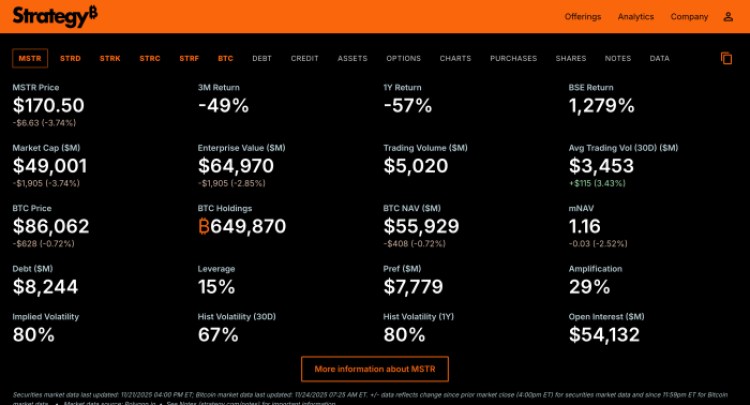
Strategy Bitcoin Holdings

Strategy even ran a poll that showed nearly 78% of respondents were simply HODLing through the sell-off. Hardcore Bitcoiners still see turbulence, not terminal failure, but not everyone’s built for that degree of mark-to-market pain.

Retail, smaller funds, and DeFi traders are increasingly searching for ways to keep Bitcoin exposure without just holding spot and praying.

That’s where the new rotation narrative comes in. If Bitcoin stays the monetary backbone of crypto, the best altcoins this cycle may be the ones solving what Bitcoin can’t: throughput, fees, and programmability.

Bitcoin Hyper ($HYPER) fits that thesis almost too well, positioning itself as a Bitcoin Layer-2 designed to make BTC behave like a fast, flexible, programmable asset, all without compromising the base layer.

Bitcoin Hyper Turns Bitcoin Volatility Into Layer-2 Utility

Behind the branding, Bitcoin Hyper is targeting a very real structural gap in the Bitcoin ecosystem. BTC still handles only a handful of transactions per second, and fees spike whenever activity increases, which is why most of today’s DeFi, NFTs, and on-chain experimentation have migrated to faster environments, such as Solana.

Bitcoin Hyper’s solution is a rollup-style Layer-2 anchored to Bitcoin but powered by an SVM (Solana Virtual Machine) execution layer. Users send BTC to a monitored main-chain address, a canonical bridge verifies the deposit, and the network mints an equivalent amount of wrapped BTC on Hyper.

From there, transactions run on a high-throughput chain with near-instant finality and low fees, while zero-knowledge proofs periodically settle back to Bitcoin L1.

The architecture aims to preserve Bitcoin’s security while moving actual activity, payments, DEX trades, lending, NFT markets, even meme-coin chaos, onto a chain that feels Solana-fast.

Because it uses SVM, existing Rust developers can port their apps with minimal friction, giving Hyper a realistic shot at building an ecosystem instead of becoming another pretty but empty L2.

Of course, there are risks. $HYPER is still in presale, and the roadmap is ambitious: audits and presale throughout 2025, mainnet and SVM+dApp integration between late 2025 and early 2026, then token listings, SDKs, and a DAO rollout in 2026. Execution needs to hit those milestones for the L2 thesis to play out.

Security is at least trending positively. The contracts have already cleared audits from Coinsult and SpyWolf, with no hidden mint functions or obvious backdoors flagged, a good start, even if it doesn’t eliminate the typical smart-contract and market risks associated with new chains.

For anyone who wants to stay structurally long Bitcoin while also capturing upside from where the next wave of blockspace demand might land, $HYPER offers a clean play.

If Bitcoin activity increases and DeFi migrates toward BTC-secured infrastructure, a functioning Bitcoin-anchored Layer-2 could absorb a disproportionate share of that value.

Inside the Bitcoin Hyper Presale and $HYPER Token Economics

While Bitcoin has been violently whipsawing, the Bitcoin Hyper presale has been doing the opposite, grinding steadily upward. It has now crossed $28.3M raised, with the current stage pricing $HYPER around $0.013325.

That still puts it in micro-cap range, but the raise is now large enough that this is no longer a small degen side-quest. Real capital is flowing in.

Presale buyers can also stake $HYPER at 41% rewards, with more than a billion tokens already locked. Those yields will naturally taper off as more wallets join in, but the intent is clear: early participants are encouraged to behave like long-term network partners, not short-term flippers.

It aligns neatly with the idea of $HYPER acting as a “beta on Bitcoin’s evolution” rather than just another momentum meme.

On the valuation side, upside scenarios being circulated are bold but at least mathematically grounded. One widely shared fundamental review puts a potential 2025 high near $0.02595 once mainnet is live and liquidity deepens, roughly a 2x from the current presale range if the thesis holds.

More aggressive models project further out, mapping a possible 2026 high around $0.08625 and a 2030 target near $0.253, assuming the roadmap lands, the ecosystem fills in, and major exchanges eventually list the token.

Relative to today’s pricing, that implies roughly 6–7x to the 2026 level and close to 19x by 2030. Nothing is guaranteed, but it explains why $HYPER keeps showing up in alt-rotation threads whenever traders discuss asymmetric setups tied to Bitcoin infrastructure instead of random meme noise.

Crucially, $HYPER isn’t pitched as a hedge against Bitcoin; it’s pitched as a way to amplify it.

If Saylor’s “I Won’t Back Down” stance represents the diamond-hands end of the spectrum, Bitcoin Hyper is where the more risk-tolerant crowd is rotating: still ideologically long BTC, but looking to high-beta Layer-2 infrastructure for bigger potential multiples as the cycle churns through volatility.

This article is informational only; crypto, especially presales, is highly volatile. Always do your own research and never risk rent money.

Authored by Aaron Walker, NewsBTC – https://www.newsbtc.com/news/best-altcoins-saylor-wont-back-down-bitcoin-hyper-presale

Market Opportunity
Threshold Logo
Threshold Price(T)
$0.010083
$0.010083$0.010083
+0.37%
USD
Threshold (T) Live Price Chart
Disclaimer: The articles reposted on this site are sourced from public platforms and are provided for informational purposes only. They do not necessarily reflect the views of MEXC. All rights remain with the original authors. If you believe any content infringes on third-party rights, please contact service@support.mexc.com for removal. MEXC makes no guarantees regarding the accuracy, completeness, or timeliness of the content and is not responsible for any actions taken based on the information provided. The content does not constitute financial, legal, or other professional advice, nor should it be considered a recommendation or endorsement by MEXC.

You May Also Like

Why The Green Bay Packers Must Take The Cleveland Browns Seriously — As Hard As That Might Be

Why The Green Bay Packers Must Take The Cleveland Browns Seriously — As Hard As That Might Be

The post Why The Green Bay Packers Must Take The Cleveland Browns Seriously — As Hard As That Might Be appeared on BitcoinEthereumNews.com. Jordan Love and the Green Bay Packers are off to a 2-0 start. Getty Images The Green Bay Packers are, once again, one of the NFL’s better teams. The Cleveland Browns are, once again, one of the league’s doormats. It’s why unbeaten Green Bay (2-0) is a 8-point favorite at winless Cleveland (0-2) Sunday according to betmgm.com. The money line is also Green Bay -500. Most expect this to be a Packers’ rout, and it very well could be. But Green Bay knows taking anyone in this league for granted can prove costly. “I think if you look at their roster, the paper, who they have on that team, what they can do, they got a lot of talent and things can turn around quickly for them,” Packers safety Xavier McKinney said. “We just got to kind of keep that in mind and know we not just walking into something and they just going to lay down. That’s not what they going to do.” The Browns certainly haven’t laid down on defense. Far from. Cleveland is allowing an NFL-best 191.5 yards per game. The Browns gave up 141 yards to Cincinnati in Week 1, including just seven in the second half, but still lost, 17-16. Cleveland has given up an NFL-best 45.5 rushing yards per game and just 2.1 rushing yards per attempt. “The biggest thing is our defensive line is much, much improved over last year and I think we’ve got back to our personality,” defensive coordinator Jim Schwartz said recently. “When we play our best, our D-line leads us there as our engine.” The Browns rank third in the league in passing defense, allowing just 146.0 yards per game. Cleveland has also gone 30 straight games without allowing a 300-yard passer, the longest active streak in the NFL.…
Share
BitcoinEthereumNews2025/09/18 00:41
Academic Publishing and Fairness: A Game-Theoretic Model of Peer-Review Bias

Academic Publishing and Fairness: A Game-Theoretic Model of Peer-Review Bias

Exploring how biases in the peer-review system impact researchers' choices, showing how principles of fairness relate to the production of scientific knowledge based on topic importance and hardness.
Share
Hackernoon2025/09/17 23:15
The Role of Reference Points in Achieving Equilibrium Efficiency in Fair and Socially Just Economies

The Role of Reference Points in Achieving Equilibrium Efficiency in Fair and Socially Just Economies

This article explores how a simple change in the reference point can achieve a Pareto-efficient equilibrium in both free and fair economies and those with social justice.
Share
Hackernoon2025/09/17 22:30