The post Ethereum (ETH) Price Slides; Mirrors 2017 & 2020 Patterns—Is a Breakout Ahead? appeared first on Coinpedia Fintech News Following the Bitcoin price plunge below the crucial support at $84,000, driven by bid-side liquidity collapse, the crypto markets have shaken. The ripple effects spread to other altcoins such as Ethereum and Solana, whose prices fell more than Bitcoin’s. ETH price slipped sharply this week, falling back toward the mid-$2,700 range as broader crypto market volatility pushed investors into risk-off mode. While the short-term technicals look fragile, deeper analysis of staking flows, historical price structure, and long-term accumulation zones suggests the latest decline may be less about weakness and more about opportunity for long-horizon players. ETH Returns to Its ‘Discount Zone’—A Level Where Major Rallies Historically Begin Ethereum has re-entered a major multi-year “discount zone”—a price region that has consistently acted as a long-term accumulation range. The chart shows the ETH price still moving inside an ascending parallel channel that dates back to early 2022. Source: X Previous dips into this lower band (late-2022, mid-2023, and early-2025) all triggered strong rallies, often marking the beginning of multi-month uptrends. The current return to the discount zone mirrors those earlier setups, suggesting the downside may be more limited than the recent market sentiment implies. This structural trend remains intact despite the pullback, offering a key insight: ETH’s macro uptrend is unbroken. Whales Are Staking More ETH — Even During the Correction While spot price weakness might suggest fading confidence, on-chain data shows the opposite. Large validators—typically whales or institutions—continue sending repeated batches of 32 ETH to the Ethereum Deposit Contract. The above data suggest an early Ethereum whale just staked 40,000 ETH worth $120 million after 10 years of inactivity. This behavior indicates sustained accumulation and long-term commitment. When whales increase staking during market drawdowns, it often signals they see the move as temporary, not structural. Historically, aggressive staking inflows have aligned with major cycle expansions, as they reduce liquid supply and tighten exchange reserves. The pattern appears to be repeating. Ethereum’s Current Structure Mirrors the 2017 and 2020 Accumulation Phases Zooming out, Ethereum’s current consolidation zone looks strikingly similar to previous cycle setups in 2017 and 2020 — both of which ended in explosive breakouts. Source: X Each cycle followed a repeated behavior pattern: Long consolidation near the midpoint of the macro trend A final shakeout or drop toward support A rapid expansion phase once liquidity returned In the chart, 2025’s price action is mimicking this same structure, suggesting ETH could be nearing the end of its consolidation rather than beginning a deeper downtrend. What Comes Next for ETH Price? Ethereum’s latest correction has pushed the asset back into a historical “value zone,” but on-chain data suggests the pullback may be more of an opportunity than a setback. Whales continue to accumulate, staking deposits remain strong, and ETH’s broader market structure still resembles previous pre-breakout phases. While short-term volatility may persist, the underlying fundamentals point to a network that is strengthening beneath the surface—setting the stage for a potential recovery once market sentiment stabilizes. If ETH can reclaim the $3,100–$3,250 band with strong volume, the next major leg toward the $3,800–$4,200 region becomes increasingly likely. And if history continues to rhyme, Ethereum may be positioning for a much larger move later in 2025.The post Ethereum (ETH) Price Slides; Mirrors 2017 & 2020 Patterns—Is a Breakout Ahead? appeared first on Coinpedia Fintech News Following the Bitcoin price plunge below the crucial support at $84,000, driven by bid-side liquidity collapse, the crypto markets have shaken. The ripple effects spread to other altcoins such as Ethereum and Solana, whose prices fell more than Bitcoin’s. ETH price slipped sharply this week, falling back toward the mid-$2,700 range as broader crypto market volatility pushed investors into risk-off mode. While the short-term technicals look fragile, deeper analysis of staking flows, historical price structure, and long-term accumulation zones suggests the latest decline may be less about weakness and more about opportunity for long-horizon players. ETH Returns to Its ‘Discount Zone’—A Level Where Major Rallies Historically Begin Ethereum has re-entered a major multi-year “discount zone”—a price region that has consistently acted as a long-term accumulation range. The chart shows the ETH price still moving inside an ascending parallel channel that dates back to early 2022. Source: X Previous dips into this lower band (late-2022, mid-2023, and early-2025) all triggered strong rallies, often marking the beginning of multi-month uptrends. The current return to the discount zone mirrors those earlier setups, suggesting the downside may be more limited than the recent market sentiment implies. This structural trend remains intact despite the pullback, offering a key insight: ETH’s macro uptrend is unbroken. Whales Are Staking More ETH — Even During the Correction While spot price weakness might suggest fading confidence, on-chain data shows the opposite. Large validators—typically whales or institutions—continue sending repeated batches of 32 ETH to the Ethereum Deposit Contract. The above data suggest an early Ethereum whale just staked 40,000 ETH worth $120 million after 10 years of inactivity. This behavior indicates sustained accumulation and long-term commitment. When whales increase staking during market drawdowns, it often signals they see the move as temporary, not structural. Historically, aggressive staking inflows have aligned with major cycle expansions, as they reduce liquid supply and tighten exchange reserves. The pattern appears to be repeating. Ethereum’s Current Structure Mirrors the 2017 and 2020 Accumulation Phases Zooming out, Ethereum’s current consolidation zone looks strikingly similar to previous cycle setups in 2017 and 2020 — both of which ended in explosive breakouts. Source: X Each cycle followed a repeated behavior pattern: Long consolidation near the midpoint of the macro trend A final shakeout or drop toward support A rapid expansion phase once liquidity returned In the chart, 2025’s price action is mimicking this same structure, suggesting ETH could be nearing the end of its consolidation rather than beginning a deeper downtrend. What Comes Next for ETH Price? Ethereum’s latest correction has pushed the asset back into a historical “value zone,” but on-chain data suggests the pullback may be more of an opportunity than a setback. Whales continue to accumulate, staking deposits remain strong, and ETH’s broader market structure still resembles previous pre-breakout phases. While short-term volatility may persist, the underlying fundamentals point to a network that is strengthening beneath the surface—setting the stage for a potential recovery once market sentiment stabilizes. If ETH can reclaim the $3,100–$3,250 band with strong volume, the next major leg toward the $3,800–$4,200 region becomes increasingly likely. And if history continues to rhyme, Ethereum may be positioning for a much larger move later in 2025.

Ethereum (ETH) Price Slides; Mirrors 2017 & 2020 Patterns—Is a Breakout Ahead?
2025/12/02 01:52
3 min read
For feedback or concerns regarding this content, please contact us at crypto.news@mexc.com
Ethereum Crashes to $2,700, 10x Research Warns the Real Problem Is On-Chain

The post Ethereum (ETH) Price Slides; Mirrors 2017 & 2020 Patterns—Is a Breakout Ahead? appeared first on Coinpedia Fintech News

Following the Bitcoin price plunge below the crucial support at $84,000, driven by bid-side liquidity collapse, the crypto markets have shaken. The ripple effects spread to other altcoins such as Ethereum and Solana, whose prices fell more than Bitcoin’s. ETH price slipped sharply this week, falling back toward the mid-$2,700 range as broader crypto market volatility pushed investors into risk-off mode. While the short-term technicals look fragile, deeper analysis of staking flows, historical price structure, and long-term accumulation zones suggests the latest decline may be less about weakness and more about opportunity for long-horizon players.

ETH Returns to Its ‘Discount Zone’—A Level Where Major Rallies Historically Begin

Ethereum has re-entered a major multi-year “discount zone”—a price region that has consistently acted as a long-term accumulation range. The chart shows the ETH price still moving inside an ascending parallel channel that dates back to early 2022.
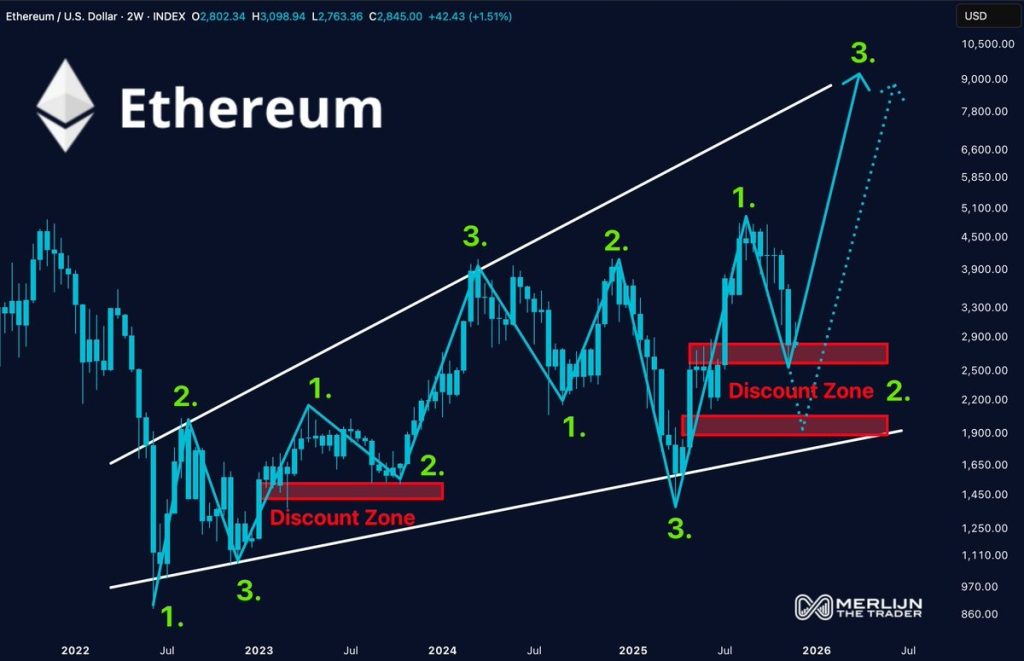
eth priceSource: X

Previous dips into this lower band (late-2022, mid-2023, and early-2025) all triggered strong rallies, often marking the beginning of multi-month uptrends. The current return to the discount zone mirrors those earlier setups, suggesting the downside may be more limited than the recent market sentiment implies.

This structural trend remains intact despite the pullback, offering a key insight: ETH’s macro uptrend is unbroken.

Whales Are Staking More ETH — Even During the Correction

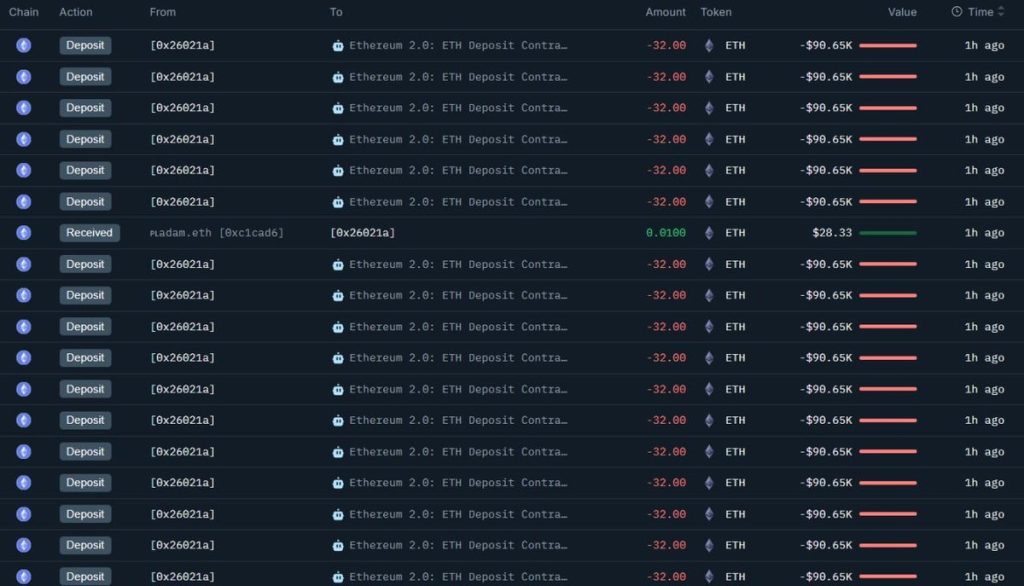
While spot price weakness might suggest fading confidence, on-chain data shows the opposite. Large validators—typically whales or institutions—continue sending repeated batches of 32 ETH to the Ethereum Deposit Contract.
eth price

The above data suggest an early Ethereum whale just staked 40,000 ETH worth $120 million after 10 years of inactivity. This behavior indicates sustained accumulation and long-term commitment. When whales increase staking during market drawdowns, it often signals they see the move as temporary, not structural.

Historically, aggressive staking inflows have aligned with major cycle expansions, as they reduce liquid supply and tighten exchange reserves. The pattern appears to be repeating.

Ethereum’s Current Structure Mirrors the 2017 and 2020 Accumulation Phases

Zooming out, Ethereum’s current consolidation zone looks strikingly similar to previous cycle setups in 2017 and 2020 — both of which ended in explosive breakouts.
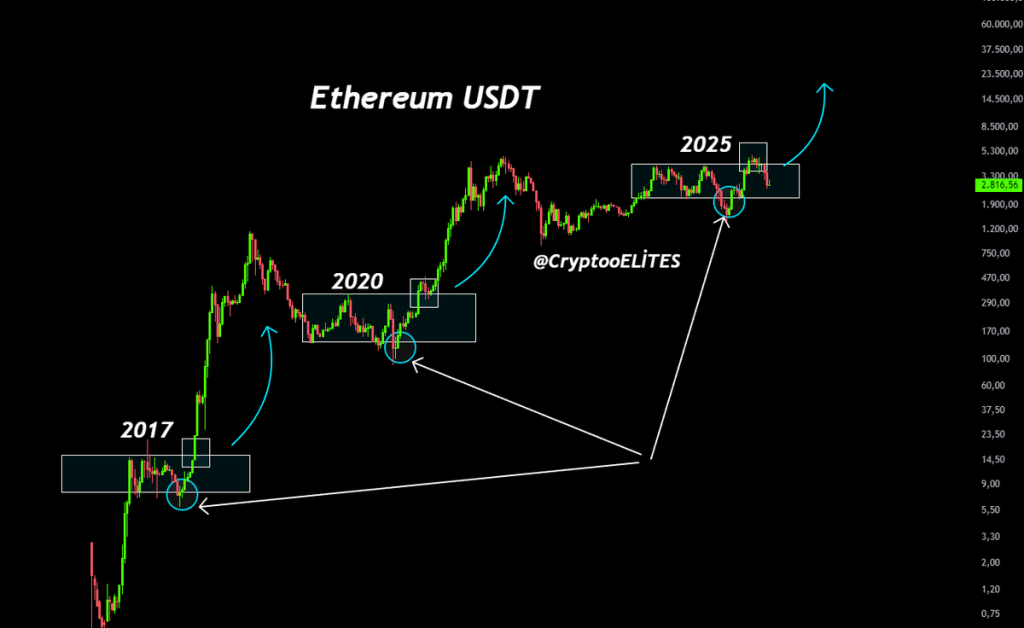
eth priceSource: X

Each cycle followed a repeated behavior pattern:

  • Long consolidation near the midpoint of the macro trend
  • A final shakeout or drop toward support
  • A rapid expansion phase once liquidity returned

In the chart, 2025’s price action is mimicking this same structure, suggesting ETH could be nearing the end of its consolidation rather than beginning a deeper downtrend.

What Comes Next for ETH Price?

Ethereum’s latest correction has pushed the asset back into a historical “value zone,” but on-chain data suggests the pullback may be more of an opportunity than a setback. Whales continue to accumulate, staking deposits remain strong, and ETH’s broader market structure still resembles previous pre-breakout phases. While short-term volatility may persist, the underlying fundamentals point to a network that is strengthening beneath the surface—setting the stage for a potential recovery once market sentiment stabilizes.

If ETH can reclaim the $3,100–$3,250 band with strong volume, the next major leg toward the $3,800–$4,200 region becomes increasingly likely. And if history continues to rhyme, Ethereum may be positioning for a much larger move later in 2025.

Market Opportunity
Ethereum Logo
Ethereum Price(ETH)
$2,143.43
$2,143.43$2,143.43
+0.36%
USD
Ethereum (ETH) Live Price Chart
Disclaimer: The articles reposted on this site are sourced from public platforms and are provided for informational purposes only. They do not necessarily reflect the views of MEXC. All rights remain with the original authors. If you believe any content infringes on third-party rights, please contact crypto.news@mexc.com for removal. MEXC makes no guarantees regarding the accuracy, completeness, or timeliness of the content and is not responsible for any actions taken based on the information provided. The content does not constitute financial, legal, or other professional advice, nor should it be considered a recommendation or endorsement by MEXC.

You May Also Like

American Bitcoin’s $5B Nasdaq Debut Puts Trump-Backed Miner in Crypto Spotlight

American Bitcoin’s $5B Nasdaq Debut Puts Trump-Backed Miner in Crypto Spotlight

The post American Bitcoin’s $5B Nasdaq Debut Puts Trump-Backed Miner in Crypto Spotlight appeared on BitcoinEthereumNews.com. Key Takeaways: American Bitcoin (ABTC) surged nearly 85% on its Nasdaq debut, briefly reaching a $5B valuation. The Trump family, alongside Hut 8 Mining, controls 98% of the newly merged crypto-mining entity. Eric Trump called Bitcoin “modern-day gold,” predicting it could reach $1 million per coin. American Bitcoin, a fast-rising crypto mining firm with strong political and institutional backing, has officially entered Wall Street. After merging with Gryphon Digital Mining, the company made its Nasdaq debut under the ticker ABTC, instantly drawing global attention to both its stock performance and its bold vision for Bitcoin’s future. Read More: Trump-Backed Crypto Firm Eyes Asia for Bold Bitcoin Expansion Nasdaq Debut: An Explosive First Day ABTC’s first day of trading proved as dramatic as expected. Shares surged almost 85% at the open, touching a peak of $14 before settling at lower levels by the close. That initial spike valued the company around $5 billion, positioning it as one of 2025’s most-watched listings. At the last session, ABTC has been trading at $7.28 per share, which is a small positive 2.97% per day. Although the price has decelerated since opening highs, analysts note that the company has been off to a strong start and early investor activity is a hard-to-find feat in a newly-launched crypto mining business. According to market watchers, the listing comes at a time of new momentum in the digital asset markets. With Bitcoin trading above $110,000 this quarter, American Bitcoin’s entry comes at a time when both institutional investors and retail traders are showing heightened interest in exposure to Bitcoin-linked equities. Ownership Structure: Trump Family and Hut 8 at the Helm Its management and ownership set up has increased the visibility of the company. The Trump family and the Canadian mining giant Hut 8 Mining jointly own 98 percent…
Share
BitcoinEthereumNews2025/09/18 01:33
Tether Engages Big Four for First Full Audit – Crypto News Bitcoin News

Tether Engages Big Four for First Full Audit – Crypto News Bitcoin News

The post Tether Engages Big Four for First Full Audit – Crypto News Bitcoin News appeared on BitcoinEthereumNews.com. New Transparency Push for Tether With Major
Share
BitcoinEthereumNews2026/03/25 04:39
Fed Decides On Interest Rates Today—Here’s What To Watch For

Fed Decides On Interest Rates Today—Here’s What To Watch For

The post Fed Decides On Interest Rates Today—Here’s What To Watch For appeared on BitcoinEthereumNews.com. Topline The Federal Reserve on Wednesday will conclude a two-day policymaking meeting and release a decision on whether to lower interest rates—following months of pressure and criticism from President Donald Trump—and potentially signal whether additional cuts are on the way. President Donald Trump has urged the central bank to “CUT INTEREST RATES, NOW, AND BIGGER” than they might plan to. Getty Images Key Facts The central bank is poised to cut interest rates by at least a quarter-point, down from the 4.25% to 4.5% range where they have been held since December to between 4% and 4.25%, as Wall Street has placed 100% odds of a rate cut, according to CME’s FedWatch, with higher odds (94%) on a quarter-point cut than a half-point (6%) reduction. Fed governors Christopher Waller and Michelle Bowman, both Trump appointees, voted in July for a quarter-point reduction to rates, and they may dissent again in favor of a large cut alongside Stephen Miran, Trump’s Council of Economic Advisers’ chair, who was sworn in at the meeting’s start on Tuesday. It’s unclear whether other policymakers, including Kansas City Fed President Jeffrey Schmid and St. Louis Fed President Alberto Musalem, will favor larger cuts or opt for no reduction. Fed Chair Jerome Powell said in his Jackson Hole, Wyoming, address last month the central bank would likely consider a looser monetary policy, noting the “shifting balance of risks” on the U.S. economy “may warrant adjusting our policy stance.” David Mericle, an economist for Goldman Sachs, wrote in a note the “key question” for the Fed’s meeting is whether policymakers signal “this is likely the first in a series of consecutive cuts” as the central bank is anticipated to “acknowledge the softening in the labor market,” though they may not “nod to an October cut.” Mericle said he…
Share
BitcoinEthereumNews2025/09/18 00:23
