Kalshi has switched on tokenized versions of its event contracts on Solana, making its first explicit play to court the same crypto-native traders who have funneled billions of dollars into rival prediction platform Polymarket. Instead of holding positions solely as traditional off-chain contracts on Kalshi’s regulated venue, users can now buy and sell tokenized representations […]Kalshi has switched on tokenized versions of its event contracts on Solana, making its first explicit play to court the same crypto-native traders who have funneled billions of dollars into rival prediction platform Polymarket. Instead of holding positions solely as traditional off-chain contracts on Kalshi’s regulated venue, users can now buy and sell tokenized representations […]

Kalshi Picks Solana To Ignite Tokenized Event Trading

2025/12/02 22:30
3 min read
For feedback or concerns regarding this content, please contact us at crypto.news@mexc.com

Kalshi has switched on tokenized versions of its event contracts on Solana, making its first explicit play to court the same crypto-native traders who have funneled billions of dollars into rival prediction platform Polymarket.

Instead of holding positions solely as traditional off-chain contracts on Kalshi’s regulated venue, users can now buy and sell tokenized representations of those wagers on Solana. The economic exposure is identical, but the wrapper is crypto-native: the bet becomes a transferable token on a public blockchain.

Solana Lands Kalshi’s First Fully Tokenized Event Markets

“The tokenized versions of the contracts work the same way as the regular ones found previously on Kalshi’s platform,” the company told CNBC. The key difference is market structure. By trading the tokens rather than the contracts themselves, users can operate with greater pseudonymity and more flexibility in how they custody and move positions, putting Kalshi “on par with Polymarket, which allows users to trade directly on-chain.”

Support for these tokenized wagers is already live on Solana. Decentralized finance protocols DFlow and Jupiter are onboarding as institutional conduits, effectively bridging Kalshi’s off-chain orderbook into Solana’s liquidity. That link is designed to let crypto-native traders discover, route and size positions through the DeFi stack while Kalshi continues to run its core matching and settlement infrastructure in a regulated environment.

The timing coincides with a sharp upswing in prediction market activity. Combined trading volume in prediction markets reached almost $28 billion through October 2025, with a weekly record of $2.3 billion in the week of October 20, according to data cited from Crypto.com’s research arm. Kalshi’s thesis is that the next leg of growth will be driven by the digital asset market, which it pegs at roughly $3 trillion and heavily populated by traders already comfortable with on-chain risk.

“There’s a lot of power users in crypto,” said John Wang, Kalshi’s head of crypto. “This is about tapping into the billions of dollars of liquidity that crypto has, and then also enabling developers to build third party front ends that utilize Kalshi’s liquidity.”

Founded in 2018, Kalshi was the first exchange to roll out federally regulated event contracts on US congressional races for American traders in late 2024, following a years-long legal battle with the Commodity Futures Trading Commission. Since then, it has expanded to roughly 3,500 markets, raised more than $300 million at a $5 billion valuation, and grown its footprint to over 140 countries, according to the company.

That regulatory and capital advantage is being tested as Polymarket moves to relaunch in the US and other competitors scale. Kalshi’s leadership is effectively betting that deeper liquidity is the decisive differentiator — and that crypto traders are the marginal source of that liquidity.

Digital asset holders tend to trade prediction markets at higher volumes than non-crypto users, Wang said, arguing that their funds can meaningfully thicken orderbooks and sharpen pricing across Kalshi’s markets. “If you have a market with no liquidity, then you don’t really have a market,” he said. “People can’t really trade size or get the prices that they want.”

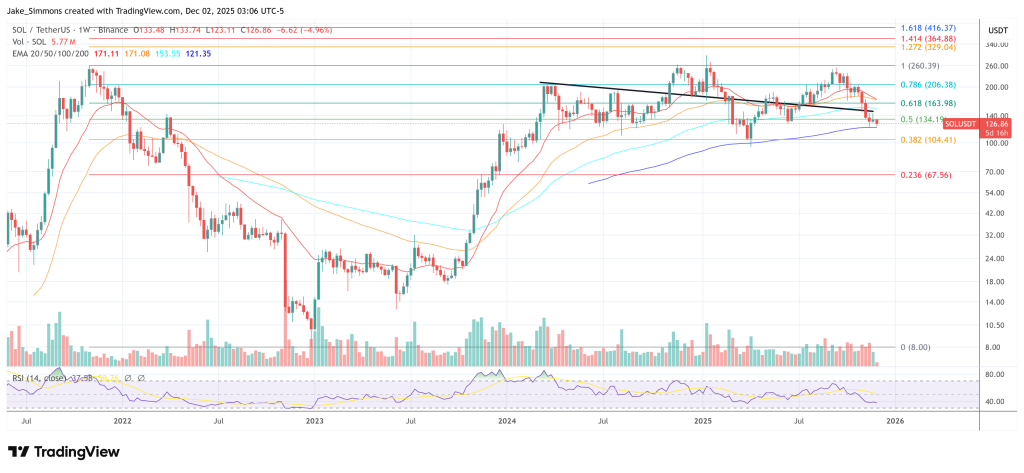
At press time, Solana (SOL) traded at $126.86.
Solana price
Market Opportunity
PlaysOut Logo
PlaysOut Price(PLAY)
$0.04568
$0.04568$0.04568
+3.74%
USD
PlaysOut (PLAY) Live Price Chart
Disclaimer: The articles reposted on this site are sourced from public platforms and are provided for informational purposes only. They do not necessarily reflect the views of MEXC. All rights remain with the original authors. If you believe any content infringes on third-party rights, please contact crypto.news@mexc.com for removal. MEXC makes no guarantees regarding the accuracy, completeness, or timeliness of the content and is not responsible for any actions taken based on the information provided. The content does not constitute financial, legal, or other professional advice, nor should it be considered a recommendation or endorsement by MEXC.

You May Also Like

South Korea Party Moves to Scrap Crypto Tax Plan

South Korea Party Moves to Scrap Crypto Tax Plan

South Korea’s People Power Party (PPP) is taking a clear stand on crypto taxes. The party has now officially adopted a plan to scrap the country’s proposed crypto
Share
Coinfomania2026/03/25 15:00
CME Group to launch options on XRP and SOL futures

CME Group to launch options on XRP and SOL futures

The post CME Group to launch options on XRP and SOL futures appeared on BitcoinEthereumNews.com. CME Group will offer options based on the derivative markets on Solana (SOL) and XRP. The new markets will open on October 13, after regulatory approval.  CME Group will expand its crypto products with options on the futures markets of Solana (SOL) and XRP. The futures market will start on October 13, after regulatory review and approval.  The options will allow the trading of MicroSol, XRP, and MicroXRP futures, with expiry dates available every business day, monthly, and quarterly. The new products will be added to the existing BTC and ETH options markets. ‘The launch of these options contracts builds on the significant growth and increasing liquidity we have seen across our suite of Solana and XRP futures,’ said Giovanni Vicioso, CME Group Global Head of Cryptocurrency Products. The options contracts will have two main sizes, tracking the futures contracts. The new market will be suitable for sophisticated institutional traders, as well as active individual traders. The addition of options markets singles out XRP and SOL as liquid enough to offer the potential to bet on a market direction.  The options on futures arrive a few months after the launch of SOL futures. Both SOL and XRP had peak volumes in August, though XRP activity has slowed down in September. XRP and SOL options to tap both institutions and active traders Crypto options are one of the indicators of market attitudes, with XRP and SOL receiving a new way to gauge sentiment. The contracts will be supported by the Cumberland team.  ‘As one of the biggest liquidity providers in the ecosystem, the Cumberland team is excited to support CME Group’s continued expansion of crypto offerings,’ said Roman Makarov, Head of Cumberland Options Trading at DRW. ‘The launch of options on Solana and XRP futures is the latest example of the…
Share
BitcoinEthereumNews2025/09/18 00:56
EuroVision Facing Possible Boycotts Over Gaza Disputes

EuroVision Facing Possible Boycotts Over Gaza Disputes

The post EuroVision Facing Possible Boycotts Over Gaza Disputes appeared on BitcoinEthereumNews.com. (Photo by Harold Cunningham/Getty Images) Getty Images As Paris hunkers down for another day of “manifestations” (national protest marches and strikes) over Israel’s continuing war on a battered Gaza, following similar massive protests in Spain, one of Europe’s biggest televised annual events faces boycotts, delays or worse as it tries to survive the controversy. Eurovision is a reality TV competition featuring single bands representing each participating country, with fans across Europe voting on their favorites. Last year, 37 countries participated in the 69th contest since the first one in 1956, with Austria’s JJ performing Wasted Love for a mammoth audience of 166 million viewers. But both the number of participants and audience members might be considerably smaller in the 2026 edition, despite those huge ratings, acknowledged the man charged with overseeing the competition. The problem: whether Israeli public broadcaster KAN will be able to keep participating despite calls for boycotts from some countries. “We’re a member-owned organization,” said Noel Curran, director general of the European Broadcasting Union, or EBU. He was talking over the weekend from the stage of IBC, the big annual broadcasting conference in Amsterdam, The Netherlands. “This is a member decision. This is not a decision taken in an office in Geneva. We understand how complicated this is.” Some countries have said they won’t participate in 2026 if KAN is involved, Curran said. Others have said they won’t participate if KAN is blocked. Though the statements on each side put Curran in an uncomfortable position, he said he welcomed the clarity. The EBU’s board will consider the statements and other issues when it meets in November, then make a recommendation that the entire membership will vote on. “It’s tricky,” Curran said. “The views are diametrically opposed.” The EBU represents 112 state-owned, public-service broadcasters from 56 countries, and…
Share
BitcoinEthereumNews2025/09/18 05:47