Bitwise Chief Investment Officer Matt Hougan is pushing back against one of the loudest bearish narratives around bitcoin treasury company Strategy (MSTR, formerly MicroStrategy): that it could be forced into a liquidation of its roughly $60 billion bitcoin stack. In his latest CIO memo, Hougan writes bluntly that “Michael Saylor and Strategy selling bitcoin is […]Bitwise Chief Investment Officer Matt Hougan is pushing back against one of the loudest bearish narratives around bitcoin treasury company Strategy (MSTR, formerly MicroStrategy): that it could be forced into a liquidation of its roughly $60 billion bitcoin stack. In his latest CIO memo, Hougan writes bluntly that “Michael Saylor and Strategy selling bitcoin is […]

Could Strategy Be Forced To Sell Its Bitcoin? Bitwise CIO Says No

2025/12/05 19:00

Bitwise Chief Investment Officer Matt Hougan is pushing back against one of the loudest bearish narratives around bitcoin treasury company Strategy (MSTR, formerly MicroStrategy): that it could be forced into a liquidation of its roughly $60 billion bitcoin stack. In his latest CIO memo, Hougan writes bluntly that “Michael Saylor and Strategy selling bitcoin is not one of” the real risks in crypto.

Will Strategy Sell Its Bitcoin?

The immediate trigger for market anxiety is MSCI’s consultation on whether to remove so-called digital asset treasury companies (DATs) like Strategy from its investable indexes. Nearly $17 trillion in assets tracks those benchmarks, and JPMorgan estimates index funds might have to sell up to $2.8 billion of MSTR if it is excluded.

MSCI’s rationale is structural: it views many DATs as closer to holding companies or funds than operating companies, and its investable universes already exclude holding structures such as REITs.

Hougan, a self-described “deep index geek” who previously spent a decade editing the Journal of Indexes, says he can “see this going either way.” Michael Saylor and others are arguing that Strategy remains very much an operating software company with “complex financial engineering around bitcoin,” and Hougan agrees that this is a reasonable characterization. But he notes that DATs are divisive, MSCI is currently leaning toward excluding them, and he “would guess there is at least a 75% chance Strategy gets booted” when MSCI announces its decision on January 15.

He argues, however, that even a removal is unlikely to be catastrophic for the stock. Large, mechanical index flows are often anticipated and “priced in well ahead of time.” Hougan points out that when MSTR was added to the Nasdaq-100 last December, funds tracking the index had to buy about $2.1 billion of stock, yet “its price barely moved.”

He believes some of the downside in MSTR since October 10 already reflects investors discounting a probable MSCI removal, and that “at this point, I don’t think you’ll see substantial swings either way.” Over the long term, he insists, “the value of MSTR is based on how well it executes its strategy, not on whether index funds are forced to own it.”

The more dramatic claim is the so-called MSTR “doom loop”: MSCI exclusion leads to heavy selling, the stock trades far below NAV, and Strategy is somehow forced to sell its bitcoin. Here Hougan is unequivocal: “The argument feels logical. Unfortunately for the bears, it’s just flat wrong. There is nothing about MSTR’s price dropping below NAV that will force it to sell.”

He breaks the problem down to actual balance sheet constraints. Strategy, he says, has two key obligations: about $800 million per year in interest payments and the need to refinance or redeem specific debt instruments as they mature.

Smaller DATs Are The Bigger Problem

On interest, the company currently has approximately $1.4 billion in cash, enough to “make its dividend payments easily for a year and a half” without touching its bitcoin or needing heroic capital markets access. On principal, the first major maturity does not arrive until February 2027, and that tranche is “only about $1 billion—chump change” compared with the roughly $60 billion in bitcoin the company holds.

Governance further reduces the likelihood of forced selling. Michael Saylor controls around 42% of Strategy’s voting shares and is, in Hougan’s words, a person with extraordinary “conviction on bitcoin’s long-term value.” He notes that Saylor “didn’t sell the last time MSTR stock traded at a discount, in 2022.”

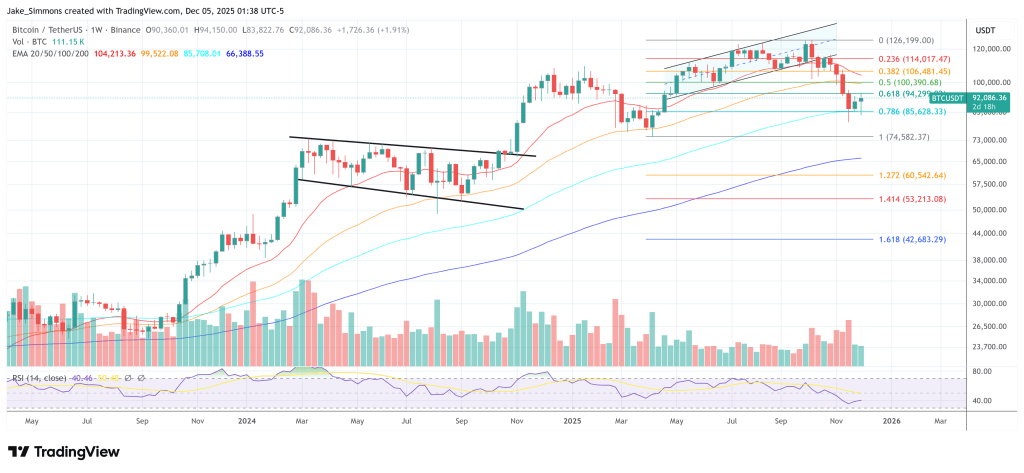
Hougan concedes that a forced liquidation would be structurally significant for bitcoin, roughly equivalent to two years of spot ETF inflows dumped back into the market. He simply does not see a credible path from MSCI index mechanics and equity volatility to that outcome “with no debt due until 2027 and enough cash to cover interest payments for the foreseeable future.” At the time of writing, he notes, bitcoin trades around $92,000, about 27% below its highs but still 24% above Strategy’s average acquisition price of $74,436 per coin. “So much for the doom.”

Hougan ends by stressing that there are real issues to worry about in crypto—slow-moving market structure legislation, fragile and “poorly run” smaller DATs, and a likely slowdown in DAT bitcoin purchases in 2026. But on Strategy specifically, his conclusion is direct: he “wouldn’t worry about the impact of MSCI’s decision on the stock price” and sees “no plausible near-term mechanism that would force it to sell its bitcoin. It’s not going to happen.”

At press time, BTC traded at $92,086.
Bitcoin price
Disclaimer: The articles reposted on this site are sourced from public platforms and are provided for informational purposes only. They do not necessarily reflect the views of MEXC. All rights remain with the original authors. If you believe any content infringes on third-party rights, please contact service@support.mexc.com for removal. MEXC makes no guarantees regarding the accuracy, completeness, or timeliness of the content and is not responsible for any actions taken based on the information provided. The content does not constitute financial, legal, or other professional advice, nor should it be considered a recommendation or endorsement by MEXC.

You May Also Like

Dogecoin, HBAR Rank High On Watchlists But One Crypto Is Stealing The Show

Dogecoin, HBAR Rank High On Watchlists But One Crypto Is Stealing The Show

The post Dogecoin, HBAR Rank High On Watchlists But One Crypto Is Stealing The Show appeared on BitcoinEthereumNews.com. Crypto traders searching for the best crypto to buy now are keeping a close eye on Dogecoin (DOGE) and Hedera (HBAR), two altcoins that remain top picks for September. DOGE continues to benefit from its loyal community and brand recognition, while HBAR’s enterprise partnerships keep it relevant as a layer-1 solution. But despite these strong contenders, analysts say one project is stealing the show — Layer Brett ($LBRETT), a fast-growing Ethereum Layer 2 that has taken the market by storm. Why Dogecoin and HBAR are still relevant Dogecoin remains a fan favorite, with its meme status and history of viral rallies making it a top speculative asset. Analysts believe DOGE could see another strong run in the next bull market, especially if Elon Musk tweets about it or if a DOGE payment integration is announced. In 2021, DOGE’s price rallied thousands of percent, proving that viral moments can still drive massive upside when the community is fully engaged. HBAR, meanwhile, is considered one of the most technically advanced layer 1 blockchains, its hashgraph consensus and enterprise partnerships gave it a unique edge. Projects in sectors like supply chain, tokenized assets, and enterprise data security continue to choose HBAR, which helps support steady price appreciation. Price predictions for HBAR suggest consistent growth into 2026 as adoption expands. Layer Brett: The real market disruptor While DOGE and HBAR are strong players, Layer Brett is where traders are seeing the most explosive potential. Built on Ethereum Layer 2, $LBRETT offers lightning-fast transactions, near-zero fees, and security backed by Ethereum. Its rapidly growing social presence, with thousands of new community members joining weekly, is driving massive buzz. Analysts say this mix of speed, low cost, and meme energy is creating a narrative that could dominate the next bull run. Key reasons analysts are calling…
Share
BitcoinEthereumNews2025/09/21 06:34
Will Bitcoin Beat S&P 500 Index? ‘Forever,’ Says Michael Saylor

Will Bitcoin Beat S&P 500 Index? ‘Forever,’ Says Michael Saylor

The post Will Bitcoin Beat S&P 500 Index? ‘Forever,’ Says Michael Saylor appeared on BitcoinEthereumNews.com. In recent Bitcoin news, Strategy CEO Michael Saylor once again made a bold claim about the future of Bitcoin (BTC USD). He said that Bitcoin will outperform the S&P 500 “forever.” According to him, the index would lose nearly 29% in value each year when compared to the top cryptocurrency. In his statement, Saylor highlighted Bitcoin’s strength as a long-term investment. He believes its fixed supply and global adoption will continue to drive its value higher. On the other hand, he argued that a traditional index like the S&P 500 will struggle to keep pace. Bitcoin News: Why is it “Digital Capital,” Stronger Than S&P 500 In his interview with Coin Stories, MicroStrategy executive chairman, Michael Saylor, explained Bitcoin was a unique digital investment vehicle. According to him, it grows in value much faster than traditional assets. Saylor noted that the S&P 500’s average return is often treated as the standard measure of investment growth. However, he emphasized that Bitcoin (BTC USD) consistently outpaces this benchmark. This difference, he said, highlights a clear performance gap. Because of this, Saylor believes a major financial shift is taking place. He argued that Bitcoin is emerging as a superior choice for investors, an increasingly popular opinion as witnessed in recent news. In his view, it also serves as stronger collateral compared to traditional assets. In his view, Bitcoin’s steady appreciation gives investors a chance to create new forms of credit backed by the asset. He explained that Bitcoin-backed loans could last longer, deliver higher returns, and reshape global finance. Michael Saylor also highlighted that this perspective influenced his role in policy discussions. Recently, he joined other crypto executives in a meeting to advocate for the strategic Bitcoin reserve bill. In addition, he compared Bitcoin’s reliability with weakness in traditional currencies. He argued that…
Share
BitcoinEthereumNews2025/09/20 18:34