

How to Build Resilient APIs With Resilience4j Circuit Breaker in Spring Boot
Overview
Learn how to make your microservice calls resilient using the Circuit Breaker pattern with Resilience4j and Spring Boot — complete demo, step-by-step commands, class-by-class explanations, sample outputs, real-world use cases, and production tips.
Why This Matters
In distributed systems, a failing downstream service can cascade and cause overall system outages. The Circuit Breaker pattern:
- Detects a failing dependency,
- Stops sending requests to it (to avoid wasting resources),
- Returns a graceful fallback response,
- Periodically tests the dependency and restores normal operation when healthy.
\ This reduces downtime, protects thread pools, keeps user experience reasonable, and prevents retry storms.
Demo Summary (What You Have)
A two-service Maven demo:
-
hello-service (port 8081) — simple REST provider that intentionally fails intermittently.
\
End point
GET /api/hello
-
client-service (port 8080) — calls hello-service using RestTemplate and is protected by Resilience4j @CircuitBreaker with a fallback.
\
End point
GET /api/get-message
\ Run both (hello-service and client-service)
\ Then test
GET http://localhost:8080/api/get-message
Architecture Diagram
This is a small, focused flow suitable for drawing a diagram
Files & Code: Class-By-Class Explanation
hello-service
HelloServiceApplication.java
-
Standard @SpringBootApplication bootstrap class.
\
HelloController.java @RestController public class HelloController { private static int counter = 0; @GetMapping("/api/hello") public String sayHello() { counter++; // simulate intermittent failure: fail on every 3rd request if (counter % 3 == 0) { throw new RuntimeException("Simulated failure from Hello-Service!"); } return "Hello from Hello-Service! (count=" + counter + ")"; } }
\ Explanation: This controller intentionally throws a RuntimeException on periodic calls to simulate transient failures you’d see in real systems (DB outage, bad data, timeouts).
client-service
ClientServiceApplication.java
- Standard Spring Boot main class. No special config required.
AppConfig.java @Configuration public class AppConfig { @Bean public RestTemplate restTemplate() { return new RestTemplate(); } }
\ Explanation: Provides a single RestTemplate bean. Ensure RestTemplate is a Spring bean so AOP/resilience proxies can work properly.
HelloClientService.java @Service public class HelloClientService { private final RestTemplate restTemplate; @Value("${hello.service.url}") private String helloServiceUrl; public HelloClientService(RestTemplate restTemplate) { this.restTemplate = restTemplate; } @CircuitBreaker(name = "helloService", fallbackMethod = "fallbackHello") public String getHelloMessage() { System.out.println("Calling hello service: " + helloServiceUrl); return restTemplate.getForObject(helloServiceUrl, String.class); } public String fallbackHello(Throwable t) { System.out.println("Fallback triggered: " + t); return "Hello Service is currently unavailable. Please try again later."; } }
Explanation (crucial bits)
-
@CircuitBreaker(name = "helloService", fallbackMethod = "fallbackHello") wraps the getHelloMessage() call in a circuit breaker. The name links to configuration properties.
\
-
fallbackHello(Throwable t) is called when the call fails according to the breaker rules.
The fallback must:
o Be in the same class o Have the same return type o Accept the original method parameters (none here) and a final Throwable parameter (or Exception/Throwable compatible with thrown exceptions)
\
-
Important: The method must be public, and the class must be a Spring bean (@Service), so proxy-based AOP works.
\
ClientController.java @RestController public class ClientController { private final HelloClientService helloClientService; public ClientController(HelloClientService helloClientService) { this.helloClientService = helloClientService; } @GetMapping("/api/get-message") public String getMessage() { return helloClientService.getHelloMessage(); } }
\ Explanation: Simple controller delegating to HelloClientService. This ensures the call goes through the proxy where the circuit breaker is applied.
Configuration Used (client-service application.properties)
Key configuration used in the demo
\
server.port=8080 spring.application.name=client-service hello.service.url=http://localhost:8081/api/hello resilience4j.circuitbreaker.instances.helloService.registerHealthIndicator=true resilience4j.circuitbreaker.instances.helloService.slidingWindowSize=5 resilience4j.circuitbreaker.instances.helloService.minimumNumberOfCalls=2 resilience4j.circuitbreaker.instances.helloService.failureRateThreshold=50 resilience4j.circuitbreaker.instances.helloService.waitDurationInOpenState=10s logging.level.io.github.resilience4j.circuitbreaker=DEBUG
\ Meaning of important properties
- slidingWindowSize: number of calls the breaker monitors for failure percentage.
- minimumNumberOfCalls: minimum calls before failure rate is evaluated.
- failureRateThreshold: percent failures (e.g., 50) to open the circuit.
- waitDurationInOpenState: how long the circuit stays open before moving to half-open.
- registerHealthIndicator: exposes breaker state via actuator.
Step-By-Step Run & Expected Outputs
Start Services
- Start hello-service
Visit: http://localhost:8081/api/hello
\ Returns → "Hello from Hello-Service!" (or throws simulated failure)
- Start client-service
Visit: http://localhost:8080/api/get-message
Test Scenarios & Outputs
Scenario A — Hello-Service Healthy
Make a request
GET http://localhost:8080/api/get-message
\ Client logs
Calling hello service: http://localhost:8081/api/hello 2025-11-13T11:58:23.366+05:30 DEBUG 32692 --- [client-service] [nio-8080-exec-8] i.g.r.c.i.CircuitBreakerStateMachine : CircuitBreaker 'helloService' succeeded: 2025-11-13T11:58:23.366+05:30 DEBUG 32692 --- [client-service] [nio-8080-exec-8] i.g.r.c.i.CircuitBreakerStateMachine : Event SUCCESS published: 2025-11-13T11:58:23.366634+05:30[Asia/Calcutta]: CircuitBreaker 'helloService' recorded a successful call. Elapsed time: 15 ms
\ Response
Hello from Hello-Service! (count=4)
Scenario B — Hello-Service Intermittent Failures
If you call repeatedly and hello-service throws RuntimeException on some requests:
● Successful calls: client returns the hello message.
● When a downstream call returns HTTP 500/exception:
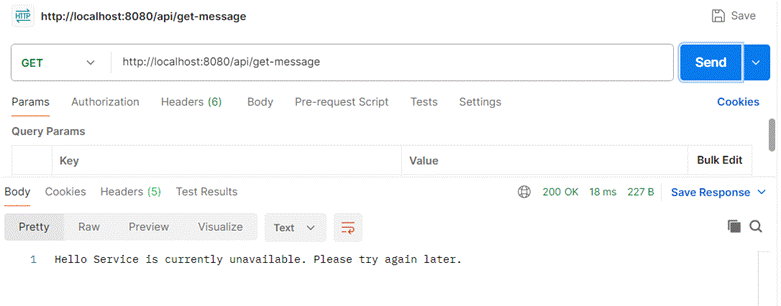
o Resilience4j records the failure. o If failure rate exceeds threshold (e.g., 50% over sliding window), the Circuit becomes **OPEN**. o While OPEN, calls are short-circuited; **fallbackHello**() is immediately executed — no network call. \n **Client response while fallback active**
\ Client Response while active
Response
Hello Service is currently unavailable. Please try again later.
\ 
Sample client log sequence
Calling hello service: http://localhost:8081/api/hello 2025-11-13T12:00:55.842+05:30 DEBUG 32692 --- [client-service] [nio-8080-exec-1] i.g.r.c.i.CircuitBreakerStateMachine : CircuitBreaker 'helloService' recorded an exception as failure:
Scenario C — Recovery
After waitDurationInOpenState (10s):
- Circuit goes to HALF_OPEN: a few test calls are allowed.
- If test calls succeed, breaker CLOSES and normal traffic resumes.
- If tests fail, the breaker goes back to OPEN.
Real-World Use Cases
- Payment Integration - A checkout service calling an external bank API: if the bank’s API becomes slow/fails, the circuit breaker returns a user-friendly message and prevents retry storms.
- Third-party rate-limited APIs - APIs with limited calls per second — when limits are reached, the circuit opens to avoid hitting quotas further; fallback returns cached data.
- Microservice chains inside an enterprise - Service A calls B, which calls C. If C is unstable, open breakers protect B and A, preventing system-wide slowdown.
- Feature toggles and graceful degradation - When a non-critical feature service fails, return a simpler result to keep core functionality available (e.g., return product list without recommendations).
Advantages & Business Value
- Fault isolation — prevents one bad dependency from cascading.
- Faster failure response — fails fast instead of waiting on timeouts.
- Graceful degradation — offers fallback responses instead of full outages.
- Resource protection — avoids wasting CPU, threads, and network.
- Auto recovery — automatically returns to normal when the dependency is healthy.
- Observability — breaker states and metrics can be exposed via the Actuator and monitored.
\ Sample logs you’ll see (realistic)
Calling hello service: http://localhost:8081/api/hello 2025-11-13T12:00:55.842+05:30 DEBUG 32692 --- [client-service] [nio-8080-exec-1] i.g.r.c.i.CircuitBreakerStateMachine : CircuitBreaker 'helloService' recorded an exception as failure 2025-11-13T12:00:55.847+05:30 DEBUG 32692 --- [client-service] [nio-8080-exec-1] i.g.r.c.i.CircuitBreakerStateMachine : Event ERROR published: 2025-11-13T12:00:55.847908200+05:30[Asia/Calcutta]: CircuitBreaker 'helloService' recorded an error: 'org.springframework.web.client.HttpServerErrorException$InternalServerError: 500 : "{"timestamp":"2025-11-13T06:30:55.842+00:00","status":500,"error":"Internal Server Error","path":"/api/hello"}"'. Elapsed time: 8 ms Fallback triggered: org.springframework.web.client.HttpServerErrorException$InternalServerError: 500 : "{"timestamp":"2025-11-13T06:30:55.842+00:00","status":500,"error":"Internal Server Error","path":"/api/hello"}"
\


You May Also Like

The changing face of elder care in Malaysia — Sayed Mohammad Reza Yamani Sayed Umar

Not a loophole: Singapore AI export controls let China tap US AI legally

Exclusive interview with Smokey The Bera, co-founder of Berachain: How the innovative PoL public chain solves the liquidity problem and may be launched in a few months



