BitcoinWorld Crypto Trust Charters: US Comptroller’s Bold Warning to Obstructive Banks In a powerful move that could reshape the financial landscape, the U.S. Comptroller of the Currency has issued a stark warning to traditional banks. Jonathan Gould has criticized the industry for actively blocking cryptocurrency firms from obtaining vital crypto trust charters. This stand challenges the status quo and signals a potential new era of integration […] This post Crypto Trust Charters: US Comptroller’s Bold Warning to Obstructive Banks first appeared on BitcoinWorld.BitcoinWorld Crypto Trust Charters: US Comptroller’s Bold Warning to Obstructive Banks In a powerful move that could reshape the financial landscape, the U.S. Comptroller of the Currency has issued a stark warning to traditional banks. Jonathan Gould has criticized the industry for actively blocking cryptocurrency firms from obtaining vital crypto trust charters. This stand challenges the status quo and signals a potential new era of integration […] This post Crypto Trust Charters: US Comptroller’s Bold Warning to Obstructive Banks first appeared on BitcoinWorld.


Crypto Trust Charters: US Comptroller’s Bold Warning to Obstructive Banks

2025/12/09 04:55
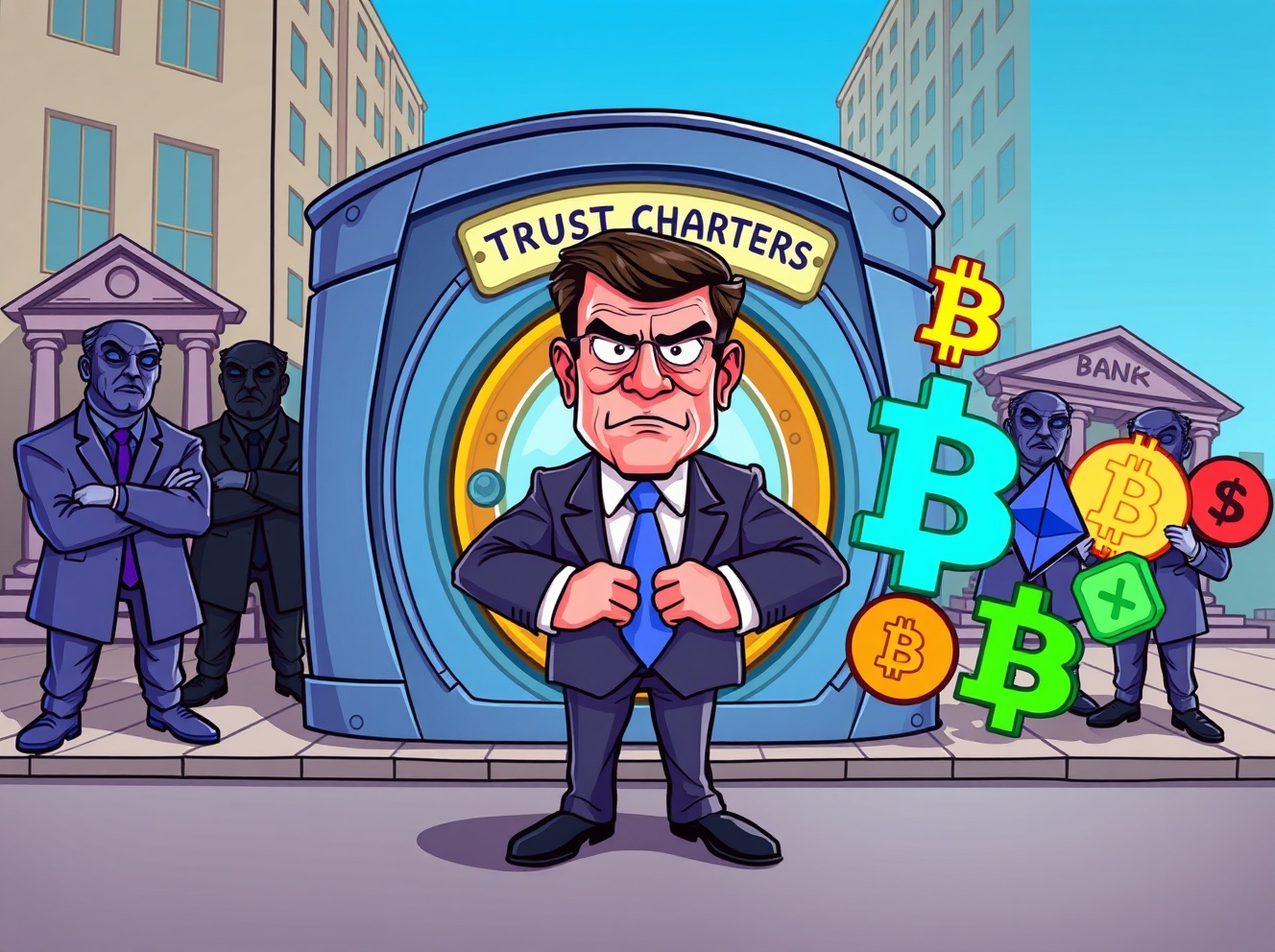
A cartoon official protecting crypto trust charters from obstructive traditional banks.

BitcoinWorld

Crypto Trust Charters: US Comptroller’s Bold Warning to Obstructive Banks

In a powerful move that could reshape the financial landscape, the U.S. Comptroller of the Currency has issued a stark warning to traditional banks. Jonathan Gould has criticized the industry for actively blocking cryptocurrency firms from obtaining vital crypto trust charters. This stand challenges the status quo and signals a potential new era of integration between digital assets and mainstream finance. Why are banks resisting, and what does this mean for the future of money?

What Are Crypto Trust Charters and Why Do They Matter?

Think of a trust charter as a special banking license. It allows a company to act as a fiduciary, holding and managing assets on behalf of clients. For crypto companies, securing a crypto trust charter is a game-changer. It provides a regulated pathway to offer custodial services, legitimizes their operations, and bridges the gap to the traditional financial system. Without it, they often face an uphill battle for credibility and access.

Gould’s core argument is simple yet revolutionary: there is no valid reason to treat digital assets differently from traditional ones like stocks or bonds. He insists that banks should not be confined to outdated technologies or business models that exclude innovation. This principle is at the heart of the debate over crypto trust charters.

Why Are Traditional Banks Pushing Back?

The resistance from established banks isn’t surprising, but the Comptroller is calling it out. Banks may fear the competition, the perceived risk of a new asset class, or the complexity of compliance. However, Gould points to the data: over the past year, new charter applications rose to 14, with many tied to digital assets and fintech. The demand is clearly there.

Moreover, the Office of the Comptroller of the Currency (OCC) is now investigating ‘de-banking’—where banks abruptly cut off services to crypto-related firms. This practice can stifle innovation and push activity into less regulated spaces. The warning against obstructing crypto trust charters is part of a broader push for fair access.

What Does This Mean for the Future of Crypto Banking?

This regulatory stance could unlock significant growth. If more firms secure crypto trust charters, we could see:

  • Enhanced Consumer Protection: Assets held under a charter are subject to strict regulatory oversight and capital requirements.
  • Mainstream Adoption: Easier for traditional investors and institutions to participate through trusted, regulated entities.
  • Innovation in Financial Services: New products blending crypto efficiency with banking stability.

The Comptroller’s position acts as a catalyst. It encourages banks to adapt rather than obstruct, fostering an environment where crypto trust charters can be evaluated on their merits, not fear.

Navigating the Path Forward for Digital Assets

The message from the top is clear: obstruction is not a strategy. The financial system must evolve. For crypto companies, this opens a door, but the path still requires navigating complex regulatory standards to prove they are safe, sound, and fair custodians worthy of a charter.

For traditional banks, the warning is an invitation—or perhaps an ultimatum—to engage with the future. They can choose to be gatekeepers of the past or architects of a modern, inclusive financial system that includes digital assets. The push for equitable access to crypto trust charters is a central battleground in this transformation.

Conclusion: A Turning Point for Finance

Jonathan Gould’s warning is more than regulatory commentary; it’s a bold declaration of principle. By challenging banks to stop obstructing crypto trust charters, he advocates for a financial ecosystem defined by technological neutrality and competitive fairness. This stance, if upheld, could accelerate the merger of traditional and digital finance, creating a more robust and innovative market for everyone. The era of walls between old and new money may finally be ending.

Frequently Asked Questions (FAQs)

What is a crypto trust charter?
A crypto trust charter is a special banking license granted by a state or federal regulator (like the OCC) that allows a company to operate as a fiduciary, legally holding and safeguarding cryptocurrency assets for clients, similar to how a trust company holds traditional assets.

Why is the US Comptroller getting involved?
As the head of the OCC, which charters and supervises national banks, the Comptroller ensures the federal banking system is safe, sound, and fair. He sees unequal access to charters and practices like de-banking as threats to competition and innovation.

What is ‘de-banking’ in the crypto context?
De-banking refers to when traditional banks refuse to provide or suddenly withdraw basic services (like bank accounts or payment processing) from businesses solely because they are involved with cryptocurrencies, often without clear cause.

Will this make cryptocurrencies more mainstream?
Yes, potentially. If more regulated entities can offer custodial services via trust charters, it reduces risk and complexity for large institutions and everyday investors, paving the way for broader adoption.

What are the biggest challenges for a crypto firm getting a charter?
The main hurdles are meeting stringent capital requirements, proving robust anti-money laundering (AML) and know-your-customer (KYC) systems, and demonstrating a comprehensive risk management framework for holding digital assets.

Found this insight into the future of crypto banking compelling? Help others understand this critical shift by sharing this article on your social media channels. Spark a conversation about innovation, regulation, and the future of finance!

To learn more about the latest trends in cryptocurrency regulation, explore our article on key developments shaping institutional adoption and market maturity.

This post Crypto Trust Charters: US Comptroller’s Bold Warning to Obstructive Banks first appeared on BitcoinWorld.

Disclaimer: The articles reposted on this site are sourced from public platforms and are provided for informational purposes only. They do not necessarily reflect the views of MEXC. All rights remain with the original authors. If you believe any content infringes on third-party rights, please contact service@support.mexc.com for removal. MEXC makes no guarantees regarding the accuracy, completeness, or timeliness of the content and is not responsible for any actions taken based on the information provided. The content does not constitute financial, legal, or other professional advice, nor should it be considered a recommendation or endorsement by MEXC.

You May Also Like

BFX Presale Raises $7.5M as Solana Holds $243 and Avalanche Eyes $1B Treasury — Best Cryptos to Buy in 2025

BFX Presale Raises $7.5M as Solana Holds $243 and Avalanche Eyes $1B Treasury — Best Cryptos to Buy in 2025

BFX presale hits $7.5M with tokens at $0.024 and 30% bonus code BLOCK30, while Solana holds $243 and Avalanche builds a $1B treasury to attract institutions.
Share
Blockchainreporter2025/09/18 01:07
OCC Findings Suggest Major U.S. Banks Restricted Access for Digital Asset Firms Amid Debanking Probe

OCC Findings Suggest Major U.S. Banks Restricted Access for Digital Asset Firms Amid Debanking Probe

The post OCC Findings Suggest Major U.S. Banks Restricted Access for Digital Asset Firms Amid Debanking Probe appeared on BitcoinEthereumNews.com. The Office of the Comptroller of the Currency (OCC) has confirmed that nine major U.S. banks engaged in debanking practices from 2020 to 2023, restricting access for digital asset firms and other sectors. This marks the first official acknowledgment of these policies, which limited services based on customer types, affecting crypto businesses significantly. OCC report highlights inappropriate distinctions by banks like JPMorgan Chase and Bank of America, targeting crypto and high-risk sectors. Nine banks reviewed showed similar policies restricting customer access without objective risk assessments. Impacted industries include digital asset firms, with potential referrals to the Attorney General for unlawful practices. Discover how major U.S. banks’ debanking policies hit crypto firms hard, per OCC’s 2025 report. Learn the implications for digital assets and what regulators are doing next—stay informed on banking risks today! What Are the OCC’s Findings on Banks Debanking Crypto Firms? Banks debanking crypto firms involves major financial institutions limiting or denying services to digital asset businesses based on perceived risks, as detailed in a recent Office of the Comptroller of the Currency (OCC) report. From 2020 to 2023, nine of the largest U.S. banks implemented policies that required escalated reviews or outright restrictions for certain customers, including those in the crypto sector. This practice, now publicly confirmed, underscores ongoing tensions between traditional banking and emerging digital asset industries. How Did These Debanking Practices Affect Digital Asset Companies? The OCC’s six-page report, released on Wednesday, revealed that institutions such as JPMorgan Chase, Bank of America, Citigroup, Wells Fargo, U.S. Bancorp, Capital One, PNC Financial Services Group, Toronto-Dominion Bank, and Bank of Montreal made distinctions among customers that were deemed inappropriate. For digital asset firms, this meant heightened scrutiny or complete denial of banking services, hindering operations in an already volatile market. The regulator noted that these policies spanned…
Share
BitcoinEthereumNews2025/12/11 11:01
Patriots Hall Of Famer Julian Edelman Is A Rising Media Star At FOX Sports

Patriots Hall Of Famer Julian Edelman Is A Rising Media Star At FOX Sports

The post Patriots Hall Of Famer Julian Edelman Is A Rising Media Star At FOX Sports appeared on BitcoinEthereumNews.com. Julian Edelman has a burgeoning media career, including as an analyst on FOX NFL Kickoff. Lily Hernandez The day before the Kansas City Chiefs hosted the Philadelphia Eagles, Julian Edelman was in a reflective mood. The last weekend he had spent in Arrowhead Stadium was when he helped the New England Patriots defeat the Chiefs in overtime to advance to the Patriots’ last Super Bowl. “I was definitely getting some flashbacks,” Edelman exclusively shared. “It’s definitely a special place to come. Not because we won (but) because we knew how hard it was to win here. This place rocks. Arrowhead is one of the most electric opponent stadiums that we played in. It was one of the greatest to be the villain.” Edelman had seven catches and 96 yards in that 37-31 overtime win against the Chiefs, paving the way for Super Bowl LIII, a game in which he won Super Bowl MVP. That may have been the apex of his playing career, which earned him induction into the Patriots’ Hall of Fame this weekend, but his post-NFL media career is ascending. He’s not only an analyst on FOX NFL Kickoff, the show that precedes FOX NFL Sunday, but also has his own production company and hosts two weekly podcasts. “It kind of (just) happened,” Edelman said. “My goal is really to just be around football in some form or fashion.” Julian Edelman of the New England Patriots celebrates after scoring in the fourth quarter against the Seattle Seahawks during Super Bowl XLIX. (Photo by Kevin C. Cox/Getty Images) Getty Images Toward the end of his playing career, Edelman started creating short-from content for his YouTube channel and picked up a cult following among New England fans. Then for his first two years out of the league, he was an…
Share
BitcoinEthereumNews2025/09/18 21:56