DOGE, led by Musk, has not played its role effectively, and the US government will fall into an economic crisis due to debt.DOGE, led by Musk, has not played its role effectively, and the US government will fall into an economic crisis due to debt.

The crisis hidden in the chart: America’s growing “debt snowball”

2025/03/17 17:50
4 min read

By NOAH SMITH

Compiled by: Tim, PANews
The crisis hidden in the chart: America’s growing “debt snowball”

I know you all have a lot of concerns about the Trump administration. Trump's tariffs are causing the stock market to plummet and consumer confidence to collapse. Trump has abandoned European allies to curry favor with Putin. Musk's Government Effectiveness Department is recklessly hacking into US government agencies in an attempt to eradicate leftist ideology. And Trump is dramatically expanding presidential power, trying to jail opponents and deport illegal immigrants.

Unfortunately, I have to give you one more thing to worry about, because it is really important. Trump and his Republican Party are planning to borrow a lot more at a time when the current national debt is becoming increasingly unsustainable.

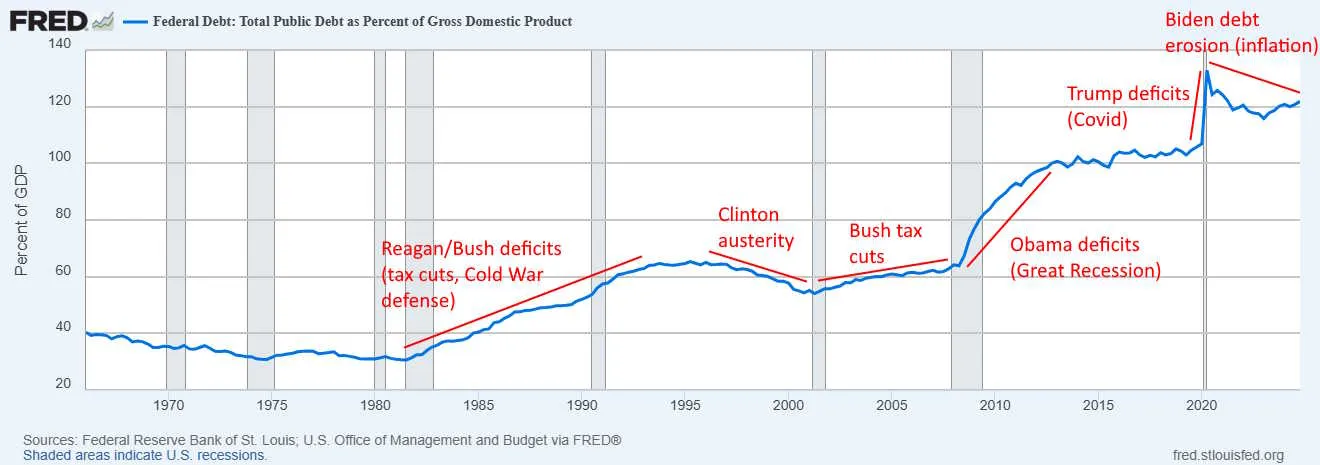
Before I explain why this crisis is so urgent, let me make an important note: Trump does not bear the bulk of the blame for the current debt problem. Democrats and Republicans bear almost equal responsibility for it. Here is a brief history of the rise in the U.S. federal government debt since 1980.
The crisis hidden in the chart: America’s growing “debt snowball”

You can see that the growth of the U.S. national debt is mainly concentrated in three major jumps: the first occurred during the Reagan and Bush Sr. administrations in the 1980s and early 1990s, the second during the Obama administration in response to the Great Recession (subprime mortgage crisis), and the third during the COVID-19 pandemic during Trump's first administration. In general, there are two main reasons for the long-term rise in U.S. government debt:

  • Major challenges the U.S. government has responded to with debt (Cold War, Great Recession, and COVID-19)
  • Republican government cuts taxes but not spending

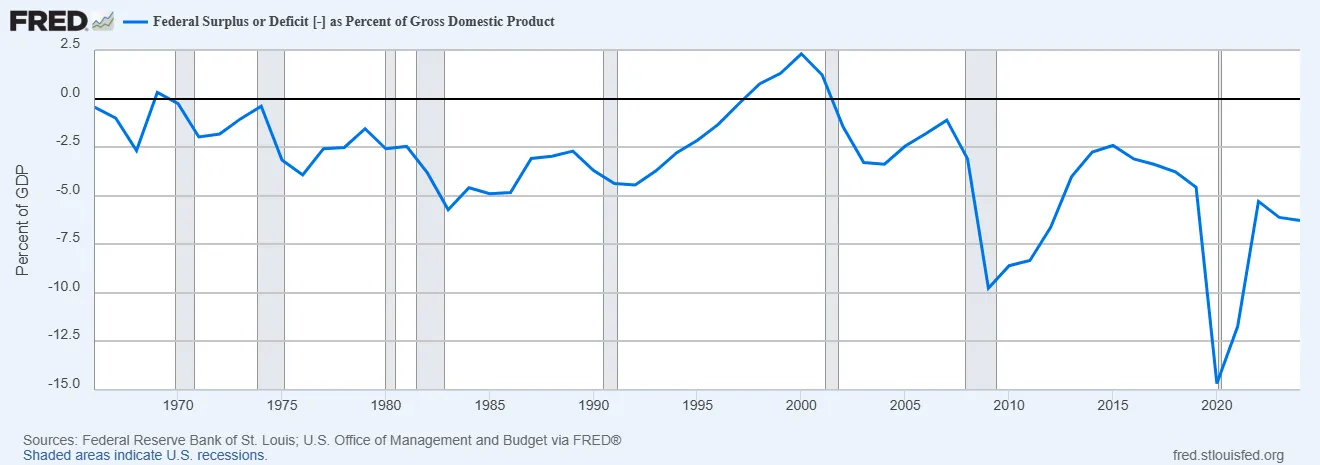
In the 1990s and early 2000s, the Democrats were the more fiscally responsible party, but that pattern has broken down under the Biden administration. The federal debt burden has fallen under Biden, but only because inflation has soared. Biden has spent massively: first on the pandemic relief program, then on student loan forgiveness and health care subsidies. Although the pandemic relief spending has ended, other spending continues, and Biden has not even tried to pay for it with tax increases. The result is that even as the U.S. economy recovers strongly and the threat of the coronavirus recedes, Biden is continuing to borrow at a rate unprecedented in non-pandemic or recessionary times:
The crisis hidden in the chart: America’s growing “debt snowball”

This was obviously very unwise. In 2021-2022, I paid insufficient attention to the debt problem for three reasons: A) inflation was eroding the value of the debt B) I expected interest rates to fall C) I thought the government deficit would be under control after the pandemic relief spending ended. Most worryingly, the Democratic Party's core fiscal policy philosophy has undergone a major shift: they have gone from a party that advocates tax increases to a party that promotes unfunded spending plans. Later, I began to realize the seriousness of the problem and began to call for fiscal austerity in the government.

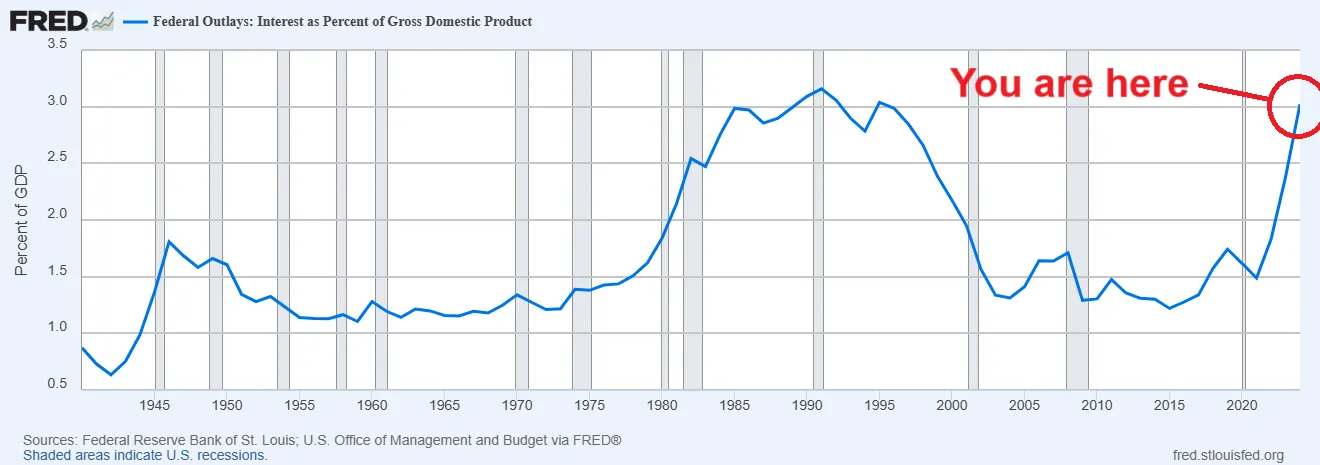
But as the chart at the top of this article shows, rising interest rates are the direct cause of today’s debt problems. As the government’s bond issuance continues to grow, it is forced to refinance that debt at higher rates, causing interest costs as a percentage of GDP to rise sharply. These interest payments are about to break the historical highs set in the early 1990s.

That’s bad enough. But the bigger problem is that the Republicans are preparing massive tax cuts that will make the problem worse—and Musk’s Department of Government Efficiency (DOGE) has done nothing to rein in spending. Democrats have become fiscally irresponsible, and, incredibly, Republicans have become even more profligate rather than implementing fiscal austerity to fix the problem. As a result, the U.S. economy is headed for trouble.


Market Opportunity
DOGE Logo
DOGE Price(DOGE)
$0.10281
$0.10281$0.10281
-0.58%
USD
DOGE (DOGE) Live Price Chart
Disclaimer: The articles reposted on this site are sourced from public platforms and are provided for informational purposes only. They do not necessarily reflect the views of MEXC. All rights remain with the original authors. If you believe any content infringes on third-party rights, please contact service@support.mexc.com for removal. MEXC makes no guarantees regarding the accuracy, completeness, or timeliness of the content and is not responsible for any actions taken based on the information provided. The content does not constitute financial, legal, or other professional advice, nor should it be considered a recommendation or endorsement by MEXC.

You May Also Like

American Bitcoin’s $5B Nasdaq Debut Puts Trump-Backed Miner in Crypto Spotlight

American Bitcoin’s $5B Nasdaq Debut Puts Trump-Backed Miner in Crypto Spotlight

The post American Bitcoin’s $5B Nasdaq Debut Puts Trump-Backed Miner in Crypto Spotlight appeared on BitcoinEthereumNews.com. Key Takeaways: American Bitcoin (ABTC) surged nearly 85% on its Nasdaq debut, briefly reaching a $5B valuation. The Trump family, alongside Hut 8 Mining, controls 98% of the newly merged crypto-mining entity. Eric Trump called Bitcoin “modern-day gold,” predicting it could reach $1 million per coin. American Bitcoin, a fast-rising crypto mining firm with strong political and institutional backing, has officially entered Wall Street. After merging with Gryphon Digital Mining, the company made its Nasdaq debut under the ticker ABTC, instantly drawing global attention to both its stock performance and its bold vision for Bitcoin’s future. Read More: Trump-Backed Crypto Firm Eyes Asia for Bold Bitcoin Expansion Nasdaq Debut: An Explosive First Day ABTC’s first day of trading proved as dramatic as expected. Shares surged almost 85% at the open, touching a peak of $14 before settling at lower levels by the close. That initial spike valued the company around $5 billion, positioning it as one of 2025’s most-watched listings. At the last session, ABTC has been trading at $7.28 per share, which is a small positive 2.97% per day. Although the price has decelerated since opening highs, analysts note that the company has been off to a strong start and early investor activity is a hard-to-find feat in a newly-launched crypto mining business. According to market watchers, the listing comes at a time of new momentum in the digital asset markets. With Bitcoin trading above $110,000 this quarter, American Bitcoin’s entry comes at a time when both institutional investors and retail traders are showing heightened interest in exposure to Bitcoin-linked equities. Ownership Structure: Trump Family and Hut 8 at the Helm Its management and ownership set up has increased the visibility of the company. The Trump family and the Canadian mining giant Hut 8 Mining jointly own 98 percent…
Share
BitcoinEthereumNews2025/09/18 01:33
UBS CEO Targets Direct Crypto Access With “Fast Follower” Tokenization Strategy

UBS CEO Targets Direct Crypto Access With “Fast Follower” Tokenization Strategy

The tension in UBS’s latest strategy update is not between profit and innovation, but between speed and control. On February 4, 2026, as the bank reported a record
Share
Ethnews2026/02/05 04:56
BlackRock boosts AI and US equity exposure in $185 billion models

BlackRock boosts AI and US equity exposure in $185 billion models

The post BlackRock boosts AI and US equity exposure in $185 billion models appeared on BitcoinEthereumNews.com. BlackRock is steering $185 billion worth of model portfolios deeper into US stocks and artificial intelligence. The decision came this week as the asset manager adjusted its entire model suite, increasing its equity allocation and dumping exposure to international developed markets. The firm now sits 2% overweight on stocks, after money moved between several of its biggest exchange-traded funds. This wasn’t a slow shuffle. Billions flowed across multiple ETFs on Tuesday as BlackRock executed the realignment. The iShares S&P 100 ETF (OEF) alone brought in $3.4 billion, the largest single-day haul in its history. The iShares Core S&P 500 ETF (IVV) collected $2.3 billion, while the iShares US Equity Factor Rotation Active ETF (DYNF) added nearly $2 billion. The rebalancing triggered swift inflows and outflows that realigned investor exposure on the back of performance data and macroeconomic outlooks. BlackRock raises equities on strong US earnings The model updates come as BlackRock backs the rally in American stocks, fueled by strong earnings and optimism around rate cuts. In an investment letter obtained by Bloomberg, the firm said US companies have delivered 11% earnings growth since the third quarter of 2024. Meanwhile, earnings across other developed markets barely touched 2%. That gap helped push the decision to drop international holdings in favor of American ones. Michael Gates, lead portfolio manager for BlackRock’s Target Allocation ETF model portfolio suite, said the US market is the only one showing consistency in sales growth, profit delivery, and revisions in analyst forecasts. “The US equity market continues to stand alone in terms of earnings delivery, sales growth and sustainable trends in analyst estimates and revisions,” Michael wrote. He added that non-US developed markets lagged far behind, especially when it came to sales. This week’s changes reflect that position. The move was made ahead of the Federal…
Share
BitcoinEthereumNews2025/09/18 01:44