Southeast Asian art is the focus of Gajah Gallery
Its 4th branch opens in Mandaluyong
GAJAH GALLERY is continuing its expansion through Southeast Asia with the opening of its newest space, this time in Manila. This is its 4th gallery space after Singapore, Jakarta, and Yogyakarta. It is located along Pioneer St. in Mandaluyong City.
Opened on Nov. 28, the gallery will showcase Southeast Asian contemporary art, with the goal of deepening artistic networks across the region. Since its founding in 1996, Gajah Gallery has mounted museum-quality exhibitions and collaborated with curators and institutions worldwide — which the Philippine space will also do.
The gallery has taken up a chunk of the NBS Park (which used to serve as a warehouse for the National Bookstore office next to it).
“The way we see it is that it’s always been inevitable to open a gallery here because we’ve been exhibiting at Art Fair Philippines since 2016, so it’s been nine years of that,” Gajah Gallery Manager Joaquin Singson told BusinessWorld during the opening reception of its inaugural exhibit.
“In 2023, we did our first all-Filipino show, then after that we just kept going and going. It was a natural progression for Gajah Gallery,” he added.
CROSS-CULTURAL EXCHANGE
The inaugural exhibit is Confabulations: A Fantasy of the Real, a group show curated by Joyce Toh. It showcases a roster of renowned Southeast Asian artists which the gallery has exhibited over the years.
These include a group of Filipinos, namely National Artist Benedicto “BenCab” Cabrera, fellow Baguio-based artist Kawayan de Guia, contemporary artists Charlie Co and Marina Cruz, and art activists Kiri Dalena, Mark Justiniani, and Leslie de Chavez.
From Southeast Asia, the show highlights Singaporean artists Suzann Victor and Jane Lee; Malaysian artist Kayleigh Goh; Indonesian artists Yunizar, Rudi Mantofani, Erizal As, and Ibrahim; Balinese artists Jemana Murti, Mangu Putra, and I Gusti Ayu Kadek Murniasih; and Javanese artist Rosit Mulyadi (Ocid).
“Each country usually has a certain characteristic. Filipino works have a certain character, and they kind of jive quite well with Indonesian works. There’s a shared energy there,” Ms. Toh told BusinessWorld at the opening reception.
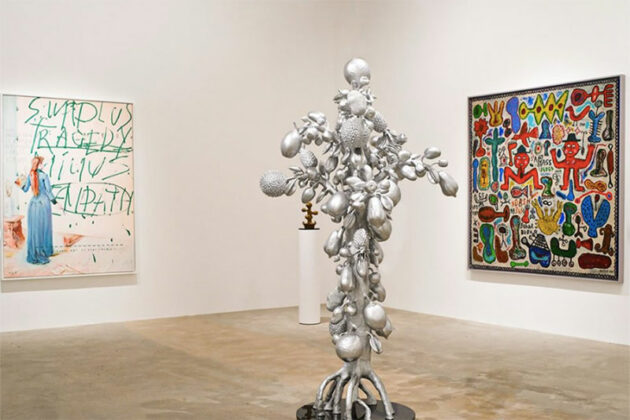
Many of Yunizar’s paintings of birds and sculptures of turtles occupy one side of the gallery and contribute to the tangible energy of the room. There’s his sculpture Pohon Buah, or Fruit Tree, which evokes a fascination with the natural world, putting together familiar tropical fruits like durian and guava into a single, strange tree.
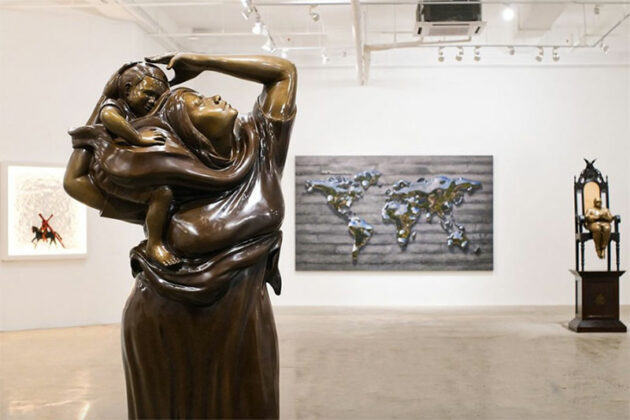
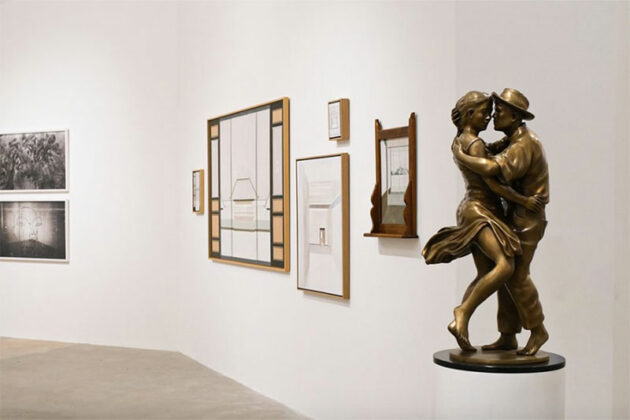
Various bronze sculptures by Filipinos also fill the space, each presenting their own realities: BenCab’s Lovers capturing human passion, Leslie de Chavez’s Coat of Arms showing an ominous political figure with symbols of power from the Philippines’ collective memory, and Charlie Co’s trio of merry men representing ways to cope (to see, hear, and speak no evil).
The work that encapsulates the sense of crossover that makes Gajah Gallery’s offerings unique is Rosit Mulyadi’s tribute to classical painter Felix Hidalgo. With an image from Hidalgo’s La Pintura, which is exhibited in Singapore, this Indonesian artist’s take on the Filipino masterpiece summarizes the melting pot of art that the gallery has come to celebrate.
MIXED-MEDIA EXPLORATIONS
For Ms. Toh, curating the mixed-media works was a highlight. One example is Malaysian artist Kayleigh Goh’s landscape of geometric interiors of rooms that unfold as an architecture of memory.
“They’re actually made with industrial materials like cement on wood. She even mixed marble dust in it so it becomes lighter,” explained Ms. Toh. “From far off, it looks very graphic. But if you go up close, there’s little textures to it. These are the details that make looking at art exciting.”
A more straightforward example of this is a mixed-media optical device by Mark Justiniani that requires the viewer to interact with a small spinning apparatus to see moving images in mirrors. It’s a compact version of the illusory experiences the Filipino artist is known to experiment with in his works.
There are triptychs of prints by Kiri Dalena, where she reworks Dean Worcester’s colonial photographs of native Filipino women by adding layers of ink. Through these different overlays, we get to see her attempts to reclaim the narratives of the women in the pictures.
Suzann Victor’s People’s Lantern is the pièce de résistance that brings the whole experience together, composed of thousands of overlapping lenses rounded to make a giant immersive installation. Stepping into the structure and seeing the exhibition through its interface offers a refracted view of one’s surroundings.
“What I enjoyed about curating this is that there’s very much a spatial relationship that you can’t really have on paper. There’s no linear narrative. You can wander in and out,” Ms. Toh said.
The central question that Confabulations presents is: “What manner of realism can truly picture ‘the real?’” The answer can only be found by taking a closer look and exploring the ways different artists have come to grapple with this question.
Confabulations runs until Dec. 31 at Gajah Gallery Manila, located at Unit 1B-1E, NBS Park, 125 Pioneer St., Mandaluyong City. — Brontë H. Lacsamana
You May Also Like

Academic Publishing and Fairness: A Game-Theoretic Model of Peer-Review Bias

New Crypto Investors Are Backing Layer Brett Over Dogecoin After Topping The Meme Coin Charts This Month