Stablecoin market capitalization reaches a record $310 billion amid widespread crypto liquidations exceeding $650 million, indicating investors are holding capitalStablecoin market capitalization reaches a record $310 billion amid widespread crypto liquidations exceeding $650 million, indicating investors are holding capital

Stablecoin Market Cap Nears $310B at Record Highs Despite Crypto Crash

2025/12/16 03:16
3 min read
For feedback or concerns regarding this content, please contact us at crypto.news@mexc.com

Stablecoin total market capitalization now approaches the $310 billion mark, reaching another all-time high despite poor market conditions as cryptocurrency prices crash and hundreds of millions of dollars are liquidated from leveraged positions in a long squeeze.

Coinspeaker retrieved data from DefiLlama on December 15 that shows a $309.83 billion market cap for stablecoins, up 0.44% in the last 24 hours and marking record high levels. Tether USDT $1.00 24h volatility: 0.0% Market cap: $186.28 B Vol. 24h: $82.90 B dollar-pegged token is the leading stablecoin, dominating 60% of the market share.

This metric has grown 50.95% year-to-date, from the $205.24 billion registered on January 1, 2025, and has more than doubled from the values seen two years ago between December 2023 and January 2024.

Total Value Locked in Defi | Source: DeFiLLama

Total Value Locked in Defi | Source: DeFiLLama

Overall, stablecoin market cap growth indicates direct capital inflow into this asset class, as the market cap rises together with the supply increase due to unity price stability. Effectively, this phenomenon means that more addresses are acquiring stablecoins in exchange for other financial assets, which can usually come from other cryptocurrencies or from USD injection into crypto markets.

For this reason, this can be an indicator of strong interest in crypto products despite current market conditions and price performance from volatile cryptocurrencies like Bitcoin BTC $86 305 24h volatility: 2.7% Market cap: $1.72 T Vol. 24h: $46.98 B , Ethereum ETH $2 951 24h volatility: 4.6% Market cap: $356.21 B Vol. 24h: $29.00 B , Solana SOL $125.7 24h volatility: 3.5% Market cap: $70.60 B Vol. 24h: $5.42 B , and others. In summary, capital is not leaving crypto rails.

Crypto Market Crashes: Over $600M Liquidations

On Monday (Dec. 15), crypto markets saw another relevant crash that negatively affected over 185,000 traders. In the last 24 hours, derivative markets liquidated nearly $650 million of trading positions, most of which were longs, betting on a price rise, according data from CoinGlass.

Prices crashed and these positions were squeezed, accumulating $558 million in losses from the bulls alone. Bitcoin led the daily liquidations, with a total of $222 million, out of which $200 million were from long positions.
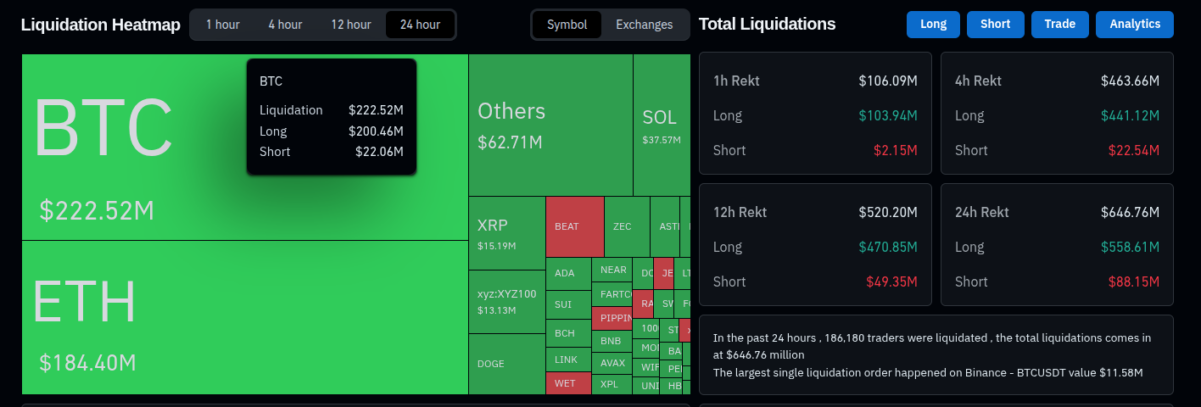
Crypto market liquidation heatmap | Source: CoinGlass

Crypto market liquidation heatmap | Source: CoinGlass

The Kobeissi Letter mentioned $100 billion in losses in market cap for BTC in 24 hours when total liquidations were at $400 million. This number has already increased as the price crash continues.

Nevertheless, while part of this capital is likely moving into fiat currencies outside the crypto market, a significant part flows into stablecoins—keeping its capitalization at all-time high levels and suggesting investors could be planning to buy back the crashing cryptocurrencies at better conditions, offering a grasp of hope for traders and investors who are still holding underwater positions.

Other signals also suggest promising market conditions despite the short-term bearish outlook, per earlier Coinspeaker reports.

Crypto investment products saw a third week of inflows as BTC attracted $522 million, while XRP XRP $1.91 24h volatility: 4.1% Market cap: $115.23 B Vol. 24h: $3.24 B followed closely with $245 million. In particular, BitMine Immersion expanded its Ethereum treasury with a $320 million purchase, pushing total holdings to nearly four million ETH as the firm continues its strategic accumulation.

TradFi firms continue to invest and position themselves for crypto-related products, especially stablecoins. For example, Visa announced a stablecoin advisory practice for banks and fintechs, fostering adoption for this asset class.

next

The post Stablecoin Market Cap Nears $310B at Record Highs Despite Crypto Crash appeared first on Coinspeaker.

Market Opportunity
Capverse Logo
Capverse Price(CAP)
$0.09497
$0.09497$0.09497
-1.26%
USD
Capverse (CAP) Live Price Chart
Disclaimer: The articles reposted on this site are sourced from public platforms and are provided for informational purposes only. They do not necessarily reflect the views of MEXC. All rights remain with the original authors. If you believe any content infringes on third-party rights, please contact crypto.news@mexc.com for removal. MEXC makes no guarantees regarding the accuracy, completeness, or timeliness of the content and is not responsible for any actions taken based on the information provided. The content does not constitute financial, legal, or other professional advice, nor should it be considered a recommendation or endorsement by MEXC.

You May Also Like

Why This New Trending Meme Coin Is Being Dubbed The New PEPE After Record Presale

Why This New Trending Meme Coin Is Being Dubbed The New PEPE After Record Presale

The post Why This New Trending Meme Coin Is Being Dubbed The New PEPE After Record Presale appeared on BitcoinEthereumNews.com. Crypto News 17 September 2025 | 20:13 The meme coin market is heating up once again as traders look for the next breakout token. While Shiba Inu (SHIB) continues to build its ecosystem and PEPE holds onto its viral roots, a new contender, Layer Brett (LBRETT), is gaining attention after raising more than $3.7 million in its presale. With a live staking system, fast-growing community, and real tech backing, some analysts are already calling it “the next PEPE.” Here’s the latest on the Shiba Inu price forecast, what’s going on with PEPE, and why Layer Brett is drawing in new investors fast. Shiba Inu price forecast: Ecosystem builds, but retail looks elsewhere Shiba Inu (SHIB) continues to develop its broader ecosystem with Shibarium, the project’s Layer 2 network built to improve speed and lower gas fees. While the community remains strong, the price hasn’t followed suit lately. SHIB is currently trading around $0.00001298, and while that’s a decent jump from its earlier lows, it still falls short of triggering any major excitement across the market. The project includes additional tokens like BONE and LEASH, and also has ongoing initiatives in DeFi and NFTs. However, even with all this development, many investors feel the hype that once surrounded SHIB has shifted elsewhere, particularly toward newer, more dynamic meme coins offering better entry points and incentives. PEPE: Can it rebound or is the momentum gone? PEPE saw a parabolic rise during the last meme coin surge, catching fire on social media and delivering massive short-term gains for early adopters. However, like most meme tokens driven largely by hype, it has since cooled off. PEPE is currently trading around $0.00001076, down significantly from its peak. While the token still enjoys a loyal community, analysts believe its best days may be behind it unless…
Share
BitcoinEthereumNews2025/09/18 02:50
USD/JPY Intervention: How Verbal Warnings Dramatically Slowed the Japanese Yen’s Slide

USD/JPY Intervention: How Verbal Warnings Dramatically Slowed the Japanese Yen’s Slide

BitcoinWorld USD/JPY Intervention: How Verbal Warnings Dramatically Slowed the Japanese Yen’s Slide TOKYO, March 2025 – Japanese authorities’ carefully calibrated

Share
bitcoinworld2026/03/30 23:25
USDH Power Struggle Ignites Stablecoin “Bidding Wars” Across DeFi: Bloomberg

USDH Power Struggle Ignites Stablecoin “Bidding Wars” Across DeFi: Bloomberg

A heated contest for control over a new dollar-pegged token has set the stage for what analysts say could define the next phase of the stablecoin industry. According to Bloomberg, a bidding war unfolded on Hyperliquid, one of crypto’s fastest-growing trading platforms, with the prize being the right to issue USDH, its native stablecoin. The competition drew some of the sector’s most prominent names, including Paxos, Sky, and Ethena, who later withdrew their bid, alongside the lesser-known Native Markets, a startup backed by Stripe stablecoin subsidiary Bridge. Hyperliquid Stablecoin Race Shows Branding and Partnerships Matter as Much as Tech Over the weekend, Hyperliquid’s validators, the contributors who secure the network and vote on key decisions, awarded the USDH contract to Native Markets over the weekend. Despite its relatively new status, the firm’s connection with Stripe helped it outpace more established rivals. Stablecoins underpin decentralized finance by providing a dollar-backed medium for collateral, settlement, and payments across applications. What began as a grassroots, community-led sector has evolved into a battleground for institutions and payment companies seeking revenue from interest on reserves. Circle, for example, shares proceeds from its USDC with Coinbase under a partnership designed to stabilize earnings during market swings. The Hyperliquid contest offered a rare glimpse into just how intense competition has become. Paxos pledged to take no revenue until USDH surpassed $1 billion in circulation. Agora offered to share 100% of net revenue with Hyperliquid, while Ethena put forward 95%. All were outbid by Native Markets, whose ties to Stripe’s $1.1 billion acquisition of Bridge and subsequent rollout of the Tempo blockchain positioned it as a strong contender. “Every stablecoin issuer is extremely desperate for supply,” said Zaheer Ebtikar, co-founder of Split Capital. “They are willing to publicly announce how much they are willing to offer. It just shows it’s a very tough business for stablecoin issuers.” While USDC remains dominant on Hyperliquid with more than $5.6 billion in deposits, the arrival of USDH could shift flows and revenue dynamics. Paxos co-founder Bhau Kotecha said the firm sees the exchange’s growth as an important opportunity, while Agora’s co-founder Nick van Eck warned that awarding the contract to a vertically integrated issuer risked undermining decentralization. Regulatory positioning also factored into the debate. Paxos operates under a New York trust charter and is seeking a federal license, while Bridge holds money transmitter approvals in 30 states. Native Markets, in a blog post, cited regulatory flexibility and deployment speed as reasons for its selection. Hyperliquid said the strong engagement from its community validated the process. Circle CEO Jeremy Allaire dismissed concerns over USDC’s status, noting on X that competition benefits the ecosystem. Analysts suggested that fears of centralization may be exaggerated, noting that Hyperliquid is likely to remain neutral and support multiple stablecoins. Still, the contest over USDH highlighted a new reality for stablecoins: branding, partnerships, and business strategy are becoming as decisive as technology. Native Markets Secures USDH Stablecoin Mandate on Hyperliquid Hyperliquid has concluded its governance vote for the USDH stablecoin, awarding the mandate to Native Markets after a closely watched process that drew weeks of community debate and rival proposals. USDH, described by Hyperliquid as a “Hyperliquid-first, compliant, and natively minted” dollar-backed token, is intended to reduce the platform’s dependence on USDC and strengthen its spot markets. Validators on the decentralized exchange voted in favor of Native Markets, a relatively new player backed by Stripe’s Bridge subsidiary, over established contenders including Paxos and Ethena. The outcome followed a string of proposals offering aggressive revenue-sharing terms to win validator support, underscoring the scale of incentives attached to controlling USDH. Hyperliquid’s exchange has become a critical hub for stablecoin liquidity, with $5.7 billion in USDC, around 8% of its total supply, currently held on the network. At prevailing treasury yields, that translates to an estimated $200 million to $220 million in annual revenue for Circle, underlining why a native alternative could be transformative. Hyperliquid’s validators, who secure the network and vote on key decisions, selected Native Markets following an on-chain governance process that concluded September 15. Native Markets has laid out a phased rollout for USDH, beginning with capped minting and redemption trials before expanding into spot markets. Its reserves will be managed in cash and treasuries by BlackRock, with on-chain tokenization through Superstate and Bridge. Yield from those reserves will be split between Hyperliquid’s Assistance Fund and ecosystem development. The launch of USDH comes as Hyperliquid records record profits from perpetual futures trading, with $106 million in revenue in August alone, and prepares to slash spot trading fees by 80% to bolster liquidity. Analysts say the move positions Hyperliquid to capture more of the stablecoin economics internally, marking a significant step in its bid to rival the largest players in decentralized finance
Share
CryptoNews2025/09/18 00:48