Ethereum price slips below $3K as ETH ETFs see three-day outflows

Ethereum price lost the key $3,000 psychological support as U.S. Ethereum ETFs recorded their third straight day of net outflows, as the broader market sentiment adopted a risk-averse sentiment.
- Ethereum price fell below $3k on Tuesday for the third time this month.
- U.S. Ether ETFs hit a three-day outflow streak, losing nearly $140 million.
- ETH price is close to confirming a bearish flag on the daily chart.
According to data from SoSoValue, the nine spot Ethereum ETFs recorded $224.7 million in net outflows on Monday, Dec. 15, marking the largest single-day outflows since Nov. 21. BlackRock’s IBIT led the outflows with $139 million exiting the fund, while investment manager Grayscale’s ETHE and ETH funds followed with outflows of $35 million and $20 million, respectively. None of the ETH ETFs saw any inflows on the day.
Monday’s outflows marked the third consecutive day of net outflows from these investment products, during which they shed nearly $286.5 million. Notably, the nine ETFs have been overall negative so far in December, continuing the trend seen in the prior month when they lost $1.42 billion.
Amidst this, Ethereum (ETH) price fell below $3,000 to as low as $2,895 before settling slightly above at $2,929 at press time, down over 6.3% in the past 24 hours. The $3K psychological level has served as a strong support area multiple times over the past weeks, and analysts earlier noted that the level must hold to avoid any further decline ahead.
The leading altcoin by market share fell sharply as large, highly leveraged derivative traders or whales were likely caught off guard by the sudden drop in Ethereum below $3,000, triggering what is known as a liquidation cascade.
For context, liquidations occur when long positions are forcefully closed due to margin shortfall. As such, a sharp price drop can lead to a liquidation cascade, which drives prices even further lower.
Data from CoinGlass shows nearly $207 million worth of long positions were liquidated from the Ethereum futures market, contributing to a total of $658.8 million from the broader crypto market.
This happened as investors likely pulled back their positions from the market ahead of the U.S. jobs data set to be revealed today, which could influence the Fed’s rate cut decision over the next year. Investors are already cautious after the Fed hinted at only one rate cut in 2026 in their third rate cut this year, which reduced interest rates by 0.25%.
Cryptocurrencies, including Ethereum, tend to react positively to expectations of more Fed rate cuts and drop when the outlook for cuts becomes unclear.
Ethereum price forms multiple bearish patterns
On the daily chart, Ethereum price has formed a giant bearish flag pattern, which is formed when a sharp price drop on high volume creates the “pole,” followed by a brief period of consolidation or slight upward movement on lower volume, forming the “flag.” The pattern typically acts as a precursor to further downside over the following months, as price often breaks below the flag’s lower boundary and resumes the prior downtrend.
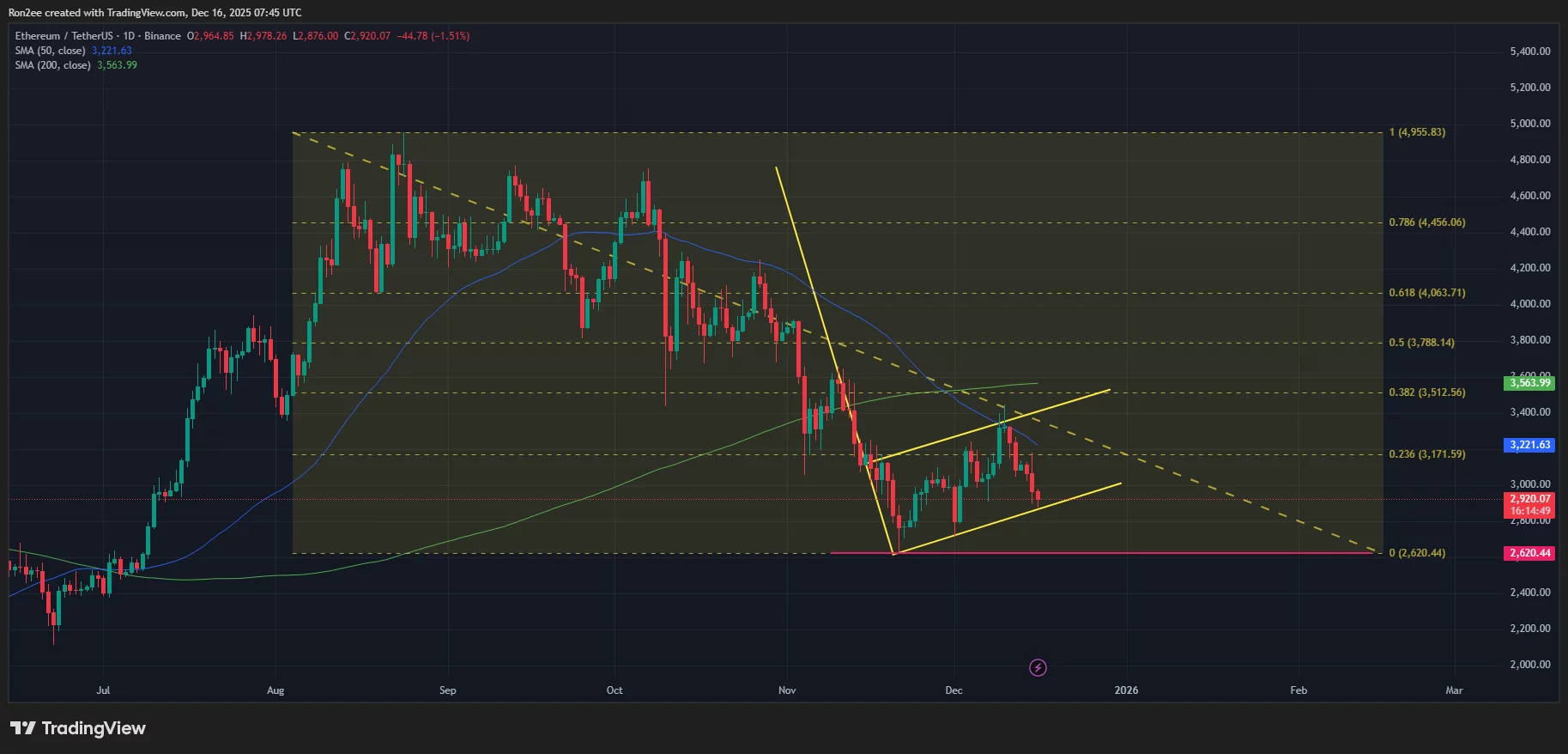
The leading altcoin has also confirmed a death cross in late November, which occurs when the 50-day simple moving average crosses below the 200-day one. Together, these two bearish indicators significantly increase the probability that Ethereum could continue to decline, at least until a market reversal occurs.
For now, there’s a chance ETH could drop below the lower boundary of the flag toward $2,620 next, which marks its November low, a level bulls have previously managed to defend and initiate a short-term recovery.
Meanwhile, traders should keep an eye on the $3,170 resistance, which aligns with the 23.6% Fibonacci retracement level. A break above this could end the current downtrend and shift the momentum back in favor of the bulls.
Disclosure: This article does not represent investment advice. The content and materials featured on this page are for educational purposes only.
You May Also Like

Dodgers’ Viral Shohei Ohtani Souvenir Cup Gets $250 Update After Fan Outrage

Critical Update: Netanyahu Reveals No Timeline for Ending War with Iran as U.S. Prioritizes Uranium and Strait