

SBF’s Ex-Girlfriend Caroline Ellison Transferred to Early Community Confinement
Caroline Ellison has been transferred from federal prison to community confinement after serving approximately 11 months of her two-year sentence for her role in the $11 billion FTX fraud scheme.
The former Alameda Research CEO was moved from Danbury Federal Correctional Institution in Connecticut to either home confinement or a halfway house on October 16, according to Federal Bureau of Prisons records obtained by Business Insider.
Ellison’s projected release date is now February 20, 2026, nearly 9 months ahead of the completion of her original sentence.
The 31-year-old former Alameda executive, who served as a star witness against her ex-boyfriend, Sam Bankman-Fried, during his criminal trial, began her sentence at the low-security Connecticut facility in early November 2024 after receiving a two-year prison term from U.S. District Judge Lewis Kaplan.
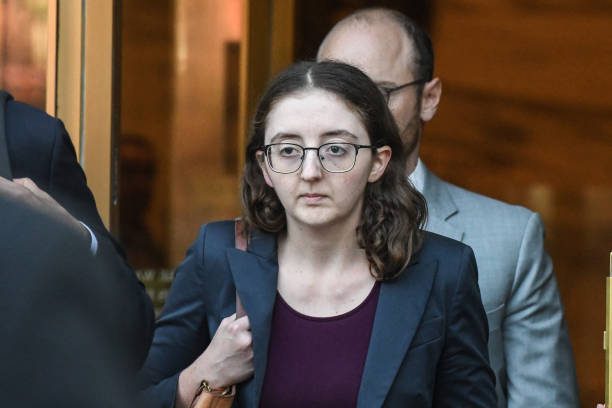 Bloomberg via Getty Images
Cooperation Earns Leniency Despite Serious Fraud Charges
Judge Kaplan praised Ellison’s “substantial” cooperation during Bankman-Fried’s prosecution while maintaining that the case’s severity still warranted incarceration.
Ellison had pleaded guilty in December 2022 to conspiracy charges, including wire fraud, money laundering, securities fraud, and commodities fraud, offenses carrying a potential maximum sentence of 110 years in prison.
During her September 2024 sentencing hearing, Ellison expressed deep remorse while holding back tears.
“On some level, my brain doesn’t even comprehend all the people I harmed,” she told the court. “That doesn’t mean I don’t try.”
Her attorneys had requested no prison time, but Kaplan rejected what he termed a “literal get-out-of-jail-free card” despite acknowledging her unprecedented cooperation.
Federal prosecutors emphasized Ellison’s critical testimony in their September 17 letter recommending leniency.
“The ‘what’ and ‘how’ of the crimes, as well as the ‘why,’ would have been difficult to prove without Ellison’s testimony,” they wrote, noting she endured extraordinary public attention and harassment for her cooperation.
During Bankman-Fried’s month-long October 2023 trial, Ellison testified for three days, painting the FTX founder as an image-conscious and power-hungry figure who orchestrated the fraudulent scheme.
Ellison revealed that Bankman-Fried instructed her and other executives to use Alameda Research to invest billions of dollars in customer assets that had been secretly siphoned from FTX.
She described feeling like an “unequal partner” in their romantic relationship due to his position of power.
“I would always ultimately defer to Sam,” Ellison testified, explaining concerns about the intersection of their personal and professional relationship.
FTX Associates Face Divergent Legal Outcomes
Ellison’s early community placement follows contrasting fates for other FTX executives involved in the collapse.
Former FTX CTO Gary Wang and engineering director Nishad Singh both received time-served sentences with supervised release after testifying against Bankman-Fried, avoiding additional prison time entirely.
Both testified that Bankman-Fried directed them to create an “allow negative” feature on Alameda’s FTX-linked account, granting access to nearly unlimited customer funds.
Meanwhile, former FTX Digital Markets CEO Ryan Salame serves a seven-year sentence at a Maryland federal facility after pleading guilty to campaign finance violations and operating an unlicensed money transmitter.
Salame refused to cooperate with prosecutors and has vocally criticized the disparate treatment, claiming authorities offered “get out of jail free cards” to witnesses supporting their narrative.
“The government hands get out of jail free cards if you parrot the narrative they want and everyone who would provide any counterpoint is frightened,” Salame told journalist Tucker Carlson.
Bankman-Fried remains incarcerated at a California federal prison serving his 25-year sentence following conviction on all seven fraud and conspiracy counts.
The FTX founder’s appeal hearing was scheduled for November 4, as his legal team argues he was “presumed guilty” and denied a fair trial.
His family has called for presidential clemency while he continues to contest that FTX was never truly insolvent, claiming the exchange always had sufficient assets to repay customers in full.
Federal Bureau of Prisons spokesperson Randilee Giamusso declined to specify Ellison’s exact location or conditions within community confinement, citing privacy and security protocols.
Ellison’s attorneys have not commented on her early transfer to supervised community placement, as FTX creditors continue to receive bankruptcy distributions exceeding $16 billion in recovered funds.
You May Also Like

The Role of Reference Points in Achieving Equilibrium Efficiency in Fair and Socially Just Economies

XLM Price Prediction: Stellar Targets $0.20 by Mid-2026 Amid Technical Consolidation


