

AI-Driven Manufacturing: Revolutionizing CNC Turning Parts with Smart Factory Solutions
Introduction
In today’s manufacturing landscape, CNC turning parts production often grapples with challenges like high costs, delivery delays, and precision fluctuations, particularly in multi-variety, low-volume customized production. Traditional production models reliant on manual experience lead to inefficiency and frequent errors; the lack of data-driven optimization further exacerbates resource waste.
This article will analyze AI-driven manufacturing and smart factory solutions, explaining how generative AI and Industry 4.0 technologies enable automation and precise control, providing upgrade strategies for the manufacturing industry.
What Is AI-Driven Manufacturing and How Does It Enhance CNC Turning Parts Production?
AI-Driven Manufacturing refers to the construction of an intelligent production system with autonomous perception, decision-making, and execution capabilities through advanced technologies such as artificial intelligence, the Internet of Things, and big data analytics. In the production of CNC Turning Parts, its core value lies in achieving full-process data-driven optimization and automation from design to delivery.
Deep Integration of Industry 4.0 Technologies
Smart Factory Solutions utilize IoT sensors to collect real-time machine tool data (e.g., spindle vibration, tool wear, temperature changes) and combine it with AI algorithms for dynamic analysis. For example:
- Real-time Monitoring and Adaptive Control:
The system automatically adjusts feed rates and spindle speeds by analyzing cutting force data, stabilizing machining accuracy within ±0.005mm. - Predictive Maintenance Mechanism:
AI models predict tool life and equipment failure probability based on historical operational data, reducing unplanned downtime and increasing Overall Equipment Effectiveness (OEE) to over 90%.
Efficiency Improvement and Quality Optimization
According to a World Economic Forum report, manufacturing enterprises adopting AI-driven solutions see an average productivity increase of over 20%. In CNC Turning Parts production, this benefit manifests specifically as:
- Reduction of Human Error:
Automated process planning and parameter optimization reduce the rework rate caused by programming errors or operational deviations by over 15%. - Resource Utilization Optimization:
AI analyzes material properties and cutting parameters to maximize material utilization, reducing waste scrap rate by approximately 12%.
For readers needing a deeper understanding of the fundamental technologies and application scenarios of CNC Turning Parts, they can refer to the authoritative industry guide: guide to CNC turning parts, which details core aspects from material selection to process design.
Certification Systems and Standardized Management
Manufacturing enterprises certified with international standards like ISO 9001 and IATF 16949, combined with Smart Factory Solutions, build full-process quality traceability systems. For instance, in the aerospace sector, blockchain technology records the processing parameters and inspection data of each part, ensuring compliance and traceability.
How Can Generative AI for Design Optimize Aluminum CNC Turning Parts?
Generative AI for Design automatically generates part solutions that meet performance, weight, and cost constraints through algorithms, making it particularly suitable for aluminum CNC turning parts with high lightweight requirements.
Geometric Shape and Material Utilization Optimization
Generative AI employs topology optimization technology to reduce redundant material while ensuring structural strength. For example, an aluminum bracket part designed by AI achieved a 30% weight reduction while maintaining the same load capacity, significantly lowering material costs.
Cost and Precision Balance
AI simulates the cutting characteristics of different aluminum alloys (e.g., 6061, 7075) to recommend optimal tool parameters, controlling the surface roughness of CNC Precision Turning to within Ra 0.4μm. As noted by MIT Technology Review, AI-driven design iterations can shorten the development cycle by 50%, while simultaneously optimizing the cnc precision turning parts price.
What Role Do Smart Factory Solutions Play in Improving CNC Precision Turning Efficiency?
Smart Factory Solutions leverage IoT and automation technologies to build flexible production lines, enhancing the response speed and consistency of CNC Precision Turning.
Full-Process Automation and Real-Time Quality Control
Integrated robotic flexible manufacturing cells enable 24/7 continuous production and real-time compensation for tool wear through online measurement systems. For example, after adopting a smart factory, a Chinese manufacturer shortened its order delivery cycle by 40% and reduced the product defect rate to below 0.02%.
Certification Systems and Standardized Management
CNC turning parts manufacturers certified with standards like IATF 16949 and AS9100D, combined with digital twin technology, achieve full life cycle quality traceability, ensuring high reliability required in aerospace and medical fields.
How Are Industry 4.0 Technologies Transforming the Selection of CNC Turning Parts Manufacturers in China?
Industry 4.0 Technologies are reshaping the evaluation criteria used by global purchasers for cnc turning parts china suppliers through digital tools and intelligent analysis. Companies no longer base decisions solely on price or basic production capacity but instead rely on data-driven transparency and flexible production capabilities to screen partners.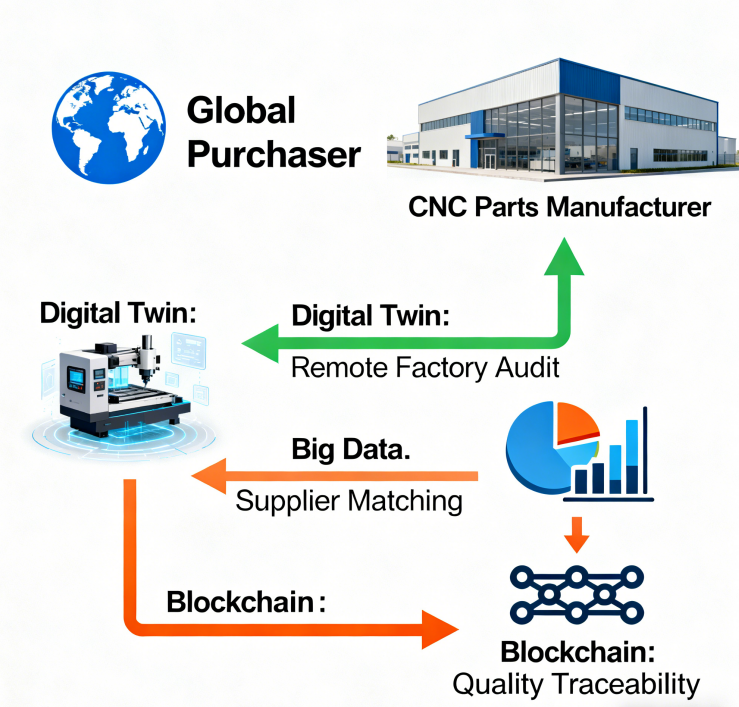
Technology-Enabled Supply Chain Assessment Innovation
The traditional model reliant on on-site audits and sample inspections is being replaced by digital twins and real-time data platforms. Taking an industrial cluster in Eastern China as an example, its clustered manufacturing ecosystem enhances competitiveness in the following ways:
- Digital Twins Enable Remote Factory Audits:
Purchasers can use the equipment digital twin models provided by suppliers to monitor the production progress, machine status, and quality inspection data of cnc turning parts manufacturer in china in real-time, increasing cross-border collaboration efficiency by 40%. - Big Data Optimizes Supplier Matching:
By analyzing historical order data (such as material compatibility, tolerance compliance rate, delivery stability), AI systems can accurately recommend manufacturers that match the purchaser’s industry-specific needs, reducing the supplier screening cycle by about 60%. - Blockchain Enhances Quality Traceability:
Integrated with certification systems like ISO 9001, key process parameters and inspection reports are encrypted and stored on the blockchain, ensuring full life cycle traceability for parts used in aerospace, medical, and other critical fields.
Customization Capability and Supply Chain Resilience
Chinese manufacturers are pushing the response speed for small-batch custom orders to new heights through industrial internet platforms. For instance, a Shenzhen based enterprise uses a cloud-based collaborative system, allowing customers to submit design requirements online and automatically generate process solutions and pricing, compressing the prototyping cycle from the traditional 14 days to within 72 hours. This flexible production capability demonstrates the significant resilience of cnc turning parts china amidst global supply chain fluctuations. According to McKinsey research, Chinese manufacturers adopting Industry 4.0 technologies exhibit 35% higher order delivery stability compared to traditional factories.
For readers needing to further understand how cnc turning parts manufacturer in china leverages smart technology for rapid response, they can explore the core service capabilities of leading enterprises in the industry: CNC Turning Services, which details the complete solution from instant quoting to full-process digital management.
Can AI-Driven Cost Analysis Reduce CNC Precision Turning Parts Price? A Case Study
Using a case study of an automotive parts supplier, significant cost reduction was achieved by optimizing mass production strategies through AI analysis of material utilization and energy consumption data.
Dynamic Parameter Optimization and Resource Scheduling
The AI system learns from historical data, matching cutting speed and feed rate to specific tool life, reducing tool consumption by 15%. Simultaneously, intelligent production scheduling algorithms reduce equipment idle time, increasing High-Volume Production efficiency by 25%.
Certification Standards and Quality Cost Control
Within the framework of the IATF 16949 system, AI monitors process parameter deviations in real-time, preventing batch scrap. The case study enterprise achieved an 18% annual reduction in quality costs, demonstrating the effectiveness of AI-Driven Manufacturing in controlling the cnc precision turning parts price.
Conclusion
AI-Driven Manufacturing, through Smart Factory Solutions, has achieved full-chain innovation from generative design and real-time production optimization to cost analysis, elevating CNC turning parts manufacturing to new heights. Through dynamic adjustment of machining parameters via machine learning algorithms,full-process simulated monitoring via digital twin technology, and AI-driven resource scheduling optimization, manufacturing enterprises can not only achieve precise tolerance control of ±0.005mm but also effectively reduce unit costs by approximately 20% in high-volume production, significantly enhancing competitiveness in the customized, short-delivery market environment.
If you are seeking to optimize the production efficiency and cost structure of CNC turning parts through AI technology, welcome to immediately explore customized solutions. Visit their website to obtain instant quotes based on AI analysis and professional manufacturing consultation. Their technical team will provide full-process support from design optimization to production implementation.
Author Bio
This article was written by a team of senior experts in the field of precision manufacturing, representing JS Precision—a leading CNC turning parts manufacturer certified with multiple international standards including ISO 9001, IATF 16949, ISO 13485, AS9100D, and ISO 14001. The company deeply integrates AI-Driven Manufacturing and Smart Factory Solutions, committed to driving innovation and sustainable development in the precision manufacturing industry through digitalization and automation technologies, providing global customers with high-precision, high-efficiency manufacturing services.
FAQs
1.What is CNC precision turning?
CNC precision turning is a technology that processes axi symmetric parts using computer-controlled lathes, achieving tolerances of ±0.005mm. It is suitable for medical and aerospace fields, ensuring high consistency and efficiency.
2.How does AI reduce the cost of CNC turning parts?
AI reduces costs by optimizing design, predicting maintenance, and allocating resources, thereby lowering material waste and downtime. It can achieve savings of over 20%, especially in small-batch production.
3. Why choose a CNC turning parts manufacturer in China?
Chinese manufacturers offer complete supply chains and cost advantages. Combined with AI technology, they can deliver high-quality parts rapidly and comply with international standards like ISO 9001, making them suitable for global procurement.
4. What are the benefits of aluminum CNC turning parts?
Aluminum CNC turning parts are lightweight, corrosion-resistant, and easy to machine. AI design can further reduce weight and cost. They are widely used in the electronics and automotive industries.
5. How to ensure quality in CNC precision turning?
Quality is ensured by implementing real-time monitoring in smart factories, adhering to strict certifications like IATF 16949, and conducting full-size inspections. This guarantees part accuracy and consistency, reducing rework risks.



You May Also Like

U.S. Dollar Plummets to One-Week Low as Hopeful Middle East Ceasefire Talks Intensify

Understanding the Difference Between Pi on Exchanges and Pi in Wallets



