Pi Coin price rose slightly for two consecutive days after the developers announced some tweaks to its decentralized exchange and automated market maker tools.Pi Coin price rose slightly for two consecutive days after the developers announced some tweaks to its decentralized exchange and automated market maker tools.

Pi Coin price rises after key DEX, AMM update, as a risky pattern forms

Pi Coin price rose slightly for two consecutive days after the developers announced some tweaks to its decentralized exchange and automated market maker tools. 

Summary
  • Pi Coin price has risen slightly in the past few days.
  • The developers unveiled some upgrades in the DEX and AMM platform that is in its testnet.
  • Technical analysis suggests that the token will likely resume the downward trend.

Pi Network (PI) token rose to $0.2070, up by 7% from its lowest level this week. This price remains much lower than the all-time high of ~$3. Its market cap has fallen from a record high of approximately $20 billion to $1.8 billion today.

In a blog post, the developers said that the DEX, AMM, and liquidity tools testnet was going on well. Based on the feedback they received, the developers made some improvements.

For example, they improve the organization and user interface to make trading easier. Additionally, they improved asset pairing in the testnet by introducing Pi-dominated pairs, with Pi as the base currency. 

The goal of the changes to its pairs is to lower price volatility, reduce slippage, reduce manipulation, and make price discovery easier. 

Additionally, the testnet upgrades include domain verification and liquidity-based ranking tokens. 

Pi Core Team hopes to launch the DEX network in 2026. In line with this launch, they will also unveil their token-generation feature that will make it easy for people to introduce new tokens in the network. 

The DEX aspect is one way that the team is aiming to create utility for the network. Other ways include running hackathons and investing in technology companies using the $100 million ecosystem fund.

The team has already invested in CiDi Games and OpenMind as it seeks to boost the network. CiDi Games will introduce games leveraging the Pi token, a move that will give it utility. OpenMind and Pi Network will also collaborate on incorporating AI to the network.

Pi Coin price technical analysis 
Pi coin price

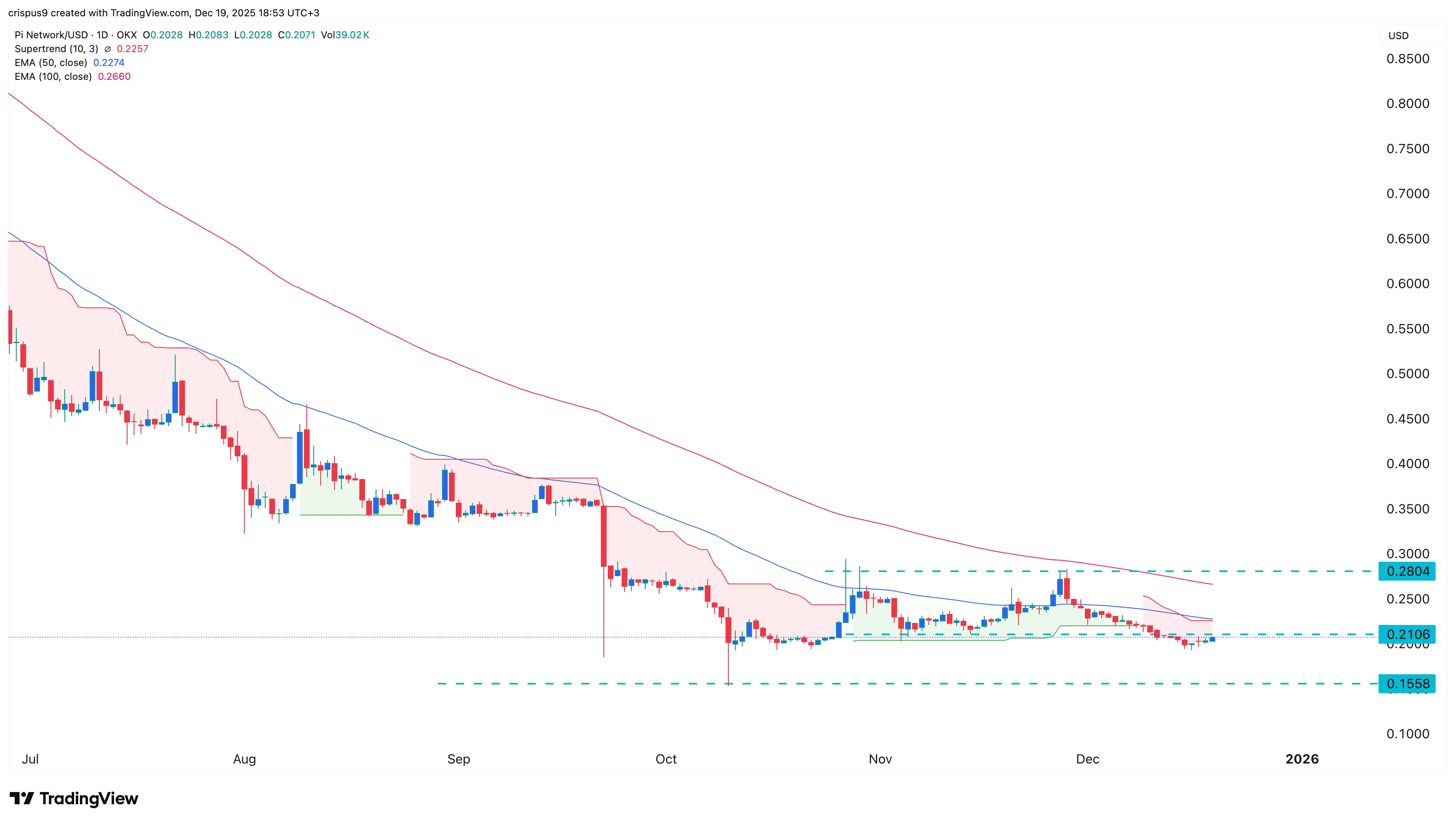
The daily timeframe chart shows that the Pi Network price has been in a downward trend in the past few days, dropping from $0.2805 in November to a low of $0.1945.

A closer look shows that the token formed a double-top pattern at $0.2800 and a neckline at $0.2106. It has now retested the neckline, a pattern known as a break-and-retest.

The token has dropped below the Supertrend indicator and the short-term moving averages. 

Therefore, the most likely scenario is where the token resumes the downtrend and possibly retests the key support level at $0.1500, its lowest level on record.


Market Opportunity
Pi Network Logo
Pi Network Price(PI)
$0.20851
$0.20851$0.20851
+0.75%
USD
Pi Network (PI) Live Price Chart
Disclaimer: The articles reposted on this site are sourced from public platforms and are provided for informational purposes only. They do not necessarily reflect the views of MEXC. All rights remain with the original authors. If you believe any content infringes on third-party rights, please contact service@support.mexc.com for removal. MEXC makes no guarantees regarding the accuracy, completeness, or timeliness of the content and is not responsible for any actions taken based on the information provided. The content does not constitute financial, legal, or other professional advice, nor should it be considered a recommendation or endorsement by MEXC.

You May Also Like

Whales keep selling XRP despite ETF success — Data signals deeper weakness

Whales keep selling XRP despite ETF success — Data signals deeper weakness

The post Whales keep selling XRP despite ETF success — Data signals deeper weakness appeared on BitcoinEthereumNews.com. XRP ETFs have crossed $1 billion in assets
Share
BitcoinEthereumNews2025/12/20 02:55
Foreigner’s Lou Gramm Revisits The Band’s Classic ‘4’ Album, Now Reissued

Foreigner’s Lou Gramm Revisits The Band’s Classic ‘4’ Album, Now Reissued

The post Foreigner’s Lou Gramm Revisits The Band’s Classic ‘4’ Album, Now Reissued appeared on BitcoinEthereumNews.com. American-based rock band Foreigner performs onstage at the Rosemont Horizon, Rosemont, Illinois, November 8, 1981. Pictured are, from left, Mick Jones, on guitar, and vocalist Lou Gramm. (Photo by Paul Natkin/Getty Images) Getty Images Singer Lou Gramm has a vivid memory of recording the ballad “Waiting for a Girl Like You” at New York City’s Electric Lady Studio for his band Foreigner more than 40 years ago. Gramm was adding his vocals for the track in the control room on the other side of the glass when he noticed a beautiful woman walking through the door. “She sits on the sofa in front of the board,” he says. “She looked at me while I was singing. And every now and then, she had a little smile on her face. I’m not sure what that was, but it was driving me crazy. “And at the end of the song, when I’m singing the ad-libs and stuff like that, she gets up,” he continues. “She gives me a little smile and walks out of the room. And when the song ended, I would look up every now and then to see where Mick [Jones] and Mutt [Lange] were, and they were pushing buttons and turning knobs. They were not aware that she was even in the room. So when the song ended, I said, ‘Guys, who was that woman who walked in? She was beautiful.’ And they looked at each other, and they went, ‘What are you talking about? We didn’t see anything.’ But you know what? I think they put her up to it. Doesn’t that sound more like them?” “Waiting for a Girl Like You” became a massive hit in 1981 for Foreigner off their album 4, which peaked at number one on the Billboard chart for 10 weeks and…
Share
BitcoinEthereumNews2025/09/18 01:26
New York Regulators Push Banks to Adopt Blockchain Analytics

New York Regulators Push Banks to Adopt Blockchain Analytics

New York’s top financial regulator urged banks to adopt blockchain analytics, signaling tighter oversight of crypto-linked risks. The move reflects regulators’ concern that traditional institutions face rising exposure to digital assets. While crypto-native firms already rely on monitoring tools, the Department of Financial Services now expects banks to use them to detect illicit activity. NYDFS Outlines Compliance Expectations The notice, issued on Wednesday by Superintendent Adrienne Harris, applies to all state-chartered banks and foreign branches. In its industry letter, the New York State Department of Financial Services (NYDFS) emphasized that blockchain analytics should be integrated into compliance programs according to each bank’s size, operations, and risk appetite. The regulator cautioned that crypto markets evolve quickly, requiring institutions to update frameworks regularly. “Emerging technologies introduce evolving threats that require enhanced monitoring tools,” the notice stated. It stressed the need for banks to prevent money laundering, sanctions violations, and other illicit finance linked to virtual currency transactions. To that end, the Department listed specific areas where blockchain analytics can be applied: Screening customer wallets with crypto exposure to assess risks. Verifying the origin of funds from virtual asset service providers (VASPs). Monitoring the ecosystem holistically to detect money laundering or sanctions exposure. Identifying and assessing counterparties, such as third-party VASPs. Evaluating expected versus actual transaction activity, including dollar thresholds. Weighing risks tied to new digital asset products before rollout. These examples highlight how institutions can tailor monitoring tools to strengthen their risk management frameworks. The guidance expands on NYDFS’s Virtual Currency-Related Activities (VCRA) framework, which has governed crypto oversight in the state since 2022. Regulators Signal Broader Impact Market observers say the notice is less about new rules and more about clarifying expectations. By formalizing the role of blockchain analytics in traditional finance, New York is reinforcing the idea that banks cannot treat crypto exposure as a niche concern. Analysts also believe the approach could ripple beyond New York. Federal agencies and regulators in other states may view the guidance as a blueprint for aligning banking oversight with the realities of digital asset adoption. For institutions, failure to adopt blockchain intelligence tools may invite regulatory scrutiny and undermine their ability to safeguard customer trust. With crypto now firmly embedded in global finance, New York’s stance suggests that blockchain analytics are no longer optional for banks — they are essential to protecting the financial system’s integrity.
Share
Coinstats2025/09/18 08:49





