

Bank of Japan rate hike to 0.75% tests global funding structures, Bitcoin stability
The Bank of Japan raised its benchmark interest rate to 0.75% on Dec. 18, marking the highest level since 1995, according to statements from the central bank.
Governor Kazuo Ueda characterized the move as a departure from the “ultra-accommodative” monetary policy that has supported global risk-taking for decades.
- Market analysts indicated the rate increase represents a test of global funding mechanisms.
- If the Fed shifts to rate cuts while Japan continues raising rates, the U.S.-Japan interest-rate spread would compress, eroding the economic foundations of global leverage.
- Bitcoin has maintained levels above recent intraday support despite the monetary policy shifts.
Bitcoin prices were little changed after the announcement, but analysts warned of longer-term risks tied to shifts in global funding.
The rate increase is testing the yen carry trade, which has long supported leverage across assets including crypto.
If Japan continues tightening while the U.S. moves toward rate cuts in 2026, the narrowing U.S.–Japan rate gap could unwind carry trades, trigger capital repatriation to Japan, and pressure risk assets.
Rising Japanese bond yields above 2% and high FX hedging costs are already making domestic bonds more attractive, potentially diverting capital away from U.S. assets and Bitcoin.
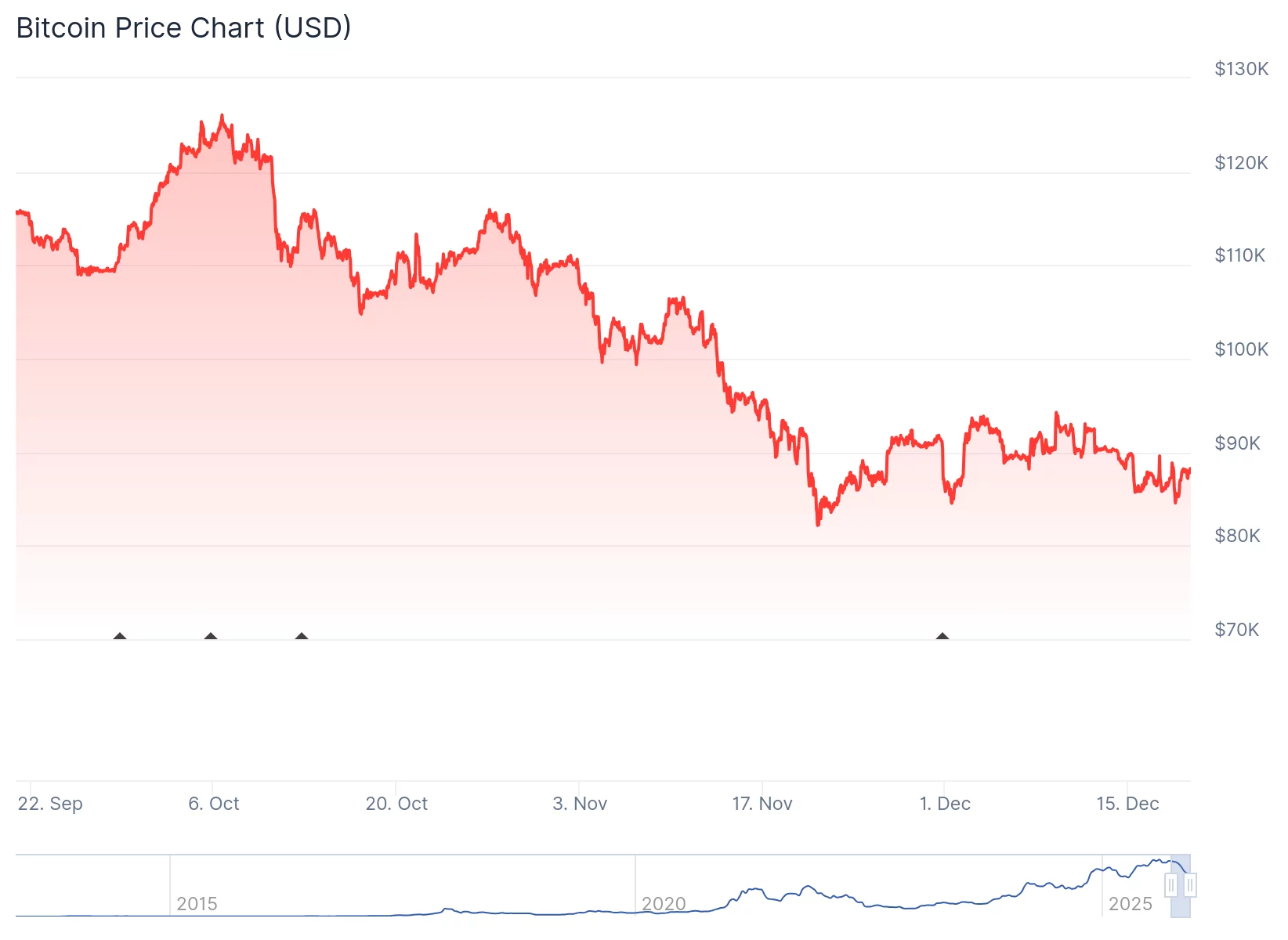
CryptoQuant data shows American investors sold Bitcoin following the Bank of Japan announcement. The Coinbase premium gap, measuring the spread between the USD pair on Coinbase and the USDT pair on Binance, moved into negative territory during U.S. trading hours. See below.
A negative premium indicates Coinbase, where U.S. institutional trading volume dominates, traded at a discount to offshore venues, suggesting portfolio risk reduction.
Guilherme Tavares, chief executive of i3 Invest, stated that the combination of rising Japanese yields and Bitcoin’s price stability serves as a cautionary signal. “Liquidity has been crucial lately. With long term yields so high in Japan, risky assets are finally starting to show more weakness,” Tavares said. He noted that the correlation between Japanese 40-year bonds and Bitcoin has recently reached extreme lows, indicating the asset may be losing macro support.
Bitcoin has maintained levels above recent intraday support despite the monetary policy shifts.
Timothy Misir, head of research at BRN, characterized the situation as a “macro stalemate” in comments to CryptoSlate.
“US data argues for easing. Japan just tightened. Crypto is caught in between,” Misir stated, describing recent price action as “positioning stress” rather than fundamental capitulation.
Bank of Japan remains limited by Japan’s heavy debt and balance sheet, keeping real rates negative despite the hike to 0.75%. Negative real rates are deliberate policy, likely leading to yen weakness and higher Bitcoin prices over time.
If Japanese insurers pull back from hedged U.S. Treasuries due to high FX costs, the Fed will likely absorb more debt and cap yields, a dynamic that could ultimately be bullish for Bitcoin.


You May Also Like

Pastor Involved in High-Stakes Crypto Fraud
Here’s Why Pi Network Coin Price Remains Under Pressure Despite Upgrades



